
SEO Attribution Model: Assisted Conversions Explained
You look at last month's dashboard and there it is again: paid ads get the shiny "conversion" tag, email gets credit for the sale, and SEO shows up with almost nothing to its name — even though you know a lot of those customers found you through a Google search first. It feels unfair, but you can't quite prove it, so SEO keeps getting the smallest slice of the budget every year.
The usual way most tools measure this only counts whoever "touched" the customer right before they bought — usually a retargeting ad or a branded search. That means SEO, which often does the hard work of bringing a stranger in and building trust over several visits, never gets marked as the reason the sale happened. This gets even trickier when you consider that, theo SparkToro, 68% of US Google searches in the first four months of 2026 ended without a click at all, up from 60% in 2024 — meaning a huge chunk of SEO's influence never even shows up as a session in your analytics, let alone a last-click conversion. This isn't because SEO stopped working; it's because the way credit is being counted is built to favor the last click, not the real journey.
This article walks you through a fairer way to measure what SEO actually brings you — called an seo attribution model (a method for deciding which marketing channel deserves credit for a sale). By the end, you'll understand why SEO tends to lose out, what other ways of splitting credit exist, and which one makes the most sense for your business. You'll also get a simple process you can apply yourself to finally see SEO's real contribution, in plain numbers you can defend to anyone who controls the budget.
Does the player who passes the ball get any credit?
In football, the goal is credited to whoever takes the final shot. But everyone knows: without the brilliant assist that set it up, there'd be no goal. If the coach only rewards the scorer and ignores the passer, what happens? Gradually no one wants to pass — everyone just lurks to shoot — and the team falls apart. A winning team credits the assist too, not just the scorer.
Multi-channel marketing is the same. Customers rarely buy the first time they hear your name. They typically: search Google and find your article (SEO), see an ad a few days later, return via social media, then buy. If you only credit the "last touch" before the purchase (often an ad or typing your name directly), then SEO — which assisted by planting awareness from the start — gets "forgotten". The dangerous result: the boss thinks SEO isn't working, cuts the budget, and the whole "marketing team" weakens.
How you split credit among channels in the purchase journey is called attribution. This guide shows how to understand and choose well: what attribution is, why SEO often loses out, the multi-touch journey, attribution models, "assisted conversions", which model fits SEO, and the application process.
What is attribution? How you split "credit" among marketing channels that helped bring a customer to the point of purchase. Since customers usually pass through many channels (SEO, ads, social, email...), attribution decides how much each channel is credited — and therefore where the budget flows.
Why SEO often "loses out" in attribution
What is a multi-touch customer journey? When a customer touches many channels before buying — e.g.: search Google (SEO) → read article → see an ad days later → return via Facebook → then buy. Each touch is a "touchpoint". Understanding the multi-touch journey is the key to fair attribution.
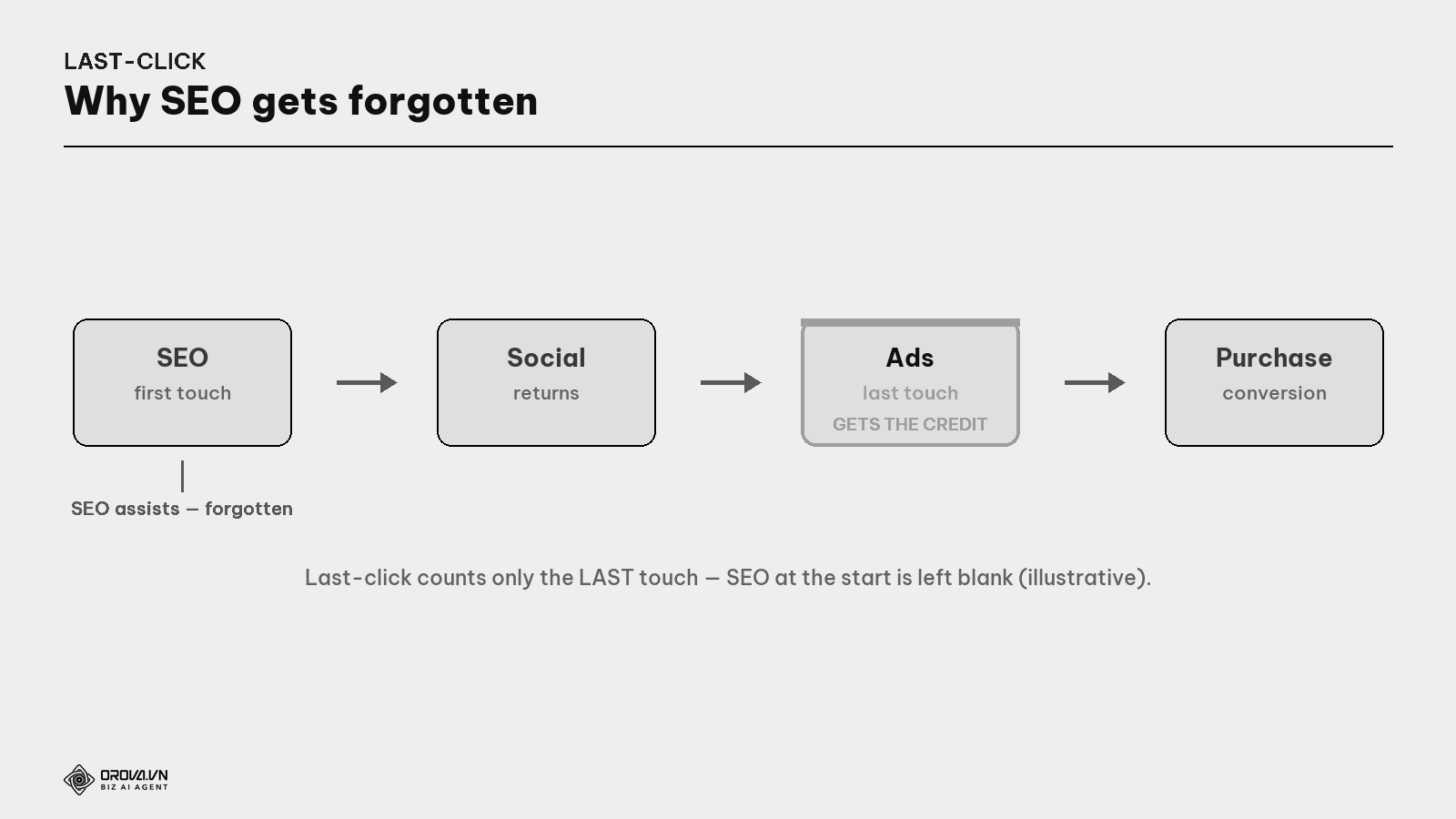
What is last-click attribution? A model giving all credit to the last touch before purchase. It's a common model (and the old default), but hurts SEO — because SEO is often the first touch (when the customer is just researching), not the last. Like rewarding only the scorer, forgetting the passer.
SEO loses out because by nature it plants awareness at the top of the funnel: people search Google to research (see the Search Intent guide), then decide to buy days later via another channel. If you only measure the last touch, SEO's "seed-planting" work vanishes from the report — and that's why many people undervalue SEO unfairly.
Attribution models
There are many ways to split credit, each telling a different story about which channel matters.
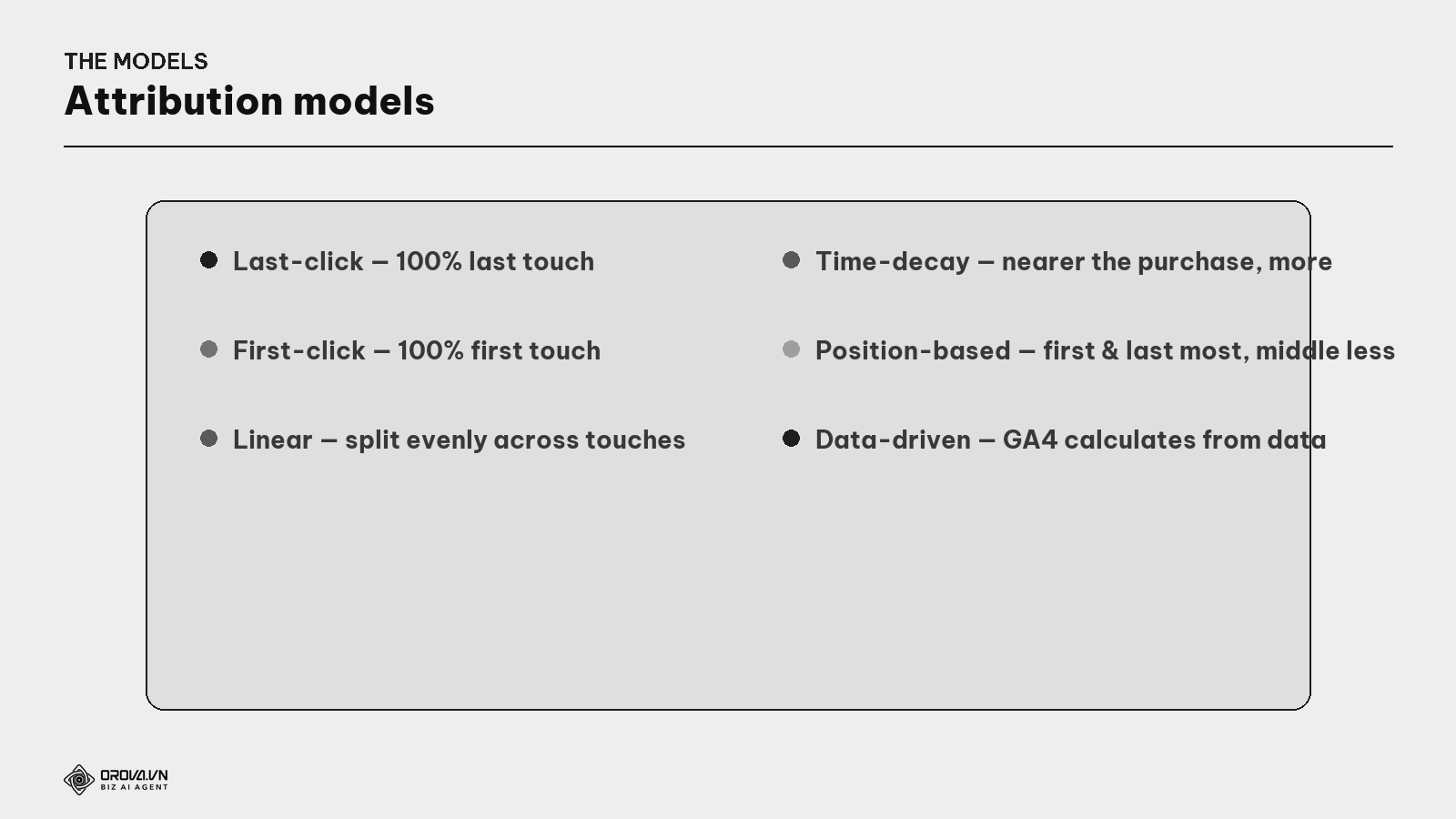
- Last-click — 100% to the last touch. Simple but hurts SEO.
- First-click — 100% to the first touch. Favors SEO but ignores closing channels.
- Linear — split evenly across all touches. Fair but doesn't distinguish which touch matters more.
What are time-decay & position-based? Time-decay: touches closer to the purchase get more credit. Position-based (or "U-shaped"): the first and last touches get the most (e.g., 40% each), middle touches share the rest. Both give top-of-funnel SEO a fairer share than last-click.
What is data-driven attribution? A model letting Google (GA4) calculate each channel's credit based on real data about how touches actually influence conversions — instead of applying a rigid rule. It's GA4's currently recommended model for being more objective.
Assisted conversions: SEO "assists" even without the final goal
This is the number that saves SEO from being forgotten.
What is an assisted conversion? A conversion that a channel contributed to (was present in the journey) but wasn't the last touch. It's that channel's "number of assists". SEO usually has high assisted conversions — meaning it sets up many goals, even if it rarely scores the final one itself.
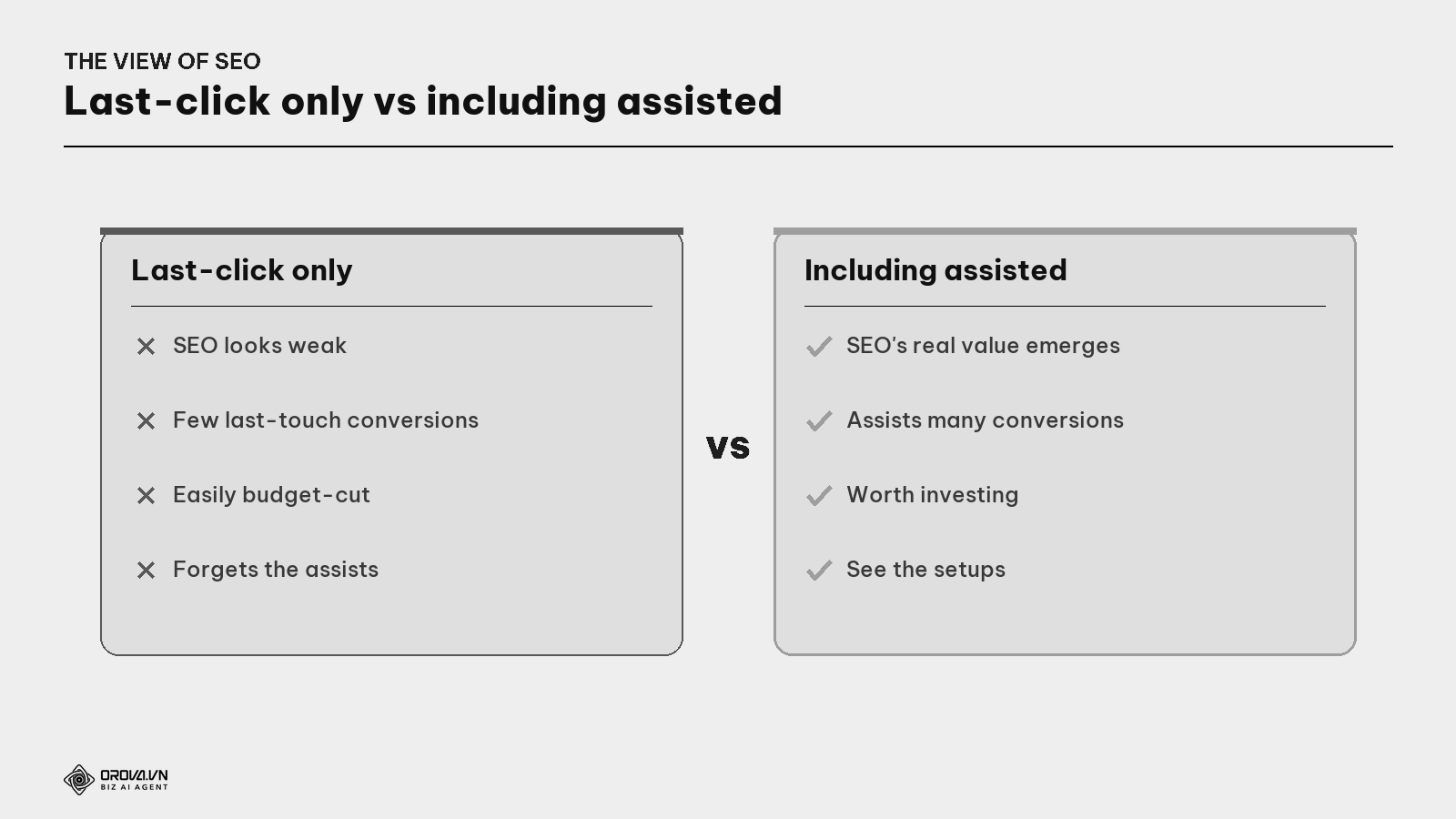
GA4 has a "conversion paths" report showing assisting channels. Always look at this when evaluating SEO — otherwise you're rating the striker while forgetting the playmaker who assists.
Which model fits SEO?
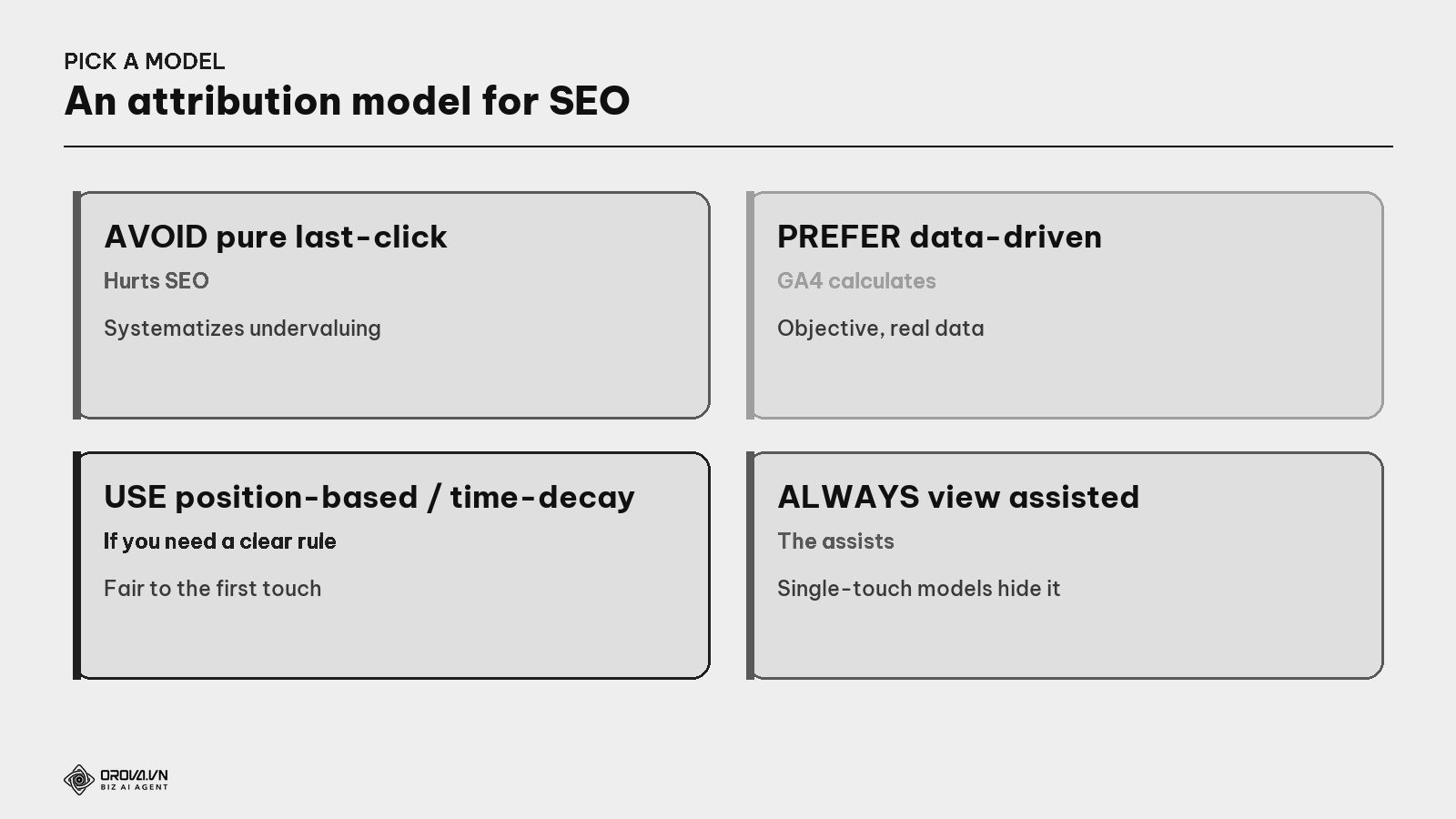
- Avoid using only last-click — it systematizes undervaluing SEO.
- Prefer data-driven (GA4's recommended default) — objective, based on real data.
- If you need a clear, explainable rule, use position-based or time-decay — they give the first touch (where SEO is strong) a fair share.
- Always view alongside assisted conversions — to see the "assist" part that every single-touch model hides.
There's no "absolutely correct" model; each is a lens. What matters is knowing which lens you're looking through and not letting one biased lens decide the budget.
The process to apply fair attribution
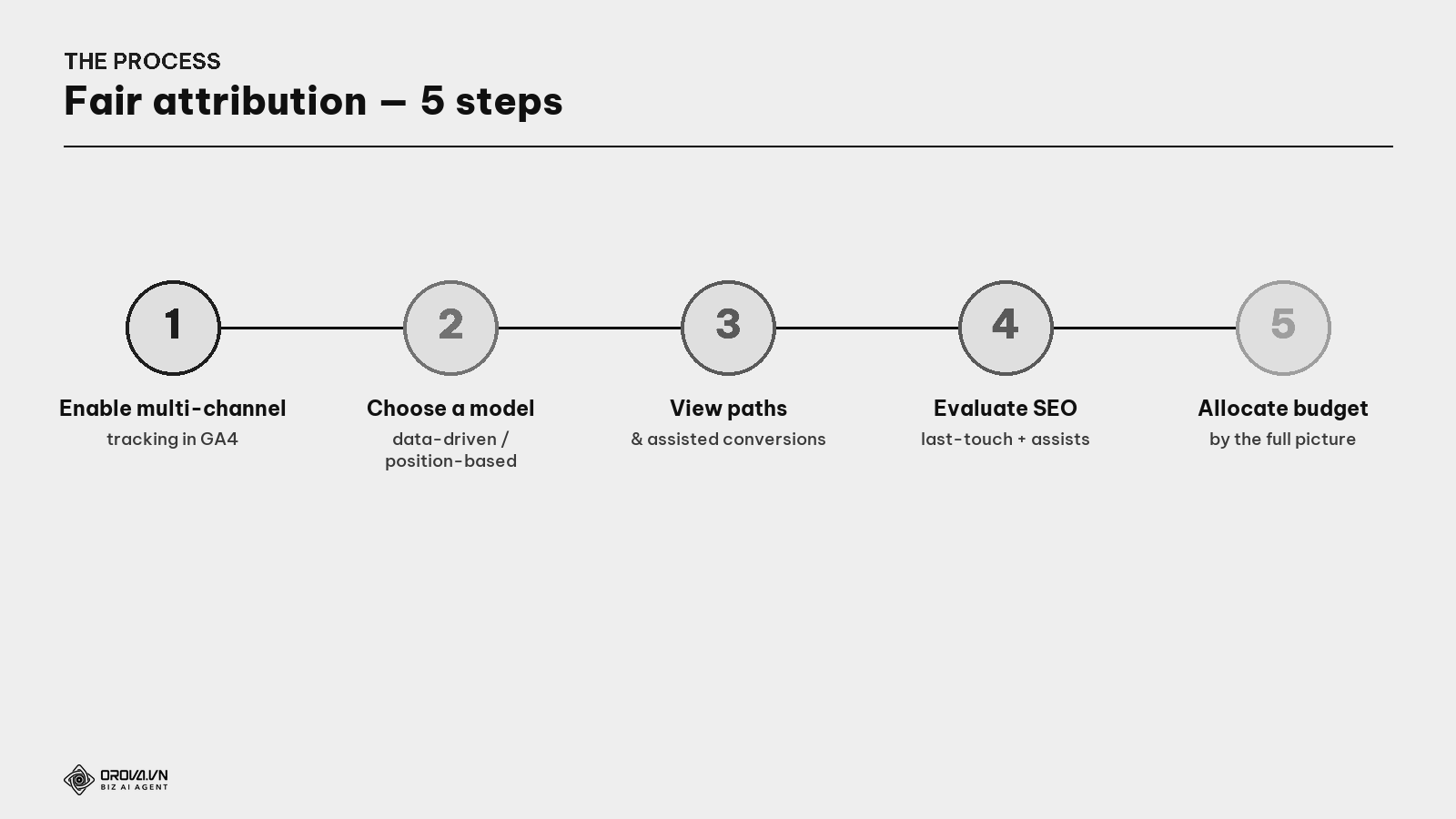
- Enable multi-channel conversion tracking in GA4 (see the GA4 + GSC guide) — you need journey data to attribute.
- Choose a fitting model — data-driven (recommended) or position-based/time-decay.
- View conversion path reports & assisted conversions — to see SEO's assisting role.
- Evaluate SEO by both — last-touch conversions and assisted (setup) conversions.
- Allocate budget by the full picture — don't cut SEO just because it "doesn't score the final goal".
"Pass" standard
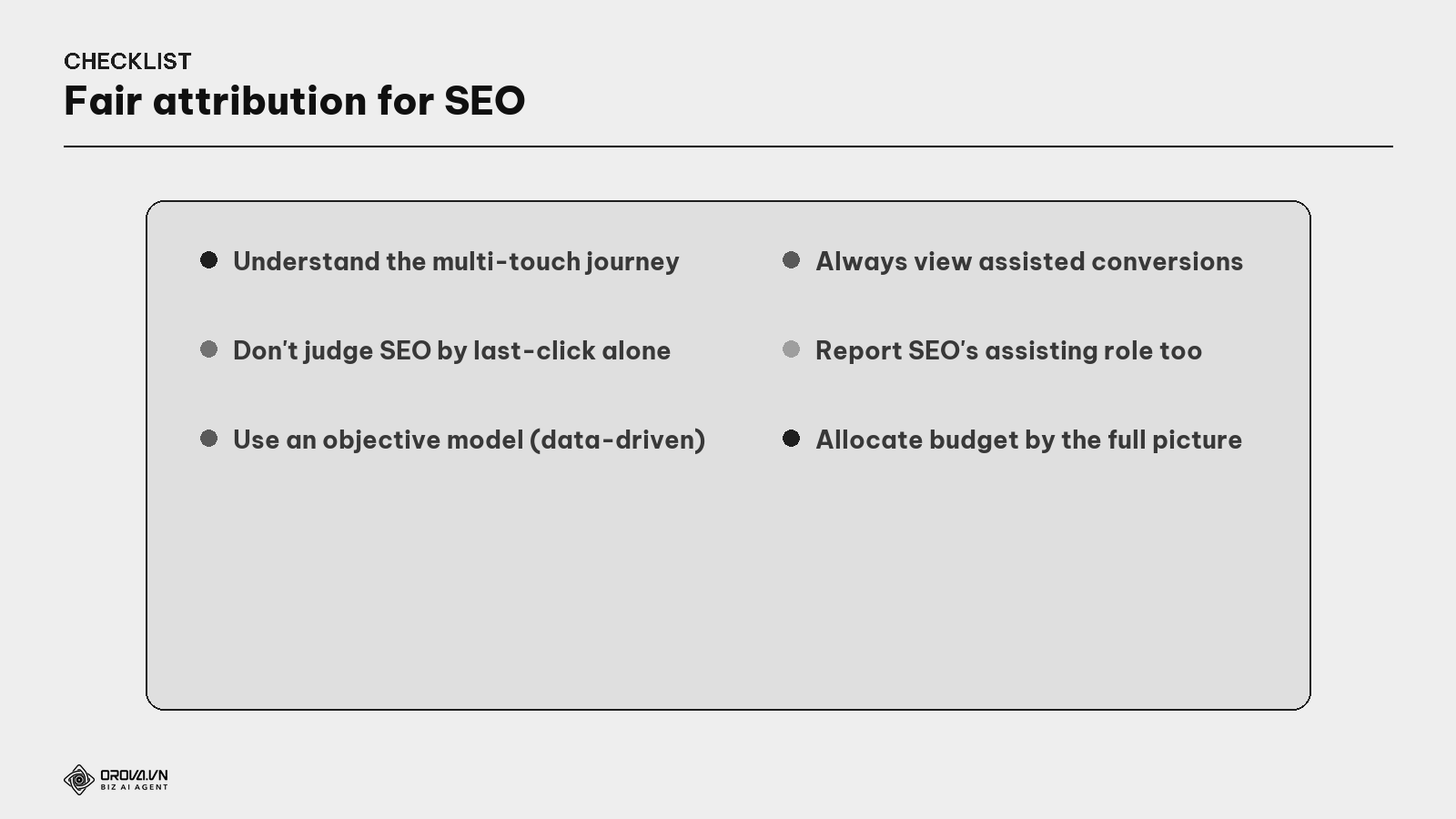
"Pass" standard: you understand customers pass through many touches before buying; you don't judge SEO by last-click alone; you use an objective model (data-driven) or a clear-rule model fair to the first touch; you always view assisted conversions to see SEO's assisting role; you report that assisting role to leadership; and you allocate budget by the full picture. At this level, SEO gets the credit it deserves — and isn't unfairly cut just because it rarely takes the "final shot".
Benefit: understanding attribution is how you protect SEO from being systematically undervalued. SEO usually plants seeds at the top of the funnel, so under the last-click lens it always looks worse than reality — and that's why many good SEO programs get unfairly cut. When you show leadership the "assists" (assisted conversions), SEO's real value emerges, the budget is kept, and the whole "marketing team" gets stronger because each channel is credited for its true role.
FAQ
What is attribution and why does it matter for SEO? Attribution is how you split "credit" among channels in the purchase journey. It matters for SEO because SEO is usually at the start of the journey (planting awareness); if you only count the last touch, SEO gets forgotten and is easily cut unfairly.
What's wrong with last-click? Not technically "wrong", but biased: it gives 100% credit to the last touch, ignoring every channel that set it up. For SEO (often the first touch), last-click systematizes undervaluing.
Which attribution model is best? There's no absolute "best". GA4 now recommends data-driven (calculated from real data) for being more objective. If you need an explainable rule, position-based/time-decay are fairer to SEO than last-click. The key is to always view alongside assisted conversions.
What are assisted conversions and where do I see them? Conversions a channel contributed to but wasn't the last touch — that channel's "assists". In GA4, see the conversion paths report. SEO usually has high assisted conversions.
How do I convince the boss not to cut SEO despite low last-click? Show the boss assisted conversions and path reports: point out how many customers start their journey from SEO even if they buy via another channel. Use the "assist vs goal" metaphor — drop the playmaker and the striker runs dry too.
Is SEO ever the last touch? Yes — e.g., a customer searches your brand name directly then buys, or searches a transactional keyword and closes immediately. But most SEO value is in top-of-funnel assisting, so don't measure only the last-touch part.
Do I need an expensive tool for attribution? No. GA4 (free) has enough: the data-driven model, conversion path reports, assisted conversions. What matters is enabling conversion tracking and knowing how to read these reports, not buying an expensive tool.
Back to the football pitch
Remember the player who passes the ball? The goal is credited to the final shooter, but a team that only rewards the scorer and forgets the assist soon falls apart — because no one wants to pass anymore. A winning team credits the assist that set up the goal.
Attribution is how you fairly credit your "marketing team". SEO is usually the playmaker — planting awareness at the top of the funnel, setting up goals that other channels finish. If you only look at last-click, you're the coach rewarding only strikers and abandoning playmakers — and you'll soon cut SEO by mistake. See the assists: enable multi-channel tracking, use an objective model, always view assisted conversions. Then SEO gets the credit it deserves, the budget stays in the right place, and the whole team — each channel in its role — brings customers home together.
This article is part of Orova's complete SEO guide series. It's a deep-dive within the cluster — see "Measuring SEO & ROI", "GA4 + Google Search Console", and "SEO KPIs & Dashboards for Leaders" for the full picture. Get started with Orova at orova.vn/en/seo.
Sources
Google Analytics 4 Help (attribution models, data-driven, conversion paths) · Google Marketing Platform (attribution models) · Search Engine Journal (attribution for SEO, assisted conversions).
Stop Guessing, Start Seeing SEO's Real Value
Doing this properly by hand means pulling data from several places, matching up customer journeys, testing different credit-splitting models, and updating it all regularly — which eats up hours you probably don't have every month. Most business owners either skip it entirely or make a rough guess, and both options mean SEO keeps getting underfunded for the wrong reasons.
This is exactly the kind of repetitive, data-heavy work Orova SEO is built to take off your plate — automatically tracking the full customer journey and applying fair attribution so you can see SEO's true contribution without doing the manual math yourself. If you're curious how it would look with your own data, feel free to give it a try.
Related reading: Proving SEO ROI When Conversions Take Six Months
Let Orova SEO handle the repetitive part
Keyword research, drafting, refreshing old posts and rank tracking — running automatically on your own site.
Explore Orova SEO