
AI Won't Replace SEOs — But It Just Changed the Job
There is a sentence that has been repeated so often it has worn smooth: "AI won't replace SEOs — but SEOs who use AI will replace those who don't." It is true enough to be useful and tidy enough to be suspicious. Like most aphorisms about disruption, it is comforting on first hearing and unsettling on the second. It promises that nothing essential will change while quietly admitting that almost everything will. This article takes that sentence, and a handful of others like it, seriously — because the slogans about AI and SEO contain more truth than the people repeating them usually unpack.
The honest position is not "AI changes nothing" and not "AI changes everything." It is narrower and more interesting: AI did not delete the SEO job, it rewrote the job description. The work that used to fill your week is not the work that will fill it next year. Understanding which parts moved, and which parts did not, is the difference between riding the change and being surprised by it.
"The tool changed; the craft did not"
Start with the most reassuring aphorism, because it is half right and the wrong half matters. The craft of SEO — understanding what a searcher actually wants, deciding what deserves a page, judging whether a piece of content genuinely answers the question better than the ten results above it — that craft did not change. A searcher in 2026 wants the same thing a searcher wanted in 2016: their problem solved, quickly, by someone who clearly knows the subject. No model altered that.
What changed is the tooling around the craft, and it changed completely. The keyword research that took an afternoon takes minutes. The first draft that took a day takes an hour to assemble and an hour to fix. The monthly report that ate a Friday assembles itself. If you defined your job as the execution of those tasks, the slogan "the craft did not change" is cold comfort, because your job was mostly tooling. If you defined your job as the judgement behind the tasks, the slogan is genuinely reassuring. Most SEOs sit somewhere between, and the uncomfortable exercise is working out how much of your week is craft and how much is tooling. The tooling half is the half that moved.
"AI is a junior who never gets tired — and never gets wiser"
This is the most useful mental model I have found for working with an AI agent day to day, and it explains both the enthusiasm and the disappointment people report.
An AI system is, in practice, an extraordinarily fast and tireless junior. Hand it a well-defined, well-scoped task and it returns a competent first pass at a speed no human junior could match, at two in the morning, without complaint, a hundred times in a row. That is real, and it is genuinely valuable. But the same model that never tires also never accumulates the kind of wisdom a human junior accumulates — the scar tissue of having watched a campaign fail, the instinct that a particular SERP is more competitive than its difficulty score suggests, the taste that says a draft is technically fine but tonally wrong for this brand. It does not get wiser between tasks the way a person does between projects.
So the job becomes supervising a brilliant, fast, slightly literal-minded junior who will never be promoted. You set the direction. You define the task well — because a vague brief produces a vague output at high speed, which is just being wrong faster. You check the work, because the junior cannot tell when it is confidently incorrect. And you keep the judgement, the strategy, and the accountability, because those were never things a junior was supposed to own. The aphorism is glib, but the working relationship it describes is exactly right.
"Garbage in, garbage out — now at industrial scale"
An old computing proverb has acquired a sharp new edge. "Garbage in, garbage out" used to be a warning about a single bad calculation. With an AI agent, it is a warning about a publishing program.
The thing AI removed was the natural friction of bad work. It used to be that producing a hundred mediocre articles took so much human effort that the effort itself acted as a filter — exhaustion stopped you before the damage was large. That filter is gone. A weak strategy, a misjudged audience, a sloppy brief: feed any of those into an agentic workflow and you do not get one bad article, you get a hundred, indexed, with your name on them. The garbage now arrives at industrial scale, and so does the cleanup.
This reframes what the SEO's attention is worth. The highest-leverage hour in an AI-assisted workflow is no longer the hour spent producing — it is the hour spent at the front of the pipeline, making sure the inputs are right: the strategy, the topic selection, the brief, the quality bar. Get those right and AI multiplies something good. Get them wrong and AI multiplies something bad, faster than you can read it. The proverb did not stop being true. It started applying to your whole content operation at once.
"Speed is free; direction is not"
Here is the aphorism I would tattach to every AI-assisted SEO program as a warning label. AI made speed almost free. It did nothing for direction — and direction is the part that was always hard.
It is intoxicating to suddenly be fast. A team that used to publish four articles a month can publish forty, and the velocity feels like progress. But velocity is only progress if it is pointed somewhere. Forty articles a month aimed at the wrong keywords, written for the wrong audience, with no internal structure connecting them, is not forty times the progress — it is forty times the motion and roughly the same result, plus a larger mess to maintain. The thing that decides whether speed becomes progress is direction: a real strategy, a coherent topic cluster structure, a defensible reason for each page to exist.
And direction is exactly the thing AI did not make cheaper. Setting a content strategy still requires understanding a market, a product, and a buyer. It still requires judgement, which is to say it still requires a human who is accountable for being right. Speed without direction just means arriving at the wrong place sooner. The job is increasingly the direction-setting — because that is the part the machine left on your desk.
"The bottleneck moved — it did not disappear"
Every productivity revolution has the same quietly disappointing structure: it removes one bottleneck and reveals the next one behind it, which was always there, hidden by the first.
For years the bottleneck in SEO content was production. There was simply never enough time to research, write, and edit everything the strategy called for. AI demolished that bottleneck. But the work did not become infinitely fast, because a new constraint stepped forward into the light. Now the bottleneck is review and judgement: how fast can a competent human verify claims, check that a draft genuinely satisfies intent, ensure the brand voice survived, and confirm the piece earns its place in the cluster? Production is cheap; trustworthy review is not, and review does not parallelise the way production does.
This is why teams that adopt AI naively are often disappointed. They optimised the old bottleneck — they can now produce enormous quantities — and they did nothing about the new one, so quality-controlled output barely rises while unreviewed output explodes. The teams that win treat review as the scarce resource it has become, and they design their workflow around protecting and scaling that human judgement, not around producing ever more drafts for it to drown under. The bottleneck moved. The job moved with it.
"Anyone can prompt; few can judge"
For a brief moment the industry believed the scarce skill of the AI era would be prompting — that "prompt engineering" was the new literacy. That moment is passing, and its passing tells you where the real value sits.
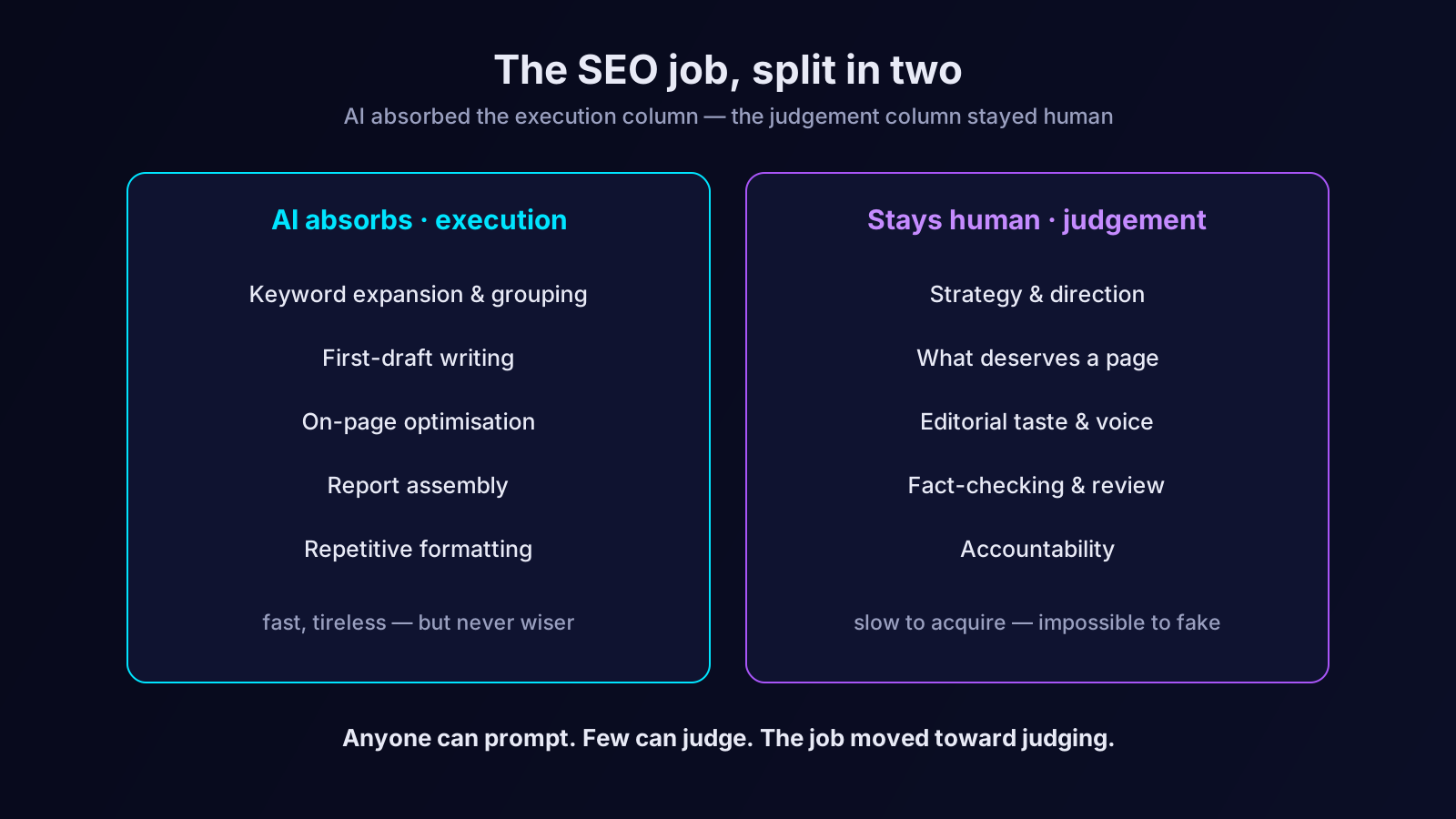
Prompting is a genuine skill, but it is a shallow one and it is commoditising fast. Models get better at understanding ordinary instructions; good prompt patterns get shared and copied within weeks. What does not commoditise is judgement — the ability to look at what the model produced and know, reliably, whether it is good. Is this draft accurate? Does it actually answer the searcher's question, or merely circle it? Is the angle right for this brand? Would a real expert in this field nod, or wince? Those questions cannot be prompted into existence. They require domain knowledge and taste, and those are slow to acquire and impossible to fake.
So the SEO role is tilting, decisively, away from being a producer of content and toward being an editor and director of it. The valuable person in an AI-assisted team is not the one who can coax a draft out of the model — almost anyone can do that now. It is the one who can look at the draft and say, with authority, "this is publishable" or "this is plausible nonsense, here is what is wrong with it." Anyone can prompt. Few can judge. The judges are the ones whose jobs got more secure, not less.
What the new job description actually reads like
Collect those aphorisms and a coherent picture emerges. The SEO job did not vanish; it was rewritten, and the new version is — for anyone willing to make the shift — a better job.
The old job was heavy on execution: hours of keyword research, hours of drafting, hours of reformatting reports. Necessary work, but repetitive, and not the work most people entered the field to do. The new job is heavier on the parts that were always the most interesting and the most valuable: setting strategy, deciding what deserves to exist, defining quality, supervising and editing, and being accountable for the judgement calls. AI took the repetitive execution. It left — and in fact concentrated — the thinking.
That is genuinely good news for SEOs who define themselves by their judgement rather than their typing speed. It is uncomfortable news for anyone whose value was mostly in execution volume, because that value is now produced by a machine for a fraction of the cost. The slogan was right all along. It just never spelled out the homework: to be an SEO who uses AI well, you have to be willing to do less producing and far more deciding.
"The first draft is free; the last ten percent is the job"
One more aphorism deserves unpacking, because it corrects a specific and expensive misreading of what AI made cheap. People hear "AI writes the draft" and conclude the writing is done. It is not. AI made the first ninety percent of a piece nearly free. It did almost nothing for the last ten percent — and the last ten percent was always the part that determined whether the piece was any good.
Think about what that final tenth actually contains. It is the genuine expertise that turns a competent explanation into an authoritative one. It is the specific worked example drawn from real experience. It is the sharpened argument, the line that makes a reader stop and think, the angle no other page on the topic has taken. It is the rigorous fact-check that catches the confident error. It is the brand voice asserting itself over the model's neutral default. None of that is in the free ninety percent — and a reader, or a search engine, can tell instantly when a piece stopped at ninety.
So the aphorism reframes the SEO's writing job precisely. The job is no longer producing the draft; the draft is a commodity now. The job is the last ten percent — and that ten percent is dense, skilled, and slow. A team that understands this spends its writing hours where they count. A team that does not declares victory at the draft and ships content that is ninety percent finished, which in a competitive results page is the same as unfinished.
What does not change, ever
Amid all this rewriting it is worth naming the things that no model and no aphorism will ever touch, because they are the bedrock the new job is built on.
The searcher does not change. A person typing a query wants their problem solved by someone who clearly knows the subject — that has been true for as long as search has existed and it will be true for as long as it exists. The reward for genuinely helping that person does not change. The penalty for wasting their time does not change. And the fact that someone, a human someone, has to be accountable for what gets published under a brand's name does not change. AI moved the tools, the speed, the bottleneck, and the job description. It did not move the fundamental contract: be the most genuinely useful result, or do not rank. Everything in this article is, in the end, just a description of how to keep honouring that unchanged contract with changed tools.
Where this leaves you, and where an agent fits
If the job is now direction, judgement, and review, then the right tool is not another point solution that does one execution task slightly faster. It is something that takes the whole execution layer off your plate cleanly enough that your attention is freed for the parts that stayed human.
That is the role an SEO AI agent is meant to play. Orova works as the tireless junior these aphorisms describe — running the keyword research, expanding topics into a structured content plan, drafting, and assembling reports — while leaving the strategy, the quality bar, and the final editorial call exactly where they belong: with you. It does not replace the SEO. It does precisely what the slogan promised — it changes the job, by absorbing the execution so the human can spend the day on direction and judgement.
The sentence everyone repeats is true. AI will not replace SEOs. But it has already replaced the old definition of the work, and the SEOs who thrive will be the ones who notice that the job description quietly changed under them — and choose, deliberately, to grow into the new one.
Let an AI Agent handle your SEO
Orova plans, writes, optimizes, and tracks rankings on its own — you just read the results.
Try it free