
Algorithm Update or Self-Inflicted? How to Tell the Difference
When organic traffic falls, the search community reaches for one explanation faster than any other: it must have been an algorithm update. The phrase has a comforting quality. It is external, it is impersonal, and it implies that whatever happened was not your fault. But comfort is not the same as accuracy, and a great many traffic drops blamed on updates were, in fact, self-inflicted — caused by something the team itself did, often without realising it.
This article is an analytical breakdown of how to tell the difference. Not a feeling, not a guess, but a structured separation of two categories of cause that demand completely different responses. Get the distinction wrong and you will spend weeks treating the wrong problem. Get it right and the path forward becomes obvious.
Why the distinction matters so much
It is worth being precise about why this is not a pedantic exercise. The reason to separate "algorithm update" from "self-inflicted" is that the two have almost nothing in common in terms of how you recover.
A self-inflicted drop has a specific, identifiable cause that lives inside your control: a deployment, a configuration change, a content decision, a technical break. It is usually reversible. Once you find it, the recovery is often as simple as undoing what was done, and traffic returns on roughly the timeline it took to fall. The work is detective work — find the change, reverse the change.
An algorithm-driven drop is the opposite in every dimension. There is no single change to undo, because nothing on your site changed at all — the way search evaluates your site changed. There is no rollback. Recovery is not reversal; it is improvement, measured in months, against a moving target. The work is not detective work but craft work — understand the new standard, then meet it. If you misclassify a self-inflicted drop as an update, you will sit and wait for a recovery that a five-minute fix would have delivered. If you misclassify an update as self-inflicted, you will tear your site apart hunting for a change that does not exist. The classification is the whole game.
The first analytical cut: the shape of the fall
The most informative single piece of evidence is the shape of the drop over time, and it is freely available in any analytics tool. Two shapes, two different stories.
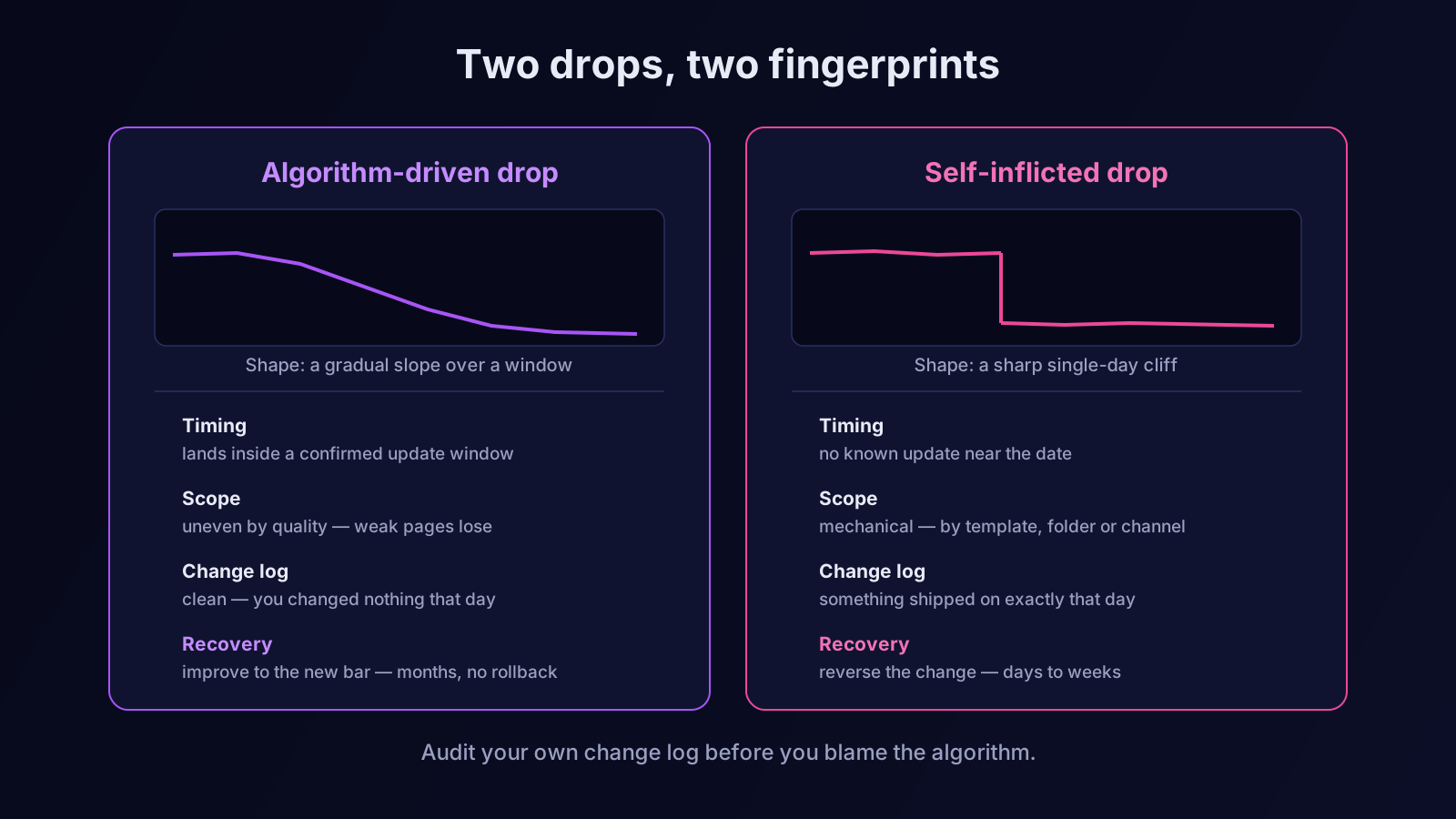
A self-inflicted drop is usually a cliff. Traffic was at one level on Tuesday and at a visibly lower level on Wednesday, with a sharp, near-vertical edge between them. This shape is the signature of a discrete event — something happened on a specific day, at a specific time, and the effect was immediate. Code deploys on a date. A setting is changed on a date. A page is deleted on a date. Discrete causes produce discrete cliffs.
An algorithm update tends to produce a slope. Major updates roll out over days or weeks, not in an instant, so the traffic change is gradual — a decline that unfolds across a fortnight rather than a fall that happens overnight. There are exceptions; some updates land harder and faster, and some self-inflicted issues take time to surface as Google slowly re-crawls. But as a first analytical cut, the rule holds well: a sharp cliff points inward, toward something you did on a particular day. A gradual slope points outward, toward something search did to you over a window. Read the shape before you read anything else.
The second cut: does the date line up with a known update?
The single most decisive test in this entire diagnosis is also the simplest. Find the exact date your traffic began to fall. Then check whether a confirmed search algorithm update was rolling out on or around that date.
The search ecosystem documents major updates publicly, with start and end dates. If your drop began squarely inside a confirmed update window, that is strong, specific evidence for an algorithmic cause. If your drop began on a date with no known update anywhere near it, then "it was probably an update" has just failed its most basic test, and you should be looking inward instead.
Be disciplined about this. The temptation is to find an update somewhere in the same month and declare a match. That is not a match. Updates and drops should line up to within a few days for the alignment to mean anything. Loose, approximate timing is how teams talk themselves into a comforting external explanation when the real cause was a deployment they would rather not examine. The date test only protects you if you apply it strictly.
The third cut: the scope and pattern of the loss
The third analytical lens is the pattern of which pages lost traffic, because algorithmic and self-inflicted causes leave very different fingerprints across a site.
Algorithm updates re-weight quality signals, and they do so selectively. A typical update-driven drop is uneven by quality: your thinner, weaker, less differentiated pages lose ground while your strongest, most genuinely helpful pages hold or even gain. The pattern correlates with content quality, because that is what the update is sorting on. If you rank your pages by how good they honestly are and the losses cluster at the weak end, that is an algorithmic fingerprint.
Self-inflicted drops leave a more mechanical pattern. They tend to hit by structure rather than by quality: every page built on one template, every URL in one directory, every page in one language or one country. The cause is mechanical — a template change, a directory-level robots.txt rule, a broken set of redirects for one section — so the damage follows the mechanism, not the merit. If your losses cluster around a template or a folder rather than around a quality level, look at what you changed in that template or folder. And the most mechanical pattern of all — every channel dropping at once, including direct and email — is almost never an algorithm update, because an update cannot touch your non-search traffic. An all-channel drop is a tracking or site-wide problem, full stop.
The fourth cut: your own change log
Here is the test that the algorithm-update explanation conveniently lets people skip, and skipping it is the single biggest source of misdiagnosis. Before you conclude anything external, examine what you changed.
Reconstruct the change history of your own site around the drop date. What was deployed? What content was edited, merged, or deleted? Were redirects added or removed? Did a configuration setting change — robots directives, canonical logic, meta-robots tags, hreflang? Did a plugin or dependency update? Did anyone touch the CDN, the firewall, the bot rules, the consent banner? Did a third-party script change behaviour?
The difficulty is that the person diagnosing the drop is often not the person who made the change. The developer who pushed a release on Tuesday does not connect it to the SEO's panic on Thursday, because they are not looking at the same dashboard. This is why teams that handle drops well keep a shared, dated change log spanning code, content, and configuration. With that log, the fourth cut takes minutes: line the drop date up against the change log and see what sits on the same day. Without it, you are reduced to interviewing colleagues from memory — and memory, under pressure, is generous about leaving things out. A self-inflicted drop is only mysterious when nobody wrote down what they did.
Putting the cuts together
None of these four cuts is conclusive alone. Together they converge on an answer with real confidence, and the convergence is what makes the diagnosis trustworthy.
The algorithmic profile is coherent: a gradual slope, beginning inside a confirmed update window, hitting pages unevenly by quality, with a clean change log showing nothing on the relevant date. When all four point the same way, you can be reasonably sure the cause is external, and you should stop hunting for a change to undo.
The self-inflicted profile is equally coherent: a sharp cliff, on a date with no known update nearby, with damage clustered by template or directory or channel, and a change log that shows something landed on exactly that day. When those align, stop blaming the algorithm and go reverse what you did.
The genuinely dangerous situation is the mixed signal — a cliff that happens to fall inside an update window, or a clean change log paired with a mechanical loss pattern. Mixed signals are not a reason to guess; they are a reason to keep gathering evidence until the picture resolves. The discipline is to follow the evidence to a confident classification, not to grab the first explanation that lets you stop looking. For more on building this kind of measurement discipline into your workflow, see our guide to a practical SEO workflow.
What recovery looks like in each case
Because the two causes are so different, it is worth being explicit about the two recovery paths, since the whole point of the diagnosis is to choose the right one.
For a self-inflicted drop, recovery is reversal. You found the change; now undo it. Restore the robots.txt rule, remove the stray noindex, fix the broken redirects, roll back the template change, correct the canonical logic. Then verify the fix is live, ask search to re-crawl the affected pages, and wait for re-indexing. Recovery typically arrives on a timescale similar to the drop — often days to a few weeks — because nothing fundamental about your site's quality is in question. It was simply, briefly, broken.
For an algorithm-driven drop, recovery is improvement, and it is slower and less certain. There is nothing to roll back. The work is to understand what the update rewarded — almost always more genuine helpfulness, stronger demonstrated expertise and experience, better matching of real intent, less thin or derivative content — and to raise your pages to that standard. Then you wait, often months, for the next crawl-and-evaluation cycle to register the improvement. It requires patience and honesty, because the update is, in effect, feedback. The recovery is not getting the old ranking back; it is earning a new one.
The honest conclusion
Algorithm updates are real, and they do cause genuine, painful traffic drops. But "it was an update" has become the search industry's most overused explanation, precisely because it is the most comfortable one — it asks nothing of you, blames nobody on your team, and turns a fixable problem into an act of weather you can only endure.
The analytical discipline outlined here exists to keep you honest. Read the shape of the fall. Apply the date test strictly. Examine the scope and pattern. And above all, audit your own change log before you reach for an external cause. Often, uncomfortably often, the answer is sitting in a deployment from the day the line fell — and the recovery you were dreading was a fifteen-minute fix all along.
Where an AI agent helps
The reason this diagnosis goes wrong is not that the logic is difficult. It is that running it well requires assembling several streams of information — traffic shape, exact drop date, the public calendar of confirmed updates, the per-page loss pattern, and your own change history — and doing it under time pressure, when the instinct to blame the algorithm and move on is strongest.
An SEO AI agent removes that friction. Orova detects a drop as it forms, automatically reads its shape, lines the date up against the known update calendar, breaks the loss down by template, directory, and channel, and surfaces the per-page quality pattern — handing you the four analytical cuts already made. It gives you the evidence to classify the drop with confidence, instead of leaving you to reach for the most comfortable story. The classification, and the recovery work that follows, still need human judgement. But the agent makes sure that judgement is exercised on real evidence rather than on a guess.
A traffic drop is feedback before it is anything else. Whether it is feedback from an algorithm or feedback from your own change log, the worst response is to misread which one it is. Classify it correctly, and the path forward stops being frightening and starts being obvious.
Let an AI Agent handle your SEO
Orova plans, writes, optimizes, and tracks rankings on its own — you just read the results.
Try it free