
Content Pruning: Why Deleting Posts Can Lift Your Traffic
There is a piece of advice so deeply embedded in content marketing that almost nobody questions it: more is better. Publish more, index more, accumulate more. A blog with eight hundred posts feels more substantial than a blog with two hundred, and an archive that only grows feels like progress you can point to. So teams keep adding, never subtracting, and the archive swells year after year into a sprawling, half-remembered estate.
This article is going to argue the uncomfortable opposite. For a large share of established sites, the single fastest way to lift organic traffic is not to publish another post — it is to delete posts you already have. Content pruning, the deliberate removal or consolidation of underperforming pages, is one of the most reliably effective SEO interventions available, and it is also one of the most resisted. The resistance is the interesting part, because it reveals a misunderstanding about how search engines actually read a website.
Why "more pages" stopped being an advantage
The instinct that more content equals more traffic comes from an older era of search. There genuinely was a time when indexing another page was close to free upside — a few more keywords covered, a slightly larger footprint, very little downside. That era is over, and the reason it is over has to do with how a modern search engine forms an opinion of an entire domain.
A search engine does not evaluate each of your pages in perfect isolation. It builds a general sense of the site: how authoritative it is, how reliably it satisfies the people who land on it, how much of it is genuinely useful. Every page you publish becomes a data point feeding that site-wide judgement. A strong page raises the average. A weak page — thin, outdated, duplicative, ignored by searchers — drags it down. When a large fraction of your archive is weak, you are not sitting on a neutral pile of harmless old posts. You are sitting on a pile of evidence that your site, on average, is mediocre.
That is the shift most teams have not internalised. Pages are no longer a pure asset that can only help. A page that nobody visits, that answers no real query, that has not been touched in four years is not free. It costs you a fraction of your site's reputation. And reputation is the thing that decides whether your good pages rank.
What dead weight actually looks like
Before defending the act of deletion, it is worth being precise about what deserves deletion, because pruning done carelessly destroys value rather than creating it. Dead weight tends to fall into a few recognisable categories.
There is the genuinely obsolete page — the post about a feature you discontinued, the event recap from years ago, the news item with no lasting relevance. There is the thin page — three hundred words written to "cover a keyword," never substantial enough to satisfy anyone, never going to rank. There is the redundant page — one of several posts circling the same topic, none of them definitive, all of them quietly competing with each other. And there is the abandoned page — content that may once have been fine but is now so outdated that landing on it actively misleads the reader.
What unites these categories is a simple test: the page attracts effectively no organic traffic, serves no real intent, and would not be missed. That last clause matters. Pruning is not about deleting pages you happen to dislike. It is about removing pages that contribute nothing and cost something.
The objection: "but it might rank someday"
The most common objection to pruning is hope. The page has not earned traffic in three years, but maybe it will. Deleting it feels like closing a door on potential.
This objection deserves a direct answer. A page that has been live and indexed for years and has attracted no meaningful traffic is not a page with unrealised potential. It is a page that has had every opportunity to perform and has demonstrably failed. Search engines have seen it, evaluated it, and declined to rank it. The "someday" is not coming. Keeping the page is not preserving an option; it is paying an ongoing cost to avoid admitting a sunk one. The honest move is to recognise that the page's performance is not a forecast — it is a verdict.
The objection: "deleting pages will lose links and authority"
The second serious objection is more legitimate, and it is the reason pruning must be done carefully rather than enthusiastically. Some old pages, even underperforming ones, have accumulated backlinks. Others sit in your internal link structure. Deleting them carelessly throws away that equity and creates a field of broken links and error pages.
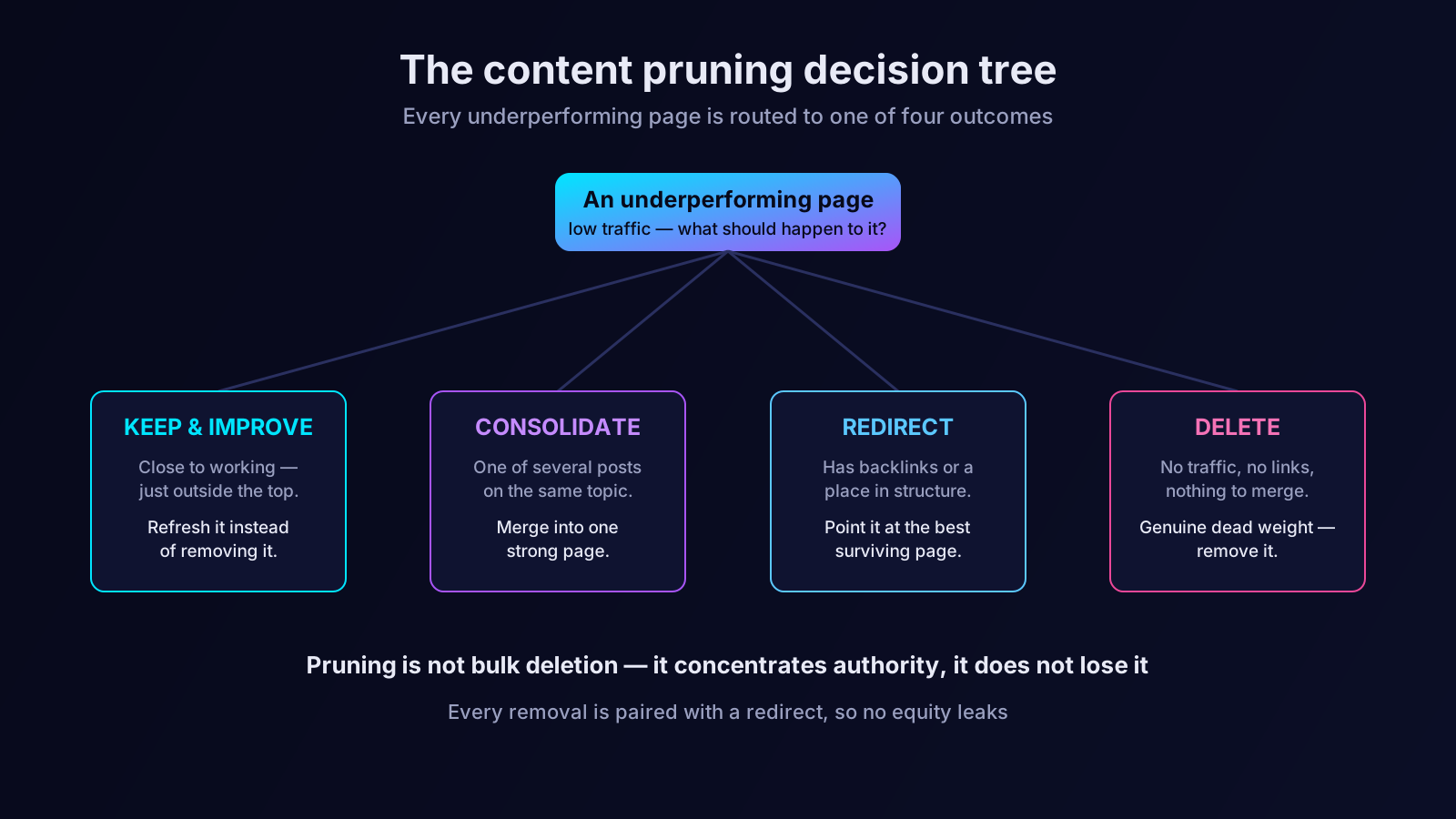
This objection does not argue against pruning. It argues for doing it properly. Pruning is not bulk deletion. It is a decision tree applied page by page. If a page has earned backlinks or holds a meaningful place in your structure, you do not simply delete it — you redirect it to the most relevant surviving page, so the equity it carries flows somewhere useful instead of evaporating. If a page is part of a cluster of overlapping posts, you consolidate: merge the worthwhile fragments into one strong page and redirect the rest into it. Only the pages that have no links, no traffic, and nothing worth merging are removed outright. Done this way, pruning does not lose authority. It concentrates it.
Why removing weak pages helps the strong ones
So far the argument has been defensive — pruning avoids harm. But pruning also creates direct, positive gains, and there are three mechanisms worth understanding.
The first is the site-wide quality signal. Remove the weakest quarter of your archive and the average quality of what remains rises immediately. The search engine's general impression of your domain improves, and that improvement lifts the pages that survive — including pages that had nothing wrong with them except the company they were keeping.
The second is crawl efficiency. A search engine allocates a finite amount of attention to crawling your site. Every dead page it crawls is attention not spent on a page you care about. On a large site, trimming hundreds of worthless URLs means your important pages get discovered and refreshed faster.
The third is the end of self-competition. When five mediocre posts all circle the same topic, they split signals, split internal links, and confuse the search engine about which one to rank. Consolidate them into a single strong page and you stop competing with yourself. One clear, authoritative page almost always outranks five blurry ones. This is the same logic behind a deliberate internal linking strategy — signals should converge on your best pages, not scatter across weak ones.
"Doubling traffic by deleting" is not a paradox
The headline result that gets people's attention — traffic rising after pages are removed — sounds like a contradiction. It is not. Once you understand the three mechanisms above, it is exactly what you would predict.
You did not lose traffic from the deleted pages, because they had no traffic to lose. You raised the site-wide quality average, so surviving pages rank better. You freed up crawl attention, so important pages get refreshed faster. You consolidated competing pages, so a single strong page now ranks where five weak ones used to cancel each other out. Add those up and the archive gets smaller while the traffic gets bigger. It is not a paradox. It is arithmetic that only looks strange if you still believe page count is the metric that matters.
How to prune without breaking things
Pruning is powerful and also genuinely risky if done bluntly, so the process matters. A sound approach has a clear shape.
It starts with a full inventory: every indexable URL on the site, with its organic traffic, its backlinks, its last meaningful update, and the query — if any — it satisfies. You cannot prune what you have not measured. Then each underperforming page is routed through the decision tree: keep and improve the ones that are close to working, consolidate the overlapping ones, redirect the ones with links or structural value, and delete only the genuine dead weight. Every removal or merge is paired with a redirect to the most relevant surviving destination, so no equity leaks and no reader hits an error. And then you wait — pruning's effects unfold over weeks as the search engine recrawls and re-evaluates, so resist the urge to judge the outcome after three days.
The one rule that protects you throughout: when genuinely unsure about a page, improve it rather than delete it. Pruning is reversible in spirit but tedious in practice. Caution costs little; recklessness can cost a page that was quietly doing fine.
How often pruning should happen
A common misconception treats pruning as a one-time event — a dramatic spring clean you do once, declare the archive tidy, and never repeat. That framing guarantees the problem comes back, because the conditions that produce dead weight never stop operating.
Content goes stale continuously. Topics keep changing, the competition keeps improving, and queries keep drifting. A page that is healthy today can be obsolete in eighteen months without anyone touching it. If you prune once and walk away, you are simply scheduling the next overgrown archive for a few years from now. The teams that benefit most from pruning treat it as a recurring review — a regular pass through the archive on a fixed cadence, perhaps every two or three quarters, where the inventory is refreshed and the decision tree is re-run. Done this way, dead weight never accumulates into a crisis. It gets caught while it is still a handful of pages rather than a third of the site. The first prune of a long-neglected archive is a big project. Every prune after that, on a regular schedule, is a small and manageable one. The same logic applies to organising what survives into topic clusters — structure is something you maintain, not something you set once.
Pruning and the new-content question
An argument this strongly in favour of deletion invites an obvious worry: does pruning mean you should slow down publishing, or stop creating new content altogether? It does not, and the relationship between the two is worth being precise about.
Pruning is not the opposite of publishing. It is the discipline that makes publishing sustainable. A team that only ever adds will, by simple accumulation, eventually be buried under its own archive — every new post landing on a foundation that gets weaker each year. A team that prunes regularly keeps that foundation strong, which means new content lands on a site search engines already trust and therefore performs better from the start. The two activities are partners. New content brings in fresh topics and fresh demand; pruning keeps the site lean enough that the new content actually gets the credit it deserves. The mistake is not publishing. The mistake is publishing without ever subtracting — treating the archive as a place things only enter and never leave. A healthy content operation has both an intake and an exit, and the exit is just as deliberate as the intake.
Why pruning is uncomfortable — and why that is the point
If pruning works this reliably, why is it so rare? The honest answer is psychological, not technical.
Deleting content feels like erasing work. Someone wrote that post. It represents hours, maybe a paid invoice, certainly effort. Removing it feels like a small admission of failure, and organisations are bad at admitting sunk costs. So the archive grows, not because every page in it earns its place, but because deleting things is emotionally harder than adding them.
The reframe that makes pruning bearable is this: you are not erasing work. You are concentrating it. The effort that went into five overlapping posts is not destroyed when you merge them into one strong page — it is gathered into something that finally performs. The discomfort of pruning is real, but it is the discomfort of correcting a mistake, and correcting mistakes is how anything improves. A team that cannot bring itself to delete will, by simple accumulation, end up judged by its worst pages instead of its best.
Where an AI agent fits
The reason pruning stays on the to-do list and rarely gets done is scale. Auditing every URL on a site of any size — pulling traffic, checking backlinks, finding last-updated dates, identifying which pages overlap which, deciding the right outcome for each, and mapping a correct redirect for every removal — is a large, careful, deeply unglamorous project. It is exactly the kind of work that is easy to agree is important and easy to never start.
This is structured, repetitive analysis at volume, which is what an SEO AI agent is built for. Orova can inventory every page on a site, surface the underperformers, identify clusters of pages that overlap and quietly compete, and recommend the right action for each — improve, consolidate, redirect, or remove — with a redirect target proposed for every change. The judgement stays yours: you decide what survives. But the punishing audit that stops most teams from ever pruning is handled, which turns "we should clean up the blog someday" into a decision you can actually make this quarter.
Stop measuring your blog by how many pages it has. Start measuring it by how many of those pages earn their place. For most established sites, the next traffic gain is not hiding in a post you have not written. It is hiding behind the posts you have been afraid to delete.
Let an AI Agent handle your SEO
Orova plans, writes, optimizes, and tracks rankings on its own — you just read the results.
Try it free