
Content Strategy Is Not a Content Calendar — Here's the Difference
Ask a marketing team to show you their content strategy and, more often than not, what they hand you is a calendar. A grid of months, a column of titles, a publish date next to each, maybe a colour code for format. It looks organised. It looks like a plan. And it is the single most common reason content programs spend years producing work that never compounds.
A content calendar is a schedule. A content strategy is a set of decisions. Confusing the two is not a semantic quibble — it is the difference between a program that builds an asset and a program that simply fills a feed. This article is about why the two are not the same thing, why mistaking one for the other is so easy and so expensive, and what an actual strategy contains that a calendar never can.
What a calendar actually answers
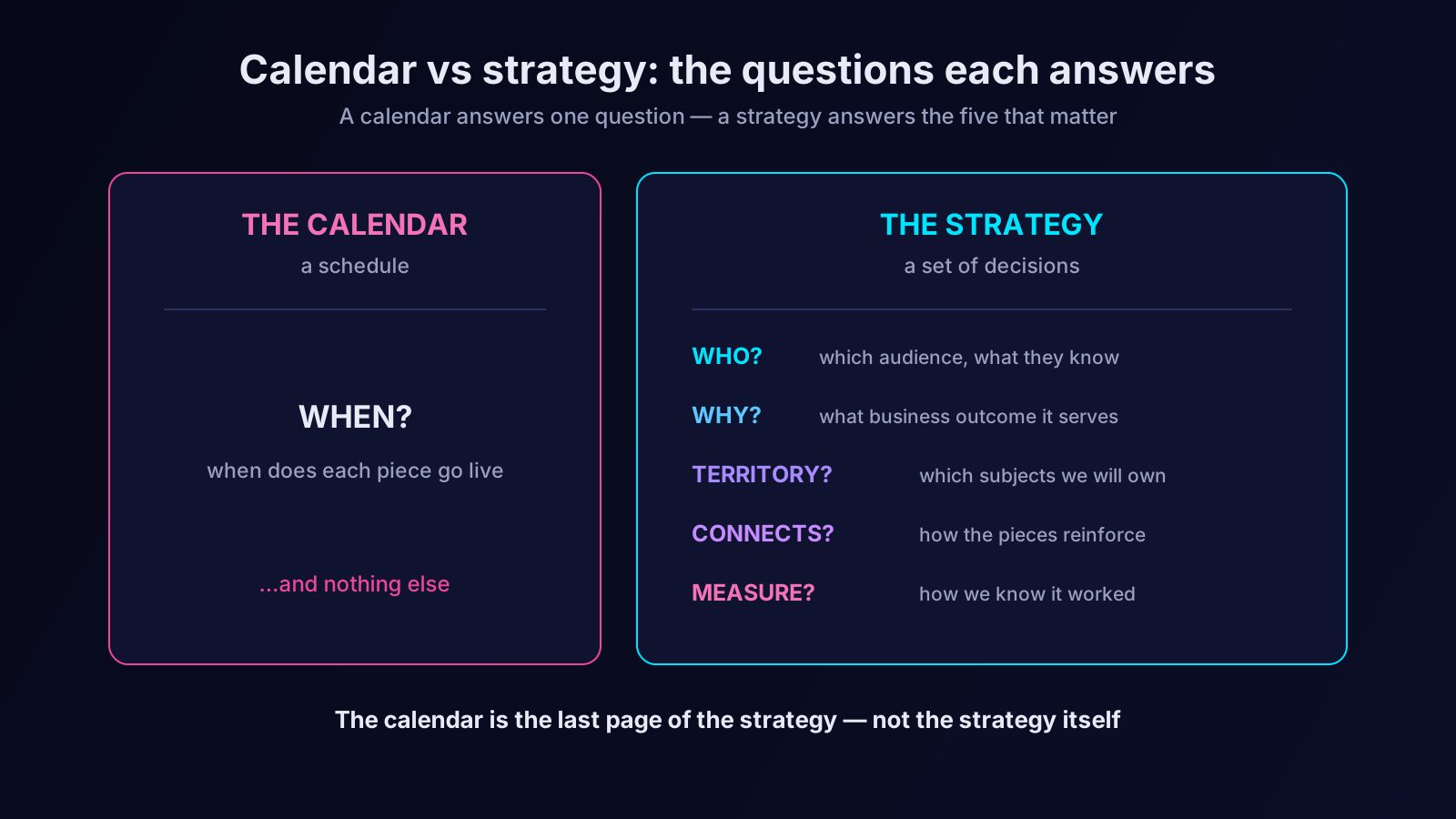
A content calendar answers exactly one question: when. When does this piece go live? When is the next one due? It is a logistics tool, and as a logistics tool it is genuinely useful — it keeps a team accountable, it spreads work across weeks instead of bunching it, it makes the pipeline visible.
But notice what it does not answer. It does not say why this topic and not another. It does not say who this piece is for, or what stage of awareness they are in, or what you want them to do next. It does not say how this article relates to the forty articles already published or the forty still to come. It does not say what "working" would look like, or when you would know the strategy had failed. A calendar takes all of those decisions as already made — and in most teams, they were never made at all. The calendar simply papers over their absence with the comforting visual of a full grid.
That is the trap. A full calendar feels like progress. It is the artefact you can show a manager, the thing that makes the quarter look planned. So teams build the calendar, feel organised, and never notice that the hard questions — the strategic ones — were quietly skipped because the calendar made it look as if they had been answered.
What a strategy actually answers
A content strategy answers a different and much harder set of questions, and it answers them before a single title goes into a calendar.
It answers who: which specific audience are we trying to reach, what do they already believe, what are they trying to do, and where do they look when they are doing it? It answers why: what business outcome is this content meant to produce — qualified signups, sales-cycle support, category education, retention — and how would we recognise that outcome if it arrived? It answers what territory: which subjects are we going to credibly own, and just as importantly, which are we deliberately not going to touch? It answers how it fits together: how does each piece relate to the others, so that the hundredth article is more valuable because the previous ninety-nine exist? And it answers how we will know: what does success look like at three months, at twelve, and what evidence would tell us to change course?
Only once those questions have answers does scheduling become meaningful. The calendar is the last step — the operational expression of a strategy already decided. Building the calendar first is building the roof before the foundation, and then wondering why the house keeps shifting.
A calendar tells you what you are publishing on Tuesday. A strategy tells you why publishing it on Tuesday is worth doing at all.
The symptom: a blog that is busy but not building
You can spot a calendar-as-strategy program from the outside. It is busy. It publishes on schedule, sometimes for years. The archive is large. And yet nothing about it compounds.
The articles are individually fine and collectively incoherent. They cover whatever seemed relevant the month they were commissioned. Two of them quietly target the same query and split its ranking between them. A reader who lands on one has no obvious next article to read, because the pieces were never designed to relate. Traffic, if it comes at all, arrives in disconnected spikes rather than a rising baseline. The team is working hard and the program is not getting stronger — it is just getting longer.
That pattern is the signature of a missing strategy. The calendar was full the whole time. The grid never had a gap. But a full grid measures activity, not direction, and a program can run at full activity in no particular direction for a very long time before anyone notices the asset was never being built.
Why the substitution is so easy to make
It is worth being honest about why intelligent teams fall into this so reliably, because the reasons are not stupidity — they are structural.
First, a calendar is concrete and a strategy is abstract. You can see a calendar. You can fill cells, assign owners, watch the grid populate. A strategy is a document of decisions and arguments, harder to picture and harder to feel finished. Given a choice between a satisfying concrete task and an uncomfortable abstract one, teams gravitate to the concrete one — and the calendar obligingly presents itself as the concrete one.
Second, a calendar produces immediate motion. The moment it exists, writers can start writing. A strategy produces a pause — a period of thinking and deciding during which nothing is being published, which in many organisations reads as the team doing nothing. The pressure to "just start producing" pushes teams to skip straight to the calendar so that visible output begins sooner.
Third, a calendar is easy to show upward. A manager asking "what's the content plan?" is reassured by a grid far more readily than by a strategy document. The calendar is legible to people who will never read the articles. So it becomes the artefact the team optimises for — the deliverable that gets the nod — and the strategy, being harder to display, quietly never gets written.
The strategy comes first, then the calendar carries it
None of this means calendars are bad. A program needs one. The error is purely in the sequence and the status — treating the calendar as the strategy rather than as the strategy's delivery mechanism.
In a healthy program the order is fixed. First you decide the audience and the business outcome. Then you decide the territory — the cluster of subjects you will own — and you structure that territory so the pieces support each other rather than compete; this is where a deliberate topic cluster structure turns a list of articles into a system. Then you turn that structured territory into a concrete list of pieces, each with a defined audience, intent, and role. Then, and only then, you load that list into a calendar and assign dates.
Done in that order, the calendar is no longer a substitute for thinking. It is the visible, schedulable surface of thinking that already happened. Every date on the grid traces back to a decision. Move a piece, drop a piece, add a piece, and you can say exactly what that does to the strategy — because there is a strategy for it to do something to.
A quick test: interrogate your own calendar
Here is a way to find out which one you actually have. Open your content calendar and pick any single row — any title, any date. Then ask it five questions.
Who is this specific piece for, and what do they already know? Why does it exist — what business outcome is it meant to support? Which other pieces does it connect to, and how does a reader move between them? What query or need is it the single best answer to, and is anything else we have published also chasing that query? And how will we know, in six months, whether this piece did its job?
If the row answers all five immediately and consistently, you have a strategy and the calendar is just expressing it. If the honest answer to most of them is "we never decided that — it just seemed like a good topic," then the grid in front of you is a schedule wearing a strategy's clothes. That is not a failure of effort. It is a failure of sequence, and the fix is to stop and make the decisions the calendar assumed were already made.
The calendar that survives a strategy, and the calendar that hides its absence
To make the distinction concrete, picture two teams whose calendars look, on a screen, almost identical. Both grids are full. Both have a title in every cell, an owner assigned, a publish date set, a tidy colour code for format. An outsider glancing at either would see a competent, organised content operation. And yet the two teams are doing fundamentally different things.
Team A built their grid last. They began with a written audience definition, argued their way to a business outcome, mapped a territory of subjects they intended to own, and structured that territory into clusters where every piece had a defined role. Only then did they take the resulting list of pieces and spread it across the months. Their calendar is a delivery schedule for a plan. If you asked Team A to justify the article in row fourteen, they would not hesitate — it fills a specific gap in a specific cluster, serves a specific reader, and links to three specific neighbours. The calendar is downstream of all of that.
Team B built their grid first. Someone opened a blank calendar template, and the team began filling cells with topics that sounded reasonable — competitor-inspired, trend-driven, suggested in a brainstorm. The grid filled up quickly and everyone felt productive. Ask Team B to justify the article in row fourteen and the honest answer is that it seemed like a good topic when the cell was filled. There is no cluster it belongs to, no defined reader, no neighbour it connects to, because none of those things were ever decided. The calendar is not downstream of a plan. It is the plan, which is to say there is no plan.
The two calendars are visually indistinguishable and operationally opposite. That is exactly why the calendar makes such a convincing disguise for a missing strategy — and exactly why you cannot judge a content program by glancing at its grid. You have to interrogate the rows.
What changes when you move the calendar to last
Teams that have made this shift — that have demoted the calendar from "the strategy" to "the last step of the strategy" — describe a few specific changes in how the work feels.
The first is that the "what do we write next" meeting disappears. Not because the team got more decisive, but because the question is already answered. The structured territory contains a backlog of defined pieces, each with a role; choosing what to write next is reading the next item off a plan, not generating an idea under pressure. The recurring scramble that used to consume a meeting every few weeks simply stops happening.
The second is that editing the calendar becomes a strategic act with visible consequences. When the grid is the strategy, moving a piece or dropping one is just rearranging cells. When the grid expresses a strategy, every change can be traced: drop this piece and that cluster loses a supporting page; add this piece and you have created a second page chasing a query you already cover. The calendar becomes a place where you can see the strategic effect of a logistics decision — which is what a calendar should be.
The third change is the quietest and the most important: the program starts to feel like it is building toward something rather than merely keeping up. A calendar-as-strategy program is always running to fill the next slot. A strategy-with-a-calendar program is always adding the next piece to a structure, and the structure is visibly getting more complete. The work is the same volume of writing. The difference is entirely in whether there is a thing being built, or just a feed being fed.
Why the distinction decides whether content pays off
The reason this matters so much is that content is a slow asset. A single article rarely justifies its cost. The return comes from accumulation — from a body of work that, taken together, establishes that your site is the credible, comprehensive answer on a subject, so that each new piece ranks faster and each existing piece is lifted by its neighbours.
That accumulation is precisely what a calendar cannot produce on its own, because accumulation requires coherence, and coherence is a strategic decision. A calendar of unrelated good articles never becomes more than the sum of its rows. A strategy-driven program becomes an asset whose value grows faster than its page count, because every piece is positioned to reinforce the others. Same number of articles, same publishing effort, radically different outcome — and the only difference is whether the decisions were made before the grid was filled.
Where an AI agent helps — and where it does not
It is worth being precise here, because AI is often sold as a way to fill calendars faster, and filling a calendar faster is exactly the wrong thing to get good at if the strategy underneath is missing. A tool that helps you publish more, sooner, in no particular direction simply lets you run harder down the wrong road.
The genuine help is upstream. The strategic work — mapping a territory, deciding which subjects to own, checking that a planned piece does not duplicate something already published, organising pieces so they reinforce each other rather than compete, keeping the whole structure coherent as it grows — is demanding, and it is the work most often skipped because it is abstract and slow. Orova is an SEO AI agent built for that upstream work: it can take a defined audience and goal, map the territory of subjects around them, structure those subjects into coherent clusters, flag candidate pieces that overlap content you already have, and produce a sequenced plan you review rather than invent from a blank page. The strategic decisions remain yours — Orova does not decide who your buyer is or what outcome you want. What it removes is the friction that makes teams skip the strategy and reach for the calendar instead. If the abstract, structural work were faster and less lonely, far fewer programs would settle for a full grid in place of a real plan.
So the next time someone asks to see your content strategy, notice what your hand reaches for. If it reaches for the calendar, pause. The calendar is real and useful and you will need it. But it is the last page of the strategy, not the strategy itself — and a program that mistakes the schedule for the plan can stay busy for years without ever building the thing content was supposed to build.
Let an AI Agent handle your SEO
Orova plans, writes, optimizes, and tracks rankings on its own — you just read the results.
Try it free