
Informational vs Commercial Keywords: Stop Mixing Them Up
Here is a mistake so common it has stopped looking like a mistake. A marketing team picks a keyword — say, "marketing automation" — and writes one article. The article opens by patiently explaining what marketing automation is, then, sensing an opportunity, swerves halfway through into why their marketing automation product is the obvious choice, and closes with a demo request. One page, doing two jobs. It feels efficient. It is, in fact, the reason the page never ranks well for either job.
The error is mixing informational and commercial keywords — treating them as one category when they are two, with two different searchers, two different page formats, and two different definitions of success. Untangling them is one of the highest-leverage corrections a content team can make, and this article is about how to make it cleanly.
The two categories, defined plainly
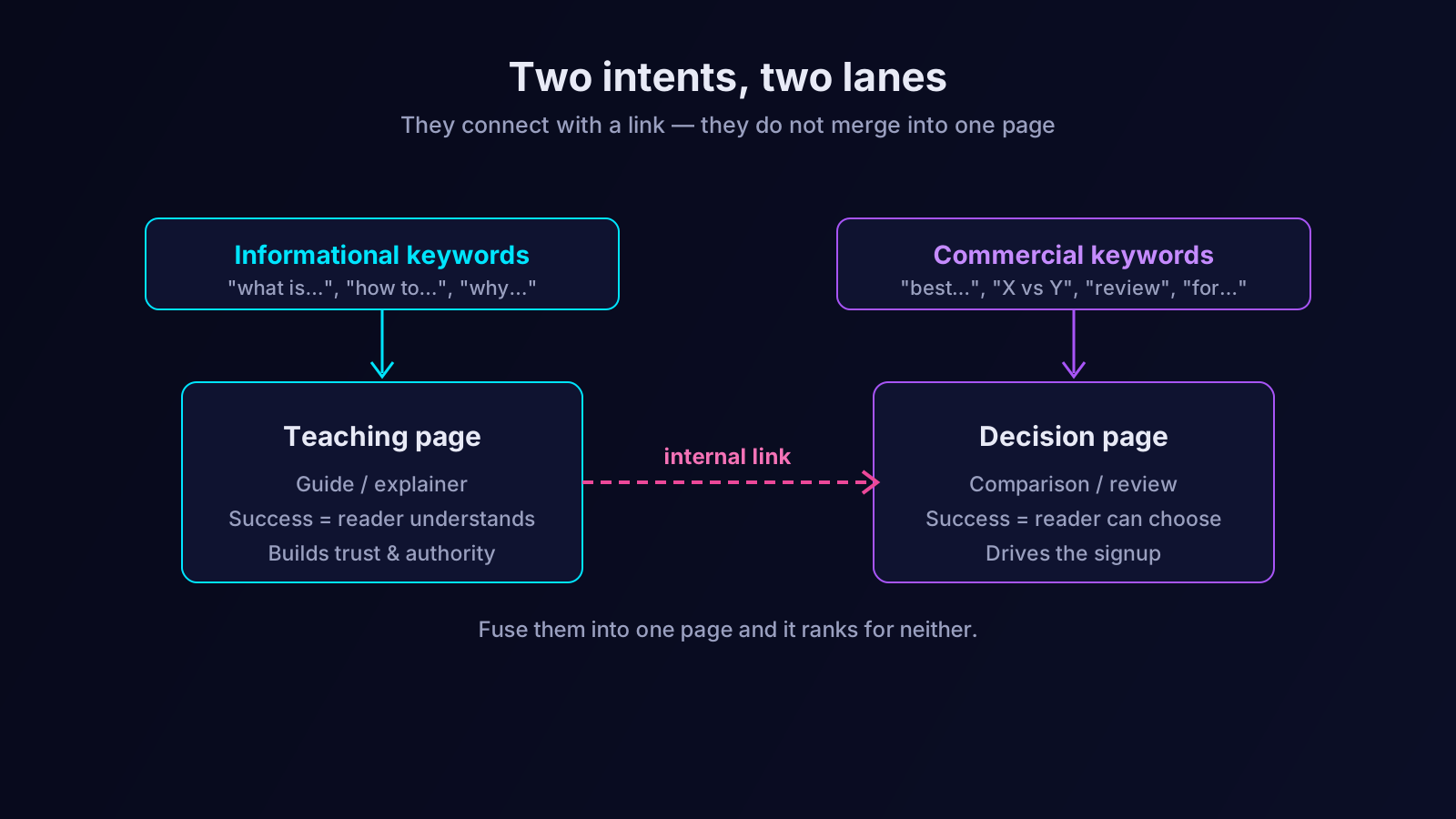
An informational keyword belongs to someone trying to understand something. "What is marketing automation." "How does lead scoring work." "Why do emails land in spam." They are learning. They are not, in this moment, shopping.
A commercial keyword belongs to someone trying to decide what to buy. "Best marketing automation software." "HubSpot vs ActiveCampaign." "Marketing automation for small business." They have moved past understanding the concept; now they are evaluating options and reducing the risk of a wrong purchase.
These are two distinct moments in a person's life. The informational searcher might become a customer eventually — months from now. The commercial searcher might become one this week. A keyword belongs firmly to one camp or the other, and the searcher behind it has decided which, long before you get a vote.
Why mixing them is the most common content mistake
The mix happens for an understandable reason: it looks like getting two results from one effort. Why write a separate explainer and a separate comparison when you could fuse them and save a slot in the calendar? Because Google does not rank fused pages. It ranks pages that satisfy an intent — singular — completely.
When a page tries to serve both, it does each one badly. The reader who came to learn hits the sales pitch, feels handled, and leaves. The reader who came to compare options wades through four paragraphs of beginner definitions they did not need, gets impatient, and leaves. Both audiences are underserved, both bounce, and the engine reads those bounces as a verdict: this page does not satisfy the people who land on it. The fused page does not split the difference. It loses on both fronts at once.
A page aimed at two intents does not get two chances to rank. It gets zero. Specificity is not a constraint on SEO content — it is the mechanism.
What an informational page is actually for
An informational page has one job: leave the reader genuinely more knowledgeable than they arrived. It is a teacher, not a salesperson. Its success is measured in comprehension and trust — did the reader's question get answered, fully, clearly, without an agenda?
This is the part teams resist, because informational pages rarely convert on the spot, and a page that does not convert today feels like a page that is not working. It is working. It is doing the slow job: building topical authority that helps the whole site rank, and earning the reader's trust so that when they do reach the buying moment, your brand is the one they already respect. An informational page that hard-sells trades a long-term asset for a short-term pitch nobody asked for. The most you should do is offer a quiet, relevant next step for the reader who is ready — an invitation, not an ambush.
What a commercial page is actually for
A commercial page has the opposite job: help a decision get made. The reader has stopped asking "what is this" and started asking "which one, and is it safe to choose." The page that wins here is a genuine decision aid — honest criteria, real trade-offs, clear comparisons, and, crucially, a confident recommendation.
The mistake on commercial pages is the mirror image of the informational one: instead of selling too hard, teams go too soft. Afraid of seeming biased, they write a limp, neutral overview that refuses to recommend anything. But a reader on a commercial query wants a recommendation — that is the help they came for. A page brave enough to say "for a small team, this one; for an enterprise, that one" beats a fence-sitting page every time. Commercial does not mean dishonest. It means useful enough to be decisive.
The failure modes, named
When the two get mixed, the damage shows up in recognisable shapes:
- The bait-and-switch. An informational title and opening, then a hard pivot to a pitch. The reader feels tricked. Trust spent, not built.
- The buried lede. A commercial page that makes the ready-to-decide reader scroll through 800 words of "what is X" before any actual comparison appears. Friction where speed was needed.
- The cannibal pair. The team senses the problem and writes both a guide and a comparison — but targets the same keyword with each. Now two pages compete for one query and Google ranks neither confidently.
- The orphaned funnel. A great informational page and a great commercial page exist, but nothing links them. The reader who just learned the concept has no path to the page that helps them buy.
Notice the last two: separating the intents is necessary but not sufficient. The pages must target different keywords, and they must be connected by a deliberate link so a reader can move from learning to deciding when they are ready.
There is a quieter failure mode worth naming too: the wasted measurement. When a page serves two intents, you lose the ability to judge whether it is working. Its traffic is a blend, its conversions are a blend, and no single number tells you anything clean. You cannot say "this should convert" or "this should not," because the page was never one thing. Separated pages each have an honest, readable scorecard — and a program you cannot measure honestly is a program you cannot improve.
How to tell them apart at the keyword level
You can usually classify a keyword before writing a word, using two quick checks.
Read the modifier. The words attached to the core term betray the intent. "What," "how," "why," "guide," "examples" lean informational. "Best," "top," "vs," "review," "pricing," "alternative," "for [audience]" lean commercial. The modifier is the searcher quietly telling you which moment they are in.
Then confirm with the SERP. The modifier is a strong hint; the results page is the verdict. Search the term. If the first page is dominated by explainer articles, the keyword is informational regardless of what you hoped. If it is dominated by listicles, comparisons, and product pages, it is commercial. Google has already measured what searchers want for that exact query — the SERP is that measurement, printed for free. (For the full method, see our guide on reading search intent in seconds.)
The rule: one keyword, one stage, one page
The fix is a discipline, and it is simple to state. Every keyword is classified — informational or commercial — before it enters the content plan. Each keyword gets its own page. Each page is built, start to finish, for its single intent. And the informational pages link forward to the commercial pages so the funnel actually connects.
Done properly, this does not give you fewer opportunities than the fused approach — it gives you more. Where the mixing team had one underperforming page, the disciplined team has a clean explainer ranking for the informational query, a sharp comparison ranking for the commercial query, and a link between them carrying the reader from one to the next. Two ranking pages and a working funnel, instead of one page that ranks for nothing. The "efficient" shortcut was never efficient. It just looked that way on the calendar.
This also reframes how you read a disappointing page. A guide that gets traffic but no signups is not failing — that is exactly what a guide is supposed to do, and the signups are the job of the commercial page it links to. A comparison page that gets traffic but no signups is failing, because converting is its actual job. You cannot judge a page until you know which lane it is in. Mix the intents and you also lose the ability to tell whether anything is working.
What this looks like across a content calendar
Zoom out from the single page to a year of publishing, because that is where the mixing habit does its real damage.
Imagine a team that fuses intents by default. Every keyword becomes one do-everything page: a bit of explanation, a bit of comparison, a closing pitch. After a year they have, say, forty published pages. Each one is a compromise. The explanation is too thin for the learners, the comparison too buried for the buyers, the pitch too pushy for both. Forty pages, and the blog underperforms — not because any single page is terrible, but because every page is two half-pages stapled together. The team concludes they need to "write better" and tries harder at the same broken shape.
Now imagine a team that separates intents from the start. The same year's effort produces a different library: a set of clean informational guides, each ranking for the learning queries and quietly building the site's authority; a set of sharp commercial comparisons, each ranking for the buying queries and actually converting; and a web of internal links carrying readers from the first set to the second. The page count might be similar. The outcome is not. One library competes for two sets of queries and wins a share of both. The other competes for nothing and wins nothing.
The compounding goes further. Because the informational pages are genuinely useful and un-pushy, they earn links and shares — which lift the whole domain, including the commercial pages. Because the commercial pages are decisive and trustworthy, they convert the readers the informational pages send them. The two lanes do not just coexist; they feed each other. A fused-page library has no such engine. It is forty isolated compromises, each one quietly failing in two directions at once.
This is why the informational-versus-commercial distinction is not a tidy-up detail. Over a year, it is the difference between a content program that compounds and one that merely accumulates.
Where an AI agent helps
The discipline is easy to describe and tedious to sustain. Classifying every keyword, checking each SERP to confirm, keeping informational and commercial pages from cannibalising each other, and maintaining the links that connect the two lanes — that is real, repetitive work, and under deadline pressure it is the first thing a team quietly drops. Then the fused pages creep back in.
This is structured judgement at volume, which is what an SEO AI agent is built for. Orova classifies each keyword by intent, reads the live SERP to confirm whether it is informational or commercial, flags when a new keyword overlaps a page you have already published, and keeps the internal links between your teaching pages and your decision pages coherent as the library grows. The strategy here is not complicated. Holding the line on it, across hundreds of keywords, is — and that is the part worth handing to a system.
Stop mixing the two. A person who wants to learn and a person who wants to buy are not the same person, and a single page pretending to serve both serves neither. Classify the keyword, pick the lane, build the whole page for it, and link the lanes together. That is not extra work. It is the difference between a blog that ranks and a blog that is merely busy.
Let an AI Agent handle your SEO
Orova plans, writes, optimizes, and tracks rankings on its own — you just read the results.
Try it free