
Pillar Pages: How to Build the One Page That Anchors a Cluster
Most blogs are flat. They are a long, undifferentiated list of posts, ordered by date, each one shouting for attention with no relationship to the post above or below it. Nothing anchors the subject. Nothing tells a reader — or a search engine — "this site is the place to understand X." A pillar page fixes exactly that. It is the one page that gathers a subject into a single, authoritative whole and gives an entire cluster of related articles something to point at. This article is a practical guide to building one.
If you have read about topic clusters and pillar pages and found the advice frustratingly vague — "create a comprehensive page on a broad topic" — you are not alone. The concept is simple. The execution is full of decisions, and getting them wrong produces a long page that ranks for nothing and helps no one. So we will be specific: what a pillar page is, how to choose its topic, how to structure it, how to link it, and how to keep it alive after publication.
What a pillar page actually is
A pillar page is a single, long, comprehensive page that covers a broad topic in full breadth — and links out to a set of narrower articles, each of which covers one sub-part of that topic in depth. The pillar is the hub; the narrower articles are the spokes. Together they form a topic cluster.
Notice the division of labour. The pillar covers the whole subject, but at moderate depth — enough to genuinely orient a reader on every major part of it, not so much that it becomes a book. The spoke articles cover one part each, but exhaustively. A reader who lands on the pillar gets the complete map; a reader who needs the detail on one region follows a link to the spoke that covers it. The pillar answers "what is the whole of this subject?" The spokes answer "how exactly do I do this one specific thing?"
This is the first place people go wrong. They write a pillar page that is just a very long blog post — deep on a few points, silent on others, with no spokes beneath it. That is not a pillar. It is an orphaned long-read. A pillar page is defined by its relationship to a cluster. Without spokes to anchor, it anchors nothing.
Choosing the topic of the pillar
The single most important decision is the breadth of the pillar's topic, and it is easy to misjudge in both directions.
Pick a topic too narrow and there is no cluster to build. "How to write a meta description" is a fine article, but it cannot be a pillar — there are not eight or ten distinct sub-topics beneath it, only variations of one task. Pick a topic too broad and the pillar becomes unfocused and the cluster becomes unmanageable. "Marketing" is not a pillar topic; it is a category containing dozens of potential pillars.
The right breadth sits in a specific zone. A good pillar topic is broad enough to branch naturally into eight to fifteen distinct sub-topics, each substantial enough to carry its own article. And it is narrow enough that a knowledgeable reader would recognise it as a single coherent subject — something you could put after the words "the complete guide to" and have it sound right. "Email marketing." "Technical SEO." "Customer onboarding." Each is a real subject, each branches cleanly, each can be covered in full on one page that then hands off to its spokes.
There is also a commercial test the topic must pass. The pillar will, over time, become one of the most authoritative pages on your site — it should be a subject your buyers genuinely care about, close to what you sell. A beautifully built pillar on a topic adjacent to your business attracts an audience with no reason to become customers. Choose a pillar topic the way you would choose a seed keyword: central to the product, not merely nearby.
The structure of the page itself
A pillar page has a recognisable shape, and following it makes the page easier to write, easier to read, and easier for search engines to parse.
It opens with a clear definition and a framing of the whole subject — a reader should know, within the first screen, exactly what this page covers and why the topic matters. It then moves through the major sub-topics in a logical order, devoting a clearly headed section to each one. Each section does two things: it explains that sub-topic well enough to be genuinely useful on its own, and it links out to the spoke article that covers that sub-topic in full depth. The page closes by tying the subject together — a summary, a sense of where to go next, and the relevant calls to action.
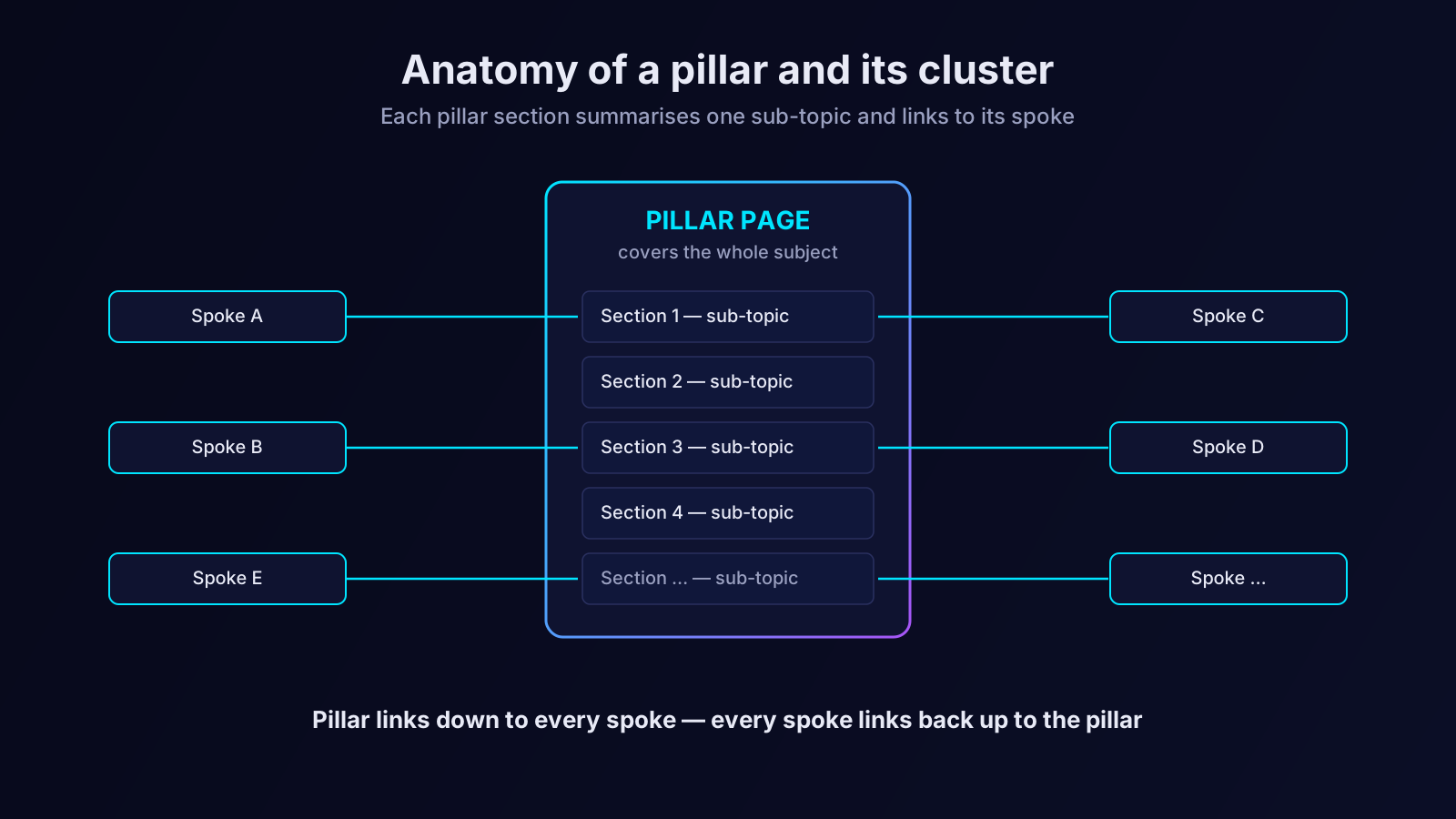
The section-per-sub-topic structure is not cosmetic. Each section is, in effect, a summary of one spoke article, and the link from that section to its spoke is the structural connection that makes the cluster a cluster. If your pillar has ten spoke articles, it should have roughly ten substantive sections, each summarising and linking to one of them. A pillar whose sections do not map to spokes is a pillar that is not really anchoring a cluster.
How long should a pillar page be?
People want a word count, and there is no honest single number — but there is a principle. A pillar page should be long enough to genuinely cover every major sub-topic at orientation depth, and no longer.
In practice this usually produces a substantial page — longer than a normal article, because it has to traverse the whole subject — but it should never feel padded. The discipline is this: each section covers its sub-topic well enough that a reader could stop there and have a real, working understanding, then follow the link if they want the full treatment. If a section is so short it teaches nothing, the pillar is thin. If a section is so long it duplicates the entire spoke article, you have two pages competing for the same query and you have wasted the spoke. Aim for the section to be a complete, satisfying summary — and let the spoke be the exhaustive version.
The linking: the part that makes it a cluster
A pillar page and a set of related articles do not form a cluster until they are linked. The linking is not an afterthought — it is the mechanism. There are two directions, and both matter.
Downward links run from the pillar to the spokes: each section of the pillar links to the spoke that covers it in depth. Upward links run from every spoke back to the pillar: each spoke article, somewhere in its body, links to the pillar as the broader context. The result is a tight web — the pillar reachable from every spoke, every spoke reachable from the pillar.
This structure does specific work. It distributes authority: the pillar, receiving a link from every spoke, accumulates internal link equity and becomes the strongest page in the cluster. It tells search engines these pages belong together and collectively cover a subject in depth. And it guides readers — someone who arrives on a narrow spoke can climb to the pillar for the wider picture, and someone who arrives on the pillar can descend to the exact detail they need. If you want the full mechanics of doing this well, our internal linking strategy guide covers the patterns in depth, and our topic clusters guide explains the structure the pillar sits inside.
Pillar first, or spokes first?
A practical sequencing question: do you publish the pillar before the spokes, or after? The honest answer is that the pillar should usually come after — or at least be finalised after — a meaningful number of its spokes exist.
The reason is structural. A pillar published into an empty cluster has nothing linking up to it and nothing concrete to link down to. Its authority comes substantially from the spokes that point at it; with no spokes, it is just a long page sitting alone, and it will rank like one. It is usually better to build several spoke articles first — establishing real depth on the sub-topics — and then publish the pillar into a cluster that can immediately support it.
A reasonable middle path: draft the pillar's outline first, because that outline is your spoke plan — each planned section is a planned spoke. Build the spokes against that plan. Then write and publish the full pillar last, linking it into the cluster that already exists. The outline guides the work; the finished pillar arrives when there is something for it to anchor.
The mistakes that ruin a pillar page
Several specific errors turn a pillar page from an asset into dead weight. They are worth naming so you can check your own work against them.
The first is the lonely pillar — a long comprehensive page with no spokes beneath it. It is the most common failure. Without spokes, there is no cluster, no upward links, no distributed authority. It is just a long post.
The second is cannibalisation — the pillar's section on a sub-topic is so deep and so complete that it competes with the spoke article for the same search query. Now two of your pages fight each other, and search engines cannot tell which to rank. The fix is the discipline already described: pillar sections summarise, spoke articles exhaust.
The third is the missing upward links — spokes that never link back to the pillar. The pillar links down, but nothing links up, so the pillar never accumulates the internal authority that is meant to be its main advantage. Every spoke must point home.
The fourth is the unfocused pillar — a topic chosen too broad, so the page sprawls and the cluster has no natural edges. If you cannot list the sub-topics cleanly, the topic is too wide; split it into two pillars.
Keeping a pillar page alive
A pillar page is not a publish-and-forget asset. It is the most valuable page in its cluster, and it needs maintenance precisely because it is.
Every time you publish a new spoke article in the cluster, the pillar should be updated — a new section added or an existing one extended, with a link to the new spoke. The pillar grows as the cluster grows. A pillar written once and never touched again slowly falls out of sync: the cluster has fourteen spokes, the pillar still mentions ten. The structure leaks. Treat the pillar as a living index of its cluster, and revisit it on a schedule — at minimum whenever a spoke is added, and periodically to refresh facts, examples, and links.
What a finished pillar gives you
When a pillar page is built well — the right topic breadth, a section per sub-topic, downward links to every spoke, upward links from every spoke, sections that summarise rather than cannibalise, and ongoing maintenance — it does something no individual article can.
It becomes the page that ranks for the broad, competitive head term of the subject, because it is backed by the demonstrated depth of an entire cluster. It becomes the natural landing page for anyone trying to understand the topic as a whole. It becomes the page other sites link to when they cite you, because it is the most complete thing you have published. And it becomes the structural centre that lifts every spoke around it. One page, doing the work of an anchor.
Where an AI agent fits
Building a pillar page properly is a substantial, structured project. You have to choose the topic at exactly the right breadth, map its sub-topics, plan a spoke for each, write the pillar's many sections so each summarises without cannibalising, wire up the downward and upward links, and then keep the whole thing in sync as the cluster grows. It is methodical work, and methodical work at this scale is exactly where teams stall — the pillar gets drafted, three spokes get written, and the structure is never finished.
This is the kind of structured, multi-part build an SEO AI agent is designed for. Orova can map a pillar topic into its sub-topics, generate the spoke plan, draft the pillar and its spokes with the summary-versus-depth boundary respected, propose the full set of downward and upward internal links, and flag when a new spoke means the pillar needs an update. The method in this article does not change — you still decide the topic and own the judgement — but the laborious wiring and the easy-to-forget maintenance stop being the reason the cluster never gets finished.
Stop publishing flat blogs. Choose one broad subject your buyers care about, build the page that covers it whole, surround it with spokes that cover each part in depth, and link the two together in both directions. That page — the one that anchors everything around it — is a pillar. It is the difference between a list of posts and a site that owns a subject.
Let an AI Agent handle your SEO
Orova plans, writes, optimizes, and tracks rankings on its own — you just read the results.
Try it free