
How to Scale to 100 Articles a Month Without Making Junk

Somewhere in the last two years, a particular sentence became fashionable in content marketing circles: "we're scaling to a hundred articles a month." It is said with a certain pride, the way someone might announce a new factory. And almost every time I hear it, my first instinct is not admiration. It is a question the speaker rarely wants asked: a hundred articles of what?
This is a critique, so let me be direct about the position before defending it. Scaling content output is not the problem. The problem is that "scale" has quietly come to mean "produce more pages," when the only version of scale that matters is "produce more pages that deserve to exist." Those are not the same project. Confusing them is the single most expensive mistake being made in content marketing right now, and AI has made the mistake easier, cheaper, and far more tempting to commit at volume.
The number is not the achievement
Start with the framing, because the framing is where the rot begins. "A hundred articles a month" is presented as an accomplishment in itself — a milestone, a thing to celebrate. It is nothing of the sort. It is an input. It is the amount of effort and tokens you spent, dressed up as a result.
No reader has ever benefited from your publishing cadence. No buyer has ever converted because your output was high. No search engine ranks a site for the volume of its archive. The number of articles you publish is, to everyone outside your own dashboard, completely invisible. What is visible — the only thing that is visible — is whether any individual article, encountered by an individual person with an individual problem, was worth their time.
When a team celebrates hitting a hundred, they are celebrating the wrong noun. They have measured the firehose and called it the harvest. And because the number is so easy to measure and the quality is so hard to measure, the number wins the meeting, the number goes in the report, and the number becomes the goal. This is the first thing to refuse: do not let output volume be a goal. It is, at best, a constraint.
What "junk" actually means
I have used the word junk, and it deserves a precise definition, because the lazy version of this critique — "AI content is junk" — is both wrong and unhelpful. Plenty of AI-assisted content is excellent. Plenty of human-written content is junk. The dividing line is not the tool.
Junk, in the specific sense that matters here, is a page that does not improve on what already exists for its query. That is the whole definition. If someone searches a question, lands on your article, and leaves knowing nothing they could not have learned faster, more clearly, or more completely from a page already ranking — your article is junk. It does not matter how grammatically clean it is. It does not matter that it hit the word count. It does not matter that it was "optimised." It added nothing, so it is nothing.
This definition is uncomfortable because it is relative. You cannot assess junk by looking only at your own draft. You have to look at the results page and ask: against this competition, for this searcher, does my page move the needle? Most content produced under a volume mandate never gets that question asked, because asking it slows down the factory. And so the factory produces, with great efficiency, pages that are individually plausible and collectively pointless.
Why the volume mandate produces junk by design
Here is the part of the critique that should genuinely worry anyone running a high-output program. The junk is not an accident. It is not a quality-control failure that better proofreading would catch. It is the predictable, structural output of the incentive you set.
When a team is measured on "hundred a month," every decision inside that team bends toward hitting the number. A topic that would make one strong article gets split into three thin ones, because three counts as three. A question with no real search demand gets an article anyway, because the slot was on the calendar. A draft that is mediocre gets published, because sending it back for another pass threatens the count. A piece that genuinely needed a subject-matter expert gets written without one, because waiting for the expert breaks the cadence.
A volume target does not ask for junk. It just removes, one by one, every reason not to produce it.
That is the mechanism. The mandate does not order anyone to make bad content. It simply makes good content — which is slower, more selective, and more willing to say "this topic isn't worth a page" — incompatible with hitting the number. The team is not lazy or cynical. They are responding rationally to the metric they were handed. If you want to know why a content program is producing junk, do not audit the writers. Audit the target.
The AI accelerant
None of this is new. Content farms were producing junk at volume long before large language models existed. But AI has changed the situation in one specific, dangerous way: it has removed the natural brake.
In the old world, producing a hundred mediocre articles a month was expensive. It required a small army of writers, and that cost imposed a kind of accidental discipline — at some point the spreadsheet forced a conversation about whether all this output was worth it. The expense was a brake. It was a bad brake, an unintentional one, but it slowed the machine.
AI removes that brake entirely. A hundred articles a month is now achievable by a tiny team at trivial marginal cost. The economic friction that used to force a quality conversation is gone. Which means the only remaining brake is a deliberate one — a brake the team chooses to install and chooses to keep its foot on. If you do not install it on purpose, there is nothing left to stop the machine from producing junk at a scale, and a speed, that was previously impossible. AI did not create the temptation to confuse volume with value. It just made the temptation nearly frictionless to act on.
So scale the right thing
It would be a weak critique that only complained. The genuinely useful point is this: you can scale to a high output without producing junk. But you have to scale the right thing. The thing to scale is not "pages published." It is "the rate at which you produce pages that deserve to exist."
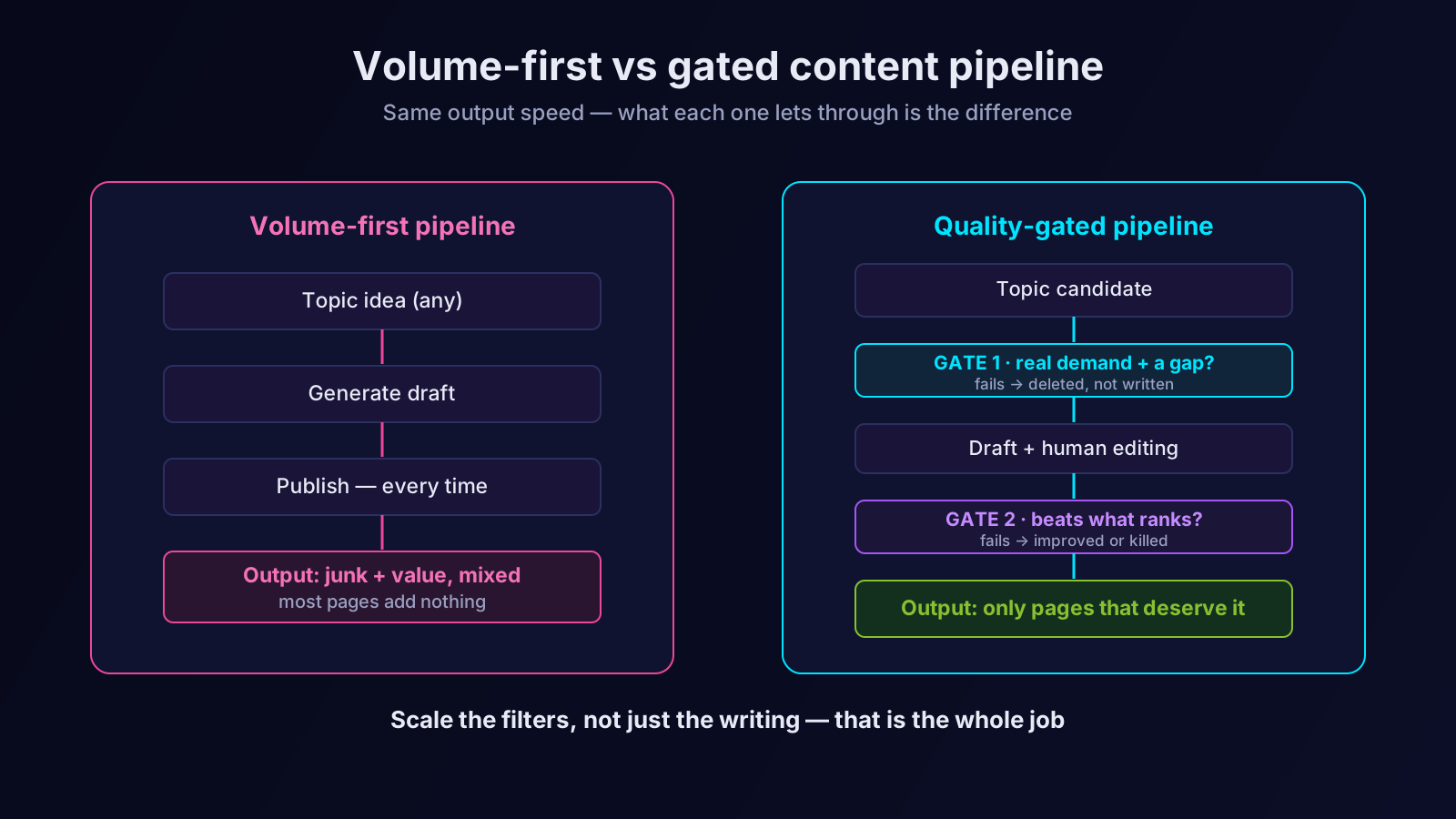
That reframing changes everything downstream. Under the wrong frame, every step of the pipeline is a step toward the number. Under the right frame, every step of the pipeline is a filter, and the filters are the point. A few of them, in order:
- The worthiness filter, before anything is written. For every candidate topic, ask two questions: does real search demand exist for this, and can we say something here that is not already said better elsewhere? A topic that fails either test does not get a slot. It gets deleted. Most volume programs skip this filter entirely, which is why they produce so much that nobody searches for.
- The improvement test, before anything is published. For every finished draft, open the results page it is meant to rank for and ask honestly: does this beat what is already there, for the person searching? If the honest answer is no, the draft does not get published. It gets improved or killed. This is the single most-skipped step in high-volume content, and skipping it is the definition of producing junk.
- The expertise check. Some topics can be handled well by a generalist with good research. Some genuinely cannot — they need a real practitioner's judgement, an actual experience, a number that came from doing the thing. A scaled pipeline has to know which is which, and route accordingly, rather than treating every topic as equally automatable.
Notice that scaling these filters is itself the hard, valuable work. Anyone can scale a writing step. Scaling judgement — applying a consistent worthiness standard and a consistent improvement standard across a hundred candidates a month — is the actual challenge, and it is the challenge a serious content operation should be spending its effort on.
The audit nobody runs
Here is a test for any team currently proud of its output. Take last month's hundred articles. For each one, find its actual performance: impressions, clicks, rankings, any downstream conversions. Then sort the list by results, worst to best.
In almost every high-volume program I have seen this done for, the result is the same and the result is brutal. A small fraction of the articles produce nearly all of the value. A large fraction produce essentially nothing — they sit at zero impressions, ranking for nothing, read by no one, an archive of effort with no audience. They were not a portfolio of bets. They were a hundred articles of which perhaps fifteen mattered and eighty-five were, by the definition above, junk — junk that still cost time to produce, still has to be hosted, still dilutes the crawl budget and the topical focus of the whole site.
This audit is rarely run, and the reason is human: it is unpleasant. It converts a celebrated number into an uncomfortable one. But until a team runs it, "we publish a hundred a month" will keep feeling like success, when the honest version of the sentence is "we publish fifteen useful articles a month and eighty-five we should never have written." The audit is the intervention. You cannot fix a problem you are still describing as an achievement.
Fewer, better, and the courage to say so
The conclusion of this critique is not "publish less" as a slogan — it is something more specific. Publish exactly as much as you can publish while every piece still clears the worthiness filter and the improvement test. If that number turns out to be a hundred, wonderful, scale to a hundred. If it turns out to be thirty, then thirty is your honest number, and a confident thirty will beat an anxious hundred on every metric that reaches the bottom line.
What this requires, more than any tool, is the institutional courage to make "we chose not to write that" a respectable sentence in a content meeting. Right now, in most organisations, it is not — restraint reads as weakness, and the person who killed a topic looks less productive than the person who shipped a thin one. Until that culture changes, the volume mandate will keep winning, and the junk will keep accumulating. Scaling content well is, in the end, less a production problem than a discipline problem. The production was always the easy part. The discipline to scale only what deserves scaling is the rare and valuable thing. For the wider context of building content that compounds rather than accumulates, our guide to structuring content into topic clusters is worth reading alongside this.
Where an AI agent fits — and where it must not
It would be strange to end a critique of careless scaling with an unqualified pitch for automation, so let me be precise. The danger this whole article describes is AI used as a pure production engine — a faster way to fill the calendar, with the filters removed. Used that way, AI is exactly the accelerant that turns a volume mandate into an industrial junk problem.
But that is a choice about how the tool is pointed, not a property of the tool. An SEO AI agent can just as easily be pointed at the filters — at the worthiness test and the improvement test — which are the parts a volume-obsessed team skips. Orova is built to apply that judgement at scale: assessing whether a candidate topic has genuine demand and a genuine gap before a word is written, and checking a finished draft against what is already ranking before it is allowed to publish. The point is not to help you hit a hundred. It is to make sure that whatever number you do hit is a number of pages that each earned their place. Scale the judgement, not just the writing — and the volume, when it comes, will be worth having.
Let an AI Agent handle your SEO
Orova plans, writes, optimizes, and tracks rankings on its own — you just read the results.
Try it free