
From One Seed Keyword to a 90-Article Plan

Most content plans begin with a kind of panic. Someone in a meeting asks "what are we going to write this quarter?" and the team scrambles — brainstorming titles, scraping competitor blogs, exporting a keyword list and hoping a plan falls out of the spreadsheet. The result is a calendar that looks full and feels arbitrary, because it was assembled from whatever ideas happened to be in the room that afternoon.
There is a calmer, more systematic way. You can start from a single keyword — one well-chosen seed — and expand it, through a repeatable sequence of steps, into a structured plan of ninety or more articles, every one of which has a clear reason to exist. This article walks through that expansion, step by step. The number ninety is illustrative, not magic; the point is the method, which scales to whatever your seed and your market can support.
What a seed keyword is — and how to choose one
A seed keyword is the broad term at the centre of a subject you want to own. Not a long-tail phrase, not a niche question — a wide, foundational concept. "Email marketing." "Content strategy." "Project management." It is deliberately too broad and too competitive to target directly with a single page; its job is not to be ranked for, but to be expanded from.
Choosing the seed well is the most important decision in the whole process, because everything downstream inherits from it. A good seed satisfies three tests. It is genuinely central to your product — the subject your buyers care about, not merely adjacent to it. It is broad enough to branch into dozens of sub-topics. And it has commercial gravity: people who care about this subject are people who could become customers. Pick a seed that fails the commercial test and you will diligently expand it into ninety articles that attract an audience with no reason to buy. The expansion method is powerful, which means a bad seed is powerfully wasteful.
Step one: break the seed into sub-topics
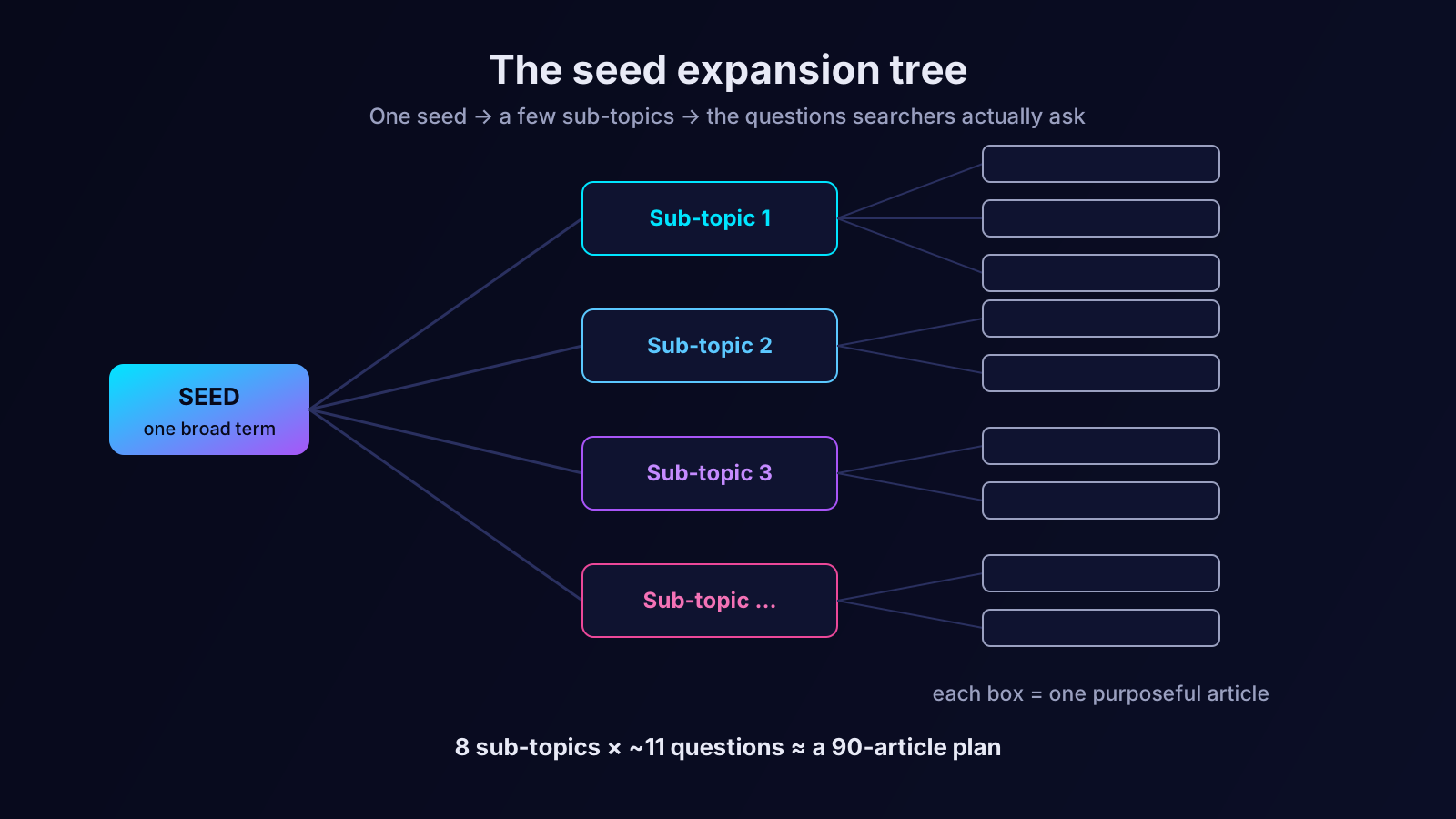
The first expansion turns one seed into a handful of major branches. You are looking for the natural divisions of the subject — the chapters the topic would have if it were a book.
Take "email marketing" as the seed. Its sub-topics fall out with a little thought: list building, email design, deliverability, automation, segmentation, analytics, copywriting, compliance. Eight branches. Each one is itself a substantial subject — broad enough to hold many articles, specific enough to be coherent. These branches will become your pillar pages: the foundational hubs of the topic clusters you are about to build. (If "topic cluster" and "pillar page" are unfamiliar, our topic clusters guide explains the structure this plan produces.)
The discipline at this step is to find divisions that do not overlap. If two sub-topics blur into each other, you will later produce articles that compete with themselves. Eight clean, distinct branches is a far stronger foundation than fifteen fuzzy ones.
Step two: expand each sub-topic into questions
Now the real multiplication happens. For each sub-topic, you generate the specific questions and tasks that searchers actually have within it. This is where one seed begins to become ninety articles.
Take just one sub-topic — "deliverability" — and expand it. How do you keep emails out of spam? What is an SPF record? What is DKIM, and how do you set it up? Why did sender reputation drop? How do you warm up a new sending domain? What is a spam trap? How do you read a deliverability report? Inside one branch, with modest effort, you have surfaced seven or eight genuine articles. Do the same for all eight sub-topics and the arithmetic does the rest: eight branches, each yielding roughly ten to twelve specific questions, lands you near a hundred candidate articles — from one seed.
Where do the questions come from? The same free sources every time: Google's autocomplete, the "People Also Ask" boxes, the "related searches" at the foot of the results page, the questions your sales and support teams field daily, and — if your site is not brand new — the queries already showing up in your Search Console. You are not inventing these questions. You are collecting questions real people already ask, and organising them under the right branch.
Step three: assign intent and format to every article
A list of ninety questions is not yet a plan. Each one needs two labels before it can be built.
The first is intent. Most questions inside a seed expansion are informational — people learning a subject. But scattered through them are commercial queries: "best email deliverability tools," "email automation software compared." Those belong to a different lane and a different page format, and they are usually your highest-value pages because they sit closest to a purchase. Labelling intent now ensures you build a teaching page where teaching is wanted and a decision page where deciding is wanted, instead of discovering the mismatch after publication.
The second label is format: is this a short focused answer, a deep how-to, a definition page, a comparison, a checklist? The format follows the intent and the question, and naming it now turns a vague title into a brief a writer can actually start from.
Step four: structure the plan into clusters
With ninety labelled articles in hand, you impose the structure that makes them work together rather than merely coexist. Each sub-topic becomes a cluster: one pillar page covering the branch broadly, and the specific question-articles as cluster pages beneath it, every cluster page linking up to its pillar and the pillar linking back down.
This is the step that converts a content list into a content system. Ninety standalone articles are ninety isolated bets. Ninety articles arranged into eight interlinked clusters tell search engines your site covers the entire subject of the seed with real depth — and that demonstrated depth is what eventually lets you rank for competitive terms, including, in time, the broad seed keyword itself. The structure is not decoration. It is the mechanism by which the plan compounds.
Step five: sequence the ninety
You cannot publish ninety articles at once, so the plan needs an order. A sound sequence follows a few principles. Lead with winnable, commercially relevant articles — the specific, lower-competition pieces that can rank reasonably soon and prove the program is working. Build clusters with enough coherence that each one starts signalling depth before you move on, rather than scattering single articles across all eight branches. And save the broad pillar pages for once their surrounding cluster pages exist to support them — a pillar published into a vacuum has nothing holding it up.
What comes out of step five is the actual deliverable: not a brainstormed calendar, but a sequenced, structured plan where every one of the ninety articles has a cluster, an intent, a format, and a position in the queue. A team can begin writing on Monday and never again hold the "what do we write next" meeting.
A worked expansion: one cluster in full
Abstract steps are easy to nod along to and hard to act on, so follow a single branch all the way through. Seed: "email marketing." Sub-topic: "deliverability." Here is that one branch expanded into a finished cluster.
The pillar page is the broad hub: "Email deliverability: the complete guide" — a foundational overview of the whole branch, informational intent, long-form. Every cluster page below links up to it.
The cluster pages are the specific questions, each labelled. "How to keep emails out of spam" — informational, deep how-to. "What is an SPF record and how to set one up" — informational, definition-plus-tutorial. "DKIM explained: a setup walkthrough" — informational, tutorial. "What is DMARC and do you need it" — informational, definition. "Why did my sender reputation drop" — informational, problem-diagnosis. "How to warm up a new sending domain" — informational, step-by-step. "What is a spam trap and how to avoid one" — informational, explainer. "How to read an email deliverability report" — informational, practical guide. "Email bounce rate: what's normal and how to fix a high one" — informational, benchmarks-and-fixes. And then the commercial outlier: "Best email deliverability testing tools" — commercial intent, comparison format, a decision page that the informational cluster pages can link into.
That is one sub-topic turned into eleven articles — a pillar, nine teaching pages, and one decision page — all interlinked, all labelled, all with a reason to exist. Now multiply: eight sub-topics, each expanded with the same discipline, and the ninety-article plan is not a stretch target but simple arithmetic. The worked branch also shows why structure matters. Those eleven pages are not eleven guesses. Read together they tell a search engine, unambiguously, that this site has genuine depth on email deliverability — and that signal lifts every page in the cluster.
The two ways a seed expansion fails
The method is reliable, but two mistakes can still spoil it, and both are worth naming so you can watch for them.
The first is the bad seed, mentioned earlier and worth repeating because it is the more expensive mistake. The expansion machine does not check whether your seed deserves expanding — it will just as efficiently turn a commercially irrelevant seed into ninety commercially irrelevant articles. If the people who care about your seed subject are not people who could plausibly buy what you sell, the entire plan is built to attract the wrong audience, and no amount of good execution downstream rescues it. Spend real thought on the seed. It is the cheapest decision in the process and the one that determines whether the other four steps were worth taking.
The second is over-expansion — pushing the branching past the point of genuine search demand. Not every sub-topic supports a dozen articles, and forcing it produces thin pages targeting questions almost nobody asks, or several near-identical pages splitting one real query between them. The aim is not to hit a round number. It is to capture the questions that genuinely exist. If a branch yields six solid articles, the branch has six articles; manufacturing four more to reach an arbitrary total just dilutes the cluster. A focused plan of seventy real articles beats a padded plan of a hundred. Let the demand set the size, not the target.
Why the systematic way wins
Compare the two approaches honestly. The brainstormed calendar produces articles that are individually plausible and collectively incoherent — a scatter of topics with no structure, frequent accidental overlaps, and no compounding effect. The seed-expansion plan produces articles that are individually purposeful and collectively structured — every piece reinforcing the clusters around it, the whole far greater than the sum.
It also solves the problem brainstorming never can: it does not run dry. A brainstorm depends on whoever is in the room having good ideas that day. A seed expansion is a method — run it and the articles appear, every time, in a structure, with reasons attached. You have replaced inspiration with a process, and a process can be relied on.
Where an AI agent fits
The seed-expansion method is sound and entirely doable by hand — but it is also a great deal of structured, repetitive work. Breaking out sub-topics, mining each one for dozens of real questions, labelling ninety articles for intent and format, checking that none of them duplicate something you have already published, arranging them into clusters, and sequencing the lot: that is a serious block of effort, and it is exactly the kind of effort that gets started enthusiastically and abandoned around sub-topic three.
This is structured expansion at volume, which is what an SEO AI agent is built to handle. Orova can take a single seed keyword and run the whole expansion — branching it into sub-topics, mining each for the questions searchers actually ask, labelling intent and format, flagging any candidate that overlaps content you have already published, and organising the result into sequenced clusters. What took a focused week becomes a draft plan you review and refine rather than build from nothing. The method in this article does not change. The agent simply removes the fatigue that stops most teams from finishing it.
Start your next quarter differently. Do not open a brainstorm. Choose one strong seed keyword, expand it through these five steps, and watch a single term become ninety purposeful articles in a structure built to compound. That is not a calendar. It is a plan.
Let an AI Agent handle your SEO
Orova plans, writes, optimizes, and tracks rankings on its own — you just read the results.
Try it free