
I Tracked 200 Keywords for a Year — Here's What Actually Moved
A year ago I did something most marketers talk about and few actually sustain: I picked roughly two hundred keywords, wrote them into a tracker, and recorded their positions on a fixed schedule — week one, week four, then monthly — for twelve months straight. No cherry-picking the winners. No quietly dropping the embarrassing ones. Every keyword stayed in the sheet whether it soared or sank.
The point was not to produce a tidy case study with a hockey-stick graph. It was to answer a question that keyword tools cannot: over a real year, what actually moves, and what just sits there? What follows are the patterns that held up. I am deliberately not going to throw precise percentages at you — a single site's year is not a controlled experiment, and dressing it up as one would be dishonest. These are observed tendencies, and they match what most people who track honestly will recognise.
How the tracking worked
The method was deliberately boring, because boring is what survives twelve months. Each keyword had a row. Each row recorded position, the URL Google was ranking, impressions, and clicks. The cadence was fixed — checking on a whim produces noise, not data. The keyword set was a mix on purpose: head terms and long-tail, informational and commercial, brand-new pages and posts already a year old.
One rule mattered more than any other: nothing left the sheet. The temptation in any tracking exercise is to stop looking at the losers. But the losers are half the lesson. A study that only remembers its winners is just a highlight reel.
A word on why the cadence mattered so much. Early on I made the rookie mistake of checking positions whenever I felt curious — which, in practice, meant checking most when I was anxious. That produces a sheet full of mood, not data: you catch a keyword on a bad day and panic, catch it on a good day and relax, and learn nothing either way because rankings wobble naturally between checks. Fixing the schedule — week one, week four, then the same date each month — was what turned the exercise from a nervous habit into something I could actually read. The discipline was not in looking often. It was in looking on a schedule and resisting the urge to look between.
Finding 1: most keywords do nothing for months — then move as a group
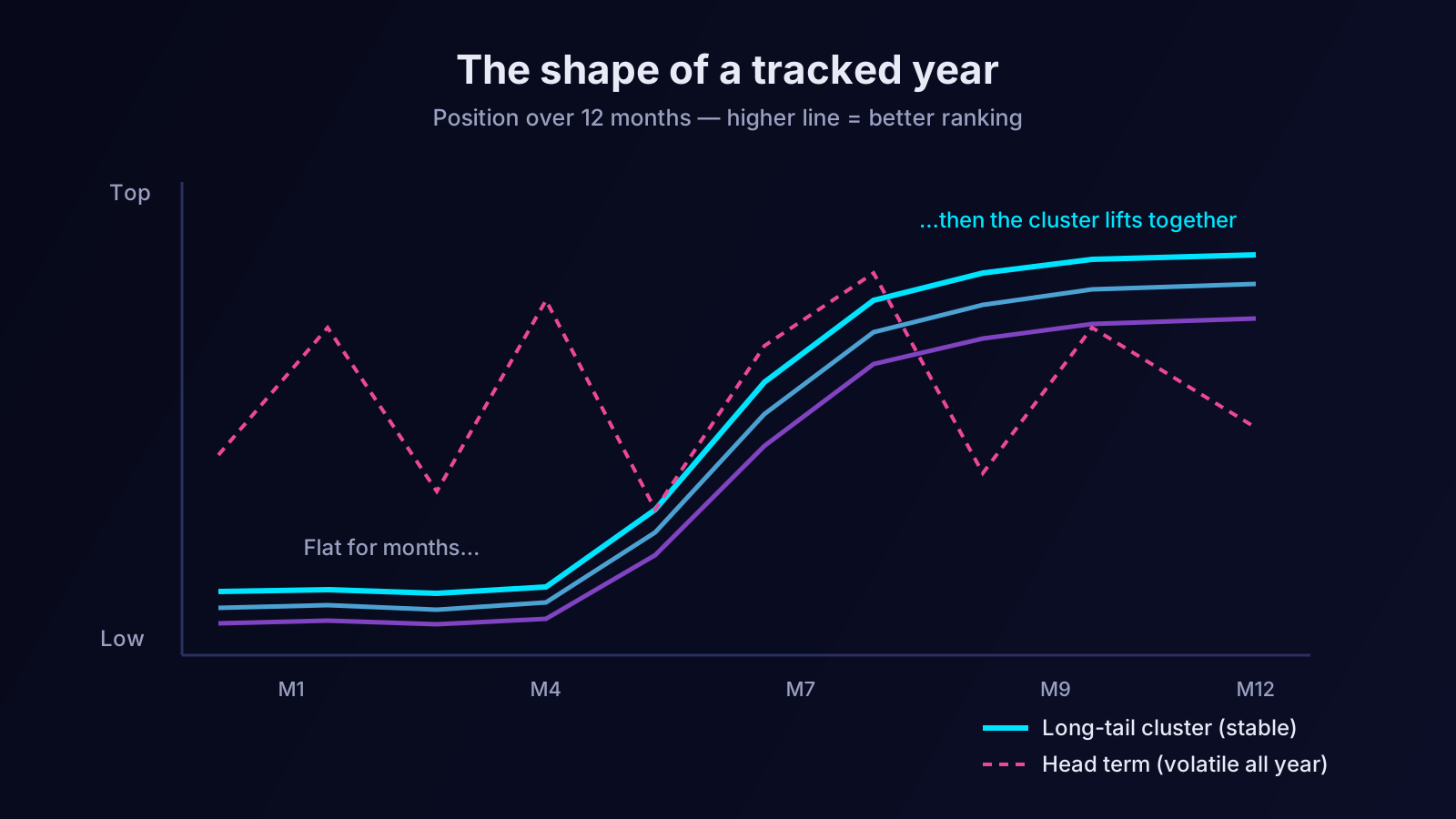
The single most useful thing the year taught me was patience, backed by evidence. For the first stretch after publishing, the large majority of keywords simply did not rank meaningfully. They hovered in the positions nobody sees, generating impressions but almost no clicks. If I had judged the work at week six, I would have called most of it a failure.
Then movement came — and it rarely came one keyword at a time. It came in clusters. A group of related pages, all pointing at one another and at a shared pillar, would sit flat for months and then lift together over a few weeks. The site seemed to earn trust on a topic, and when it did, every page on that topic benefited at once.
The lesson reframed how I read early data. A keyword stuck on page three at month two is not a failure; it is often a keyword mid-climb. Judged too early, you abandon things weeks before they were going to work. (This is the same point our topic clusters guide makes structurally — the tracker simply showed it happening in slow motion.)
Finding 2: long-tail stabilised fast; head terms thrashed all year
The contrast between the long-tail keywords and the head terms was sharper than I expected, and it never closed.
Long-tail keywords — the specific, multi-word, lower-volume phrases — tended to find a position and stay. Once a focused page settled in for a precise query, it held that spot with only minor drift. They were the calm, dependable part of the sheet.
Head terms behaved completely differently. The broad, high-volume keywords thrashed. A position could swing many spots between two monthly checks with nothing changing on my end. They were sensitive to every competitor's update and every algorithm tremor. Some never stabilised at all across the full year.
Two practical conclusions followed. First, if you want predictable traffic, the long-tail is where it lives. Second, if you report on head-term rankings weekly, you are mostly reporting noise — and inviting panic over a number that will look different on its own next week.
Finding 3: the winners were rarely the ones I predicted
This was the humbling one. Before tracking, I had quiet favourites — keywords I expected to be the year's stars based on volume and how proud I was of the article. Reality did not consult my expectations.
A meaningful share of the year's best performers were keywords I had considered minor — secondary phrases, near-afterthoughts on the brief. They had modest volume but a sharp, well-matched intent, and they converted attention into clicks far above their weight. Meanwhile, several of my predicted champions underperformed all year, usually because the SERP wanted a format I had not given it.
The takeaway is not "predictions are useless." It is that your prediction is a hypothesis, and only tracking turns it into knowledge. Without the sheet, I would have kept believing my favourites had won and never noticed the quiet keywords carrying the program.
Finding 4: internal links moved positions more reliably than anything else I controlled
Across the year, the most consistent controllable lever was internal linking. When I added strong, relevant internal links from established pages to a page that was stuck, that page tended to improve in the following checks more often than not. It was not magic and not instant, but as a repeatable input it outperformed most edits I made to the content itself.
Re-optimising the text of a stuck page — tightening, expanding, adjusting headings — helped sometimes and did nothing other times. Adding internal links from the right places helped far more dependably. By mid-year I had a habit: before rewriting a stalled page, I first asked whether it was properly linked from the rest of its cluster. Often it was not, and fixing that alone was enough. (Our internal linking guide covers the how; the tracker is what convinced me it was worth the discipline.)
Finding 5: the "dead" keywords were the most valuable data in the sheet
Because nothing ever left the tracker, I ended the year with a long list of keywords that simply never performed. The instinct is to feel bad about that list. Instead, it turned out to be the most instructive part of the whole exercise.
Sorted and read as a group, the dead keywords confessed their patterns. A cluster of them shared the same flaw: I had targeted an informational query with a page that tried to sell. Another group were head terms my site had no authority to win yet — rejections I should have made before writing. Another group were quietly cannibalising each other, two pages splitting one intent so neither could rank.
Those were not two hundred random failures. They were three or four repeatable mistakes, each made several times. The dead keywords were a diagnostic report on my own process. A tracker that discards its losers throws that report in the bin.
Your winning keywords tell you what to do more of. Your dead keywords tell you what to stop doing. The second list is harder to look at and worth more.
Finding 6: the metric that fooled me was impressions without clicks
Halfway through the year I nearly celebrated the wrong thing. A batch of keywords showed impressions climbing steadily — the page was being shown in search results more and more. It looked like momentum. It felt like a win.
It was not. The clicks were not following. Impressions rising while clicks stay flat is not progress; it is usually a diagnosis. It almost always meant one of two things. Either the page was ranking in positions too low to earn clicks — visible on page two or three, where being shown is not the same as being chosen — or the page was appearing for the query but its title and description did not convince anyone the click was worth it.
The first case is a patience-or-push decision: wait for the cluster to lift the page, or send it internal links to speed it up. The second case is a much cheaper fix — rewrite the title and meta description to match what the searcher actually wants, and clicks can rise within a week or two without the position changing at all. I had several pages in that second bucket, sitting on a decent position and quietly losing every click to a more appealing neighbour, purely because of a weak title.
The lesson reshaped how I read the tracker. A single metric in isolation lies. Impressions alone flatter you. Position alone misleads you on volatile head terms. The honest reading is always the relationship between numbers — impressions against clicks, position against click-through — because that relationship is where the actionable story lives. After Finding 6 I never again looked at one column and called it a result.
What I would do differently
Three changes, all of which I now treat as standard.
Set a baseline and a review date before publishing. Tracking a page from its first day, with a pre-agreed "we judge this at month six" date, removes both the early panic and the temptation to declare victory in week three. The decision rule should exist before the emotions do.
Track clusters, not lonely keywords. Because movement arrives by topic, a tracker organised into clusters shows the real story — a group lifting together — instead of a confusing scatter of individual lines. I now group every keyword under its pillar in the sheet itself.
Schedule the "dead keyword" review. Once a quarter, read only the non-performers, as a batch, looking for the shared flaw. That review caught process mistakes faster than any winning page ever did.
Never report a single metric on its own. After Finding 6, every entry in my tracker travels in pairs — impressions beside clicks, position beside click-through rate. A number without its companion is an invitation to celebrate noise or panic over nothing. Pairs tell the truth; lone columns flatter and mislead.
The honest problem with doing this
Everything above works. It is also, done by hand, genuinely tedious — and tedium is why most tracking efforts quietly die around month three. Logging positions on a fixed cadence, mapping each one to search behaviour, keeping clusters grouped, and running a disciplined loser-review takes steady attention that a busy team almost never protects. The result is the familiar outcome: people track for a month, miss a few checks, and lose the very continuity that makes tracking worth anything.
This is exactly the kind of patient, repetitive measurement an SEO AI agent handles without flagging. Orova tracks every published keyword on a steady schedule, ties each one to its impressions and clicks, groups them by cluster so you see topic-level movement rather than noise, and surfaces the underperformers as a ranked list with likely causes attached — the quarterly dead-keyword review, run continuously. The judgement about what to do next stays yours. The twelve-month discipline that makes the judgement possible stops depending on whether you remembered to open the spreadsheet.
If you take one thing from a year of patient, honest tracking, take this: the graph almost never moves when, or how, or in the order you expect — and the only reliable way to learn from that, instead of being surprised by the very same thing again next year, is to write every keyword down, check it on a fixed schedule, and refuse to look away from the parts that did not work.
Let an AI Agent handle your SEO
Orova plans, writes, optimizes, and tracks rankings on its own — you just read the results.
Try it free