
The Traffic Drop That Was Actually a Tracking Bug
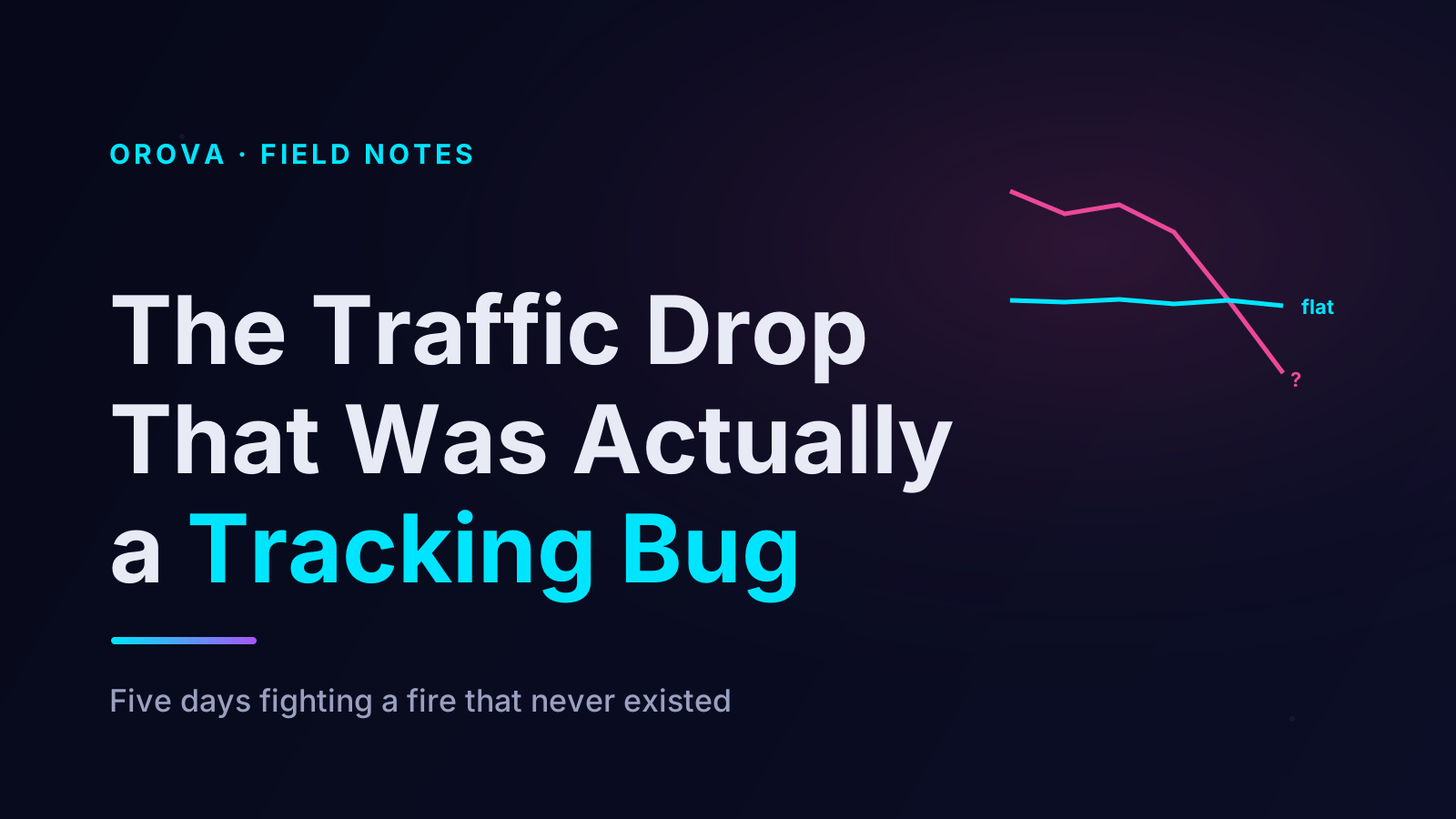
I want to tell you about the worst week of SEO panic I have ever put myself through, because the cause of it turned out to be embarrassingly small, and I have come to believe my embarrassment is the most useful thing I can offer anyone. We spent five days treating an emergency that did not exist. The traffic never actually dropped. A single line of measurement code had been removed, and we never thought to check.
This is a first-person account of how that happened, what it felt like from the inside, and the specific habits I built afterward so that it could never happen to me again. If you have ever stared at a collapsing line and felt your stomach drop, I think this story will be uncomfortably familiar — and I hope the ending is useful.
The Monday it started
It was a Monday, which in hindsight matters. I opened our analytics with my coffee, the way I did every morning, expecting the usual gentle upward drift. Instead, the organic traffic line had fallen by something close to a third. Not a wobble. A cliff.
I remember the physical sensation precisely, because panic is a bodily thing before it is a mental one. A cold feeling, a tightening, the specific dread of someone who is going to have to explain this. My very first thought was not "let me investigate." It was "how do I tell my boss." That ordering — the explanation before the diagnosis — was the first mistake of the week, and it set the tone for everything that followed. I had skipped, without noticing, the entire question of whether the drop was even real.
How the panic spread
By mid-morning I had pulled three other people into it. The drop was now a meeting. And here is something I have thought about a great deal since: a panicking meeting does not investigate, it speculates. Nobody in that room said "let us first confirm this is real." Everybody arrived already certain it was real, and immediately began proposing causes.
Someone was sure it was an algorithm update — they had a vague memory of "chatter" online. Someone else was convinced a recent design change had hurt us. A third person wanted to look at our backlinks, in case we had been hit by something. Each theory was plausible. Each theory generated tasks. By lunchtime on Monday we had a list of things to investigate, and not one of them was "is the number on the screen actually true." We had collectively agreed the building was on fire, and were now arguing about which room to hose down.
The days we lost
Tuesday and Wednesday are the days I am least proud of. We chased theories. We pulled reports. We checked our rankings manually — they looked fine, which we somehow interpreted as "the drop is even more mysterious" rather than as the enormous clue it actually was. We examined recent content changes. We drafted a document explaining the situation to leadership. We discussed, with real seriousness, whether to roll back the design change that one colleague suspected.
I want to underline that detail, because it is the part that frightens me most in retrospect. We came genuinely close to reverting a perfectly good design change — work that several people had done well — purely because it was the nearest available suspect. Had we done it, and had traffic "recovered" later for unrelated reasons, we would have learned exactly the wrong lesson and carried it forward forever. Panic does not just waste time. It manufactures false knowledge, and false knowledge is worse than ignorance because you act on it with confidence.
The question we did not ask
The thing about that week that still makes me wince is how simple the missing step was. We never asked: does any other source agree that traffic fell?
We had been staring exclusively at one analytics dashboard for three days. We had never once opened Google Search Console and looked at whether clicks and impressions had moved. We had never checked our server logs to see whether actual visit volume had changed. We had treated a single instrument as the whole truth, and built three days of frantic work on top of it, without ever asking the most basic question you can ask of any instrument: is it telling the truth?
Thursday: the line that did not move
It was Thursday afternoon when a newer colleague — someone not yet swept into the panic, and therefore still capable of asking obvious questions — said something that ended the whole crisis in about twenty minutes. They asked, mildly, "What does Search Console say?"
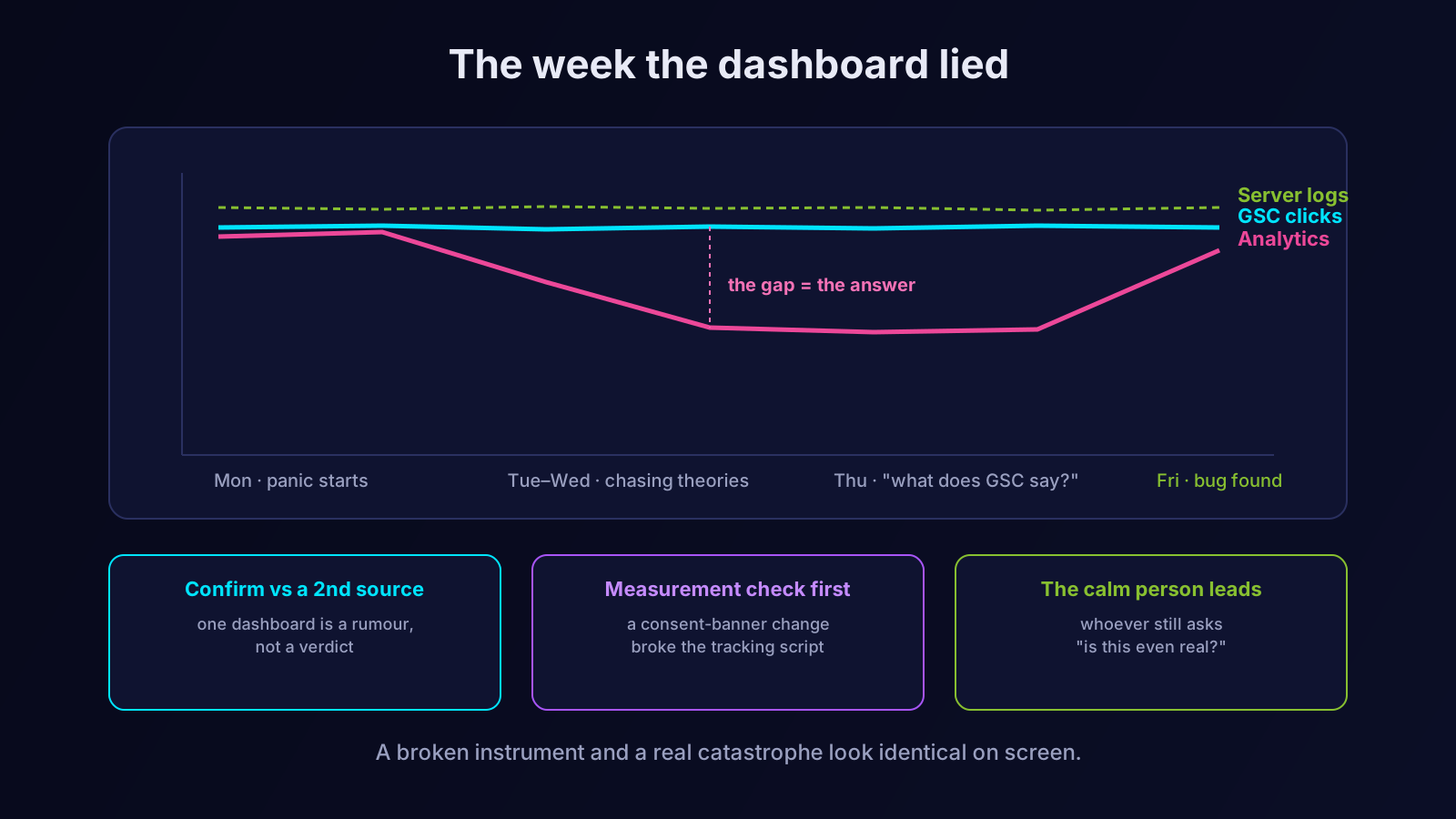
We opened it. Clicks were flat. Impressions were flat. Average position was flat. According to Google's own record of how often people saw us and clicked us, absolutely nothing had happened. Then we checked the server logs. Visit volume: flat. Two completely independent sources, both insisting the traffic had never fallen at all.
The relief was real, but it arrived tangled up with a fresh and worse feeling — because if traffic had not dropped, then we had just spent four days in an emergency that did not exist. The crisis was over. The embarrassment was just beginning.
The actual cause
It took another half hour to find. The previous week, an entirely sensible update had been made to our website's consent and cookie banner. It was good work, done for good reasons. But a side effect of that change was that, under certain conditions, our analytics measurement script was no longer firing for a portion of visitors.
So the real visitors kept arriving exactly as before. They read our pages, they clicked, they signed up — the business was completely unaffected. But our analytics tool had simply stopped counting a slice of them. The line on the dashboard fell not because reality fell, but because our ability to see reality had quietly developed a hole. We had spent a week diagnosing a sick patient. The patient was fine. The thermometer was broken.
What that week actually cost
It is tempting to file this under "funny story, no harm done." But there was harm, and naming it honestly is the only way the story earns its keep.
We lost four days of four people's focus — real, expensive work that produced nothing. We came within one decision of reverting good work for an imaginary reason. We generated genuine stress and a leadership conversation about a non-event. And most lasting of all, we damaged something quieter: the next time the line moves, a part of every one of us will remember crying wolf, which makes us slightly slower to take a future drop seriously. A false alarm does not just cost the days it consumes. It taxes your credibility for every alarm afterward. That is the real bill, and it does not arrive all at once.
What I changed, permanently
I rebuilt my response to traffic drops from scratch after that week, and the new rules are deliberately simple, because complicated rules do not survive contact with panic.
The first rule, the one that would have saved the entire week: confirm against a second source before reacting to anything. A drop in one analytics tool is now, for me, officially a rumour and nothing more. Before it is allowed to become a meeting, a task, or a feeling, it has to be confirmed by Search Console or server logs. Two independent sources must agree before a drop is treated as real. One source alone gets investigated for measurement faults first — not for SEO causes.
The second rule: a measurement check is step one, always. Before I ask "what did Google do" or "what did we do to our content," I ask "did our tracking change?" Was the analytics tag touched? Did a consent or banner change ship? Did a developer modify anything near the measurement layer? Tracking bugs are common, they are boring, and they masquerade perfectly as catastrophic SEO drops. They go to the front of the queue now, every time.
The third rule is about people, not tools: the calm person leads. I learned that the most valuable person in a traffic-drop conversation is whoever is not yet panicking — the one still able to ask "wait, is this even real?" I now consciously try to be that person, and if I cannot be, I make sure that voice is in the room and actually heard. Panic is contagious, but so, thankfully, is calm.
Why a newcomer solved it and four experienced people could not
I have turned this part over more times than any other, because it does not flatter the experienced people, and I am one of them. The crisis was ended in twenty minutes by the most junior person in the room. Not because they knew more — they knew considerably less. Because they had not yet been infected.
Panic, I have come to think, behaves like a shared belief. By Tuesday, the four of us who had been in the original meeting all knew, with the certainty of people who had been discussing it for two days, that the traffic had dropped. That knowledge was no longer a hypothesis to be tested; it had hardened into a premise we built on. Every report we pulled, every theory we chased, started from "the traffic dropped, so what caused it." Nobody questions a premise. That is what a premise is — the thing the questions stand on.
The newcomer had not sat through the meeting. They had not spent two days marinating in the shared certainty. So when they glanced at the situation, "the traffic dropped" was still, for them, an ordinary claim — the kind of claim you check. They asked "what does Search Console say?" not because they were brilliant, but because they were the only person in the building still treating the drop as a question rather than a fact. Experience did not help us here. Experience, in the specific form of two days of accumulated conviction, was the thing actively blinding us.
The practical lesson I took from this is uncomfortable but concrete: in any drawn-out investigation, the person who joined most recently is your most valuable instrument, precisely because they have not yet adopted the group's assumptions. Now, when an investigation is stretching past a day, I deliberately pull in someone fresh and ask them to challenge the premise — not the details, the premise. "Are we sure this is even happening?" It is the cheapest safeguard I know, and it costs nothing but the humility to invite it.
The broader lesson about trusting your dashboards
The deepest thing that week taught me is something I had genuinely never considered before: a dashboard is not reality. It is a measurement of reality, produced by a chain of code, tags, and configuration — and any link in that chain can break without anyone announcing it.
When the chain breaks, the dashboard does not show an error message. It does not flash red or say "warning, I may be lying to you." It simply shows a lower number, presented with exactly the same confidence as a true one. The chart has no idea it is wrong, and it cannot tell you. That is the genuinely unsettling part. A broken instrument and a real catastrophe look identical on screen. The only way to tell them apart is to ask a second, independent instrument — which is precisely the step my panic skipped for four days.
I am not arguing for paranoia about every dashboard. I am arguing for one specific, cheap reflex: when a number moves sharply enough to scare you, your first question is not "what happened to my traffic?" It is "do I trust this number?" Those are different questions, and asking them in the wrong order cost me a week.
Where an AI agent helps
I have thought a lot about why the obvious cross-check never occurred to four competent people for four days. It is not that we did not know Search Console existed. It is that confirming a drop across multiple sources is slightly tedious, and panic does not do tedious — panic wants to act, immediately, on the first frightening thing it sees. The careful step lost to the urgent feeling.
This is exactly the gap an SEO AI agent fills. Orova watches multiple signals at once — analytics, Search Console clicks and impressions, ranking positions — so when one of them moves and the others do not, it can flag the discrepancy directly: this looks less like a traffic drop and more like a measurement problem. That single observation, surfaced on Monday morning, would have ended my entire bad week before it began. The agent does not replace the judgement or the fix. It just makes sure the calm, obvious cross-check actually happens — instead of being the thing everyone skips while panicking.
So here is the story, embarrassment and all. The worst SEO emergency of my career was not an emergency. The traffic never fell. A consent banner update quietly broke a tracking script, and four of us spent a week fighting a fire that was only ever a faulty smoke alarm. I tell it freely now, because the lesson cost me a week and it can cost you about ninety seconds: before you panic about a drop, confirm the drop is real.
Let an AI Agent handle your SEO
Orova plans, writes, optimizes, and tracks rankings on its own — you just read the results.
Try it free