
Vanity Metrics in SEO: Which Ones to Stop Reporting
Every SEO team has a metric it loves. A number that goes up, that looks good in a slide, that the team has quietly agreed to treat as proof the work is going well. And in a disconcerting number of cases, that beloved metric is telling them almost nothing — or worse, it is telling them a comforting story while the things that actually matter sit flat or slide.
This is a critique of vanity metrics in SEO: the numbers that feel like progress, photograph well, and survive in monthly reports for years without anyone asking the uncomfortable question — if this number doubled tomorrow, what decision would change, and what would the business actually gain? More often than not, the honest answer is "nothing." That is the test, and a startling share of common SEO metrics fail it.
The marketing metrics that actually matter
Strip any channel down and the marketing metrics that survive are the ones a finance person would recognise: what it cost, what came in, and the rate at which one became the other. Cost per lead or per order. Conversion rate at each step that involves a decision. Revenue attributed to the channel, read as a trend rather than a single day. Everything else on the dashboard is either an ingredient of those numbers or decoration.
The decoration is the subject of this piece — because it is not harmless. Vanity metrics do not just sit there; they eat the attention that the real numbers needed.
What makes a metric a vanity metric
A vanity metric is not a false metric. It is usually perfectly accurate. The problem is not honesty — it is uselessness. A vanity metric has three properties.
It is not actionable: when it moves, it does not tell you what to do. It is not tied to value: it can rise indefinitely without the business gaining anything. And it is flattering: it tends to drift upward over time on its own, so it almost always supports the story that things are going well.
That third property is the dangerous one. A vanity metric is not just unhelpful; it is actively comforting. It provides a number to point at when someone asks how SEO is doing, and the number is usually up, so the question gets answered and the conversation ends. Meanwhile the metrics that would have revealed a real problem never get examined, because the vanity metric already supplied a reassuring answer. Vanity metrics do not merely waste time. They buy false peace, and false peace is expensive.
Vanity metric one: total keyword count
"We now rank for 14,000 keywords." It is a staple of SEO reporting, and it is close to meaningless.
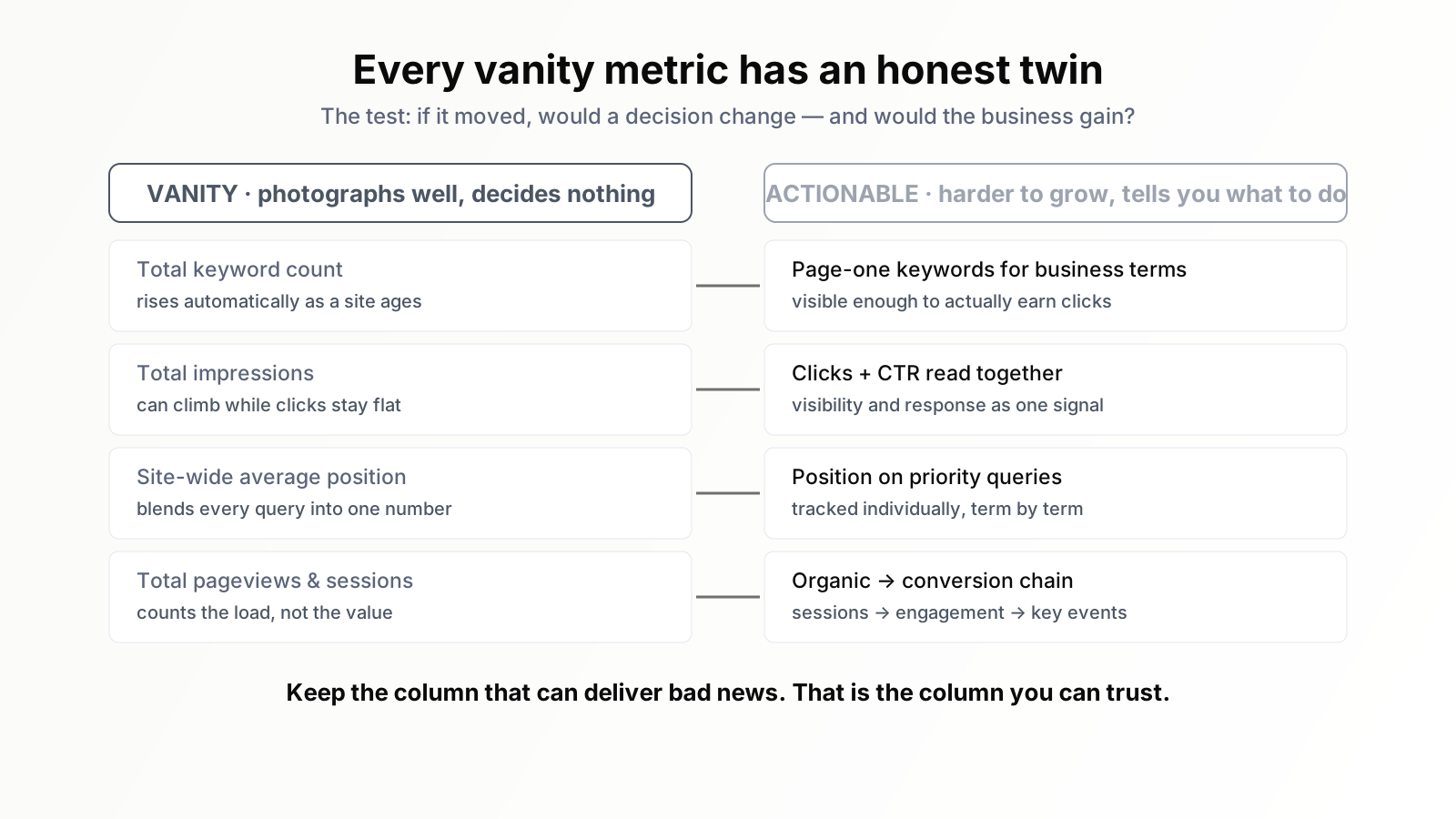
The number counts every query for which any page of yours appears anywhere in the results — including position eighty-seven, including queries with negligible search volume, including queries with no commercial relevance whatsoever, including accidental rankings for terms you never targeted and would not want. As a site ages and accumulates pages, this number rises almost automatically. It will go up whether your SEO is excellent or mediocre.
Apply the test. If your keyword count jumped from 14,000 to 18,000, what would you do differently? Nothing — because the number does not tell you whether those four thousand new keywords are valuable, winnable, or visible enough to ever earn a click. The actionable version of this question is narrow and specific: how many keywords do you rank for on page one, in positions that earn traffic, for terms tied to your business? That number is smaller, harder to grow, and infinitely more useful. The big total is the vanity version of the same idea — and the big total is the one that ends up on the slide.
Vanity metric two: total impressions
Impressions in Search Console count how often your pages appeared in results. Rising impressions feel like rising visibility, and visibility feels like progress, so the impressions line gets celebrated.
But impressions can climb for reasons entirely disconnected from value. A page can start appearing for a flood of low-relevance, low-intent queries — gathering impressions while earning no clicks and no business outcomes. Impressions can rise because a query became seasonally popular, with nothing about your SEO having changed. Worst of all, impressions can rise while clicks stay flat or fall, which is not good news at all — it means Google is showing you more and searchers are choosing you less.
Impressions are not worthless. They are a useful denominator: clicks divided by impressions gives you click-through rate, and CTR is genuinely diagnostic. But impressions as a standalone headline metric is vanity. Rising impressions with rising clicks is progress. Rising impressions with flat clicks is a warning. Reporting the impressions number alone hides the very distinction that mattered.
Vanity metric three: average position, site-wide
"Our average position improved from 18.4 to 16.9." It sounds like measured, quantified progress. It is one of the emptiest numbers in SEO reporting.
A site-wide average position blends every query together — branded and unbranded, commercial and informational, high-volume and obscure, the terms you fought for and the terms you rank for by accident. The single average can move for reasons that have nothing to do with the queries you care about. It can improve because a batch of irrelevant low-position queries dropped out of reporting entirely. It can worsen because you started ranking, at low positions, for a set of new queries — which is actually a sign of expanding visibility being reported as a decline.
The test again: if your site-wide average position improved by two places, what would you do? Nothing, because it does not tell you which queries moved or whether any of them mattered. The actionable version is position tracked for specific, important queries — the terms tied to your business, watched individually. That requires more effort and produces a less tidy headline, which is precisely why the meaningless single average is the one that survives in reports.
Vanity metric four: total pageviews and sessions
In analytics, total pageviews and total sessions are the most universally loved vanity metrics. The line goes up and to the right, everyone feels good, the meeting moves on.
But a total, unsegmented by channel, cannot tell you anything specific about SEO — it blends organic, paid, email, social, and direct, and your SEO work controls only one of those. And even isolated to organic, raw pageviews say nothing about value. A page can accumulate pageviews while every visitor bounces without engaging and nobody converts. The pageview counted the load. It did not count whether the visit was worth anything.
The actionable version is the chain GA4 actually lets you build: organic sessions to engaged sessions to key events to conversions. That chain tells you not just that traffic arrived, but that it did something the business needed. The total pageview number is the vanity shadow of that chain — the part that is easy to grow and easy to celebrate, with the part that matters quietly stripped out.
The real cost of vanity metrics
It is tempting to treat vanity metrics as merely harmless — a little optimistic, not actively damaging. That is too generous. They impose three real costs.
The first is misdirected effort. Teams optimise for what they measure. A team that reports on keyword count will, consciously or not, drift toward tactics that inflate keyword count — publishing thin pages targeting marginal terms — because that is what makes the reported number rise. The vanity metric does not just describe the work badly; it bends the work in an unproductive direction.
The second is delayed discovery of real problems. When a vanity metric is rising, it answers the "how is SEO doing?" question before anyone reaches a metric that would have revealed trouble. A site can be losing conversions from organic search for months while impressions and keyword count climb reassuringly. The vanity metric is the comfortable answer that stops the investigation that would have caught the decline.
The third is eroded credibility. Eventually a sceptical executive asks the obvious question — "this is all up, so where is the revenue?" — and the SEO team discovers it has no answer, because it has been measuring everything except the link to the business. The vanity metrics that made every past report look good now make the team look like it was never measuring anything that mattered. That is a slow, expensive way to lose trust.
The honest replacements
The fix for a vanity metric is not to stop measuring. It is to replace each comforting number with its harder, more honest twin.
Instead of total keyword count, track keywords ranking on page one for business-relevant terms. Instead of total impressions alone, track clicks and click-through rate together, so visibility and response are read as one signal. Instead of site-wide average position, track position for a defined set of priority queries, watched individually. Instead of total pageviews, track the organic-to-conversion chain — sessions, engagement, key events, conversions — at the page and cluster level.
Every honest replacement has the same shape. It is more specific, harder to grow, and worse for slides. It will not always go up, and when it goes down it will mean something — which is exactly the point. A metric that can deliver bad news is a metric that can also be trusted when it delivers good news. A metric that only ever rises is decoration.
Vanity metric five: bounce rate and time on page
Two more numbers deserve a place on the list, because they masquerade as quality signals while telling you very little: bounce rate and time on page, read as standalone metrics.
Both feel like windows into how good your content is. A low bounce rate sounds like engagement; a long time on page sounds like attention. But both are inferred from page loads and browser behaviour in ways that break easily. A "bounce" can be a visitor who arrived, read your entire article from top to bottom, got exactly the answer they came for, and left satisfied — which is a success that the metric records as a failure. Time on page is even shakier, because the way it is measured often cannot tell a deeply engaged reader from a tab someone opened and forgot.
The deeper problem is that even when these numbers are accurate, they are not tied to value. A page can have a wonderful time-on-page figure and convert nobody. The metric measures a behaviour, not an outcome. The honest replacement is to read engagement in the way modern analytics defines it — engaged sessions built on concrete criteria — and, above all, to read it next to the conversion data, so that "people stayed" is always checked against "and then they did something the business needed." A quality signal that never connects to an outcome is just another flattering number.
How vanity metrics survive in a team
It is worth asking why vanity metrics are so persistent, because understanding the mechanism is how you break it. They do not survive because people are foolish. They survive because three forces quietly protect them.
The first is that they are easy to produce. A total keyword count or a total pageview figure requires no thought to assemble — it is one number, pulled straight from a tool. The honest replacements demand segmentation, filtering, and judgement. Under deadline pressure, the easy number wins, and the easy number is usually the vanity one.
The second is that they make everyone comfortable. The person reporting gets a number that is reliably up. The person receiving the report gets a reassuring answer and can move on. Nobody in that exchange is motivated to replace a comfortable number with an uncomfortable one. The vanity metric survives because it serves a social function — ending a difficult conversation — that has nothing to do with whether it is useful.
The third is inertia. Once a metric is in the monthly report, removing it feels like an admission that the previous reports were flawed. So it stays, year after year, long after anyone remembers why it was chosen. Breaking the cycle takes a deliberate act: someone has to look at the standing report and ask, of every line, whether it earns its place. That act is uncomfortable, which is exactly why it so rarely happens on its own — and exactly why it is worth scheduling.
The one question that sorts every metric
You do not need a long checklist to audit your reporting. You need one question, asked of every number you currently track: if this metric moved significantly, what decision would change, and what would the business gain?
If a metric moves and the honest answer is "we would do nothing differently, and the business would gain nothing," it is a vanity metric, and it should be demoted out of your reporting — not necessarily deleted, but removed from the place where it shapes how people judge the work. If a metric moves and you can name a specific decision and a specific business consequence, keep it, and put it at the centre. Run every number through that single question and your reporting reorganises itself: the flattering numbers fall away, and the smaller set that actually drives decisions takes their place.
Measuring what matters, continuously
Cutting vanity metrics is the easy half. The hard half is sustaining attention on the honest ones — because the honest metrics are precisely the ones that do not always rise, the ones that demand a response when they slip, the ones a busy team is tempted to skip past in favour of the number that reliably looks good.
That sustained, value-focused attention is where an SEO AI agent earns its place. Orova monitors the metrics that pass the test — page-one rankings for terms that matter, clicks and CTR together, position on priority queries, the organic-to-conversion chain by page and cluster — and surfaces the movements that demand a decision, rather than producing another reassuring chart of impressions. It is built to answer the question this article ends on: not "did a number go up?" but "what changed, what should we do, and what is it worth?" For more on how that shifts the work, see our explainer on what an SEO AI agent is and why it changes content marketing.
Vanity metrics are comfortable, and that is exactly the problem. Trade the comfort for the truth. Measure the smaller set of numbers that can deliver bad news, and you will finally have a set of numbers worth trusting when they deliver good news.
Let Orova SEO handle the repetitive part
Keyword research, drafting, refreshing old posts and rank tracking — running automatically on your own site.
Explore Orova SEO