
AI Marketing Agency vs In-House vs DIY: The Real Costs
A mid-sized e-commerce brand spending $80,000 a month on Google and Meta has three honest options for who runs that money. It can pay an agency a 12% management fee — $9,600 a month, $115,200 a year — and get a shared team that touches the account a few times a week. It can hire an in-house performance marketer at $90,000 plus benefits and tools, roughly $120,000 fully loaded, and get one person who knows the brand intimately but goes on holiday, gets sick, and can only watch so many campaigns at once. Or it can run an AI agent on top of a lean operator for a flat software cost in the low thousands, and get a system that reviews every campaign every single day. Same spend, three completely different cost curves, speed profiles, and incentive structures.
Most comparisons of these models are written by whoever is selling one of them, which makes them useless. An agency's blog will tell you in-house is too expensive to build. An in-house manifesto will tell you agencies don't care about your brand. An AI vendor will tell you humans are obsolete. None of that is true, and none of it helps you make a $100,000+ annual decision. This is an attempt at an honest breakdown — what each model actually costs, how fast each one reacts, who controls the levers, and where the hidden conflicts of interest sit. By the end you should be able to price out your own situation and, more likely than not, conclude that the right answer is a combination rather than a pure play.
The four dimensions that actually matter
Before comparing the three models, it helps to fix the axes. People argue about ad management as if "good" and "cheap" were the only variables, but the real decision turns on four things, and different businesses weight them differently.
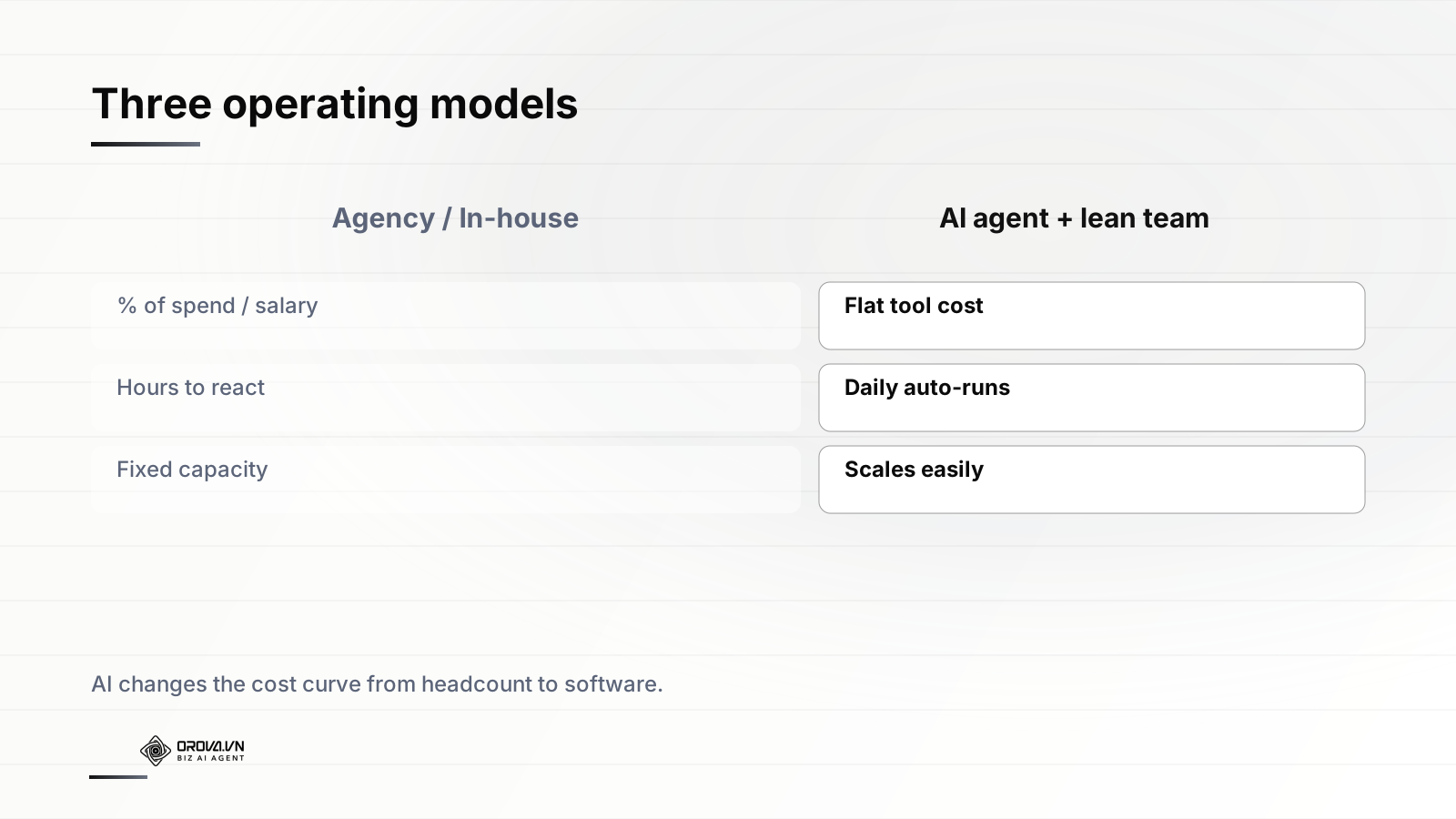
- Cost structure. Not just the headline number, but the shape. Is it a percentage of spend (scales with you, for better and worse), a fixed salary (a step function — flat until you need a second hire), or a flat tool fee (largely decoupled from spend)?
- Speed of reaction. When a campaign starts bleeding money on a Saturday, how many hours pass before someone or something does anything about it? This is where most wasted spend hides.
- Control and knowledge retention. Who holds the account logins, the historical context, the creative learnings, the audience lists? When the relationship ends, what walks out the door?
- Conflict of interest. Are the incentives of whoever runs your ads aligned with your profit, or with something else — their fee, their job security, their other clients?
Keep these four in mind. Every model wins on some and loses on others, and the trap is choosing on the one dimension a salesperson made you focus on.
The agency model: speed to start, drag at scale
Agencies exist for a good reason. They let a company go from zero to a competent, multi-channel paid program in weeks instead of the months it takes to hire and onboard. They carry battle scars from dozens of accounts, so they've seen the failure modes you're about to hit. And they absorb the operational risk of staffing — if their specialist quits, that's their problem, not yours.
How agency fees really work
The dominant pricing model is a percentage of ad spend, typically 10% to 20%, sometimes with a monthly minimum. On the surface this feels fair: you pay more when you spend more. Look closer and the incentive is openly perverse. An agency paid a percentage of spend makes more money when you spend more money, regardless of whether that spend is profitable. The agency's revenue and your profit are not the same goal, and at the margin they can be opposite. A campaign that's at break-even ROAS should arguably be cut; on a percentage-of-spend contract, cutting it costs the agency revenue.
Flat-retainer agencies fix the incentive but introduce a different problem: capacity rationing. A flat $6,000 retainer buys you a slice of an account manager's week, and that slice shrinks invisibly when the agency wins a bigger client. The work that gets deprioritized is rarely the obvious stuff — it's the unglamorous daily hygiene that quietly compounds: pausing the keyword that's been converting at 4x cost-per-acquisition for two weeks, catching the placement that's eating budget with no conversions, noticing that a top campaign's frequency has crept past the point of fatigue.
The structural drag
The real limitation of the agency model isn't the fee — it's the latency and the divided attention. Your account is one of fifteen or thirty that a pod manages. The person who knows your brand best is junior, overstretched, and rotates out within eighteen months. Decisions route through approval layers. A reasonable rule of thumb: agencies react to problems in days, not hours, and the better the agency, the more clients are competing for those days. You are paying for expertise that is real but thinly spread.
The agency question is rarely "are they good?" It's "how many other accounts are between you and the good person, and what does it cost you while you wait?"
None of this makes agencies a bad choice. For a company that lacks any internal marketing competence, an agency is often the correct first move — it buys time and capability you cannot build overnight. The mistake is staying on a pure-agency model once your spend is large enough that the percentage fee dwarfs what better-aligned alternatives would cost, and once the daily-hygiene gap is visibly leaking money.
The in-house model: control and alignment, with a capacity ceiling
Bringing ad management in-house solves the two biggest agency problems at once. The person running your ads works only for you, so attention is undivided. And their incentive is your incentive — a salaried marketer who improves ROAS gets a raise and a reputation; one who burns budget gets fired. There's no percentage-of-spend conflict, no client queue, no junior-rotation churn.
The true cost of a head
The number that matters is fully loaded cost, not base salary. A competent performance marketer in many markets commands $70,000 to $110,000 base. Add payroll taxes, benefits, equipment, and the management overhead of having an employee, and the true cost is commonly 1.25 to 1.4 times base — call it $100,000 to $150,000 for one capable person. That single person is also a single point of failure. They take vacation. They get sick. They have one set of eyes and roughly forty productive hours a week, and during those hours they also sit in meetings, write reports, and argue with the creative team.
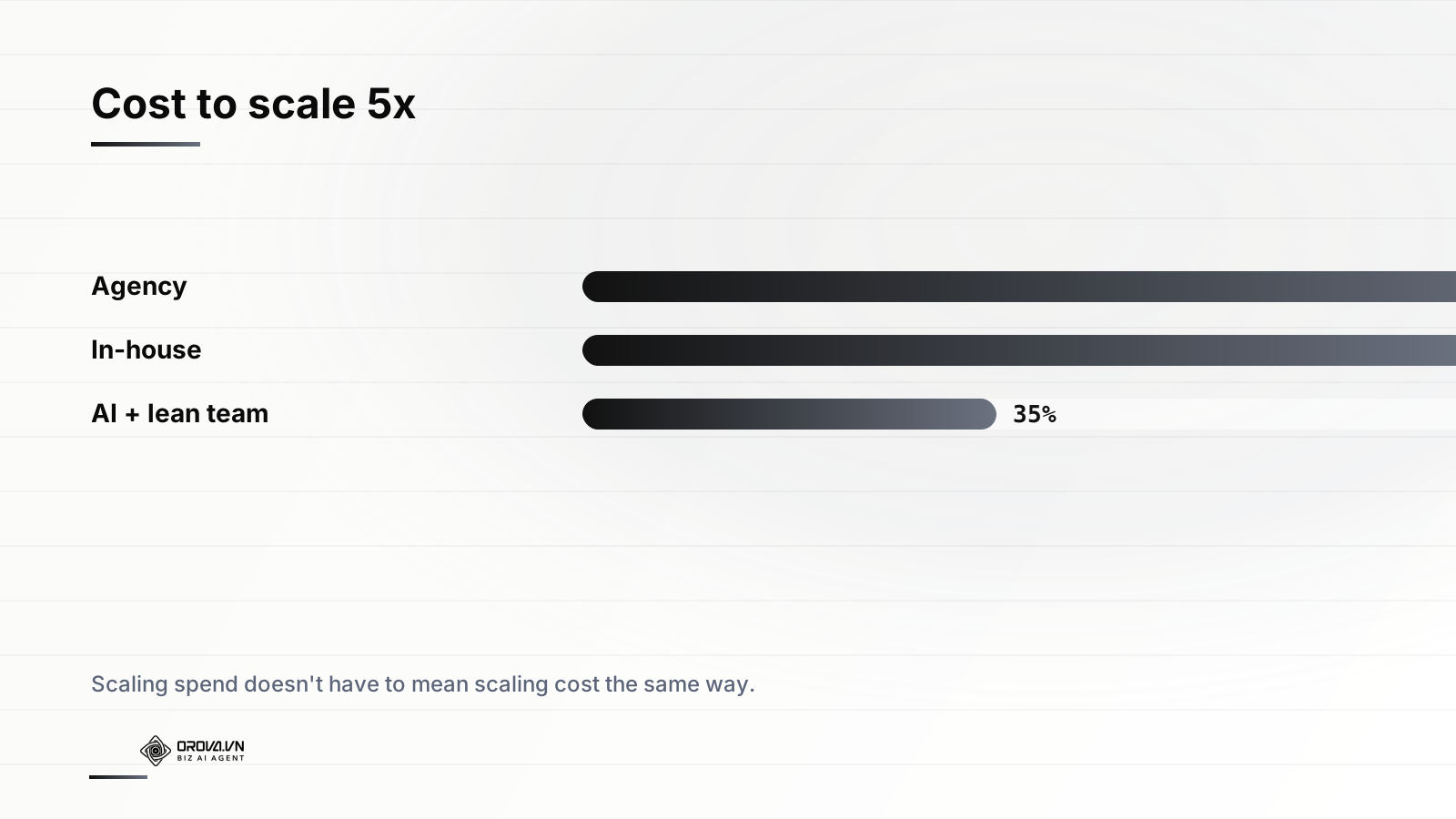
Here's the part the in-house pitch glosses over: capacity is a step function. One marketer can attentively manage a certain number of campaigns and channels. Push past that — add TikTok to your Google and Meta mix, double your campaign count, expand into three new markets — and quality degrades until you hire a second person, at which point your cost steps up by another six figures. In-house cost doesn't scale smoothly with ambition; it jumps in $100k+ increments, and there's always a painful window where one person is drowning and you can't yet justify two.
What you gain that's hard to price
For all that, in-house buys something genuinely valuable: institutional memory. The learnings stay with you. The audience lists, the creative test history, the knowledge that your Tuesday-morning audience converts twice as well as your weekend traffic — it accumulates inside the company instead of evaporating when a contract ends. For brands where paid media is core to the business model, that retained knowledge is worth a premium, and it's the strongest argument for keeping at least one experienced person in-house regardless of what else you do.
The AI agent model: changing the shape of the cost curve
The third model is newer and the most misunderstood, partly because it gets pitched in two dishonest extremes — either "AI replaces your whole team" or "AI is just a fancy dashboard." Neither is right. The accurate framing is narrower and more useful: an AI agent changes what scales. It moves the cost of running ads off the headcount line and onto the software line, and it removes the human latency from daily account hygiene.
What an AI agent actually does day to day
Strip away the marketing and an ad-management AI agent does the unglamorous, high-frequency work that humans do badly because it's tedious: it reads performance data on a schedule — every day, not when someone gets around to it — and it acts on what it finds. Reallocate budget from a campaign at 1.2x ROAS to one at 4x. Lower bids on the placement that's spending without converting. Pause the ad set whose frequency has crossed into fatigue. Flag the audience that's saturated. These are not creative or strategic decisions; they're the repetitive optimizations that, left undone for a few days, quietly leak a meaningful slice of budget.
The economic consequence is the important bit. A human's review cadence is bounded by their attention and their hours; an agent's is bounded by an API rate limit. That means the marginal cost of watching one more campaign, or one more channel, or one more market, falls close to zero. Adding TikTok to a Google-and-Meta program doesn't require a new hire or a bigger retainer — it's the same flat tool cost watching more surface area. This is the entire argument, and it's worth being precise about it rather than hand-waving at "AI efficiency." If you want the deeper version of the trust question this raises, the piece on whether you should let AI spend your budget works through the guardrails in detail.
Where AI genuinely falls short
An honest comparison has to name the limits, because they're real. An AI agent does not have taste. It will not invent your next breakout creative concept, decide your brand positioning, or know that a competitor just launched and you should change your messaging. It optimizes within the strategy it's given; it does not set the strategy. It can also be confidently wrong on edge cases — a one-day spike from a PR mention can look like a trend to a system reading numbers without context. This is exactly why the serious products keep a human in the loop rather than handing over the keys entirely.
AI doesn't remove the human from ad management. It removes the human from the parts of ad management that didn't need a human, so the human's hours go to the parts that do.
The cost comparison, made concrete
Return to our $80,000-a-month brand. Run the three models against the four dimensions:
- Agency at 12%: ~$115,000 a year, fee rises automatically as you scale, reaction time in days, account shared across a pod, incentive partially misaligned with profit.
- In-house specialist: ~$100,000–$150,000 fully loaded for one person, cost steps up sharply to scale, reaction time in hours when they're at their desk and zero when they're not, full alignment, full knowledge retention, single point of failure.
- AI agent plus a lean operator: flat software cost in the low thousands per year plus a part-time or single internal owner, cost largely flat as spend and channels grow, daily automated reaction, full control and audit trail, no percentage-of-spend conflict.
The headline isn't that AI is cheapest in absolute terms at small scale — at a tiny budget, a freelancer might beat all three. The headline is the slope. As spend and complexity grow, agency and in-house costs climb steeply while the AI-plus-lean-team cost stays close to flat. That's the difference between a model priced on your spend and one priced on software.
Conflict of interest: the dimension nobody prices
Cost and speed are easy to measure, so they dominate the conversation. Alignment is harder to measure, so it gets ignored — which is backwards, because misalignment compounds silently for years.
The percentage-of-spend trap
It bears repeating because it's so common: any party paid a percentage of your ad spend has a structural reason to want you to spend more, profitable or not. This rarely shows up as outright bad advice. It shows up as omission — the campaign that should be cut but isn't mentioned, the channel that's underperforming but stays in the deck because killing it shrinks the fee. You're not being defrauded; you're just on the wrong side of an incentive gradient, and gradients win over time.
The job-security trap
In-house has its own version. A salaried marketer's deepest incentive is to keep their job, and a marketer who has automated or simplified their own role out of existence has, in a narrow sense, worked against themselves. This is rarely cynical — more often it's a quiet preference for complexity, for keeping work that could be streamlined, for being indispensable. It's milder than the agency conflict, but it's real, and it's why even well-run in-house teams sometimes resist tooling that would make them more efficient.
The AI alignment, and its caveat
An AI agent on a flat fee has the cleanest alignment of the three on paper: it earns the same whether you spend $50,000 or $500,000, so it has no reason to inflate spend and every reason — by design — to optimize for the goal you set, whether that's ROAS, cost-per-acquisition, or volume at a target efficiency. The caveat is that "the goal you set" has to actually be set correctly. An agent optimizing relentlessly for last-click ROAS can starve top-of-funnel campaigns that feed it. The alignment is only as good as the objective, which is one more reason a human owner stays in the loop to define what "good" means and to sanity-check the machine's interpretation of it.
The case for the hybrid: AI plus a lean team
Lay the four dimensions side by side and a pattern emerges. No single model wins all four, but their weaknesses are complementary. Agencies bring breadth of experience and absorb staffing risk but are slow and misaligned. In-house brings alignment and memory but is expensive to scale and fragile. AI brings speed, flat cost, and clean incentives but lacks taste and strategy. Put differently: the things AI is worst at — creative judgment, positioning, strategic context — are exactly what a good human is best at, and the things humans are worst at — relentless daily hygiene across many campaigns and channels — are exactly what AI is best at.
What the hybrid looks like in practice
The configuration that increasingly makes sense for any business past the smallest scale is a lean human team — often one experienced person, sometimes supported by an agency for specialist creative or new-channel launches — paired with an AI agent doing the daily optimization. The division of labor is clean:
- The human sets strategy: which channels, what positioning, what the success metric is, what budget ceilings are non-negotiable, when to enter or exit a market.
- The AI executes the daily grind: reading data, reallocating budget, adjusting bids, pausing losers, flagging anomalies — across every campaign and channel, every day, without fatigue.
- The human approves and audits: the agent proposes or executes within set guardrails, and the human reviews what it did and why, keeping a full record.
This is the configuration that breaks the headcount-equals-capacity link. You can add TikTok to your Google-and-Meta mix without a second hire. You can scale spend without scaling the management line. You keep your strategic knowledge in-house where it belongs, and you stop paying a percentage of spend to anyone. The human's scarce hours go to the work only a human can do, and the tedious work that used to leak money gets done every day instead of every few days.
Human-in-the-loop is the whole point
The reason this works — and the reason it isn't the reckless "let the robot spend your money" caricature — is that the human stays in control of the things that need control. The agent operates inside guardrails the human defines: budget ceilings it cannot exceed, changes it can make autonomously versus changes it must propose for approval, a complete audit log of every action and its reasoning. That structure gives you the speed of automation and the judgment of a person at the same time, which is precisely the combination the pure models can't offer. The trust comes not from believing the AI is infallible but from being able to see and bound everything it does.
How to choose for your specific situation
The right model depends on where you are, and it changes as you grow. A few honest heuristics:
- If you have no internal marketing capability and need to launch fast, start with an agency. It buys competence you can't build in time. Just go in knowing the fee structure and planning your exit from a pure-agency model before the percentage fee gets large.
- If paid media is core to your business and your spend is substantial, you almost certainly want at least one experienced person in-house for the strategy and the institutional memory — but pair them with automation so their capacity isn't your ceiling.
- If you're scaling spend or channels and feeling the cost step-up, this is the clearest signal to add an AI agent. The moment you're tempted to hire a second performance marketer to keep up with volume is the moment automation pays for itself most obviously.
- If your management cost is climbing as fast as your spend, your cost curve is wrong, and the fix is to move work off the headcount line. That's the entire economic argument for AI in this space.
The decision isn't agency versus in-house versus AI as three boxes to pick one of. It's a question of which work belongs to which kind of resource. Strategy and taste belong to humans. Daily, repetitive, high-frequency optimization belongs to software. Specialist surges belong to agencies. Get the allocation right and you pay for each kind of work at the price it should cost — instead of paying human prices for robot work, or robot prices for human judgment.
The bottom line on the economics
Strip everything down and the comparison comes to this. The agency model prices your ad management as a percentage of your spend, which feels fair and quietly isn't, and it gives you shared, slow attention. The in-house model gives you aligned, dedicated attention but caps your capacity at what a person can watch and steps your cost up in six-figure jumps. The AI-plus-lean-team model decouples cost from spend, runs daily instead of weekly, keeps your knowledge in-house, and aligns incentives cleanly — at the price of needing a human to supply the strategy and judgment it can't.
For most businesses past the earliest stage, the answer is not to crown one model but to combine them: a small, expensive-per-hour human doing the few things humans do best, and a flat-cost agent doing the many things software does best, with the human holding the controls. That's not a compromise. It's matching each task to the resource that does it well, which is what good economics has always meant.
If your management cost is climbing in lockstep with your ad spend, that's the curve worth fixing. Orova Ads is an AI agent that runs the daily work across Google, Meta, and TikTok — reading your data every day, recommending and executing budget, bid, on/off, and audience changes with human-in-the-loop approval and a full audit log — so your team's hours go to strategy while the agent handles the grind. See how the hybrid model works at orova.vn.
Orova Ads optimises campaigns for you
Connect Google, Meta and TikTok in one place. AI reads the numbers, proposes changes and executes under the rules you set.
Explore Orova Ads