
TikTok Hooks: The First 3 Seconds That Stop the Thumb
A TikTok hook is the first two to three seconds of a video — the opening frame, the first movement, the first words spoken. On a platform where the next video is one flick away, that window is the entire negotiation: it either buys you the rest of the view or the thumb moves and the ad is over before your product appears.
Pull up the retention curve on any video ad you have run and the steepest drop almost never comes at the end. It comes in the first two to three seconds, where the line falls off a cliff before the viewer has heard your offer, seen your product, or understood what they are looking at. On Meta, a typical feed video loses somewhere between 60% and 80% of its audience inside the first three seconds. TikTok is less forgiving still, because the swipe is the default gesture rather than the exception. That single moment is where most video ad budgets quietly die.
The hook is the part of the ad that fights this. It is not the headline, not the offer, not the call to action. Its only job is to buy you the next three seconds, which buys the three after that, until the viewer is far enough in to actually consider what you are selling. Get it wrong and nothing downstream matters, because nobody is there to see it. Get it right and a mediocre offer can outperform a brilliant one nobody watched.
It is also where the auction quietly rewards or punishes you. TikTok and Meta both use early engagement signals — thumb-stop rate, three-second views, watch-through — as proxies for quality. A creative that holds attention earns cheaper impressions and more reach for the same bid; one that gets scrolled past gets throttled. So the hook is not only a creative concern. It is a media-buying lever, and one of the few that lowers cost per result and increases delivery at the same time.
This article covers what a hook is actually responsible for, how TikTok hooks differ from the same job on Meta, six opening formulas that consistently work, how to test them without fooling yourself, and how to spot fatigue before the cost per result tells you.
What the hook actually controls
It helps to be precise about what a hook is responsible for, because creatives often get blamed for problems they cannot fix. The hook controls the very top of the engagement funnel and nothing below it. If your three-second view rate is healthy but people drop at second eight, that is a body problem, not a hook problem. If your watch-through is fine but clicks are low, that is an offer or CTA problem. Diagnosing in the right place saves you from rewriting hooks that were never broken.
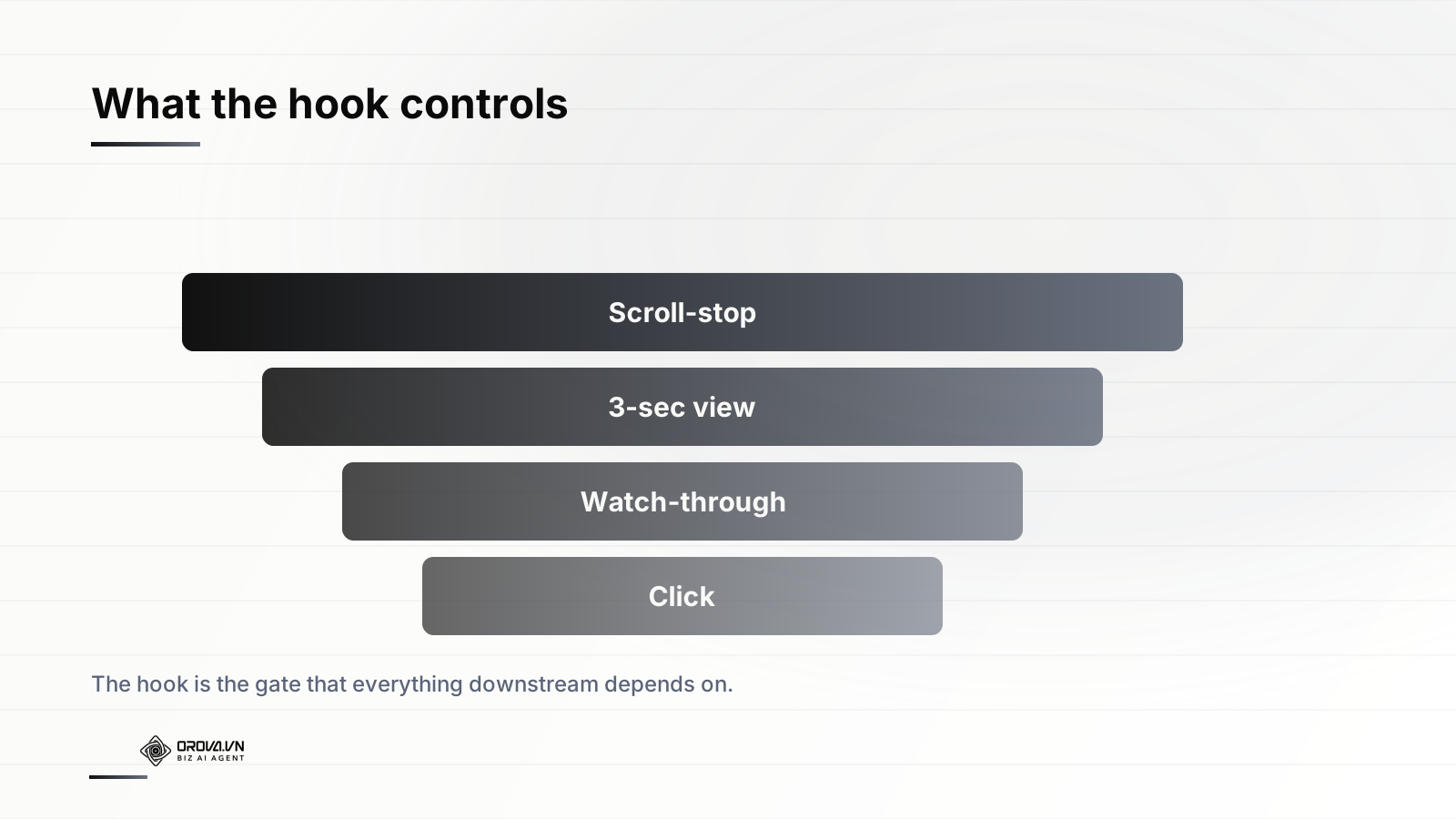
Think of it as a chain of gates, each one only reachable if the previous one opened:
- Scroll-stop: the thumb pauses. This is pure visual and auditory interruption — movement, contrast, a face, a sound, a caption that lands in peripheral vision.
- Three-second view: the pause becomes a decision to keep watching. The viewer has now formed a rough idea of what this is and whether it is for them.
- Watch-through: the body of the ad delivers on the promise the hook made. Curiosity is paid off, tension is resolved, the demo proves the claim.
- Click: the offer and CTA convert attention into intent.
The hook owns the first two gates outright and heavily influences the third, because a hook that over-promises creates a body that under-delivers. A good mental model: the hook is a contract. Whatever expectation you set in the first three seconds, the rest of the ad has to honor. "You won't believe what happened" had better lead somewhere genuinely surprising, or the drop-off arrives the moment the viewer feels conned.
Why early signals feed the auction
When you submit a bid, the platform is not just deciding whether you can afford the impression. It is predicting how the user will respond, because a happy user who stays on the platform is worth more to Meta or TikTok than a user who scrolls away annoyed. Creatives that produce fast, strong engagement get an effective discount: lower CPMs, wider delivery, more impressions before the algorithm decides whether to scale you. This is why two ad sets with identical targeting and budget can have wildly different costs. The difference is often sitting in the first three seconds.
It also explains a counterintuitive truth: a "worse" ad with a stronger hook frequently beats a "better" ad with a weak one. The strong-hook ad gets seen by more people at a lower cost, so even a lower conversion rate on a much larger, cheaper audience wins. You are not just optimizing a creative; you are optimizing your access to the auction itself.
Tailoring hooks to the platform, starting with TikTok
A hook that crushes on TikTok can flop on Meta and vice versa, because the two platforms train very different scrolling habits. Treating them as interchangeable surfaces is a quiet way to leave performance on the table. The underlying psychology of attention is the same, but the rhythm, the format, and the viewer's mindset differ enough that the execution has to change.
TikTok
TikTok viewers arrive expecting to be entertained or taught by a person, not sold to by a brand. Hooks that feel native — handheld, face-to-camera, conversational, starting mid-thought — outperform polished brand intros by a wide margin. The platform rewards a fast, almost jarring open and punishes anything that smells like an advertisement in the first frame. Spoken hooks matter more here because TikTok is largely watched with sound on, so a strong verbal opening ("Nobody talks about this, but...") carries real weight. The downside is speed of decay: TikTok audiences habituate to hook patterns faster than anywhere else, so your refresh cadence has to be quicker.
The first frame is a decision, not a title card. Logos, black frames, slow fades and anything that looks like the start of an advert all read as "skip" before a word is spoken. Open on a face mid-sentence, on the product already in use, or on the exact moment something goes wrong. Whatever the video is about, frame one should already be inside it.
Write the spoken line first, then the on-screen line. TikTok is mostly watched with sound on, so the verbal open carries the load — but a short burned-in caption of the same claim catches the silent minority and reinforces it for everyone else. Keep the two consistent; a caption that contradicts or lags the audio splits attention at the worst possible moment.
Native beats polished, but native still has to be legible. Handheld and conversational works because it matches the surrounding feed, not because low production value is a virtue. The hook still needs a clear subject, steady enough framing to read in a second, and audio you can hear on a phone speaker in public.
Plan for faster decay. TikTok audiences habituate to hook patterns quicker than anywhere else, so a formula that works this month will visibly soften next month. Treat hooks as consumable: keep several angles in rotation, retire the one whose hook rate is sliding, and refresh the bank on a schedule rather than waiting for cost per result to force it.
Meta feed and Reels
Meta spans a wider range of intent and a wider range of sound behavior, with a large silent-watching contingent in the feed. That makes burned-in text hooks especially important — the opening has to land visually even with audio off. Meta also tolerates a slightly more produced look than TikTok, and its retargeting layers mean you can run different hook angles for cold versus warm audiences. A cold-audience hook needs to establish the problem from scratch; a warm-audience hook can assume recognition and jump straight to a new angle or objection. Mismatching these — running a "here's who we are" hook to people who already know you — wastes the slot.
One body, many openings
The practical upshot is a production habit: build a strong core body once, then cut platform-specific and audience-specific hooks onto it. A single proven demo or testimonial can power a sound-on conversational open for TikTok, a captioned pattern-break for the Meta feed, and a warm-audience objection hook for retargeting. This is the cheapest way to localize without rebuilding, and it keeps your hook bank doing double duty across surfaces.
Hook formulas that consistently work
There is no shortage of "hook lists" online, but most of them are interchangeable openers stripped of the logic behind why they work. The point is not to memorize lines. It is to understand the psychological lever each formula pulls, so you can generate dozens of variations for your own product. Below are the formulas that hold up across accounts and verticals, with the lever each one uses.
The bold claim
State something strong, specific, and slightly hard to believe, then make the rest of the ad prove it. "This costs us $4 to make and we sell it for $90." "I fired my entire sales team and revenue went up." The lever is curiosity created by a gap between what you said and what the viewer expected. The danger is the empty claim — bold but generic ("the best skincare ever made") creates no curiosity because there is nothing specific to verify. Specificity is what makes a claim land. Numbers, names, and concrete consequences turn a slogan into a hook.
The question that names the problem
"Why does your foundation look cakey by noon?" "Spending $3,000 a month on ads and still not profitable?" A good question hook works because it self-selects the audience instantly — the right person feels addressed by name, and the wrong person scrolls on (which is fine, you did not want to pay for their attention). The mistake here is the rhetorical question with an obvious answer ("Want to grow your business?"), which everyone has heard a thousand times and ignores. The question must describe a specific, slightly uncomfortable situation the viewer recognizes as their own.
The pattern break
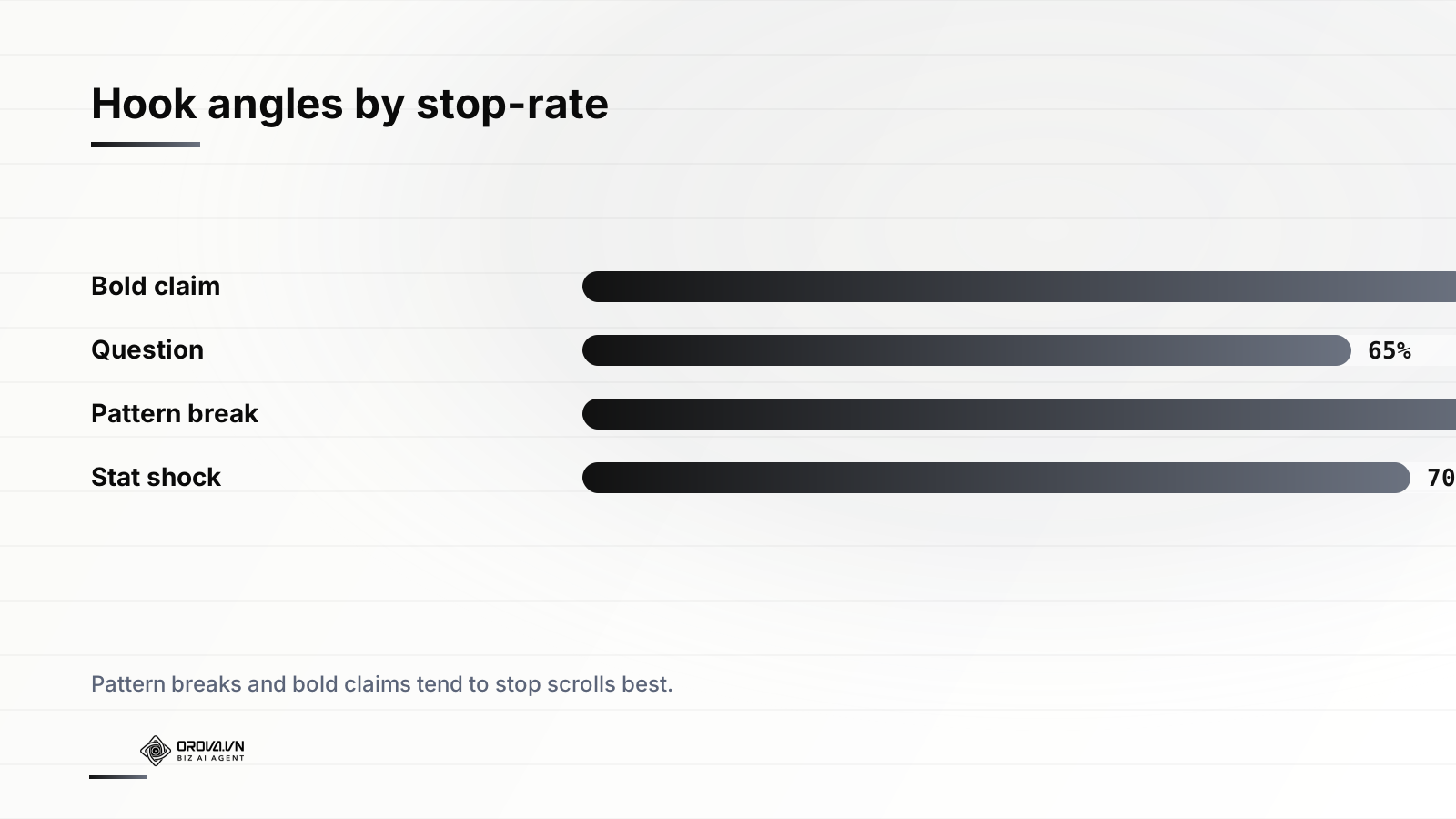
This is the visual or structural equivalent of a record scratch. The frame does something the feed has trained the eye not to expect: an abrupt cut, an unusual angle, text that contradicts the image, a person starting mid-sentence as if you walked into the room halfway through a story. "Okay, stop scrolling, I have to show you this" works not because of the words but because it breaks the fourth wall and the rhythm of the feed. Pattern breaks tend to produce the highest stop rates precisely because the brain is wired to notice anomalies. The cost is that they age fast — once a pattern break becomes the new pattern, it stops breaking anything.
The stat shock
Lead with a number that reframes the viewer's assumptions. "73% of the protein bars on this shelf have more sugar than a candy bar." "The average small business wastes 38% of its ad budget on the wrong audiences." The lever is the same surprise as the bold claim, but anchored in data, which feels more credible and is easier to defend in the body. The trap is the stat nobody cares about. The number has to threaten or upend something the viewer believes, not just sit there as trivia.
The negative or contrarian open
"Stop buying collagen supplements." "Most ad agencies are lying to you about this." Telling people not to do something, or attacking a category they trust, triggers a strong "wait, why?" The contrarian hook punches above its weight because it implies you have insider knowledge worth staying for. Use it carefully — it sets up an obligation to actually deliver the contrarian payoff, and overuse makes a brand feel perpetually angry.
The in-medias-res story
Drop the viewer into the middle of a moment with no setup. "So I'm standing in the return line for the third time this week..." The unresolved situation creates a narrative loop the brain wants to close, which is the most durable form of attention there is. Story hooks tend to have lower peak stop rates than pattern breaks but much better watch-through, because once someone is inside a story they stay to find out how it ends.
A practical note on production: the same formula can be expressed as spoken word, on-screen text, or pure visual. For sound-off feeds, your hook needs to work as a caption in the first frame even if the audio is muted, because a large share of users watch silently. Burn the hook into the opening frame as text and you double its surface area.
From hooks to a testing system
One great hook is luck. A pipeline that reliably produces great hooks is a system, and that is what separates accounts that scale from accounts that plateau. The reason testing matters so much for hooks specifically is that intuition about what stops a thumb is unreliable. The line you are sure will win loses constantly; the throwaway variant you almost cut becomes your top performer. You have to let data, not taste, pick the winner.
Isolate the variable
The whole point of hook testing is contaminated the moment you change more than one thing. Keep the body, offer, and CTA identical across variants and swap only the first three seconds. This is hard discipline — it is tempting to "improve" the whole ad while you are in there — but if the body changes too, you cannot tell whether the hook or the body moved the numbers. Many teams produce a single "core" ad and then cut four to six different openings onto the same body, running them head to head.
Measure the right thing
Do not judge a hook by conversions alone in the first few days, because conversion data is noisy and slow. Judge it by the metric the hook actually controls: the three-second-to-cost ratio, or hook rate (three-second views divided by impressions). A hook that lifts your stop rate from 25% to 40% is doing its job even before downstream numbers stabilize. Then layer in hold rate (the percentage who reach 25% or 50% of the video) to make sure the hook is not just stopping people with a promise the body breaks. The pairing you want is high stop rate plus healthy hold — that means the hook attracted the right people and the body kept them.
- Ship four to six hook variants on one body, same audience, even budget split.
- Let each accumulate enough impressions for a stable hook rate — usually a few thousand impressions per variant, not a few hundred.
- Cut the bottom half on hook rate, keep the top performers, and watch their hold rate before declaring a winner.
- Take the winning angle and spin three new variations of it, because the angle that won is your signal for what this audience responds to.
Read the angle, not just the asset
The most valuable output of hook testing is not the winning video — it is the winning angle. If your pattern-break opens consistently beat your question opens for a given audience, that is a durable insight that outlives any single creative. You can apply it to the next ten ads. Treat each test as research into what makes this specific audience pause, and you build a compounding library of angles instead of a graveyard of one-off videos. Over time you will notice some audiences respond to authority and stats, others to relatability and story, and the platform itself shifts which patterns feel fresh.
Hooks and creative fatigue
Here is the part most teams miss: hooks are not just how you launch a creative, they are how you extend its life. A winning ad does not stay winning. As the platform shows it to the same people repeatedly, frequency climbs, the novelty wears off, the stop rate decays, and your cost per result creeps up. This is the classic frequency-driven fatigue spiral, and the first symptom is almost always a falling hook rate. People who have already seen the opening recognize it and scroll before the three-second mark.
Because the hook is the part the audience habituates to fastest, swapping only the hook is often enough to reset a fatiguing ad without rebuilding it from scratch. You keep the proven body and offer, cut a fresh opening onto it, and the same content reads as new to the algorithm and the viewer. This is far cheaper than producing entirely new creative and frequently recovers most of the lost performance. Think of your winning body as an engine and hooks as interchangeable front ends you can keep bolting on.
Watch hook rate as your early-warning system
Because hook rate decays before conversions do, it is your earliest fatigue signal. By the time cost per acquisition spikes, you have already wasted budget; by the time hook rate dips, you still have time to act. Set up your monitoring so that a declining three-second view rate on a top performer triggers a review, not a panic. Often the right move is simply to queue the next hook variant before the current one fully burns out, so you always have a fresh opening ready when the old one starts to fade.
The fastest way to kill an account is to find a winner and ride it until the wheels fall off. The fastest way to scale one is to treat every winner as a body waiting for its next hook.
Build a hook bank
Rather than scrambling for a new opening each time fatigue hits, maintain a running bank of hook ideas tied to the angles that have won for you. When a creative starts to fade, you reach into the bank, cut two or three fresh openings, and test them against the dying version. This turns fatigue management from a reactive fire drill into a routine. The teams that scale paid social are rarely the ones with the single best ad — they are the ones with the deepest, fastest hook pipeline, refreshing openings on a cadence the audience never has time to tire of.
Common mistakes that kill hooks
Most failed hooks fail for predictable reasons. Watching for these saves you from burning impressions on openings that were never going to stop anyone.
- Burying the lede. Three seconds of logo animation, brand intro, or "hi guys, welcome back" spends your entire attention budget before the hook arrives. The hook has to be the very first thing.
- Vague over specific. "Transform your business" stops no one; "We cut our ad spend 40% and kept the same revenue" does. Specificity is the single highest-leverage edit you can make.
- A promise the body can't keep. Clickbait openings spike stop rate and crater hold rate. The viewer feels the bait-and-switch and leaves angrier than if you had never stopped them.
- Sound-dependent hooks in a sound-off feed. If the hook only works with audio, half your audience never gets it. Caption the first frame.
- Reusing a tired pattern. The hook style that worked six months ago may now be the default everyone scrolls past. Patterns break only while they are still patterns.
- Testing too many variables at once. Change the hook and the body together and you learn nothing transferable. Isolate.
None of these are exotic. They are the everyday failure modes of busy teams shipping creative under deadline pressure. A simple pre-publish checklist — is the hook in the first frame, is it specific, does the body honor it, does it work muted — catches most of them.
Putting it together
The first three seconds are the most valuable real estate in your entire funnel, because everything else is unreachable without them. A strong hook stops the thumb, earns the three-second view, sets an honest expectation the body can fulfill, and — through the early engagement it generates — buys you cheaper, wider delivery in the auction. Weak hooks do the opposite, throttling delivery and inflating costs no matter how good the offer behind them is.
The discipline is straightforward even if it is not easy: use formulas as starting points rather than scripts, isolate the hook as the only variable when you test, judge hooks on the metric they actually control, mine your tests for durable angle insights, and treat hook-swapping as your primary tool for fighting fatigue and extending the life of every winner. Do that consistently and you stop relying on the occasional viral fluke. You build a repeatable system that keeps producing openings the feed cannot ignore.
On TikTok specifically, almost all of this is decided before the third second — TikTok Creative Hooks: The First Three Seconds That Decide Your CPA breaks down the hook patterns that hold attention.
Running this loop by hand across dozens of creatives and multiple platforms is where it breaks down for most teams — the data is there, but watching hook rates decay, queuing the next variant, and rebalancing budget every single day is more than a person can sustainably do. Orova Ads is an AI agent that manages your paid campaigns across Google, Meta, and TikTok: it reads performance data daily, flags fatiguing creatives by their falling early-engagement signals, and recommends and executes the budget, bid, and on/off moves to keep your best work in front of the right people — all with your approval and a full audit log of every change. Let it handle the daily grind so your team can focus on writing the next hook that stops the thumb.
Orova Ads optimises campaigns for you
Connect Google, Meta and TikTok in one place. AI reads the numbers, proposes changes and executes under the rules you set.
Explore Orova Ads