
200+ Optimization Actions: A Field Guide to What an Ad Agent Can Do
Ask ten marketers what "AI optimizes your ads" means and you will get ten vague answers. Most of them reduce to "it makes the campaigns better, somehow." That is not a strategy; it is a slogan. The honest version of the sentence is much longer and much less glamorous: an ad agent watches a few hundred specific dials across your account, and every day it decides which ones to nudge, by how much, and in which direction. There is no magic in it. There is a catalogue.
This article is that catalogue, written out the way a practitioner would think about it. If you run a Google Search campaign, a Meta Advantage+ shopping campaign, and a TikTok Spark Ads push at the same time, you are sitting on roughly 200 distinct optimization actions at any given moment. Some are mechanical and safe to automate. Some are sensitive and should never move without a human nod. A handful are not actions at all — they are strategic judgements that software can inform but should not own. The difference between a useful ad agent and a dangerous one is whether it knows which is which.
I have grouped the actions into six families: campaign and budget, bidding and delivery, audience, placement and schedule, creative, and measurement. Within each, I will be concrete about the actual lever, when it makes sense to pull it, and how it differs across the three platforms. By the end you should be able to look at any "AI ads" claim and ask the right question: which of these 200 things does it actually do, and on which mode?
Why a list beats a slogan
Optimization feels like a single verb, but it is really an inventory of small, reversible decisions. Consider a mid-sized e-commerce account spending $40,000 a month. On a typical Tuesday the genuinely useful work might be: shift $300 from a saturated prospecting campaign to one that is still climbing, add eleven negative keywords harvested from yesterday's search terms, pause two ad groups whose cost per acquisition has drifted 60% above target, lower a tCPA bid cap by 8% on a campaign that is overspending its return goal, exclude a placement on the Audience Network that is eating 4% of budget at zero conversions, and flag a creative whose frequency just crossed 3.2 for a refresh. That is six actions before lunch, and none of them is the kind of thing you would put in a slide titled "AI Strategy."
This is exactly why the slogan misleads. The value is not in one clever move; it is in doing two hundred boring, correct things consistently, every day, without forgetting, without fatigue, and without the emotional pull that makes humans leave a losing campaign running because they "have a good feeling about it." A list is honest because it is checkable. You can audit a list. You cannot audit a vibe.
The three modes every action carries
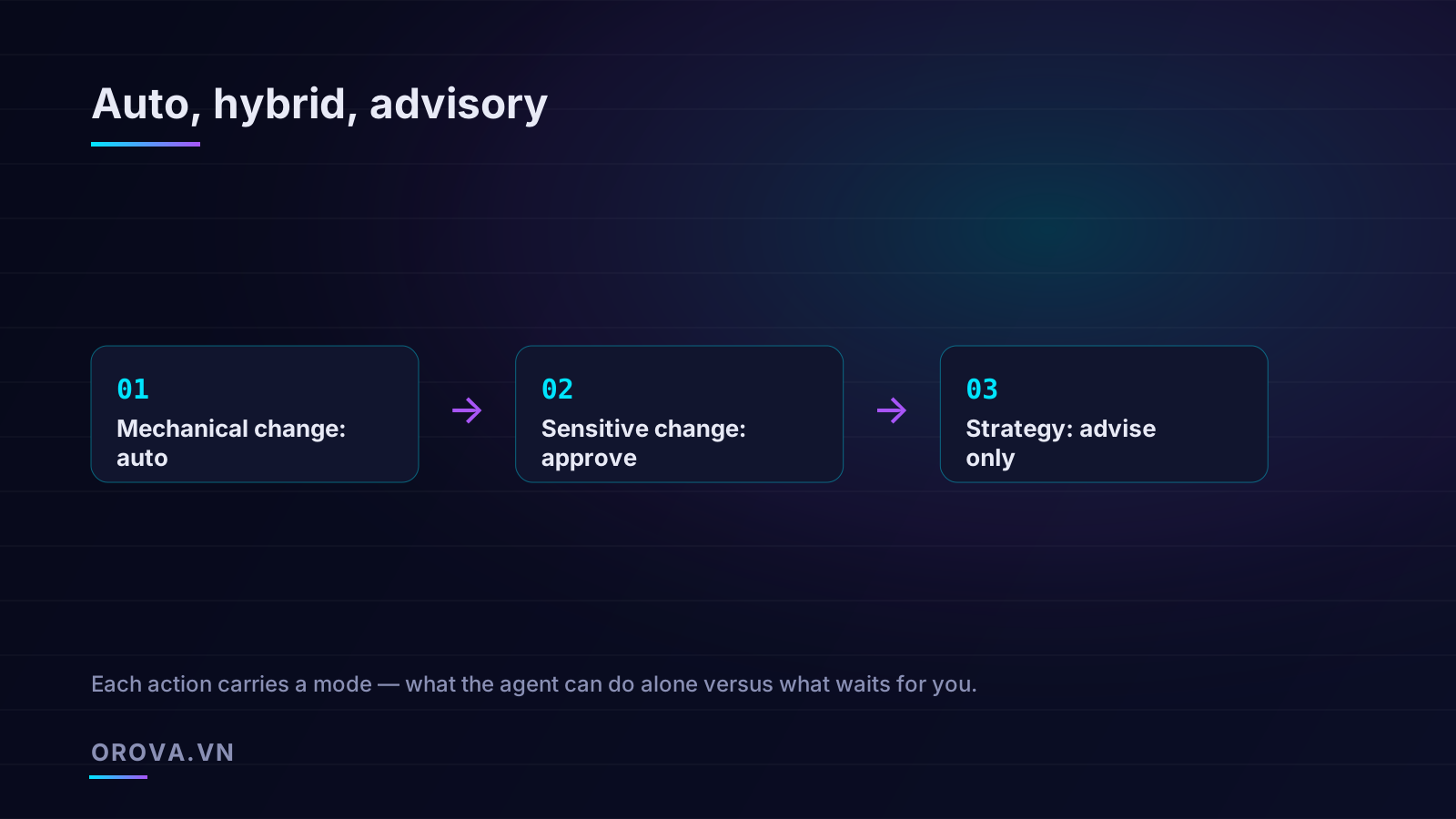
Before the catalogue, the single most important concept: every action has a risk profile, and that profile should determine who is allowed to execute it. Throughout this guide I will tag actions with one of three modes.
- Auto — mechanical, reversible, low-blast-radius changes. Adding a negative keyword, pausing a single dead ad, trimming a placement with statistically clear waste. If it goes wrong, you lose a few dollars and undo it in one click. These are safe to delegate fully.
- Hybrid (approve) — sensitive changes that move real money or real reach. Raising a daily budget by 30%, changing a bid strategy, launching a new audience. The agent should propose the exact change with its reasoning and the expected effect, then wait for a human to approve. The thinking is automated; the commitment is not.
- Advisory only — strategy and judgement. Whether to enter a new market, kill a product line, or change your target cost per acquisition because the business margin changed. Software can surface the evidence. It should not pull this lever, because the inputs live outside the ad platform entirely.
Keep these three modes in mind. The same nominal action — "change budget" — is auto when it is a $50 reallocation between two of your own campaigns and advisory when it is a decision to triple total spend for the quarter. Context, not the verb, sets the mode. The transition from a recommendation to a safe, logged execution is itself a discipline; I have written about how an agent should move from recommendation to execution in more detail, because that hand-off is where most automation either earns trust or loses it.
Family 1 — Campaign and budget actions
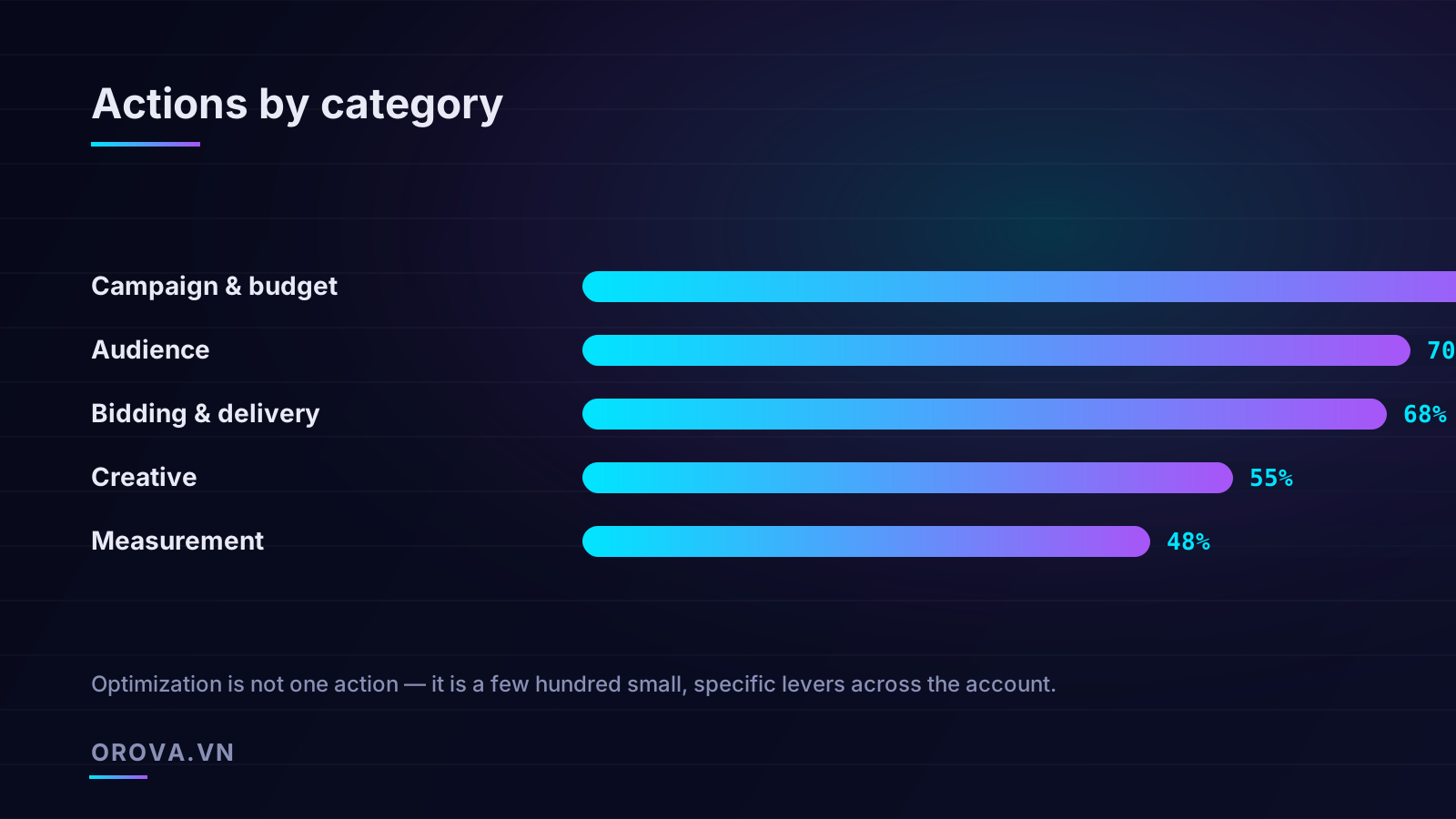
This is the largest family, roughly eighty distinct actions, because money is the most direct lever you have. Budget decisions are also the ones where automation pays off fastest, because they are the ones humans handle worst — we reallocate too slowly, anchor on last week's numbers, and hate admitting a campaign we built has stopped working.
Reallocation between campaigns
The bread-and-butter move: take spend away from campaigns hitting diminishing returns and give it to campaigns still converting efficiently below their ceiling. On Google this means shifting daily budgets between Search, Performance Max, and Demand Gen campaigns based on marginal return, not average return. The distinction matters — a campaign averaging a 4x return might be wasting its last 20% of budget at 1.5x, and that marginal dollar is what you want to move.
On Meta the same logic runs through campaign budget optimization (CBO/Advantage campaign budget), where you decide whether to let the platform distribute across ad sets or to cap individual ones. On TikTok, where the auction is younger and more volatile, reallocation needs a wider confidence band — TikTok performance swings harder day to day, so an agent should require more data before declaring one campaign a winner over another. Mode: auto for small intra-account shifts, hybrid once the move exceeds a meaningful share of total daily spend.
Budget scaling
Scaling a winner is more dangerous than it looks. Push a Meta ad set's budget up 50% overnight and you can knock it out of the learning phase, resetting delivery and spiking cost per result for days. The disciplined action is graduated scaling — 20% steps with a stabilization window between them — and an agent should encode that rule rather than yanking the budget to match yesterday's enthusiasm. Mode: hybrid, almost always. Scaling commits future money against an assumption that today's performance holds.
Status changes — pause, enable, archive
Pausing is the most common single action in any account and the easiest to automate well, because it is fully reversible. Pause an ad group that has spent 3x your target CPA with zero conversions. Pause a campaign that has run out of fresh audience and is now just re-serving the same people. Re-enable a paused campaign when a seasonal window opens. The trap is over-pausing on thin data — pausing a campaign after one bad day when the conversion lag is three days means you are killing things before their results arrive. A good agent waits for the data to mature. Mode: auto for clear, sustained waste; hybrid when the signal is young.
The fastest way to lose money in paid media is not a bad campaign — it is a good campaign you scaled before it was stable, or a recovering campaign you paused before its conversions reported in.
Pacing and dayparting at the budget level
Budgets interact with time. A campaign that exhausts its daily budget by 2pm is invisible to the entire afternoon and evening. Actions here include raising daily budgets on campaigns that consistently run out early and clip strong evening demand, and lowering them on campaigns spending freely overnight at poor efficiency. This shades into the schedule family below, but the budget-level version — "this campaign needs more headroom" — is its own distinct lever.
Family 2 — Bidding and delivery actions
If budget decides how much you spend, bidding decides how aggressively you compete for each impression. Roughly sixty-eight actions live here, and they are the most platform-specific of the six families because each network's auction works differently.
Bid strategy selection and tuning
On Google the headline choices are Maximize Conversions, Maximize Conversion Value, Target CPA, and Target ROAS. The actions are not just picking one but tuning the target: raising a tROAS goal when a campaign comfortably beats it (to capture more profitable volume) or relaxing it when the campaign is starving for impressions. A common, correct action is loosening a target that is set too aggressively — a tCPA pinned below what the auction can deliver simply throttles the campaign to near zero. Mode: hybrid. Changing a bid strategy can re-enter the learning phase, so it commits real volatility.
Bid adjustments and modifiers
Layered on top of the base strategy are modifiers: device bid adjustments (mobile converts worse for many B2B advertisers, so reduce mobile bids), location adjustments (bid up where conversion rate is demonstrably higher), and audience bid adjustments (bid up for cart abandoners, down for low-intent segments). On Meta and TikTok these are expressed more through bid caps and cost caps than granular modifiers, but the principle is the same — pay more for the impressions that convert and less for the ones that do not. Mode: auto for small data-backed nudges, hybrid for larger swings.
Learning-phase protection
This is less a single action than a constraint that governs all the others. Meta's learning phase needs roughly fifty conversions per ad set per week to stabilize. Actions that reset it — significant budget changes, creative swaps, audience edits, bid strategy changes — should be batched and timed rather than dribbled out daily. A genuinely useful agent does not just know how to make a change; it knows when a change is too expensive to make right now, and holds it. That restraint is itself an optimization action, and an underrated one.
Delivery diagnostics
When a campaign under-delivers, the agent's job is diagnosis before action. Is the bid too low to win the auction? Is the audience too narrow? Is the budget capped? Is the creative fatigued and suppressing the relevance score? Each diagnosis points to a different family of fix, and applying the wrong one — raising budget when the real problem is a low bid — wastes time and money. Mode: the diagnosis is auto; the prescribed fix inherits the mode of whatever family it belongs to.
Family 3 — Audience actions
Audience is where Google, Meta, and TikTok diverge most in philosophy, and where roughly seventy actions cluster. Google's audiences are increasingly signal-based hints to its automation; Meta has moved hard toward broad targeting with Advantage+ audiences; TikTok sits in between, rewarding interest and behavior signals while its automated targeting matures.
Negative keywords and audience exclusions
On Search, the single highest-frequency audience-adjacent action is adding negative keywords. Every day a search campaign accumulates query data, and a meaningful slice of it is irrelevant — someone searching "free," "jobs," or a competitor's product name you do not want to pay for. Harvesting these into negative lists is mechanical, reversible, and high-value. A busy account can justifiably add dozens of negatives a week. This is the textbook auto action: low risk, clearly evidenced, instantly undoable.
The mirror image on Meta and TikTok is audience exclusion — suppressing existing customers from prospecting campaigns, excluding recent purchasers from acquisition spend, removing employees and known low-value segments. Mode: auto for the obvious exclusions, hybrid when an exclusion meaningfully shrinks a working audience.
Segment testing and expansion
Beyond cleanup, there is exploration: launching a new lookalike or value-based audience, testing a fresh interest cluster on TikTok, layering an in-market segment on Google. These are genuinely new bets, not adjustments to existing performance, so they belong in hybrid mode — the agent can assemble the audience and propose the test with a hypothesis and a budget, but launching new reach is a commitment a human should sign off on. Expanding a lookalike from 1% to 3% is a particularly common proposal, trading precision for scale, and exactly the kind of trade-off worth a human glance.
Retargeting hygiene
Retargeting audiences decay. Window lengths drift out of date, frequency caps go stale, and the same warm pool gets hammered until returns collapse. Actions include tightening or widening retargeting windows, adjusting frequency caps, and refreshing the source events that feed an audience. A retargeting campaign showing rising frequency and falling click-through is asking for either a creative refresh or a wider window — and recognizing which is the practitioner's skill the agent should encode.
Family 4 — Placement and schedule actions
This family is smaller but disproportionately profitable because it is the most neglected. Advertisers obsess over creative and audience and quietly let budget leak through bad placements and indiscriminate scheduling.
Placement exclusions
On Meta, automatic placements will happily spend on Audience Network slots, Reels, and right-column inventory regardless of whether they convert for you. The action is to pull a placement report, identify slots burning budget at zero or near-zero conversion, and exclude them. On Google's Display and Performance Max, the equivalent is excluding poor-performing placements and applying content suitability and brand-safety exclusions — keeping your ads off mobile-game inventory or low-quality content where accidental clicks inflate cost. On TikTok, the Pangle network is the usual culprit worth scrutinizing. Mode: auto where the waste is statistically clear, because excluding a dead placement is as reversible as adding a negative keyword.
Dayparting
Most accounts run twenty-four hours a day because nobody changed the default. But conversion rates vary by hour and day. A B2B lead-gen account might convert three times better at 10am on a weekday than at 11pm on a Sunday. The actions are building ad schedules that concentrate budget into high-converting windows and reducing or removing spend in dead hours. This requires enough data to be confident the pattern is real and not noise — a fortnight of hourly conversion data at minimum — so the agent's discipline about data sufficiency matters as much as the change itself. Mode: hybrid, because reshaping when your ads appear is a real strategic choice.
Geographic refinement
Geography is both audience and placement. Actions include excluding regions that spend without converting, bidding up in geographies with strong conversion rates, and splitting a national campaign so high-value metros can be funded independently. For a local service business this is often the single highest-impact lever — there is no reason to pay for clicks two hundred kilometres outside your service area.
Family 5 — Creative actions
Creative is where the most value and the most genuine human judgement coexist, which makes it the trickiest family to automate honestly. Roughly fifty-five actions live here, but they split cleanly: the mechanical ones an agent can own, and the genuinely creative ones it can only assist with.
Fatigue detection and rotation
Every creative has a half-life. As frequency climbs and the audience tires, click-through rate falls and cost per result rises. The mechanical action is to detect fatigue — rising frequency plus declining CTR plus rising CPA on a previously strong asset — and to flag or pause the tired creative while rotating in fresh assets from the queue. Detection is firmly auto; the agent watches the trend lines no human can monitor continuously. Pausing a clearly dead creative is auto. Deciding what new creative should replace it is not.
Asset-level pruning
On Google's responsive search ads and Performance Max asset groups, individual headlines, descriptions, and images carry performance ratings. The action is to remove "Low" rated assets and lean into the combinations that win. On Meta's dynamic creative and TikTok's automated creative tools, the equivalent is identifying which hooks, thumbnails, and first three seconds drive completion and conversion, then concentrating delivery there. This is mechanical optimization within a creative set — auto-eligible, because it is pruning by evidence, not authoring.
What the agent should not do
An ad agent can tell you a video's first three seconds are losing 70% of viewers. It can tell you which existing thumbnail outperforms. It can even generate variations to test. What it should not do is decide your brand voice, approve a claim with legal implications, or push a new creative concept live without a human seeing it. Creative carries brand risk that does not show up in the metrics until it is too late. Mode: detection and pruning auto; new concepts and brand-facing decisions advisory. This is the family where "human-in-the-loop" stops being a buzzword and becomes a genuine safeguard.
Family 6 — Measurement and structure actions
The last family, around forty-eight actions, is the least visible and the most foundational. If measurement is wrong, every other family optimizes toward the wrong goal — you scale campaigns that look profitable and are not.
Conversion tracking integrity
Actions here include detecting broken or double-counted conversions, flagging when a conversion action stops firing, reconciling platform-reported conversions against actual back-end sales, and adjusting attribution windows when they misrepresent reality. A campaign that suddenly reports zero conversions might be failing — or its tracking tag might have broken in a site deploy. Telling those two apart is critical, and an agent that catches a broken tag before you have spent a week optimizing on phantom data has earned its keep. Mode: detection auto; structural fixes to tracking usually advisory, because they touch systems outside the ad account.
Account structure refinement
Structure is slow-moving but powerful. Actions include consolidating fragmented campaigns that are splitting data too thinly to optimize (a chronic problem — twenty tiny ad sets each starved of conversions learn nothing), separating campaigns that should not share a budget pool, and migrating legacy structures toward the formats each platform now favors. These are large, considered changes. Mode: advisory, almost always — restructuring an account is strategy, and the agent's role is to make the case with data, not to rebuild your account overnight.
Reporting and anomaly detection
Finally, the watchful actions: surfacing a sudden spend spike, a cost-per-result anomaly, a competitor entering the auction and driving up your CPCs, or a landing page whose conversion rate quietly collapsed. These are not changes at all — they are alerts that prompt a human to investigate. They belong to measurement because they are about seeing the account clearly, which is the precondition for every other action in this guide.
How to read any "AI ads" claim
Now that the catalogue is laid out, you have a practical filter. When a tool or agency says it "optimizes your ads with AI," ask three questions. First: which of these six families does it actually touch — all of them, or just budget reallocation dressed up as intelligence? Second: which actions does it execute versus merely report? Many tools dashboard the problem and leave you to fix it; that is monitoring, not optimization. Third, and most important: what is the mode of each executing action — is it pausing dead ads on auto while waiting for your approval on budget scaling and audience launches, or is it firing live changes into your account with no human checkpoint?
That third question separates the trustworthy from the reckless. Full autonomy on auto-class actions is a feature. Full autonomy on hybrid- and advisory-class actions is a liability waiting to surface on your next invoice. The right architecture is not "human or machine" — it is the machine doing the two hundred small correct things, proposing the consequential ones with its reasoning, and leaving the strategy to you, with every action it takes written into an audit log you can read.
That is what makes a list better than a slogan. You can hold a list accountable. The next time someone promises AI optimization, hand them this catalogue and ask them to check the boxes. The honest ones will be relieved to finally have a concrete conversation.
If you want to see the full catalogue running on a real account rather than on a page, that is exactly what Orova Ads does: an AI agent that reads your Google, Meta, and TikTok data every day, recommends the right optimizations across all six families, and executes them — budgets, bids, on/off, audiences — on auto where it is safe and with your approval where it matters, every action logged so you always know what changed and why.
Let an AI Agent handle your SEO
Orova plans, writes, optimizes, and tracks rankings on its own — you just read the results.
Try it free