
Anchor Text: The Small Detail With Outsized Impact
Of all the things that go into an internal link, the part most people think about least is the part that matters most: the words themselves. The decision to link page A to page B gets attention. The choice of which words form the clickable link — the anchor text — is usually made in half a second, on autopilot, and never revisited. That habit is a mistake, because anchor text is doing far more work than its size suggests. It is a small detail with an impact out of all proportion to the effort most people give it.
This article breaks down what anchor text actually does, why the common ways of handling it fail, and how to choose anchors deliberately. It is an analysis of one small component — but a component that, multiplied across every link on a site, shapes how search engines understand your content and how readers move through it.
What anchor text is — and what it signals
Anchor text is the visible, clickable text of a hyperlink. In the sentence "read our guide to keyword research," if the words "guide to keyword research" are the link, those four words are the anchor.
Those words are not neutral packaging. They are a description — a label the linking page applies to the linked page. And both readers and search engines treat that label as meaningful information.
For a reader, the anchor is a promise. It tells them what they will get if they click. A clear anchor lets them decide, before clicking, whether the destination is worth their time. A vague anchor forces them to click blind and find out.
For a search engine, the anchor is a topical signal. When a page links to another page, the anchor text is a hint about what the destination page is about. If many pages link to a page using anchors that cluster around a particular topic, that consistency reinforces the search engine's understanding of what that page is for. The anchor is, in effect, a vote that comes with a written explanation of what it is voting for. A link with no descriptive anchor still passes a vote — but a vote with the explanation torn off.
So a single anchor is doing two jobs at once: setting a reader's expectation and sending a topical signal. Neither job is optional. Every link does both whether you chose the words deliberately or not.
Why "click here" is worse than it looks
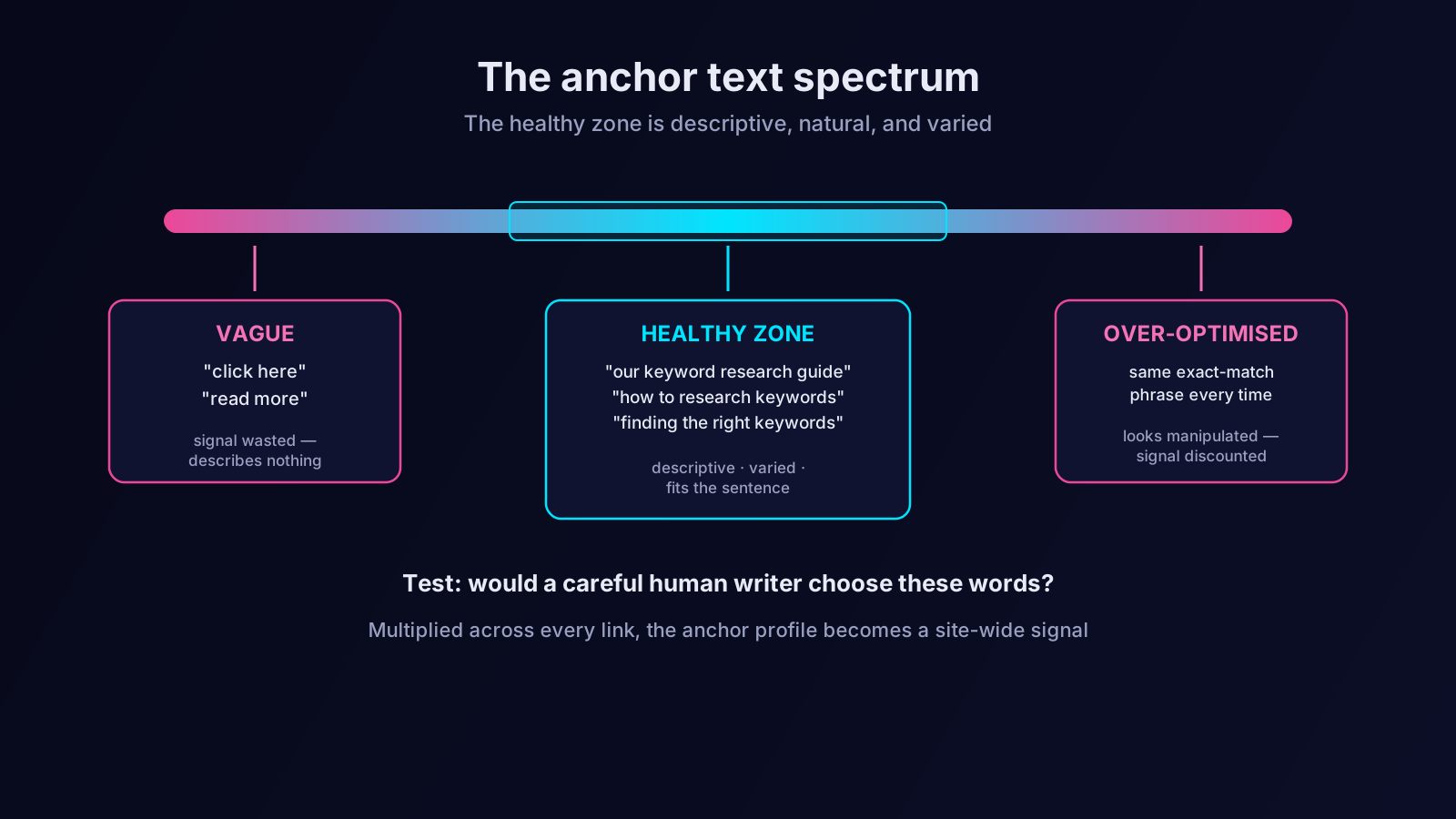
The most common anchor text mistake is the non-descriptive anchor: "click here," "read more," "this page," "learn more," "this article." These phrases feel harmless. They are anything but.
Consider what "click here" communicates. To the reader, it says nothing about the destination — they must click to discover whether it is relevant, which means some will not bother and some will click, find it irrelevant, and bounce. To the search engine, it says the destination page is about... clicking. The single most valuable property of the anchor — its descriptiveness — has been thrown away.
The deeper problem is scale. One "click here" is a tiny waste. But teams that use "click here" once use it everywhere — it is a habit, not a one-off. Across a site, that habit means hundreds of links, every one of them passing a vote with no explanation attached. The site has done the hard work of building a link structure and then systematically refused to tell anyone what the structure means. It is like labelling every folder in a filing cabinet "folder."
The fix costs nothing. "Click here to read about email deliverability" becomes "read about email deliverability." Same sentence, same link, fewer words — and now the anchor describes the destination. There is no trade-off. The descriptive version is shorter, clearer for readers, and stronger as a signal. The non-descriptive anchor is pure waste with no compensating benefit, which is what makes it such a revealing mistake: it is not a hard call made wrong, it is an easy call not made at all.
The opposite mistake: over-optimisation
If vague anchors are the common mistake, exact-match over-optimisation is the mistake made by people who have learned that anchors matter and then over-corrected.
The logic seems sound. If anchor text signals topic, and you want to rank a page for "project management software," then surely you should link to that page using the exact anchor "project management software" every single time — maximising the signal.
This backfires for two reasons. The first is that it reads as manipulation. Natural writing does not produce the identical keyword phrase as the anchor in every link across a whole site. When that pattern appears, it looks engineered — because it is — and search engines have long been able to recognise unnaturally uniform anchor patterns. A signal that looks manipulated is discounted, or worse.
The second reason is that it makes for bad writing. Forcing the exact phrase "project management software" into every sentence that links to that page produces stilted, repetitive prose. Sentences get bent out of shape to accommodate the mandated anchor. Readers feel the awkwardness even if they cannot name it.
So over-optimisation fails on both fronts: it weakens the signal it was meant to strengthen, and it damages the reading experience. The lesson is that anchor text is not a dial you turn to maximum. It is a balance.
The healthy middle: descriptive and varied
Between the vague anchor and the over-optimised anchor lies the zone you actually want. Anchors in this zone share two properties.
They are descriptive. The words tell you what the destination is about. They contain the relevant concepts naturally — not the exact target keyword forced in regardless of fit, but a phrasing that genuinely describes the page and happens to be topically relevant because the page genuinely is about that topic.
And they are varied. The same page, linked from twenty places, is described with twenty natural variations rather than one robotic repetition. "Our keyword research guide." "How to research keywords." "A practical approach to keyword research." "Finding the right keywords." All descriptive, all topically clear, none identical. That natural variety is what real editorial linking looks like, and it is both a healthier signal and better prose.
The mental test is simple: would a careful human writer, linking this page in this sentence, choose these words? If yes, the anchor is in the healthy zone. If the words were chosen to feed an algorithm rather than to inform a reader, they are not.
Anchor text and context
One subtlety worth analysing: the anchor does not work alone. The text surrounding it — the sentence and paragraph the link sits in — also informs what the link is understood to mean.
This matters because it takes some pressure off the anchor. If the surrounding sentence already makes the topic clear, the anchor itself does not have to carry the entire load. A link to a page about reducing email bounce rates, sitting in a paragraph explicitly discussing email bounce rates, is well understood even if the anchor is a modest phrase like "this can help." The context fills in.
The practical implication is that you should think about the anchor and its surroundings together. A slightly generic anchor in a richly relevant paragraph is fine. A descriptive anchor dropped into a paragraph about something unrelated is confusing — the link appears to come from nowhere. The strongest links are the ones where the anchor and the surrounding text agree, both pointing the reader and the search engine toward the same understanding of the destination. Anchor text is not an isolated unit. It is the focal point of a passage.
The placement question: where the anchor sits
An analysis of anchor text would be incomplete without addressing not just the words, but where on the page those words appear — because position changes how much weight a link carries.
A link buried in a footer, repeated identically on every page of the site, is a different thing from a link placed deliberately inside the body of an article, in a sentence written specifically around it. Both are internal links. Both have anchor text. But the editorial, in-content link is the one that genuinely signals a considered relationship between two pages. It was placed because, at that exact point in the argument, that destination was the most helpful next step for the reader. A site-wide footer link was placed because someone added it to a template once and forgot about it.
This matters for how you think about anchors. The anchors worth analysing and optimising are the editorial ones — the in-content links where the words were chosen for a specific passage. Templated, repeated links across navigation and footers are not where the descriptive-anchor effort should go; they are structural furniture. When you audit your anchor profile, separate the two. A site can look like it has thousands of internal links and discover, on inspection, that the overwhelming majority are identical templated links and only a few hundred are genuine editorial endorsements. It is those few hundred that carry the real topical signal, and it is those few hundred whose anchors deserve real thought.
Anchor text and the reader's journey
There is one more dimension to analyse, and it is the one that keeps anchor text honest: the reader does not experience your anchors as signals. They experience them as offers.
Every descriptive anchor is an invitation — "here is a related thing, and here is exactly what it is." A reader scanning an article sees those invitations and decides, link by link, whether each one is worth following. This is why descriptive anchors help even setting search engines entirely aside: they let a reader navigate intelligently, following the threads that interest them and ignoring the ones that do not. A page full of "click here" anchors gives the reader no basis for that decision, so they either click nothing or click blindly.
The analytical point is that the two audiences for anchor text — search engines and humans — want the same thing. Both are served by anchors that accurately describe the destination. There is no tension to manage, no trade-off to balance. The over-optimised anchor fails both audiences at once; the descriptive, natural anchor serves both at once. That alignment is rare in SEO, where reader interest and search-engine signal often pull in different directions. Anchor text is one of the places they point the same way — which is all the more reason the half-second autopilot choice is a mistake worth correcting.
Anchor text on a site-wide scale
Everything so far has analysed the individual anchor. The reason anchor text has outsized impact is that the individual anchor is multiplied by every link on the site, and patterns emerge at that scale that no single link reveals.
Step back and look at all the anchors pointing to one important page. Do they cluster around a coherent topic, or are they scattered and vague? A page whose inbound anchors consistently describe the same subject is being clearly and repeatedly nominated for that subject. A page whose inbound anchors are a mix of "click here," "this," and three unrelated topics is being nominated for nothing in particular.
Now look across the whole site. Is there a slow drift toward lazy "read more" anchors? Is there a suspicious over-uniformity that looks engineered? The site-wide anchor profile is a real, analysable thing — and most teams have never looked at it, because they were only ever choosing one anchor at a time, in half a second, on autopilot. The impact is outsized precisely because the detail is small enough to be ignored individually and consequential enough to matter in aggregate. (For how anchors fit into the wider linking picture, see our internal linking strategy guide.)
Getting anchor text right at scale
The analysis points to a clear conclusion: anchor text should be chosen deliberately, descriptively, and with natural variety — and that should be true of every link on the site, not just the ones you happened to think about. The trouble is the "every link" part. Choosing one good anchor is easy. Ensuring thousands of anchors are all descriptive, none vague, none over-uniform, all in context — that is a scale problem, and scale problems are where human attention runs out.
This is where systematic help earns its place. An SEO AI agent can read the anchor text across an entire site, flag the vague anchors that waste the signal, spot the over-optimised patterns that look manipulative, identify important pages whose inbound anchors fail to describe them coherently, and suggest descriptive, varied, context-appropriate alternatives. It turns anchor text from a half-second autopilot decision into a managed, site-wide signal. Orova treats anchor text as what it really is — a small detail with outsized impact — and keeps it deliberate across every link, so the structure you built is also a structure that explains itself. Stop choosing anchors on autopilot. The words are the signal.
Let an AI Agent handle your SEO
Orova plans, writes, optimizes, and tracks rankings on its own — you just read the results.
Try it free