
How to Write an Article That Ranks AND Converts
Most SaaS articles are built to do one job, and they do it at the expense of the other. The SEO-first article is engineered to rank — stuffed with the right phrases, structured for the algorithm, exhaustive to the point of exhaustion — and it ranks, and the reader who arrives feels processed rather than helped, and they leave without becoming anything. The conversion-first article is a thinly disguised sales page — persuasive, urgent, product-heavy — and it converts the rare visitor who finds it, but it never ranks, so almost nobody ever does.
This is a false choice, and treating it as real is the single most expensive habit in content marketing. An article can rank and convert. The two goals are not enemies; they are served by the same underlying quality and simply require you to design for both deliberately instead of optimising for one and hoping the other follows. This is a practical, step-by-step guide to doing exactly that — writing one article that earns its place in search results and turns the readers it earns into customers.
The foundational idea: ranking and converting share a root
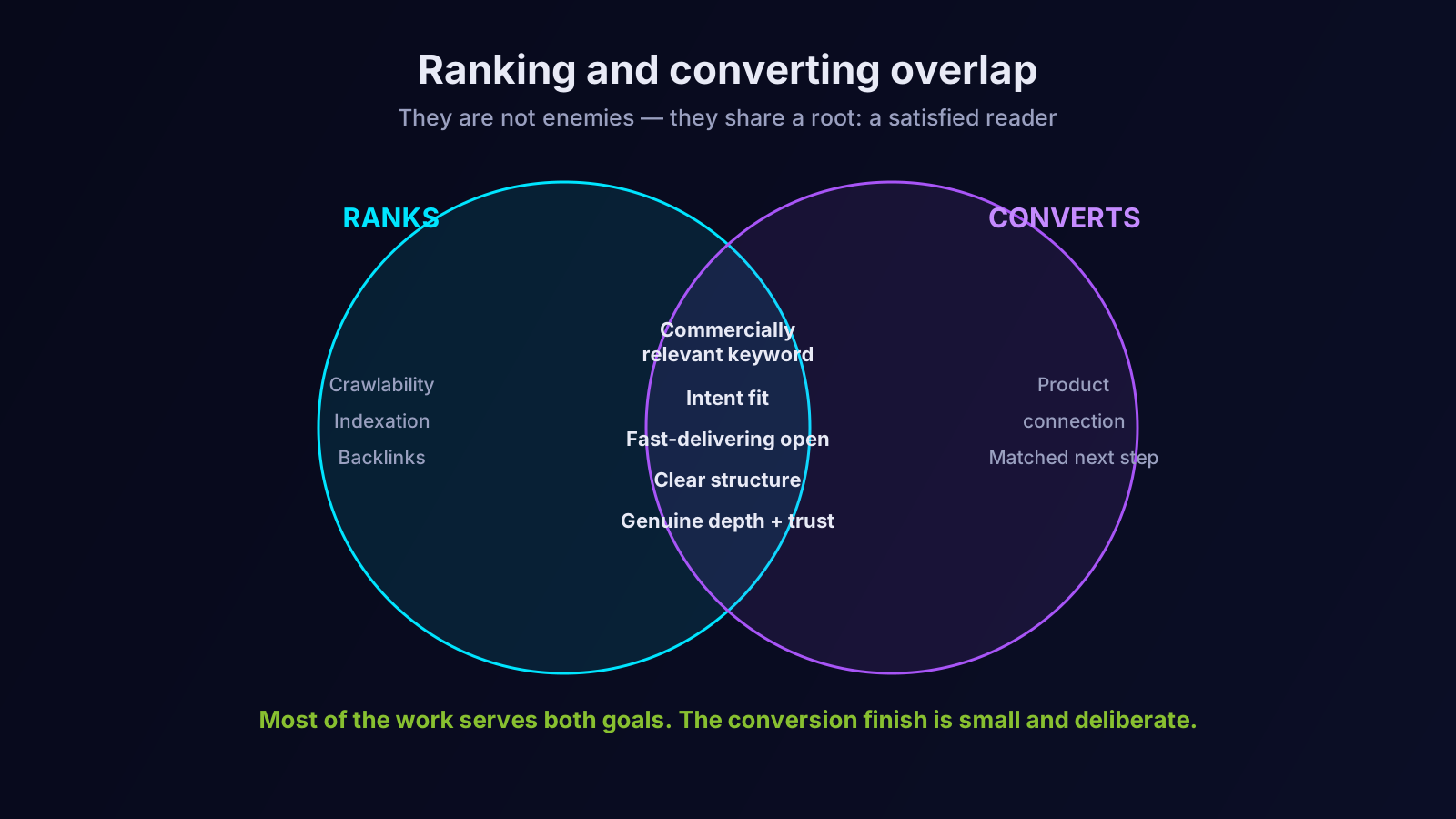
Before any tactics, the mental model. Ranking and converting feel like opposites because we measure them with different tools and assign them to different teams. But trace each back to its cause and they meet at the same root: a reader who got exactly what they came for.
Search engines rank pages that satisfy the searcher — that is, increasingly, the whole game. A page that genuinely answers the query, holds attention, and sends the reader away with their problem solved sends every signal a modern search engine rewards. And a reader who got exactly what they came for is also a reader in the right frame of mind to consider a next step — they trust you, they are engaged, the relationship is warm. The same event, a satisfied reader, produces both the ranking and the conversion. Once you internalise that, "ranking versus converting" dissolves. You are not balancing two goals. You are pursuing one outcome that happens to produce two results.
Step one: choose a keyword that can convert
The conversion of an article is decided before a word is written, in the choice of keyword. This is the step most teams rush, and it quietly determines the ceiling on everything that follows.
A keyword has two properties that matter here, and most teams only check one. The first is winnability — can a page of yours realistically rank for it? The second, the neglected one, is commercial relevance — does the searcher behind this keyword have any plausible path to becoming your customer? An article can rank perfectly for a keyword whose searchers will never, ever buy your product, and that article is a conversion dead end no matter how brilliant the writing. Before committing to a keyword, ask plainly: is the person typing this a potential customer, even a distant one? If the honest answer is no, the article may be worth writing for brand reasons, but do not expect it to convert, and do not measure it as if it should. Pick keywords where ranking and revenue can coexist — that is the discipline of turning keywords into a real content plan.
Step two: nail the search intent exactly
With a keyword chosen, the next step is understanding precisely what its searcher wants — their search intent. This step serves ranking and conversion simultaneously, which is why it is so important.
For ranking: a search engine has already decided what kind of content satisfies a query, and it shows you that decision in the current results. If every top result is a step-by-step tutorial, the intent is instructional, and an opinion essay will not rank no matter how good it is. Match the format the results reveal. For conversion: knowing the intent tells you the reader's mindset, and the mindset tells you the appropriate next step. A reader on a "what is" query is learning; a reader on a "best X for Y" query is shopping. Read the intent correctly and you simultaneously know how to structure the article so it ranks and how to pitch the next step so it converts. Misread it and you fail at both at once.
Step three: open by delivering, not warming up
The opening of the article carries an outsized share of both jobs. Most SaaS articles open badly — with several paragraphs of generic throat-clearing about how important the topic is — and that opening damages ranking and conversion together.
It damages ranking because a reader who hits four paragraphs of filler before the substance often leaves, and engagement signals suffer. It damages conversion because that same reader never reaches the part of the article that would have earned their trust. The expert move is to open by delivering value immediately: in the first paragraph or two, demonstrate that the reader is in the right place and acknowledge the real question they came with. You do not have to give away the whole answer in the first line, but you must signal, fast, that this page respects their time and intends to help. An opening that delivers keeps the reader, and a kept reader is the precondition for both a ranking and a conversion.
Step four: structure for the skimmer and the algorithm
The structure of the article — its headings, paragraph length, lists, and flow — is a place where the SEO goal and the conversion goal turn out to be the same goal wearing different clothes.
Clear, descriptive headings help a search engine understand the page's coverage of a topic. Those exact same headings let a human reader skim, find the part they need, and feel oriented rather than lost. Short paragraphs and well-used lists make a page easier for an algorithm to parse — and easier for a tired human on a phone to actually read. There is no tension here to manage. A well-structured article is well-structured for both audiences at once. The mistake teams make is structuring purely for the algorithm — keyword-laden headings that read like search queries rather than human signposts. Write the headings for the human; the algorithm benefits anyway. Structure is where serving the reader and serving the search engine are simply identical.
Step five: build genuine depth and trust into the body
The body of the article is where trust is earned, and trust is the currency that both goals spend. A search engine increasingly rewards content that demonstrates real expertise; a reader converts only for a company they have come to believe knows what it is talking about. Both are answered by the same thing: genuine depth.
Genuine depth is not length. It is specificity, honesty, and the inclusion of things a shallow article would omit — the caveats, the trade-offs, the situations where the obvious advice does not apply, the parts of the problem that are genuinely hard. A body that includes the inconvenient truths reads as written by someone who has actually done the work, and that perception drives both ranking signals and the trust that precedes a conversion. The expert article does not flatter the reader or oversimplify; it treats them as intelligent, gives them the real picture, and is rewarded with both rankings and credibility. Depth is the part of the job that cannot be faked, which is exactly why it works for both goals.
Step six: connect the problem to your product — without breaking the article
Here is the step that genuinely belongs to conversion, and the one most likely to be done clumsily. Somewhere in the article, the reader's problem has to be connected to the existence of your product. Done badly, this is a jarring sales lurch that wrecks the article's credibility and, ironically, its ranking too, because it makes the page feel like marketing rather than help.
Done well, the connection is a natural consequence of the content, not an interruption of it. The article explains the problem and the approaches to solving it honestly and thoroughly; somewhere in that honest explanation, it becomes naturally relevant to mention that this is a problem your product addresses, and how. The test is simple: if you deleted the product mention, would the article still be coherent and useful? If yes, the mention is integrated correctly — it adds, it does not hijack. If deleting it would actually improve the article, the mention is a lurch and must be reworked. The reader should never feel the article changed from helping them to selling to them. They should feel the help simply led, naturally, to the product.
Step seven: end with a matched, specific next step
The article closes with the call to action, and by now the expert approach should be predictable. The next step must be matched to where this article's reader actually is. An early-stage educational article should offer a small increment — a deeper guide, a relevant tool, a related article — not a demand for a sales call. A near-decision article can reasonably offer a trial or a comparison.
And the call to action should name a concrete benefit, not bark a bare verb. "See your site's top SEO issues in two minutes" earns a click that "Sign up" does not, because it answers the reader's silent cost-benefit question before they have to ask it. The next step is the genuinely conversion-specific work in this whole guide — but notice how small it is relative to everything else. Steps one through six were about quality that serves both goals. The conversion-specific addition is a single well-judged, well-worded invitation at the end. That is the actual ratio: ranking and converting are mostly the same work, with a small, deliberate conversion finish.
Step eight: review the finished article against both scorecards
Before publishing, run the article past two quick checks. The ranking check: does it match the intent the current results reveal, cover the topic with genuine depth, open without filler, and carry a clear structure? The conversion check: is its keyword commercially relevant, is the product connection integrated rather than bolted on, and does it end with a matched, benefit-led next step and a path onward through internal links?
An article that passes both checks is the thing this guide promised: a page built to earn its rankings and to turn the readers those rankings deliver into customers. Most articles pass one check and fail the other not because writing for both is hard, but because the writer only ever had one scorecard in mind. Hold up both, every time, and the false choice disappears.
Where an AI agent makes this repeatable
Everything in this guide is doable. The honest difficulty is not doing it once — any capable writer can produce one article that ranks and converts. The difficulty is doing it consistently across every article, for months, while also choosing commercially relevant keywords, reading intent accurately, and keeping the internal-link paths between articles coherent as the library grows. The method is teachable; the sustained, disciplined repetition is what defeats teams.
That is where an SEO AI agent changes the economics. Orova helps choose keywords that are both winnable and commercially relevant, reads the intent the live results reveal so each article is structured to rank, and keeps the internal links and next-step paths coherent so readers can travel from any article toward conversion. It makes the eight-step method above a repeatable system rather than a heroic effort sustained by one diligent writer. Writing an article that ranks and converts is not a special talent. It is a process — and a process is exactly the kind of thing an agent is built to run, reliably, at the scale a real content operation needs. (For the strategic context, see what an SEO AI agent is and why it changes content marketing.)
Let an AI Agent handle your SEO
Orova plans, writes, optimizes, and tracks rankings on its own — you just read the results.
Try it free