
Advantage+ Shopping Campaigns: When to Trust Meta's Automation and When to Steer

A few years ago, building a Meta campaign meant assembling a machine by hand: a campaign shell, three or four ad sets split by interest, lookalike percentages, placement toggles, age brackets, and a small spreadsheet to track which combination was quietly draining your budget. Advantage+ Shopping Campaigns (ASC) took that machine and hid most of the dials behind a single panel. You give Meta a budget, a country, a pile of creatives, and a conversion goal — and the system decides who sees what, where, and how often. For a lot of advertisers, results went up. For others, spend went sideways and nobody could explain why.
The confusion is understandable. ASC is sold as "set it and forget it," but the accounts that actually scale with it are not forgetting anything. They are quietly steering. The trick is knowing which levers still respond to your hand and which ones are now decoration. This article walks through how ASC allocates spend, the four controls that genuinely move outcomes, the common ways advertisers sabotage their own campaigns, and where a layer of daily analysis — human or automated — turns Meta's black box into something you can actually manage.
What Advantage+ Shopping actually does under the hood
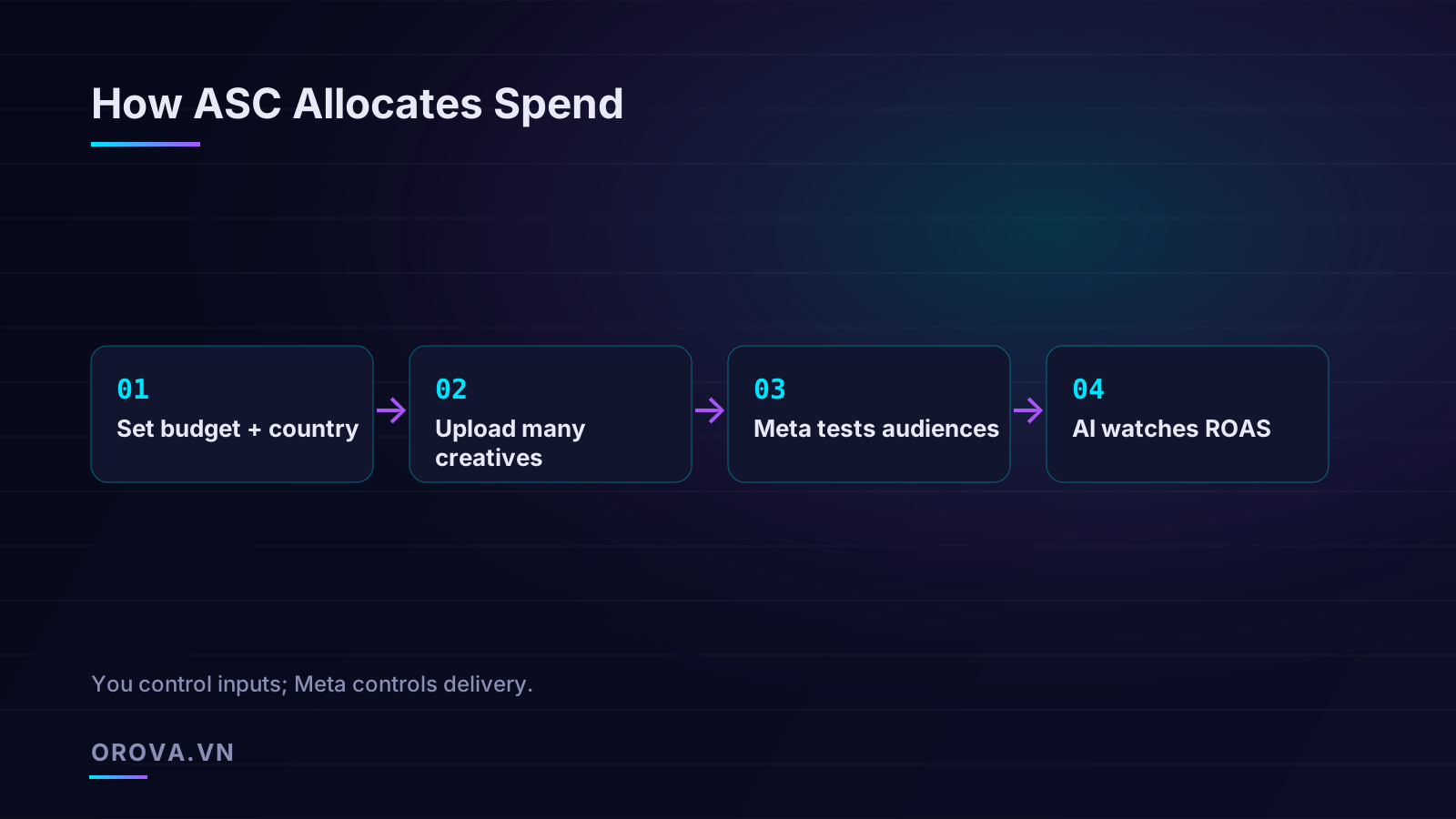
The cleanest way to understand ASC is to separate inputs from delivery. You own the inputs. Meta owns delivery. That single boundary explains almost every surprise people run into.
When you launch an ASC campaign, you are not building ad sets in the traditional sense. You hand the system a budget, pick the countries you want to serve, choose your optimization event (usually a purchase), and upload creatives — often dozens of them. From there, Meta's delivery system treats your entire addressable audience in those countries as the starting pool. It does not wait for you to define "women 25–34 interested in skincare." It uses the conversion signal flowing back from your pixel and Conversions API to find buyers wherever they are, then constantly reshuffles who gets shown which creative.
This is the part that trips people up: there is no audience to "fix." The targeting you used to obsess over is now an output of the algorithm, not an input from you. What you supply is the raw material — budget, geography, and a wide enough creative library — and the system runs a continuous auction-time experiment to figure out the rest.
Why broad targeting stopped being reckless
For a decade, "target everyone" was advertiser code for "waste your money." That logic assumed targeting was the only way to reach the right people. But targeting was always a proxy. You picked an interest because you believed people with that interest were more likely to buy. The pixel signal is a far better proxy than any interest list, because it learns from who actually purchased, not who Meta thinks fits a demographic label.
So broad targeting in ASC is not the same as broad targeting in a manual campaign. In a manual setup, going broad meant turning off the algorithm's best filter. In ASC, going broad means handing the algorithm the conversion signal as its filter — which is exactly what it is best at. The catch is that this only works when the signal is strong, clean, and high-volume. An account sending Meta noisy or sparse purchase data will get noisy, sparse targeting in return. Garbage signal, garbage delivery.
This is also why the quality of your tracking setup matters far more in the ASC era than it did when targeting was manual. With Apple's privacy changes and the steady erosion of browser-based pixel data, the Conversions API — server-side event reporting straight from your backend — has gone from a nice-to-have to the backbone of ASC performance. If half your purchase events never reach Meta because they were blocked at the browser, the algorithm is optimizing against a partial, distorted picture of who buys. Deduplicated, server-side conversion data is not a technical footnote here; it is the fuel the entire campaign runs on. Before blaming ASC for poor delivery, the first thing worth auditing is whether your conversion events are arriving complete and matched to real users.
The learning phase, but bigger
Every Meta campaign needs conversion volume to stabilize, traditionally around 50 conversions per ad set per week. ASC raises the stakes because there are no ad sets to spread that volume across — the whole campaign is one delivery engine. That is good news for accounts with thin budgets, because all your conversions concentrate in one place instead of being diluted across five ad sets that each starve for data. But it also means that if your campaign cannot generate enough purchases, the entire thing stays unstable, and no amount of creative swapping will rescue it. ASC rewards concentration. If your account is small, that concentration is a feature; if your conversion event is rare or expensive, it can be a trap.
The four levers you still own
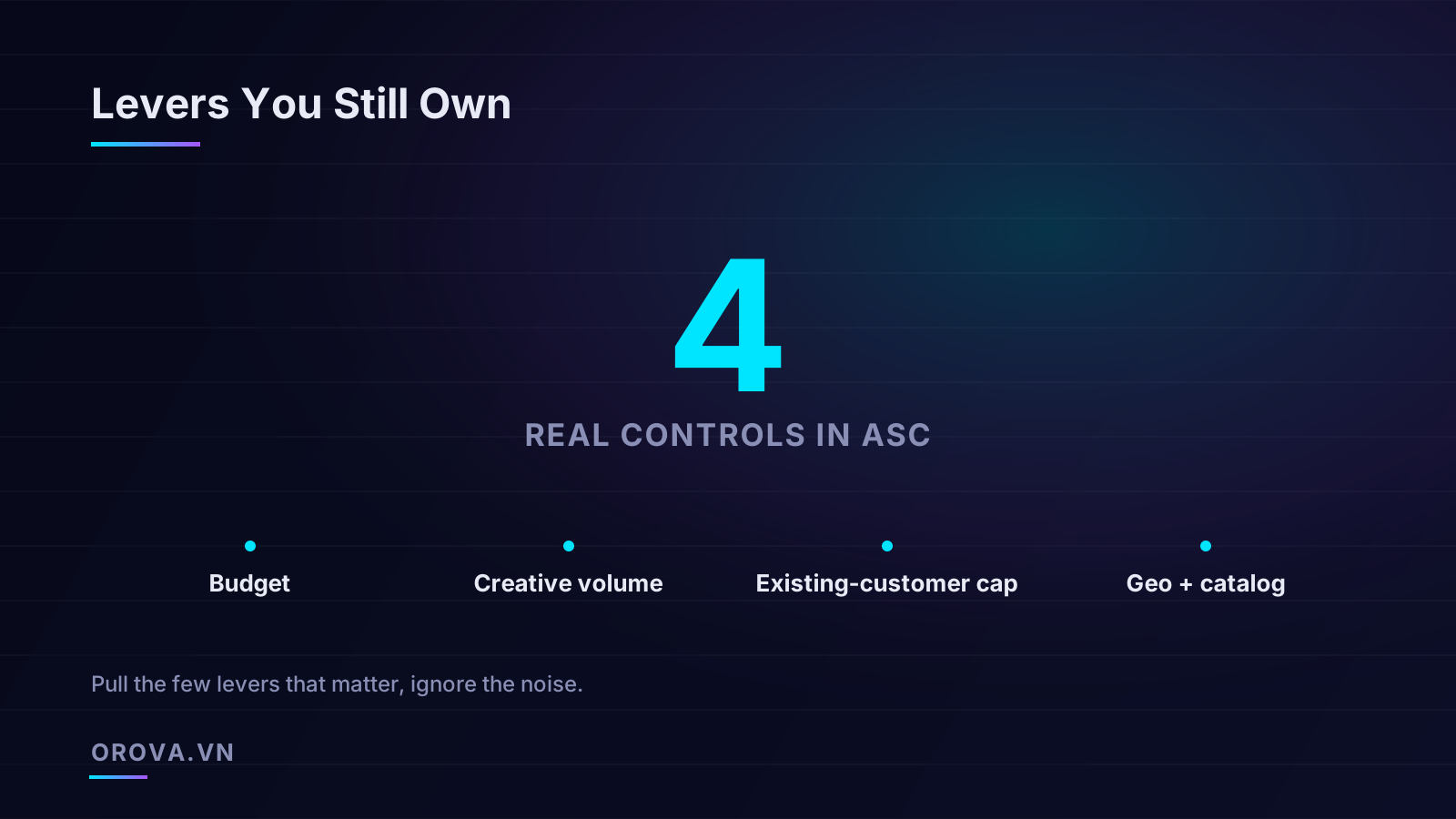
Strip away the marketing language and ASC leaves you with exactly four meaningful controls. Everything else is either automated or cosmetic. Pull these well and the campaign scales. Ignore them and you are gambling.
1. Budget — the single most powerful dial
Budget is no longer a number you set once. In ASC it is the primary instrument you play, because there is no audience to optimize and no bid to micromanage. How much you spend, and how fast you change it, is the main signal you send the algorithm about how aggressive to be.
Two practical rules matter here. First, ASC genuinely dislikes large, sudden budget swings. Doubling a daily budget overnight can throw the campaign back into an unstable, exploratory state — the delivery system effectively has to relearn how to spend the new amount profitably. The safer pattern is incremental: raise budgets by roughly 15–20% at a time, wait two or three days for performance to settle, then raise again. Slow and boring beats fast and chaotic.
Second, the right way to evaluate a budget change is by watching cost per acquisition and return on ad spend over a multi-day window, not hour to hour. ASC's intraday numbers are extremely noisy. A campaign that looks like it is collapsing at 11 a.m. is often perfectly healthy by the time the day closes. Reacting to the morning is how advertisers pause profitable campaigns.
2. Creative volume — your new targeting
Here is the mental shift that separates advertisers who win with ASC from those who don't: in this format, creative is targeting. Because you no longer choose audiences, the only way to reach different segments of buyers is to give the algorithm different creatives that resonate with different people. A single hero video can only attract one kind of person. Ten distinct creatives — different angles, formats, hooks, and offers — give Meta ten doors to test.
Volume matters, but variety matters more. Fifteen near-identical product shots are not fifteen creatives; they are one creative wearing fifteen outfits. What the system needs is genuine diversity: a problem-led video, a social-proof carousel, a founder talking to camera, a bold price-point image, a user-generated clip. Each one lets the algorithm find a pocket of buyers the others miss.
The flip side of needing volume is that creative wears out faster than people expect, especially as one ad takes the lion's share of delivery and starts hitting the same users repeatedly. Rising frequency and slipping click-through are early warnings that your winners are tiring. Treating ASC as a creative pipeline rather than a one-time upload is the difference between a campaign that plateaus and one that keeps scaling. If you want to go deeper on the mechanics of why this happens, our breakdown of Meta ad fatigue and frequency burnout covers how to read the warning signs before performance actually drops.
A practical cadence helps. Rather than dumping a creative library in once and waiting for it to decay, the strongest accounts add a small batch of fresh assets on a rhythm — say, three to five new creatives every week or two — and let the algorithm fold them in alongside the proven winners. This keeps a steady supply of fresh inventory entering the auction while the system still has stable performers to lean on, which avoids the jarring resets that come from wholesale creative overhauls. It also gives you a continuous read on which angles are working: when a new problem-led video immediately out-delivers your old price-point image, that is the market telling you something about how to position the product everywhere else, not just in ads.
One more nuance: don't confuse a creative that gets little delivery with a creative that failed. ASC concentrates spend on whatever is converting right now, so newer assets often get throttled before they have had a fair chance. The fix is not to panic and pause them; it is to keep feeding diversity and trust that the system will rotate toward a fresh winner when the current champion fatigues. Pruning too aggressively starves the very pipeline that keeps the campaign alive.
3. The existing-customer budget cap
This is the lever most advertisers either misunderstand or ignore entirely, and it quietly determines whether your reported ROAS is real growth or recycled revenue.
By default, ASC will happily spend money showing ads to people who already bought from you. Sometimes that is what you want — retention, repeat purchases, new product launches to a warm base. But often it inflates your numbers. Existing customers convert cheaply because they already trust you, so a campaign that leans on them looks brilliant on paper while doing almost nothing to grow the business. You are paying Meta to sell to people who would have come back anyway.
The existing-customer budget cap lets you decide what percentage of spend can go to people on your customer list. Set it to zero and ASC becomes a pure acquisition machine, chasing only new buyers. Set it to 30% and you reserve most of the budget for growth while letting a slice work your existing base. The right number depends on your goal, but the point is to choose it deliberately. Leaving it on default and then celebrating a 6x ROAS that is half-built on repeat buyers is one of the most common self-deceptions in performance marketing.
If your ASC ROAS looks too good to be true, check the existing-customer cap before you check anything else. The algorithm will take the easy conversions unless you tell it not to.
4. Geography and catalog
The fourth lever is the pairing of where you serve and what you sell. Country selection is straightforward but consequential: ASC pools all your conversion data across the chosen geographies, so adding a marginal country with weak conversion economics can dilute the signal that your strong markets depend on. It is usually better to run lean, focused geo sets than to blanket every market you can ship to.
The catalog side is subtler. If you connect a product catalog, ASC can dynamically match the right products to the right people, pulling from your feed rather than relying only on the static creatives you uploaded. A clean, well-structured catalog with accurate prices, good imagery, and complete product data gives the algorithm more to work with. A neglected feed — missing images, stale prices, broken links — silently caps performance no matter how good your other inputs are. Catalog hygiene is unglamorous, but for ecommerce accounts it is foundational.
How advertisers sabotage their own ASC campaigns
Most ASC failures are not the algorithm's fault. They are self-inflicted, and they cluster around a handful of predictable mistakes.
Killing the learning phase
The most expensive habit is impatience. ASC needs conversion volume and a few days of stable conditions to find its footing. Advertisers who edit budgets daily, swap creatives every 48 hours, or pause and relaunch at the first sign of a bad day never let the system stabilize. Every significant edit risks resetting learning, and a campaign perpetually stuck in learning will never deliver the efficiency ASC is capable of. The discipline here is counterintuitive: doing less, less often, usually produces more.
Running too many overlapping campaigns
Because ASC concentrates conversion data, splitting your budget across several ASC campaigns is almost always a mistake for small and mid-size accounts. Three campaigns each getting 20 conversions a week will all stay unstable; one campaign getting 60 will stabilize and outperform all three combined. Meta even competes with itself in the auction when you fragment, raising your own costs. Consolidation is one of the highest-return moves available, and it costs nothing to implement.
Thin or stale creative libraries
An ASC campaign with three creatives is starving. With creative serving as your only real targeting mechanism, a small library gives the algorithm almost nothing to explore. Worse, when those few creatives fatigue — and they will — performance falls off a cliff because there is no fresh inventory to rotate in. Accounts that win treat creative production as an ongoing process with a steady cadence of new assets, not a one-time launch task.
Misreading noisy data
ASC's reporting is volatile by nature, especially intraday and on small budgets. Advertisers who make decisions off a single bad morning, or off the first day after a creative refresh, are reacting to noise. Conversion attribution windows mean today's spend may not show its conversions for several days, so judging a fresh campaign on day-one ROAS is meaningless. The right evaluation window is rolling and multi-day; anything tighter and you are flying on static.
Where intelligent oversight adds value on top of Meta's AI
There is a tempting but wrong conclusion lurking in all of this: if Meta's AI handles targeting and delivery, surely there is nothing left for a human — or another AI — to do. The opposite is true. ASC automates the tactical work that used to fill your day, which frees up attention for the decisions that automation cannot make: when to push budget, when to pull back, which creative theme is quietly carrying the account, and whether your reported ROAS reflects real acquisition or recycled revenue.
Meta optimizes for the goal you give it within the constraints you set. It does not optimize for your business. It will happily spend to existing customers if the cap allows it, keep pouring budget into a campaign whose new-customer cost is creeping up, or let a fatiguing creative dominate delivery a week longer than it should — because from the auction's perspective, that creative is still "winning." Someone has to watch the layer above the algorithm: the trend lines, the blended economics, the moment a healthy campaign tips into diminishing returns.
The case for daily, structured review
The levers in ASC are few, but they need to be pulled at the right moments, and those moments are easy to miss when you are reviewing once a week between other work. The signals that matter — frequency climbing, new-customer CPA drifting up, ROAS holding only because of repeat buyers, a creative entering fatigue — develop gradually over days. Catch them early and a small budget nudge or a fresh creative keeps the campaign healthy. Catch them late and you are rebuilding from a dip.
This is precisely the kind of repetitive, data-heavy monitoring that suits automation. Reading the same metrics every morning, comparing them to a rolling baseline, flagging the few that have crossed a meaningful threshold, and proposing a specific action — that is mechanical work that a person does inconsistently and an agent does every single day without fatigue. The human judgment goes into approving the action and setting the strategy; the grind of watching goes to the machine.
What good oversight looks like in practice
Concretely, intelligent oversight of an ASC campaign means a handful of recurring checks. Is spend tracking toward the efficiency target on a multi-day basis, not just today? Is the existing-customer share of conversions where you intended it to be? Has any single creative crossed into fatigue, and is there a fresh asset ready to take its place? Are budget changes being made in measured increments rather than reactive swings? Is the campaign consolidated, or has it fragmented into competing shells?
None of these require reinventing Meta's delivery system. They sit on top of it, governing the four inputs you control. That governance layer — disciplined, daily, and tied to your actual business economics rather than the auction's narrow definition of success — is what turns ASC from a hopeful experiment into a reliable growth channel. The algorithm handles the millions of micro-decisions per day; you handle the four decisions per week that decide whether those micro-decisions are pointed at the right goal.
So, trust or steer?
The honest answer is both, in the right proportions. Trust Meta with what it is genuinely better at than any human: real-time targeting, placement selection, and auction bidding across an audience too large to manage by hand. The pixel signal beats your interest lists, broad delivery beats your hand-built segments, and fighting that is a losing game.
But steer hard on the four levers that remain yours. Feed the system a deep, diverse, constantly refreshed creative library. Move budgets in deliberate increments and judge them over days, not hours. Set the existing-customer cap on purpose so your numbers reflect real growth. Keep your geography focused and your catalog clean. And put a disciplined review process on top — one that watches the trends the algorithm ignores and acts on them before they cost you. Do that, and ASC stops being a black box you hope works and becomes a channel you can scale with confidence.
If watching those signals every day sounds like more than you want to do by hand, that is exactly the problem Orova Ads was built to solve. It is an AI agent that manages your paid campaigns across Google, Meta, and TikTok — reading your performance data every day, spotting fatigue and drift early, and recommending the specific budget, creative, and audience moves that keep ASC healthy. It can execute those changes for you, with your approval and a full audit log of everything it does, so you steer the strategy while the agent handles the daily watch.
Let an AI Agent handle your SEO
Orova plans, writes, optimizes, and tracks rankings on its own — you just read the results.
Try it free