
tCPA vs tROAS in Google Ads: Choosing the Right Smart Bidding Target
Two campaigns, same budget, same product feed, same account. One is set to Target CPA at $40. The other is set to Target ROAS at 400%. Six weeks later, the tCPA campaign has spent its budget every single day and delivered 312 conversions at an average cost of $41 — almost exactly on target. The tROAS campaign spent only 60% of its budget, delivered 180 conversions, but every dollar it spent returned $4.30 in revenue. Which one won?
That question has no universal answer, and that is precisely the point. Target CPA and Target ROAS are not two flavors of the same setting. They optimize for fundamentally different things — one chases a fixed cost per outcome, the other chases a ratio of revenue to spend — and choosing the wrong one for your business quietly caps your volume or quietly erodes your margin, often without throwing any obvious warning. You will not see a red banner in Google Ads telling you that tCPA is leaving profitable demand on the table, or that tROAS is starving your pipeline of leads. You only see it months later when the numbers do not add up.
This guide breaks down exactly when to use each, what value-based bidding actually requires before tROAS can work at all, the target-setting traps that wreck both, and how the targets themselves should shift over the year rather than sitting frozen the day you launched.
What tCPA and tROAS actually optimize
Both Target CPA (tCPA) and Target ROAS (tROAS) are Google's "smart bidding" strategies — automated, conversion-based bidding that uses machine learning to set a bid for every individual auction based on the predicted likelihood and value of a conversion. The signals feeding those predictions include device, location, time of day, browser, the user's recent behavior, the search query, and hundreds of other contextual factors that no human could adjust manually at auction speed.
The difference is the objective function. Target CPA tells Google: "get me as many conversions as possible while keeping the average cost per conversion at or near this dollar figure." It does not care whether one conversion is worth $50 and another is worth $5,000. To tCPA, a conversion is a conversion. It optimizes for count at a fixed cost.
Target ROAS tells Google something more sophisticated: "maximize the total conversion value I get while keeping the ratio of value-to-spend at or near this percentage." A tROAS of 400% means you want $4 of revenue for every $1 of ad spend. This strategy explicitly trades volume for value — it will happily pass on a cheap conversion if that conversion's predicted value is low, and it will bid aggressively on an expensive click if the predicted purchase is large.
Put plainly: tCPA is a volume strategy with a cost ceiling. tROAS is a value strategy with an efficiency floor. The first asks "how many can I get for this price?" The second asks "how much money can this make me at this return?"
Why the distinction matters more than it looks
Marketers routinely treat the choice as a stylistic preference, like picking a chart color. It is not. The two strategies will buy completely different traffic from the same account. Consider an ecommerce store with two products: a $25 phone case and a $1,200 laptop. Under tCPA set to $30, Google will gladly spend up to ~$30 to sell a phone case at a net loss, because the only thing tCPA tracks is conversion count and cost. Under tROAS, that same case sale gets deprioritized because its value is low — and the bidding leans into laptop buyers, where there is real money on the table.
The case sale that tCPA celebrated as a "conversion at target" is the same sale tROAS correctly ignored as margin-destroying. Same auction, opposite decision. That is why the choice is structural, not cosmetic.
Lead generation versus ecommerce: the cleanest dividing line
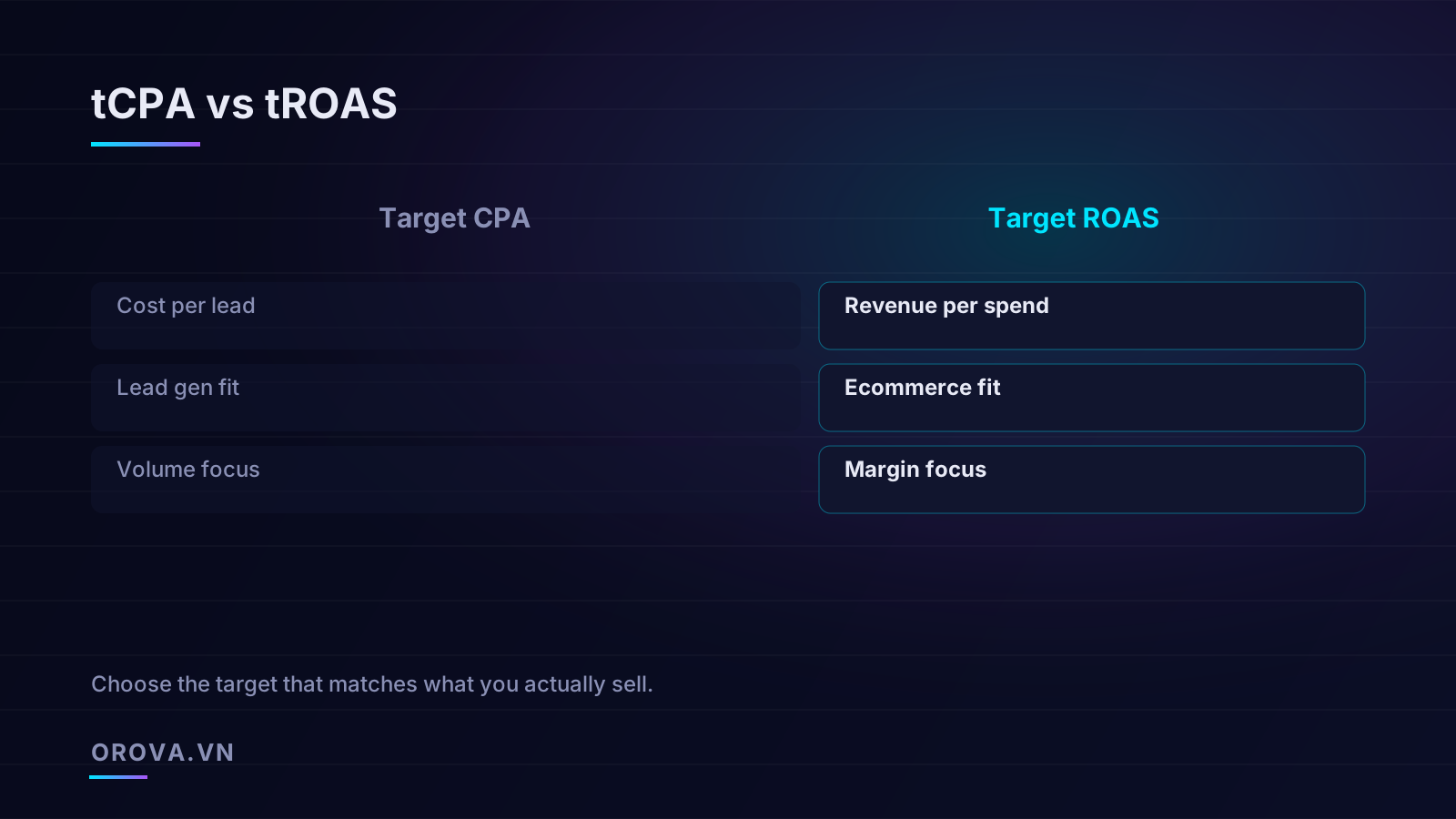
The single most reliable rule for choosing between the two is this: if every conversion is worth roughly the same to you, use tCPA. If conversions vary meaningfully in value, use tROAS. That rule maps almost perfectly onto the lead-gen versus ecommerce split, which is why the split is such a useful starting heuristic.
Why lead generation usually wants tCPA
In most lead-generation businesses, the conversion event is a form fill, a phone call, a demo request, or a quote submission. At the moment of conversion, you do not yet know what that lead is worth. A B2B SaaS company capturing a trial signup cannot tell, in the bidding system, whether this particular signup will become a $9/month self-serve account or a $90,000/year enterprise contract. Both look identical at the form-fill stage.
Because the immediate conversion value is unknown or uniform, tCPA is the natural fit. You decide what you can afford to pay for a lead — derived from your lead-to-customer conversion rate and your average customer value — and you let the system maximize lead volume at that cost. If you close 10% of leads and a customer is worth $2,000, a lead is worth ~$200; you might set tCPA somewhere below that to preserve margin and account for the leads that never close.
That said, the more mature lead-gen advertisers are increasingly moving toward value-based bidding even here, by passing back offline conversion values once leads progress through the funnel. We will return to that, because it is the bridge that lets lead-gen graduate from tCPA to tROAS.
Why ecommerce usually wants tROAS
Ecommerce has something lead-gen often lacks: a real, immediate, known dollar value at the moment of conversion. When someone checks out, you know the order value instantly. You can feed that exact number back to Google as the conversion value, and tROAS can do what it does best — concentrate spend on high-value purchases and accept a lower volume of expensive orders if that maximizes total revenue at your target return.
For a store with a wide range of order values — fashion, electronics, home goods, anything with a mix of cheap and premium SKUs — tROAS is almost always the right long-term destination. It protects margin by refusing to overpay for low-value carts and leans into the customers who actually move the revenue needle.
The gray zone, and how to think about it
Plenty of businesses do not fall cleanly on one side. A high-ticket lead-gen business where every deal is roughly $20,000 has near-uniform value — tCPA is fine. An ecommerce store that sells a single product at a single price point also has uniform value — tCPA works there too, and is often simpler. Conversely, a lead-gen company that has invested in offline conversion tracking and can pass back deal sizes should move to tROAS to stop treating a $90,000 enterprise lead the same as a $9 hobbyist.
The question is never really "am I ecommerce or lead-gen?" It is "do my conversions vary in value, and can I measure that variation reliably enough to feed it into bidding?" If the answer to both is yes, tROAS. If the value is uniform or unmeasurable at conversion time, tCPA.
What value-based bidding actually requires
Here is where a lot of accounts go wrong. Advertisers flip on tROAS because it sounds more advanced, without realizing that tROAS is only as good as the conversion-value data you feed it. If you do not send accurate, differentiated values, tROAS degenerates into a worse, noisier version of tCPA — it is optimizing for a value signal that does not actually reflect reality.
The prerequisites for tROAS to work
- Dynamic conversion values. Every conversion must report its actual revenue, not a flat placeholder. If your checkout passes the literal transaction total to Google, you are set. If it passes "1" for every order, you have no value variation, and tROAS has nothing to optimize.
- Accurate value attribution. The value you send should reflect what you care about. Many advertisers send gross order value but actually care about margin. Sending gross revenue tells tROAS to chase high-revenue, low-margin products. If margins vary widely across your catalog, consider sending margin-adjusted values or using value rules to correct for it.
- Enough conversion volume. Smart bidding needs data to learn. Google's historical guidance points to roughly 15 conversions in the past 30 days as a working floor for tCPA, and meaningfully more — often 50+ conversions in 30 days — before tROAS has enough value distribution to model returns reliably. Thin data makes tROAS erratic.
- Value consistency over time. If your values are wildly inconsistent — say, refunds and returns that are not corrected, or test orders that inflate value — the model learns from noise.
Returns, refunds, and the value you forget to subtract
A subtle trap in value-based bidding: the revenue you report at checkout is not the revenue you keep. If a category has a 40% return rate, sending full order value to Google teaches tROAS to over-invest in returns-heavy products. Mature ecommerce advertisers feed back net values — using offline conversion imports or value adjustments to claw back returned revenue — so the bidding model optimizes for money that actually stays in the bank. This is exactly the kind of correction that is tedious to maintain by hand and that benefits enormously from automation.
The target-setting traps that wreck both strategies
Choosing the right strategy is only half the job. The number you put in the target field determines whether the strategy thrives or chokes. Both tCPA and tROAS share a family of setting mistakes.
Trap 1: setting an aspirational target instead of a realistic one
The most common mistake by far. An advertiser whose campaign has historically run at a $60 CPA decides they want a $30 CPA, so they set tCPA to $30 on day one. The result is not a $30 CPA — it is a collapse in volume. Smart bidding lowers bids dramatically to try to hit the impossible target, the campaign stops entering most auctions, conversions dry up, and the campaign exits the learning phase having learned almost nothing.
The fix is to anchor your target to reality. Pull the campaign's actual CPA or ROAS over a stable recent period and set the target at or very close to that figure. You earn the right to a more aggressive target by improving the campaign, not by typing a smaller number into the box.
Trap 2: changing the target too aggressively
Even when advertisers anchor correctly, they often then yank the target by 30%, 40%, or more in a single move. Smart bidding treats a large target change as a significant disruption and re-enters a learning period, during which performance is volatile and unpredictable. Repeated big swings keep the campaign permanently unstable. The discipline that works: move targets in increments of roughly 10–20% at a time, then wait for the system to stabilize — typically one to two weeks, or one conversion cycle — before the next adjustment.
Trap 3: ignoring the conversion delay
If your typical buyer takes 7 days from first click to purchase, then today's spend will not show its conversions for a week. Judge a tROAS campaign on three days of data and you will see a terrible return that is simply incomplete. Always evaluate smart bidding over a window at least as long as your conversion lag, and ideally several times longer, before concluding the target is wrong.
Trap 4: the volume-versus-efficiency tug-of-war
This is the trap that sits underneath all the others, and it is where the tCPA-vs-tROAS choice reveals its real cost. A stricter target — lower tCPA or higher tROAS — always buys efficiency at the expense of volume. A looser target buys volume at the expense of efficiency. There is no target that gives you both maximum scale and maximum return; the frontier is a trade-off curve, and your target picks a point on it.
The right target is not the most efficient one your spreadsheet can imagine. It is the point on the volume-efficiency curve that maximizes total profit — which is usually looser than your gut wants, because the marginal conversions you give up by tightening too far were often still profitable.
Many advertisers tighten their target until efficiency looks beautiful on a per-conversion basis, then wonder why total profit fell. They optimized the ratio and forgot the absolute. If you can profitably absorb more volume, a slightly looser target that captures more conversions often beats a tighter one that looks prettier per unit.
How to actually set the target the first time
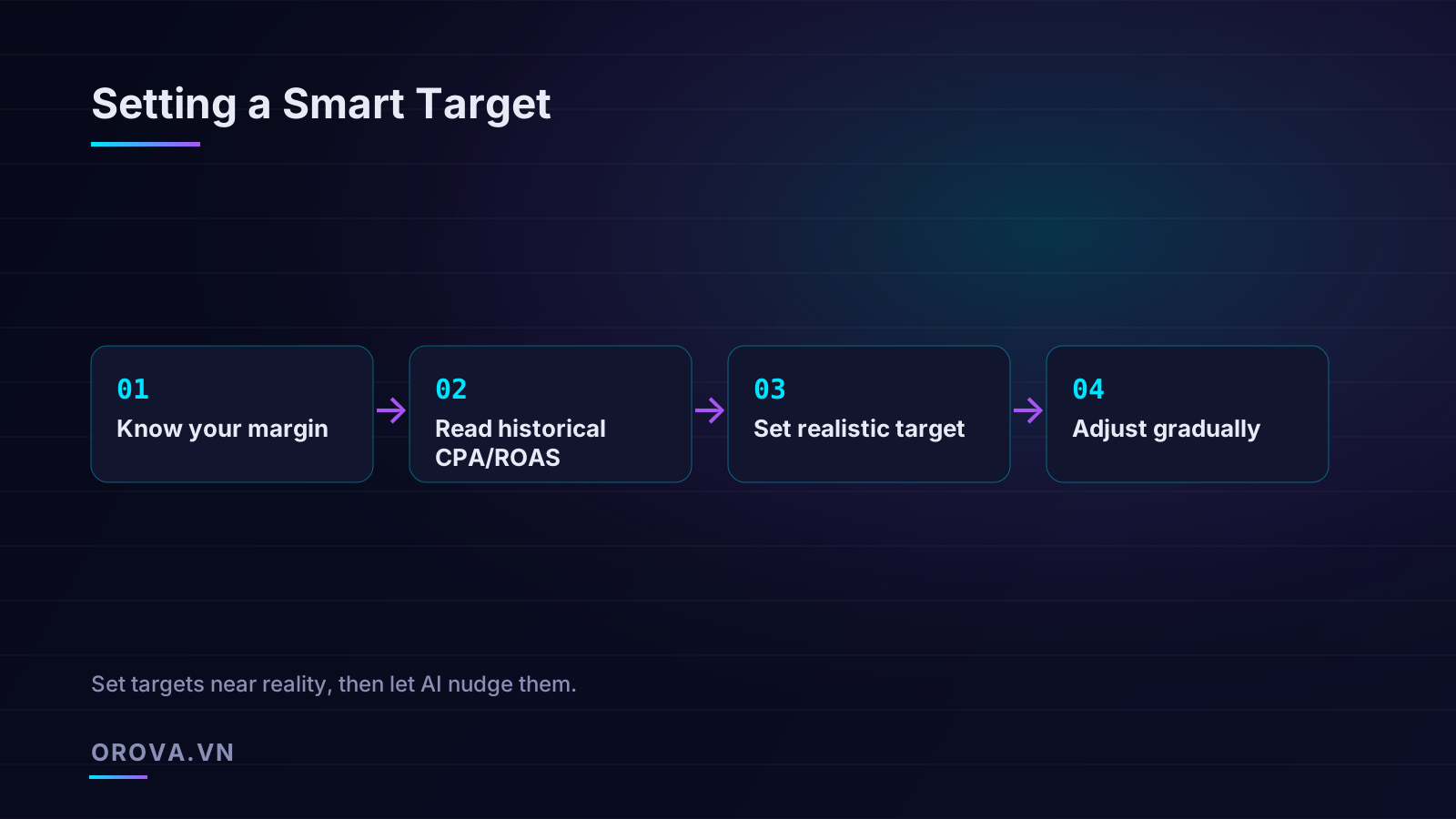
The figure above sketches the sequence. Here it is in practice.
- Know your margin and break-even. For tROAS, your break-even ROAS is simply your total revenue divided by your gross margin — if you keep 33 cents on the dollar, you break even at roughly 300% ROAS, so any profitable target lives above that. For tCPA, your break-even CPA is the gross profit you make per conversion. You cannot set a sane target without these two numbers.
- Read the historical numbers. Look at what the campaign or a comparable campaign has actually achieved over a stable 30–60 day window. That achieved CPA or ROAS is your anchor.
- Set a realistic target at the anchor. Start at or very near the historical figure. If the campaign is brand new with no history, start looser than you think you need — you can always tighten — because starting too tight strangles the learning phase.
- Adjust gradually. Once stable and profitable, tighten the target in 10–20% steps toward your goal, pausing between moves to let the system re-learn and to confirm the new target holds without cratering volume.
This is deliberately conservative. The cost of an over-aggressive target is days or weeks of wasted learning and lost conversions. The cost of a too-conservative start is a slightly higher CPA for a week before you tighten. The asymmetry favors starting loose.
Targets are not "set and forget" — they should move with your business
The biggest unspoken failure mode is treating the target as a constant. You set tROAS to 400% in February and it is still 400% in November, despite the fact that your margins, inventory, competition, and seasonal demand have all shifted underneath it. A target that was correct in a quiet quarter is wrong during peak season, and a target tuned for a clearance push is wrong once full-price inventory returns.
When the right target genuinely changes
- Seasonality. During high-intent periods like the holiday run-up, demand and conversion rates rise; a temporarily looser target (lower tCPA bar, lower tROAS requirement) lets you capture volume that is genuinely there and disappears after the season. Holding your off-season target through peak leaves easy money uncollected.
- Margin shifts. A supplier price increase that compresses your margin should push your break-even ROAS up — and therefore your target ROAS up — or you will be buying revenue that no longer profits.
- Inventory and goals. A quarter where leadership wants aggressive growth justifies a looser target to chase share. A quarter focused on profitability justifies a tighter one. The target should encode the current business goal, not last quarter's.
- Promotions. A 20%-off sale temporarily improves conversion rate and changes per-order economics; the target should flex for the promo window and revert after.
Why this is exactly the work humans do badly
Re-deriving the optimal target every time margins, seasonality, conversion lag, and competition shift is genuinely hard to do by hand, and almost nobody keeps up with it. It requires reading fresh performance data daily, recomputing break-even from current margins, distinguishing a real trend from random daily noise, and then moving the target in small, safe increments rather than panicked jumps. Most teams check in monthly at best, which means their targets are wrong most of the time — too tight when demand is high, too loose when margins compress.
This is the same continuous-tuning logic that makes automated, value-aware campaign types work, and it is worth understanding the broader machinery here — our breakdown of how Google's most automated campaign type makes its decisions in Performance Max demystified covers how these signals stack up across the wider system, since Performance Max leans on the very same tCPA and tROAS targets you are setting.
A practical decision checklist
When you sit down to choose, run through this in order:
- Do my conversions vary in value? No → tCPA. Yes → continue.
- Can I measure that value accurately at conversion time, or via offline import? No → tCPA for now; build value tracking before moving on. Yes → continue.
- Do I have enough conversion volume — comfortably more than 15 a month, ideally 50+ for value bidding? No → start with tCPA (or even Maximize Conversions) to gather data. Yes → tROAS is viable.
- Do I want to defend margin (tROAS) or maximize qualified volume at a known cost (tCPA)? Let the actual business goal decide the final call.
And a quick gut-check once you are live: if your tCPA campaign is spending its full budget every day and you suspect there is profitable demand beyond it, you may be leaving volume on the table — loosen the target or raise the budget. If your tROAS campaign chronically underspends, your target is likely too strict for the available demand at that return; loosen it in steps until spend and return reach a healthy balance.
The bigger lesson
tCPA and tROAS are not a beginner-versus-advanced choice, and tROAS is not simply "the better one." They are two answers to two different questions, and the right answer depends on whether your conversions carry uniform or variable value — and on whether you can measure that value well enough to trust it. Pick the strategy that matches what you actually sell, anchor the target to reality, move it gently, and revisit it as your margins and seasons change. Do those four things and smart bidding does what it was built to do. Skip any of them and it quietly costs you volume or margin while the dashboard looks fine.
The hard part is not the initial decision — it is the relentless, data-driven maintenance afterward. Orova Ads is an AI agent that does exactly that across Google, Meta, and TikTok: it reads your performance data every day, recomputes the right tCPA and tROAS targets as your margins and seasonality shift, and executes the adjustments — budgets, bids, on/off, audiences — with human-in-the-loop approval and a full audit log of every change. If keeping your targets honest all year sounds like work you would rather not do by hand, see how Orova Ads handles it.
Let an AI Agent handle your SEO
Orova plans, writes, optimizes, and tracks rankings on its own — you just read the results.
Try it free