
Content-Led Growth: Turning Readers Into Revenue
Every SaaS founder eventually has the same uncomfortable conversation. The blog has traffic. The numbers in the analytics dashboard go up and to the right. There is a graph somebody is proud of. And then the finance person asks the question that turns the room quiet: "How much revenue did that bring in?" The honest answer, far too often, is a shrug.
This article is about closing that gap — about turning a content operation from a cost centre that produces page views into a growth engine that produces customers. That model has a name: content-led growth. It is not a hack, not a trick, and not a clever loophole in the algorithm. It is a deliberate way of building a business where content does the heavy lifting of acquisition, and it is one of the most durable competitive advantages a SaaS company can build. This is, openly, a commercial argument. If your content currently produces applause instead of revenue, read on, because the fix is structural and entirely within your control.
What content-led growth actually means
Content-led growth is a go-to-market strategy in which content is the primary channel through which strangers discover your product, learn to trust it, and decide to buy. Not a supporting actor that "builds brand" while paid ads do the real work — the lead actor.
The distinction matters because most companies say they do content marketing while actually doing content decoration. They publish articles because a competitor has a blog, because an investor asked about SEO, because it feels like the responsible thing to do. The content exists alongside the business. In a content-led company, the content is a load-bearing wall of the business. Remove it and acquisition collapses. That is the bar, and it is worth being honest about whether your current operation would clear it.
Why content-led growth beats renting attention
Here is the commercial heart of the argument. The dominant alternative to content-led growth is paid acquisition — you pay a platform to put your message in front of people. It works, it is fast, and it has one fatal property: the moment you stop paying, it stops. You are renting attention, and the rent never stops rising.
Content-led growth builds an asset you own. An article that ranks is not a rented slot; it is a piece of digital property that brings visitors next month, next quarter, and next year, with no recurring media spend. The first article costs real money to produce. The hundredth visit it earns costs nothing. The thousandth costs nothing. Over a long enough horizon, the cost per acquired customer from content trends toward a number that paid channels can never touch, because paid channels have a price floor — the auction — and content does not.
There is a second, quieter advantage. Paid channels are controlled by other companies that can change their rules, their prices, and their targeting overnight, and have. A content-led pipeline rests on your own pages, your own domain, your own compounding authority. It is the difference between owning your storefront and renting a stall in someone else's market that they can reorganise — or close — whenever it suits them.
The mechanism: how a reader becomes revenue
"Turning readers into revenue" sounds like a slogan until you trace the actual mechanism, step by step. It is not magic. It is a chain, and every link can be designed.
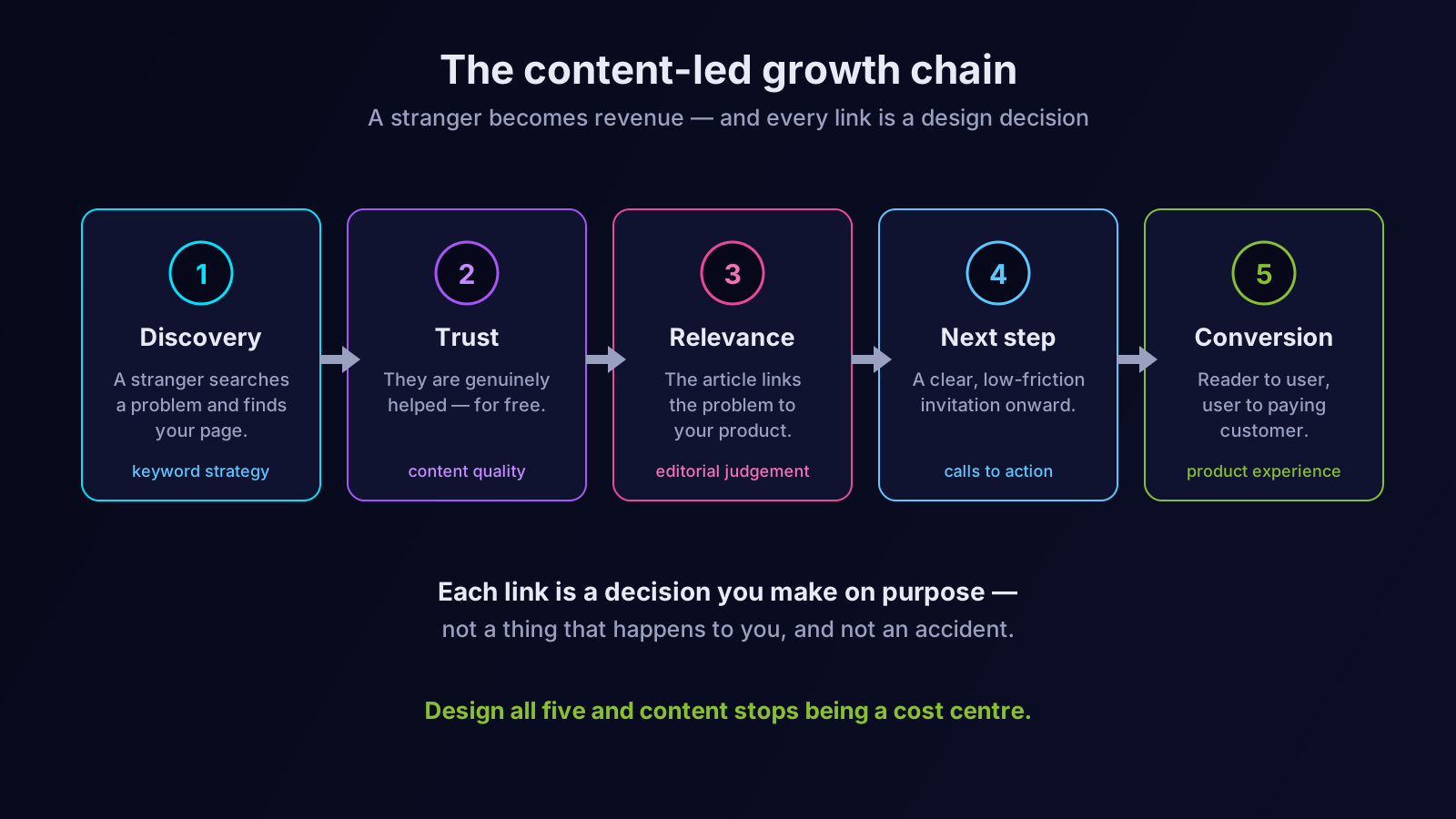
It begins with discovery. A person has a problem and types it into a search engine. If you have published a genuinely useful page targeting that problem, you appear, and a stranger who has never heard of your company arrives on your site. Then comes trust. That visitor reads something that actually helps them — clear, specific, honest, and free. In that moment a small but real transfer happens: they begin to believe that a company which explains this problem so well probably also knows how to solve it. Then relevance: the content connects, naturally and without a hard sell, the problem they came for to the product you make. Then the next step: a clear, low-friction invitation to go further — a deeper guide, a free trial, a tool. And finally, over one visit or twenty, conversion: the reader becomes a user, and the user becomes a paying customer.
Notice that every link in this chain is a decision you make, not a thing that happens to you. Discovery is keyword and topic strategy. Trust is content quality. Relevance is editorial judgement. The next step is calls to action. Conversion is the product experience. Content-led growth is simply the discipline of designing all five links on purpose instead of hoping they connect themselves.
Why most content blogs leak revenue at every stage
If content-led growth is a chain, then most underperforming blogs are leaking at predictable joints. Naming the leaks is the first step to sealing them.
The first leak is at discovery: the blog publishes content nobody is searching for — company news, opinion pieces, internal updates — so the page exists but no stranger ever finds it. The second leak is at relevance: the blog ranks beautifully for topics that have nothing to do with what the company sells, so it earns traffic that could never become a customer. A project-management company that ranks for "team-building games" gets visitors, and exactly none of them are in the market for project-management software. The third leak is at the next step: the article helps the reader, the reader nods, and then the page simply ends, offering nowhere to go. The visitor leaves satisfied and gone forever. The fourth leak is at conversion: the call to action exists but is mistimed, mismatched, or so aggressive it repels. Each leak is fixable, but you cannot fix what you have not located — and "we have traffic but no signups" is a diagnosis far too vague to act on.
The strategy: build for the funnel, not just the top
The single biggest strategic error in SaaS content is publishing only top-of-funnel material — broad, educational articles about the problem space — and nothing else. Top-of-funnel content is important; it is how strangers first find you. But a pipeline made only of top-of-funnel content is a pipeline with an entrance and no exit.
A content-led growth operation builds deliberately across the whole funnel. Top-of-funnel content attracts the stranger with the problem. Middle-of-funnel content — comparisons, frameworks, how-to guides, deeper explorations — helps the now-engaged reader evaluate approaches and start to see your product as a serious candidate. Bottom-of-funnel content — use cases, "X versus Y" pages, pricing explainers, integration guides — meets the reader who is ready to decide and removes the last objections. Most SaaS blogs are eighty percent top-of-funnel and almost nothing else. The result is exactly the symptom we started with: lots of traffic, very few signups. The traffic is real. It simply has nowhere to go because nobody built the rest of the road. To turn a content blog into a revenue engine, you have to map your topics deliberately across all three stages — the discipline behind a real content plan built from keywords.
The role of internal links in content-led growth
Here is a piece of the machine that almost everyone underuses. Internal links are the rails on which a reader travels from a top-of-funnel article they found by accident toward the bottom-of-funnel page that turns them into a customer.
A reader rarely lands on your pricing page directly from a search. They land on an article. If that article links — naturally, helpfully — to a deeper guide, and that guide links to a comparison page, and that comparison page links to a free trial, you have built a path. Without those links, every article is an island, and the reader who finished it has no bridge to the next stage. They leave not because they were uninterested, but because you forgot to show them the door. A serious content-led operation treats internal linking as a conversion system, not a technical afterthought — a deliberate network of paths from where readers arrive to where revenue happens.
Patience: the part nobody wants to hear
An honest commercial pitch does not hide the catch, and content-led growth has one. It is slow to start. A new article does not rank the day it is published; it climbs over weeks and months. A content-led pipeline can take two or three quarters before it produces meaningful, predictable revenue.
This is precisely why so many companies abandon it and retreat to paid ads — paid ads produce a number this week, and content produces a number next quarter. But the patience is the moat. The slow ramp that tempts your competitors to quit is the same dynamic that makes the eventual position so defensible. A content-led pipeline that has been compounding for three years cannot be matched by a competitor in a month, however large their budget, because authority and a deep library of ranking pages cannot be bought in a hurry. The patience tax is real. It is also the price of an advantage that, once built, is extraordinarily hard for anyone to take from you.
How to measure it without lying to yourself
Content-led growth lives or dies on honest measurement, because the easiest metrics — page views, sessions, time on page — are exactly the ones that let a failing operation look successful. To run content as a growth engine, you have to measure the chain, not the applause.
Track how many of your visitors come from content rather than other channels. Track how many of those content visitors take a next step — start a trial, request a demo, create an account. Track how many of those become paying customers, and how long that takes. Track which specific articles sit at the start of journeys that end in revenue. These numbers are harder to gather than a page-view count, and they are the only numbers that tell you whether content is growing the business or merely entertaining it. A content operation that cannot answer "which articles produced customers this quarter?" is not yet a growth engine — it is a publication that hopes.
The economics, stated plainly
Strip away the strategy talk and the economics of content-led growth are simple enough to fit on an index card. You make a one-time investment to produce an article. That article, if it is built correctly — searched-for topic, genuine quality, relevant to your product, with a clear next step and links onward — becomes an asset that acquires customers indefinitely at a marginal cost approaching zero.
Do this once and you have a curiosity. Do it a hundred times, deliberately, across the whole funnel, with the pieces linked into paths, and you have a pipeline that produces customers every day, including the days you publish nothing and the days the marketing team is on holiday. That is the asset. That is why content-led growth, despite its slow start, is one of the highest-return uses of a SaaS marketing budget in existence. You are not buying clicks. You are building property.
Where an AI agent makes content-led growth practical
The strategy in this article is not controversial. Most SaaS teams broadly know they should build content across the funnel, link it into paths, and measure it down to revenue. They do not fail on knowing. They fail on doing — because doing it properly is a large, continuous, multi-disciplinary operation that a small marketing team simply cannot sustain by hand. The plan is sound; the workload defeats it.
This is the gap an SEO AI agent is built to close. Orova finds the searched-for topics that map to real buying intent, helps structure them deliberately across the funnel rather than piling up at the top, keeps the internal links that form conversion paths coherent as the library grows, and ties content back to the outcomes that matter so you can see which articles actually produced customers. It turns content-led growth from a strategy a team admires into a system a team can actually run. The idea was never the hard part. The sustained execution was. Hand the execution to an agent, and turning readers into revenue stops being an aspiration and becomes the way your pipeline simply works. (For the bigger picture, see what an SEO AI agent is and why it changes content marketing.)
So here is the offer, stated one more time and without decoration. A customer-acquisition channel you own outright, that compounds instead of depreciating, that cannot be switched off by another company's pricing decision, and that gets cheaper per customer every single month it runs. The price of admission is patience and disciplined execution. For any SaaS that intends to still be growing in three years, that is not an expensive trade. It is the obvious one.
Let an AI Agent handle your SEO
Orova plans, writes, optimizes, and tracks rankings on its own — you just read the results.
Try it free