
The CTA Mistakes Buried in Most SaaS Articles
Read almost any SaaS blog article to the end and you will witness the same small tragedy. The piece is genuinely useful. It explains something clearly, the reader has been helped, and they are — for one fleeting moment — warm toward the company that helped them. And then the article ends with a call to action so misjudged that the moment evaporates. Either there is no call to action at all, or there is one so generic, so mistimed, or so tone-deaf that it actively repels the very reader it was meant to convert.
This is a critical article, and the target of the criticism is not the writers but the lazy conventions they have inherited. The call to action — the CTA — is where a content article either converts a reader or wastes them, and most SaaS articles waste them. Not through one dramatic error but through a handful of small, repeated, almost invisible mistakes that everyone copies from everyone else. This piece names those mistakes plainly, because you cannot stop making a mistake you have never seen described.
Mistake one: there is no CTA at all
The most expensive mistake is also the most common, and it hides behind a virtue. The writer, wanting to seem helpful rather than salesy, ends the article on the last point of substance and simply... stops. No invitation, no next step, nothing. The reader, having been helped, has nowhere to go.
This is presented as restraint. It is actually negligence. You have spent real money attracting this person, real effort earning a sliver of their trust, and at the precise moment that trust is highest you show them a door marked exit and nothing else. A CTA is not an imposition on the reader. A reader who has just been genuinely helped is often looking for a next step — they want to know who helped them and what else that company can do. Denying them a path is not politeness. It is abandoning them at the top of a staircase you forgot to build.
Mistake two: the generic, identical, everywhere CTA
The second mistake is the opposite failure and just as costly. The article does have a CTA — the same CTA that sits at the bottom of every other article on the site. "Start your free trial." "Book a demo." A box, a button, a slogan, dropped in by template, identical on a beginner explainer and an advanced technical deep-dive.
The problem is that a single generic CTA assumes every reader of every article is at the same point in their decision. They are not, and they are not even close. Someone who just read "what is customer churn" is a curious newcomer. Someone who read "how to migrate from competitor X" is days from a purchase. Hitting both with the identical "Book a demo now" is a mistake in two directions at once: it asks too much of the newcomer, who is not remotely ready, and it under-serves the near-buyer, who might have wanted something more concrete. A generic CTA is not a CTA strategy. It is the absence of one, wearing a button.
Mistake three: the mismatched ask
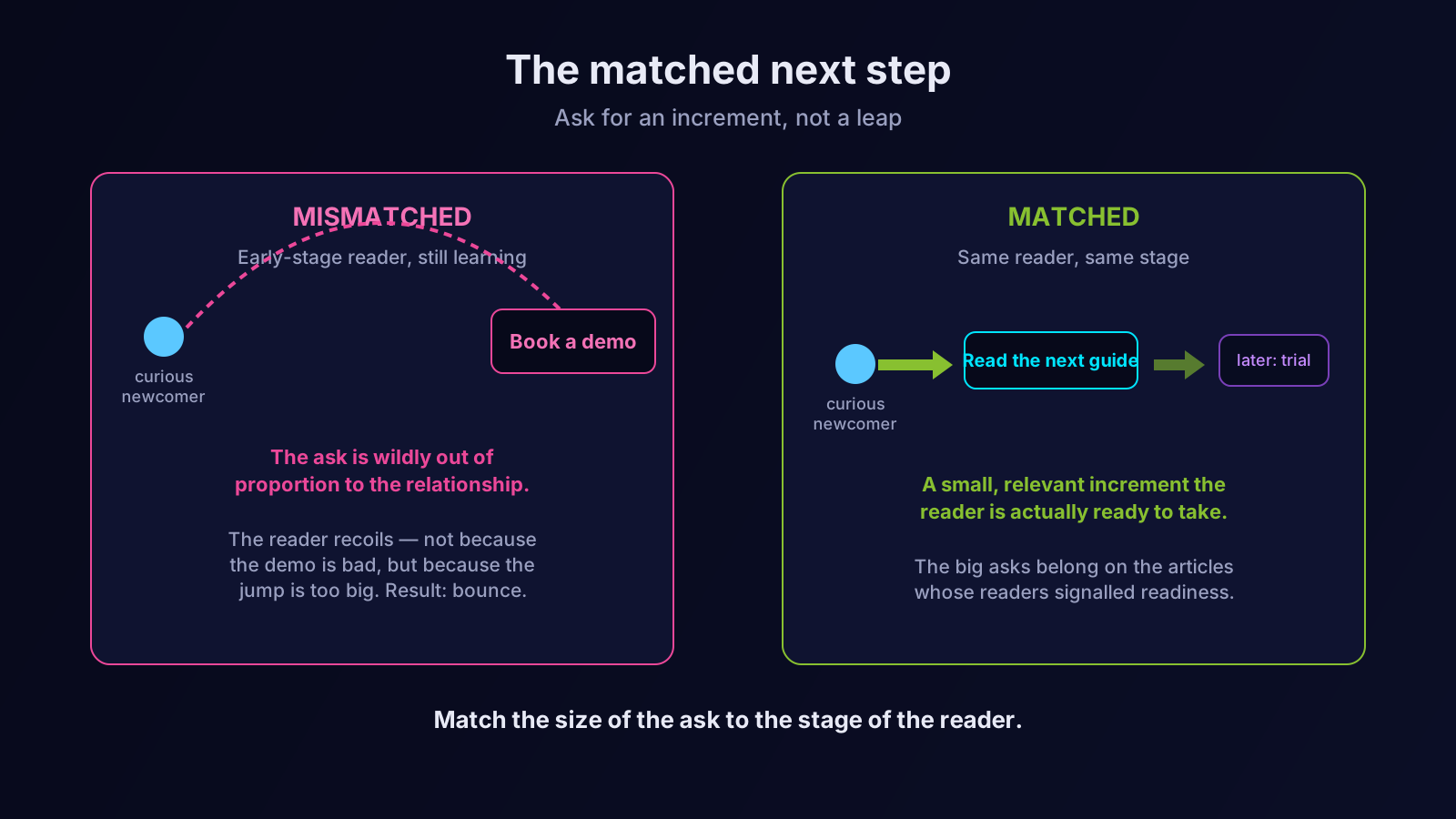
Closely related, and worth isolating, is the mismatch between what the article is about and what the CTA asks for. A reader arrives on an early-stage, educational article — they are exploring, framing a problem, not shopping. The article ends by demanding they "Book a 30-minute demo with our sales team."
That is a wild mismatch of energy. The reader wanted to understand a concept; you responded by asking them to schedule a call with a salesperson. It is the conversational equivalent of answering a stranger's question about directions by proposing marriage. The reader recoils — not because the demo is bad, but because the size of the ask is grotesquely out of proportion to the relationship. The fix is the principle of the matched next step: the CTA should ask for an increment, not a leap. An educational article should offer a slightly deeper piece of education, or a low-commitment tool. The big asks belong on the articles whose readers have signalled they are ready for them.
Mistake four: the CTA that interrupts instead of invites
Some SaaS articles commit the opposite of the no-CTA sin: they have too many, and they are too aggressive. A pop-up four seconds after the page loads. A sticky bar that eats a quarter of the screen. An inline box every three paragraphs. A second pop-up triggered when the reader's mouse drifts toward the back button.
Each of these is defended as "conversion optimisation," and each of them treats the reader as prey. The mistake is a misunderstanding of what a CTA is for. A CTA should ride the trust the article has earned. Trust is earned by the reader getting value from the content. An aggressive pop-up that fires before the reader has read a single useful sentence has earned nothing — it is asking for the sale before delivering the help. It interrupts the very value-delivery that would have made a later CTA welcome. The aggressive-CTA site is not converting harder; it is sabotaging its own trust-building and then blaming the reader for bouncing.
Mistake five: the CTA with no clear value to the reader
Look closely at the wording of a typical SaaS CTA and you will notice it describes an action, not a benefit. "Sign up." "Get started." "Create your account." Every one of these tells the reader what to do and nothing about what they will get.
This is a mistake because a CTA is, fundamentally, a tiny piece of persuasion, and persuasion runs on value, not instruction. "Start your free trial" is an instruction. "See your site's top three SEO issues in two minutes" is a value. The second works because it answers the reader's silent question — "what is in this for me, and what will it cost me in time and risk?" — before they have to ask it. A CTA that names a concrete, specific, near-term benefit will always outperform one that merely barks a verb. The mistake is treating the CTA as a button to be labelled rather than a promise to be made.
Mistake six: the CTA that ignores where the reader actually is
Step back from the wording and there is a deeper structural mistake: the CTA is chosen for the convenience of the company rather than the readiness of the reader. The company wants demos, so every article asks for a demo. The company wants trial signups, so every article asks for a trial. The CTA reflects the company's funnel position, not the reader's.
Real CTA design starts from a single question: where, honestly, is the reader of this specific article in their journey? An article answering a basic conceptual question is read by people near the start; their appropriate next step is more learning. An article comparing two products is read by people near a decision; their appropriate next step might genuinely be a trial or a comparison page. The CTA must be matched to the reader's stage, which means different articles need different CTAs — and that is the work most teams skip, because a single templated CTA is so much easier to ship. The easy choice and the effective choice are, as so often, not the same choice.
Mistake seven: burying the CTA where nobody is
A subtler mistake of placement. Many teams, having decided to be tasteful, place a single modest CTA at the very bottom of the article — and then never check how many readers actually reach the bottom. For a long article, that can be a small minority. The CTA is technically present and effectively invisible.
This does not mean returning to the pop-up assault. It means thinking about placement honestly. A reader's interest and trust rise as they move through a helpful article, but their numbers fall — people drop off. The well-placed CTA accounts for both curves. A natural, relevant inline link partway through, offered exactly when the article touches a related need, catches readers who are engaged but will not reach the end. A clear, slightly stronger CTA at the close serves the committed reader who finished. One placement at the bottom, unexamined, simply assumes everyone reaches the bottom — and most data quietly disagrees.
Mistake eight: treating the CTA as a finished decision
The final mistake is one of attitude. The CTA gets written once, when the article is built, by whoever happened to be writing, and is then never revisited. It is treated as a settled fact rather than a hypothesis.
But a CTA is one of the most testable elements on a page. Its wording, its placement, the size of the ask, the offer behind it — all of these can be changed and the effect observed. A team that never revisits its CTAs is leaving a great deal of revenue on the table out of pure inertia. This does not require an elaborate testing apparatus; it requires the basic discipline of treating the CTA as something that can be wrong and therefore improved, rather than something that was decided at launch and is now permanent. The mistake is not picking a weak CTA. The mistake is picking one and then never asking whether it was the right one.
What a good CTA actually looks like
Having criticised at length, fairness demands a clear positive picture. A good SaaS-article CTA has a short, recognisable shape. It is matched to the reader's stage — an increment beyond where the article left them, not a leap. It names a concrete benefit, not a bare action. It is specific to the article rather than templated across the whole site. It is placed where engaged readers will actually encounter it, not buried where the data says they will not. It rides on trust the article has genuinely earned, rather than interrupting before any value has been delivered. And it is treated as improvable, not final.
None of that is exotic. It is simply the result of designing the CTA for the reader instead of for the template — which is exactly the work the eight mistakes above all represent skipping.
Mistake nine: confusing the reader with too many competing CTAs
There is a failure that sits between the no-CTA sin and the aggression sin, and it deserves its own name. Some SaaS articles have not one CTA but a crowd of them, all different, all competing — a sidebar offering a webinar, an inline box pushing a template, a banner promoting a newsletter, an end-of-article block demanding a demo. Each individual CTA is reasonable. Together they are a fog.
The mistake here is a misunderstanding of how decisions work. A reader presented with one clear next step can evaluate it and act. A reader presented with five next steps must first decide which one to consider, and that act of choosing is itself friction. Faced with several roughly equal options, the most common human response is not to pick the best one — it is to pick none and move on. Choice overload converts worse than a single, well-judged option. The discipline this demands is uncomfortable for marketing teams, because every one of those CTAs was someone's idea and removing it feels like loss. But an article that asks for one thing, clearly, will reliably outperform an article that asks for five things, faintly. The fix is editorial courage: decide what the single most valuable next step is for the reader of this specific article, and let that one CTA stand mostly alone. A focused ask is a kindness; a cluttered one is a maze.
Mistake ten: forgetting that the CTA is read in context
The final mistake is the most abstract and, in some ways, the most important. Teams write and judge CTAs in isolation — as a line of copy in a document, evaluated for cleverness on its own. But a reader never encounters a CTA in isolation. They encounter it at the end of a specific journey through a specific article, in a specific emotional state that the article itself created.
This means the same CTA can be excellent or terrible depending entirely on what came before it. A confident invitation to start a trial lands well after an article that built genuine trust and demonstrated real expertise; the same words land badly after a thin, generic article that earned nothing. The CTA does not perform alone — it performs as the final beat of the whole piece. A team that polishes CTA copy while neglecting the article that precedes it is optimising the wrong thing. The most effective way to improve a CTA is often to improve the article that leads into it, so that by the time the reader reaches the ask, they actually want what is being offered. The CTA is not a detachable component. It is the conclusion of an argument, and an argument is only as persuasive as everything that came before its final line.
Where an AI agent helps fix the CTA problem
Here is the honest reason these mistakes are so universal: doing CTAs properly means matching a thoughtful, stage-appropriate next step to every article individually, and keeping those next steps coherent as a library grows into the hundreds. That is real, ongoing, per-article work, and a templated CTA is the path of least resistance for an overstretched team. The mistakes are not stupidity. They are what happens when good intentions meet limited hours.
This is where an SEO AI agent earns its place. Orova understands where each article sits in the journey — early-stage education, mid-funnel evaluation, near-purchase decision — and helps match a sensible next step and internal-link path to each one, rather than stamping the same generic CTA across everything. It keeps the paths from article to article coherent as the content library scales, so engaged readers always have a relevant, appropriately sized door to walk through. The principle of the matched, honest, well-placed CTA is not hard to understand. Applying it consistently across a few hundred articles is the hard part — and that is precisely the part an agent is built to carry. Stop ending good articles with a bad CTA, and the traffic you already have starts, finally, to convert. (See also how a real content plan is built from keywords.)
Let an AI Agent handle your SEO
Orova plans, writes, optimizes, and tracks rankings on its own — you just read the results.
Try it free