
Google Ads Account: Setup, Access and Structure Basics
If you're staring at your Google Ads account wondering why it's underperforming despite all the careful organizing you did, you're not alone. Maybe you split every product, every region, every device into its own campaign because that's what "best practice" used to mean. Now you're checking a dozen campaigns a week, and none of them seem to be getting smarter or cheaper over time.
Here's the problem: that old filing-cabinet approach was built for a world where humans set every bid by hand. Today, Google's bidding system needs a steady flow of conversion data — real signals about what's working — to learn and improve on its own. When you chop one solid campaign into six tiny ones, each piece gets too little data to work with, and the automation never gets smart. You end up doing more manual work to manage a structure that's actively working against you.
This article walks you through how to set up (or fix) a Google Ads account so it actually works with modern automation instead of fighting it. By the end, you'll know when to combine campaigns, when splitting them is genuinely worth it, how to handle brand versus non-brand searches, and what a safe step-by-step move to a cleaner structure looks like — without losing your existing results in the process.
Getting Into Your Google Ads Account: Setup and Access
Most people arriving here want one of three things: create an account, get into one they already have, or give someone else access. Quick answers first.
To create one, go to ads.google.com and sign in with a Google account. Choose Expert Mode, not the guided setup — the guided version hides the settings you will need later. To give someone access, open Admin, then Access and Security, and invite their email as Admin, Standard or Read-only. Never share your password; invited access can be removed cleanly when someone leaves. To manage several accounts, create a manager account (MCC) at ads.google.com/home/tools/manager-accounts and link the individual accounts to it. This is how agencies and multi-brand businesses keep billing and access separate.
If your account was suspended or cancelled, the notice inside the account tells you which policy triggered it — appeal from that notice rather than opening a new account, which usually gets suspended too.
With access sorted, the real work is structure: how you group campaigns decides how quickly Google's bidding learns. That is what the rest of this article covers.
Why the old structure stopped working
The SKAG era was a rational response to a manual-bidding world. When you personally set a max CPC for every keyword, isolating each term in its own ad group let you write a hyper-relevant ad, control the exact bid, and read clean performance for that one query. Quality Score rewarded the relevance, and you could see precisely which keyword spent what.
Three changes dismantled that logic.
Match types stopped being walls
Close variants expanded until exact match, phrase match, and broad match overlap heavily. A keyword in "exact match" now triggers on a wide set of semantically equivalent queries. Building separate ad groups per match type to control traffic no longer controls much — it just creates internal competition where your own keywords bid against each other in the same auction, and it fragments the conversion data that bidding wants to pool.
Bidding moved from the keyword to the auction
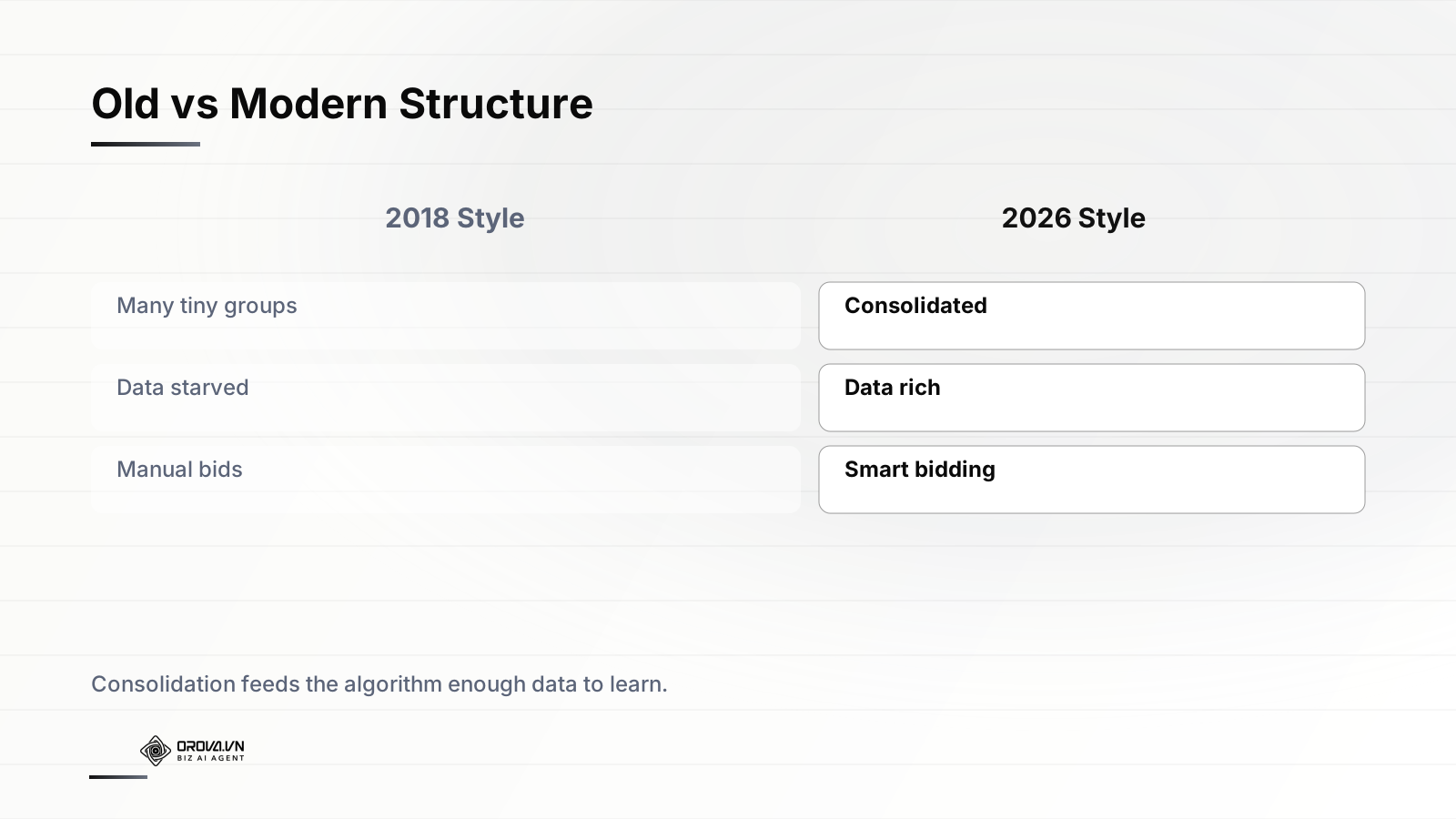
Smart Bidding does not set one bid per keyword. It sets a bid per auction, in real time, using signals like device, time of day, location, browser, query nuance, and audience. It needs those signals aggregated across enough events to find patterns. A tiny ad group with three conversions a month gives the model almost nothing to learn from. Consolidation is not laziness; it is feeding the algorithm the volume it requires to be accurate.
Responsive ads replaced single static ads
Responsive Search Ads mix and match headlines and descriptions per query, and Performance Max generates assets across the entire Google network. The "one perfect ad per keyword" premise that justified SKAGs simply does not exist anymore. Google expects you to supply a rich asset pool and let the system assemble the right combination.
The mental model has flipped. You used to optimize for control over each keyword. Now you optimize for clarity of signal into each strategy. Those two goals pull in opposite directions, and the second one wins.
Consolidation as the default, segmentation as the exception
The practical rule for 2026 is simple to state and hard to follow because it contradicts a decade of habit: start consolidated, and only split when a split clears a real bar. Default to fewer campaigns and fewer ad groups, each holding enough conversion volume to keep bidding fed, and let Google's machine learning do the slicing that you used to do manually with structure.
Consolidation delivers four concrete benefits:
- More data per learning unit. A campaign with 80 conversions a month learns faster and bids more accurately than eight campaigns with 10 each. The same budget produces better decisions simply because it is pooled.
- Faster exit from the learning period. Every time you create or significantly change a campaign, Smart Bidding re-enters a learning phase where performance is volatile. Fewer campaigns mean fewer learning resets and more stable performance.
- Less internal competition. When the same query can match keywords across several campaigns, Google picks one to enter the auction, but the fragmentation muddies your reporting and your budget allocation. Consolidation reduces this overlap.
- Cleaner reading for humans and AI. A handful of well-named campaigns is something a person can scan in thirty seconds and an AI agent can reason about without drowning in low-volume noise.
This does not mean dumping every keyword into one campaign. It means resisting the instinct to create structure for its own sake. Structure should exist to serve a decision you actually need to make — a different budget, a different goal, a different target — not to satisfy a tidiness reflex.
The conversion-volume threshold: the only segmentation test that matters
Before you split anything, ask one question: will each resulting campaign still have enough conversions to bid well? If the answer is no, do not split, no matter how appealing the organizational logic feels.
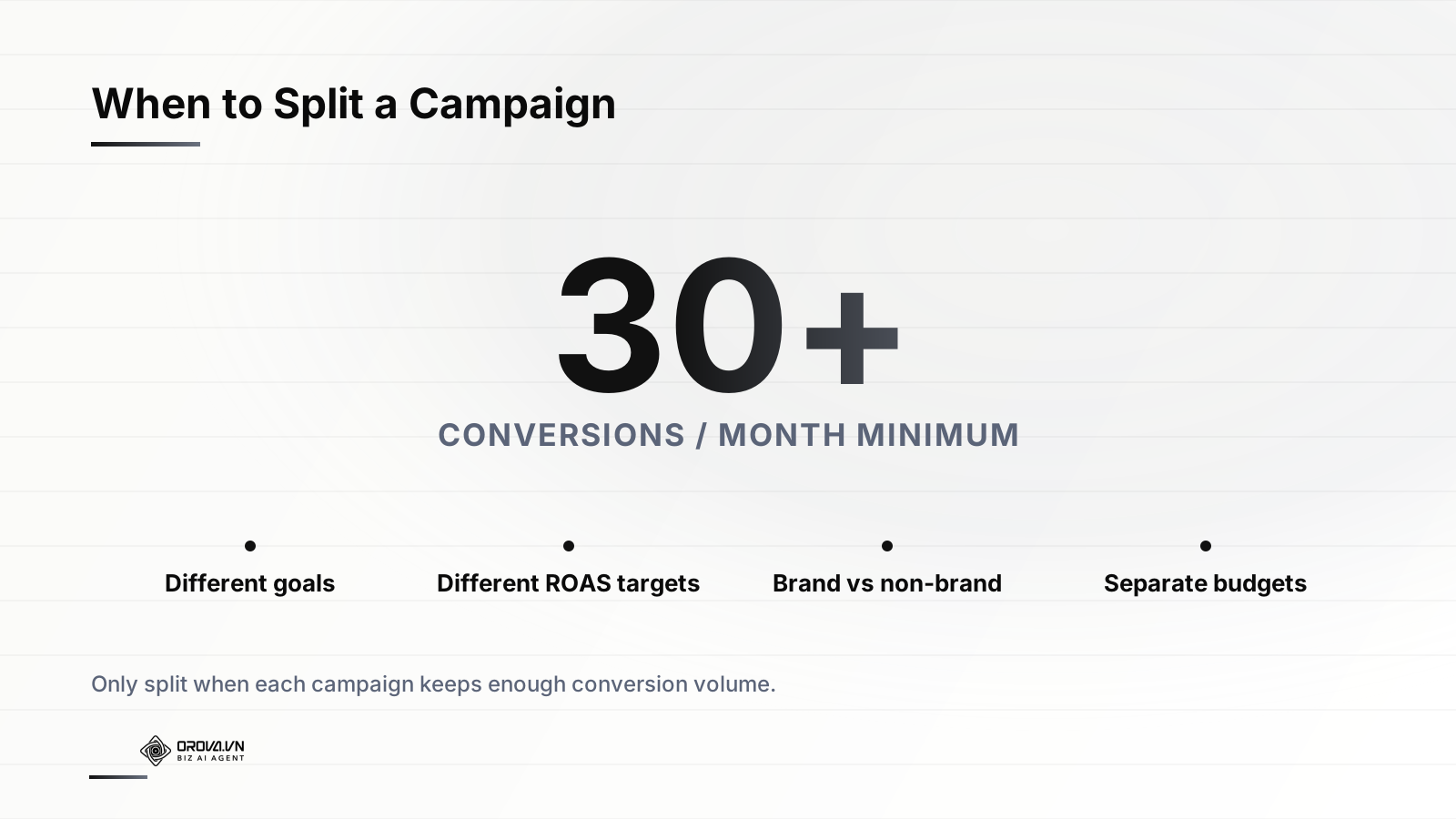
A workable threshold to carry in your head is roughly 30 or more conversions per campaign per month as a minimum for Target CPA, and meaningfully higher — often 50-plus — for Target ROAS, because value-based bidding has to model not just whether a conversion happens but how much it is worth. These are not magic numbers carved in stone; they are the rough volume below which the models become unreliable and start chasing noise.
How to apply the threshold in practice
- Measure the conversions you actually have, not the ones you wish you had. Pull the trailing 30 days of conversions for the campaign you are considering splitting.
- Divide by the number of proposed splits. If a 45-conversion campaign would become three campaigns of roughly 15 each, every child falls below the floor. Keep it whole.
- Account for seasonality and trend. If volume is climbing and you will clear the threshold per child within a month or two, a split may be defensible. If volume is flat or falling, do not.
- Prefer ad-group or asset-group segmentation over new campaigns. You can often get the organizational clarity you want inside one campaign — separate ad groups, themed asset groups, audience signals — without fragmenting the bidding strategy that sits at the campaign level.
This last point is the escape hatch that resolves most structure debates. Bidding strategies and budgets live at the campaign level, so splitting campaigns fragments your data. Themes, audiences, and creative live below that. If your reason for splitting is "these products feel different," you almost always want different ad groups or asset groups, not different campaigns.
When a split is genuinely justified
Consolidation is the default, but it is not an absolute. There are four situations where splitting is the right call even though it costs you data — because the thing you gain matters more than the volume you lose. Crucially, each of these is only valid if both resulting campaigns still clear the conversion floor.
1. Different goals
A lead-generation campaign optimizing for form fills and an e-commerce campaign optimizing for purchase value are not the same machine-learning problem. They use different conversion actions and different bidding strategies. Forcing them into one campaign confuses the model about what success even means. Split by goal.
2. Different ROAS or CPA targets
If your high-margin product line can profitably accept a 300% ROAS while your low-margin line needs 600% to break even, those targets cannot coexist in one campaign with one Target ROAS setting. The strategy is set per campaign. Different economic targets are a legitimate reason to split — provided each campaign still has the volume to hit its target reliably.
3. Brand versus non-brand
This is the most important and most frequently botched split, so it gets its own section below. The short version: brand and non-brand traffic behave so differently that mixing them poisons your reporting and misallocates budget.
4. Genuinely separate budgets
If finance allocates a fixed, non-fungible budget to a specific product line, region, or business unit — and that money cannot flow elsewhere — you need a separate campaign to enforce the spending cap. Budget is a campaign-level control. When the budget boundary is real and rigid, structure has to mirror it.
Notice what is missing from this list: device, location (unless budgets differ), match type, and individual products. Those used to drive structure and now should be handled by bid adjustments, audience signals, location targeting within a campaign, and shopping/PMax feeds — not by spinning up new campaigns.
A worked example
Imagine a B2B software company running 320 conversions a month across a sprawling 14-campaign account: separate campaigns per feature, per match type, and per device, most of them producing single-digit conversions. None of those tiny campaigns can bid well, and the account is impossible to read at a glance.
Applying the framework, the right shape is roughly four campaigns. One brand Search campaign captures the high-intent searchers who already know the company; it carries an aggressive efficiency target and the bulk of impression-share defense. One non-brand Search campaign for the company's primary product line, organized into a few themed ad groups, runs a looser target to buy new-customer growth. A second non-brand campaign exists only because a particular product line carries thinner margins and therefore a genuinely different ROAS target. And one Performance Max campaign, with brand excluded, handles broad prospecting across the network. Each of the four clears the conversion floor, each maps to a real decision, and the whole account fits on a single screen. That is the destination — fourteen units collapsed to four without losing a single control that actually mattered.
Brand versus non-brand: the split worth fighting for
People searching your brand name are most of the way to a decision. They convert at high rates and low costs, and they would often have found you anyway. People searching a generic, non-brand term ("project management software," "tăng đài cloud cho doanh nghiệp") are earlier in the journey, convert at lower rates, and cost more to win. These are two different economies sharing one account.
If you let them share a campaign, three bad things happen.
- Blended metrics lie to you. Cheap brand conversions drag down your average CPA and inflate your apparent ROAS, hiding the true (worse) economics of your non-brand prospecting. You think the campaign is healthy when half of it is bleeding.
- Smart Bidding over-invests in the easy wins. The algorithm sees brand terms converting cheaply and pours budget into traffic you would have captured for free, while underfunding the non-brand discovery that actually grows the business.
- You cannot set the right targets. Brand can sustain an aggressive efficiency target; non-brand needs a looser one to buy growth. One campaign cannot serve both.
The fix is to separate brand and non-brand into distinct campaigns, set different targets for each, and add the other side's terms as negatives so they do not leak across. Then judge each on its own terms: brand on efficiency and defense, non-brand on incremental new-customer acquisition. This split is so valuable that it is usually worth doing even when it pushes one side close to the volume floor — though if non-brand is tiny, consider consolidating non-brand themes together rather than splitting them further.
Where Performance Max fits
Performance Max complicates the brand/non-brand picture because it can serve across the whole network and, without brand exclusions, will happily claim cheap brand traffic and report it as PMax success. If you run PMax alongside Search, apply brand exclusions to PMax so it focuses on genuine prospecting, and keep your brand defense in a dedicated Search campaign where you can see and control it. If you want a deeper treatment of how PMax allocates spend and where it overlaps with your other campaigns, our piece on Performance Max demystified breaks down the mechanics and the guardrails worth setting.
How structure shapes AI optimization clarity
Everything above matters more in 2026 than it did even two years ago, because increasingly you are not the only one reading the account. Google's bidding is one layer of automation; an AI optimization agent sitting on top of the account is another. Both make better decisions when the structure is clean, and both make worse decisions when it is fragmented.
Think about what an AI agent has to do to optimize your account. It reads campaign and ad-group performance, attributes outcomes to causes, forms hypotheses ("non-brand on mobile is underperforming because the landing page is slow"), and recommends or executes changes. Every one of those steps degrades when the account is splintered into low-volume units.
Statistical confidence requires volume
An AI agent cannot responsibly recommend "raise the budget on this campaign" if the campaign produced four conversions last month. Four conversions is noise; one good week and one bad week look identical. The agent either makes a reckless call on thin data or, if it is well-built, refuses to act and tells you it lacks signal. Consolidated campaigns with real volume give the agent enough data to reach statistical confidence and act decisively.
Clear structure encodes intent
When your campaigns are named and organized around actual decisions — brand versus non-brand, goal A versus goal B, distinct ROAS targets — the structure itself tells the agent what each campaign is for. The agent can reason: "This is the brand-defense campaign, so the right move is to protect impression share, not chase volume." A flat sea of two hundred SKAGs communicates nothing about intent, so the agent has to guess.
Attribution stays interpretable
With fewer, cleaner units, cause and effect are legible. When the agent changes a bid and conversions move, it can attribute the change with reasonable confidence. In a fragmented account where the same query competes across overlapping campaigns, the agent changes one lever and the effect smears across several units, making it nearly impossible to learn what actually worked.
This is the through-line of modern account design: the structure that helps Google's algorithm learn is the same structure that helps an AI agent reason, and it is the same structure that helps you understand your own account. Consolidation is not a compromise between human control and machine efficiency. It is the configuration that serves all three readers at once.
A practical migration plan
If you are staring at a legacy account full of tiny ad groups and dozens of campaigns, do not rebuild it overnight — every change triggers learning resets, and doing them all at once creates a multi-week performance crater. Migrate deliberately.
- Audit conversion volume per campaign. List every campaign and its trailing-30-day conversions. Flag anything under the threshold; those are your consolidation candidates.
- Group the starved campaigns by shared logic. Find low-volume campaigns that share a goal, a target, and a budget rationale. Those are the ones to merge into a single consolidated campaign with multiple ad groups.
- Establish the brand/non-brand boundary first. Before anything else, make sure brand and non-brand are cleanly separated with negatives in place. This usually delivers the biggest immediate clarity gain.
- Consolidate in waves, not all at once. Merge one cluster, let it exit the learning period and stabilize (give it a couple of weeks and enough conversions), then merge the next. Sequencing protects performance.
- Move themes down a level. Where you split campaigns purely for organization, recreate that organization as ad groups or asset groups inside a consolidated campaign so you keep the clarity without fragmenting the bidding.
- Re-check targets after consolidation. A newly merged campaign blends the economics of its parts. Reset its Target CPA or ROAS based on the combined reality, and give Smart Bidding time to relearn before you judge it.
What good looks like when you are done
A well-structured 2026 account is small enough to take in at a glance. For many businesses that means a brand Search campaign, one or two non-brand Search campaigns organized by goal or target, a Shopping or Performance Max campaign for product feeds with brand excluded, and perhaps a separate campaign or two only where a hard budget boundary or a genuinely different ROAS target demands it. Each campaign clears its conversion floor. Each one maps to a decision you actually make. Nothing exists merely because it always has.
That is the whole philosophy in one sentence: structure should encode the decisions you need to make and nothing else. Every campaign that does not correspond to a real, distinct decision is a campaign that dilutes your data, slows the algorithm's learning, and clouds the judgment of every system — human or machine — trying to make sense of the account.
Common mistakes to avoid
- Splitting by device. Device performance differences are handled by bid adjustments and audience signals, not separate campaigns. Splitting by device fragments data for no control benefit.
- Recreating SKAGs out of habit. Single-keyword ad groups starve bidding and fight the close-variant reality. Build themed ad groups with related keywords instead.
- Letting Performance Max eat brand traffic. Without brand exclusions, PMax inflates its own reported success on traffic you would have won for free. Exclude brand and keep brand defense in dedicated Search.
- Splitting for organization rather than decisions. If the only reason to split is "these feel different," use ad groups or asset groups, not new campaigns.
- Changing everything at once. Mass restructuring triggers simultaneous learning resets and a deep performance dip. Migrate in waves and let each stabilize.
- Ignoring the volume floor when splitting brand/non-brand. The brand split is worth fighting for, but if non-brand is tiny, keep non-brand themes consolidated rather than splintering them further.
If you would rather not police all of this by hand, this is exactly the kind of disciplined, daily work an AI agent is built for. Orova Ads reads your Google, Meta, and TikTok accounts every day, flags campaigns that are over-segmented or starved of conversions, recommends consolidations and target adjustments, and can execute budget, bid, audience, and on/off changes for you — always with human-in-the-loop approval and a full audit log, so clean structure becomes something the system maintains rather than something you have to remember to fix.
Getting the Structure Right Without Doing It All Yourself
Rebuilding a Google Ads account the right way takes real time: auditing every campaign, checking conversion data, deciding what to merge, testing the new structure, and watching it closely afterward to make sure nothing breaks. Most business owners don't have the hours to spare, and getting it wrong can cost more than leaving things alone.
Orova Ads is built to handle this kind of heavy lifting for you — reviewing your account structure, spotting where campaigns are starving each other of data, and helping you move toward a setup that actually lets automation do its job. If you'd rather not untangle this by hand, it's worth taking a look at what Orova Ads can do for your account.
Read next: Dynamic & Responsive Ad Creative: How AI Assembles Ads · Performance Max Asset Groups: How to Structure Them · Google Performance Max: How It Works and What to Watch · Performance Max Search Themes: How to Use Them Right · Google Ads Optimization: 200+ Actions an AI Agent Can Do
Orova Ads optimises campaigns for you
Connect Google, Meta and TikTok in one place. AI reads the numbers, proposes changes and executes under the rules you set.
Explore Orova Ads