
Smart Bidding and Broad Match: How to Combine Them Right
For a decade, the safest move in a Google Ads account was to keep keywords on a short leash. Exact match and tight phrase match gave you control: you knew which queries you were paying for, you could read the search terms report and recognize almost everything in it, and waste stayed under five or ten percent of spend. Then Google quietly changed the rules. Exact match stopped meaning exact. Modified broad match disappeared. And the official advice flipped to something that sounds reckless to anyone who remembers the old days: pair broad match with Smart Bidding and let the machine sort it out.
Plenty of advertisers tried it, watched their cost-per-acquisition double in a week, and swore off broad match forever. They are not wrong about what happened. They are wrong about why. Broad match did not fail them; the missing scaffolding around it did. When you turn broad match loose without a strong conversion signal, without daily negative keyword maintenance, and without anyone actually reading the search terms report, you have not adopted Google's recommended strategy. You have removed the brakes from a car and blamed the car for the crash.
This article is about making the pairing work. Not in theory, and not as a leap of faith, but as a controlled system with measurable inputs and a tight feedback loop. We will cover why Smart Bidding genuinely needs broad match's query volume to do its job, why broad match genuinely needs Smart Bidding's per-auction judgment to avoid disaster, what conversion data quality actually has to look like before you flip the switch, and the unglamorous discipline of negatives and search-term review that separates the accounts that scale from the accounts that hemorrhage.
Why Google pushes this combination at all
It helps to understand the mechanics before deciding whether the advice is self-serving. Smart Bidding strategies like Target CPA, Target ROAS, and Maximize Conversions set a bid for every individual auction based on a model of how likely that specific query, from that specific user, on that device, at that time of day, is to convert and at what value. The model is only as good as the signals it can chew on. Feed it a narrow set of exact-match keywords and you starve it of the query diversity it needs to learn which contexts are valuable and which are not.
Broad match solves the volume problem. A single broad-match keyword can match hundreds or thousands of related queries, including ones you never would have thought to add. That breadth is the point. It gives Smart Bidding a wide field of auctions to evaluate, and because the bidding model decides how much to pay per auction, the messy edges of broad match get priced accordingly. A loosely related query that rarely converts gets a low bid or no bid at all. A query that looks new but matches a high-intent pattern the model has seen succeed gets a competitive bid.
So the two technologies are genuinely complementary. Broad match supplies reach and discovery; Smart Bidding supplies the per-auction judgment that keeps that reach from becoming a free-for-all. Manual bidding plus broad match was a nightmare precisely because a human cannot set a sane bid for thousands of unpredictable queries. The machine can. That is the real argument, and it is sound.
Where the argument breaks down in practice
The argument assumes the bidding model has learned something worth acting on. It assumes the model has seen enough conversions to distinguish a good auction from a bad one. In a brand-new account, a campaign with three conversions a month, or a business that just changed its tracking setup, the model has no such knowledge. It is guessing. And broad match plus a guessing bidder is exactly the spend-sprawl machine the skeptics warn about. Google's recommendation is correct for accounts that meet the prerequisites and dangerous for accounts that do not. The recommendation rarely comes with the prerequisites stapled to it, which is how so many advertisers got burned.
The non-negotiable prerequisite: conversion signal you can trust
Before broad match and Smart Bidding are even on the table, you need conversion tracking that is accurate, complete, and high-volume enough to teach a model. This is the single most common point of failure, and it is worth being uncompromising about.
Start with volume. As a working rule, a Smart Bidding strategy wants to see roughly 30 conversions in the trailing 30 days at the campaign level before its predictions become reliable, and meaningfully more than that before you should trust it with broad match's wider net. Target ROAS strategies want even more, because they are modeling conversion value, not just conversion likelihood, and value carries more variance. If your campaign generates eight conversions a month, broad match will hand the bidder a flood of unfamiliar queries it has no basis to evaluate, and your budget will fund that education in real time.
Volume alone is not enough; the conversions have to mean something. Three quality problems quietly poison Smart Bidding:
- Counting the wrong thing. If your primary conversion action is a newsletter signup or a thirty-second page view because those fire often, the model optimizes toward cheap, low-intent actions. Broad match then expands aggressively into queries that produce signups and no revenue. The numbers look great and the bank account does not.
- Double counting and inflation. Duplicate conversion tags, counting every conversion instead of one per click on lead-gen actions, or imported offline conversions that overlap with online ones all inflate the signal. The model thinks certain query patterns are gold and bids them up, sprawling spend into territory that only looks profitable.
- Lag and attribution gaps. If your sales cycle is three weeks but your conversion window is seven days, the model never learns which queries actually drive revenue. It optimizes for the fast, shallow conversions and starves the patient, valuable ones. Broad match amplifies whatever the model believes, so a distorted belief becomes a distorted spend pattern at scale.
The practical test before enabling broad match is blunt: can you point to a conversion action that represents real business value, fires at sufficient volume, is not double-counted, and is measured over a window that matches your actual sales cycle? If any of those is shaky, fix it first. Broad match will magnify the quality of your conversion data, for better or worse. Magnifying garbage produces more garbage, faster.
Negatives are not optional housekeeping; they are the steering
If conversion data is the fuel, negative keywords are the steering wheel. Broad match without an active negative keyword program is the defining characteristic of the accounts that fail. This is not a one-time setup task you complete during onboarding. It is an ongoing discipline, and the cadence matters as much as the existence.
Here is the mechanism that makes negatives so critical with broad match specifically. Broad match is constantly testing new queries, including queries that share a word or concept with your keyword but carry completely different intent. Sell "running shoes" on broad match and you will eventually pay for "how to clean running shoes," "running shoes for flat feet free," "running a marathon," and "shoes for running errands." Some of those are genuinely irrelevant; some are relevant but low-intent; some are research queries that will never convert in your funnel. Each one you do not block becomes a small, recurring tax on your budget, and broad match keeps finding new ones every single day.
The accounts that scale broad match treat negative keyword review as a daily or near-daily ritual, not a monthly cleanup. The reason is compounding. A wasteful query you catch on day one cost you a few dollars. The same query left running for a month, while broad match expands into a dozen variations of it, can quietly absorb a meaningful slice of spend. The team that wrote our deeper guide to finding and eliminating wasted spend with negative keywords found that the gap between weekly and daily review was often the difference between a profitable broad-match campaign and one that had to be paused.
Building negatives that scale, not just react
Reactive negatives, where you wait for a bad query to appear and then block it, are necessary but slow. The stronger approach combines reaction with a small set of pre-built negative themes that you know will never be relevant to your business:
- Free, cheap, DIY. If you sell a paid product or service, queries containing "free," "DIY," "how to make," "template," or "open source" usually signal someone who will not buy. Block the obvious ones upfront.
- Jobs and careers. "Jobs," "salary," "career," "hiring," and "internship" pull in people researching employment, not customers. These leak into almost every broad-match campaign.
- Competitors and wrong products. If broad match keeps matching adjacent products you do not sell, or competitor brand names you do not want to bid on, build a negative list and apply it across campaigns.
- Informational modifiers. "What is," "definition," "meaning," "examples of," and similar phrasings often indicate top-of-funnel research that converts poorly on a conversion-focused campaign. Whether to block these depends on your goals, but you should make the decision deliberately rather than fund them by default.
Maintain these as shared negative keyword lists applied at the account level so a new campaign inherits your accumulated knowledge instead of relearning every mistake. And revisit the lists, because broad match evolves; the wasteful patterns of this quarter are not identical to last quarter's.
Reading the search terms report like it is your job
The search terms report is where broad match shows you what it is actually doing with your money. With exact match, the report holds few surprises. With broad match, the report is the single most important screen in the account, and the discipline of reading it is what converts the abstract promise of "let the machine learn" into a controlled, improving system.
A productive search-term review is not a glance at the top ten queries. It is a structured pass that asks several questions of the data:
- What is consuming spend without converting? Sort by cost descending and look for high-cost, zero-conversion terms. These are your immediate negative candidates. Be careful with sample size; a term with one click and no conversion is noise, but a term with fifty clicks, real spend, and nothing to show is a leak.
- What is converting that you did not expect? Broad match's genuine value is discovery. Look for queries that converted well and that you never would have added manually. These reveal new intent patterns, new audience language, sometimes whole new product angles. Some deserve their own tightly-themed ad groups or campaigns where you can write better-matched ads and landing pages.
- Where is intent drifting? Watch for queries that are technically related but tonally off, the early signal that broad match is starting to wander. Catching drift while it is small keeps it from becoming a spend category.
- Is the match getting looser over time? Compare this week's terms to last week's. Broad match expands as it gains confidence; you want to confirm that expansion is heading toward profitable territory, not away from it.
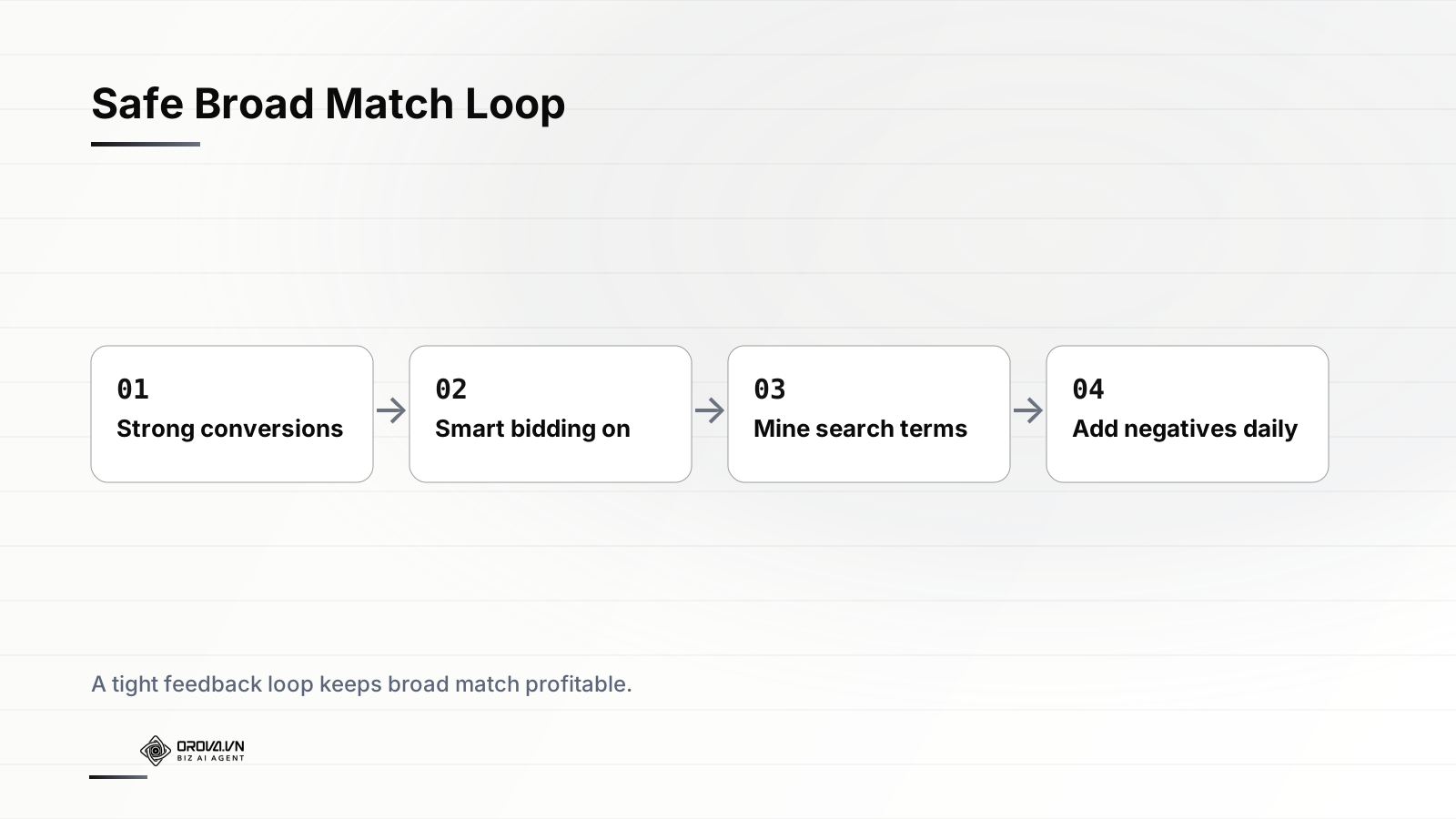
This review feeds directly back into your negatives and your campaign structure, which is what makes the whole system a loop rather than a one-way bet. You enable broad match, the bidder explores, you read what it found, you prune what is wasteful and promote what is valuable, and the next cycle starts from a smarter baseline. Skip the reading and the loop is broken; you are just spending and hoping.
The operational reality: this is too much manual work
Here is the honest tension at the center of this strategy. Everything above is correct, and almost nobody does it consistently. Reading the search terms report daily across a dozen campaigns, cross-referencing spend and conversions, building negatives that are specific enough to block waste but not so broad they choke valuable queries, doing this every day without skipping a Friday or a vacation week, is a genuine labor burden. The strategy that works on paper collapses against the calendar.
The failure mode is predictable. An advertiser enables broad match with Smart Bidding, does the search-term review diligently for two weeks, sees good results, gets busy with something else, and stops reviewing. Broad match keeps expanding because that is what it does. Three weeks of unreviewed expansion later, CPA has crept up, a handful of wasteful query categories have established themselves, and the account quietly slid from the controlled column back into the unmanaged column. Nobody made a bad decision. The system just required a level of sustained attention that humans are bad at sustaining.
What good monitoring actually catches
The leaks that matter are usually not dramatic. They are slow. A new query pattern that appears with three clicks one day, eight the next, twenty by the end of the week. A gradual rise in the share of spend going to non-converting terms. A bidding strategy that drifts above target after a seasonal shift in conversion rates. None of these trips an alarm on the day it starts. All of them are obvious in hindsight. The entire value of disciplined monitoring is catching the slow leak on day two instead of day twenty, when it cost a few dollars instead of a few hundred.
That is precisely the kind of work that suits automation, because it is high-frequency, pattern-based, and brutally consistent in a way that a busy human cannot match. A system that reads the search terms report every day, flags high-spend non-converting terms, watches the trend in wasted-spend share rather than just the daily snapshot, and proposes negatives for review does not get tired, does not take Fridays off, and does not forget the campaign exists because a client escalation ate the afternoon.
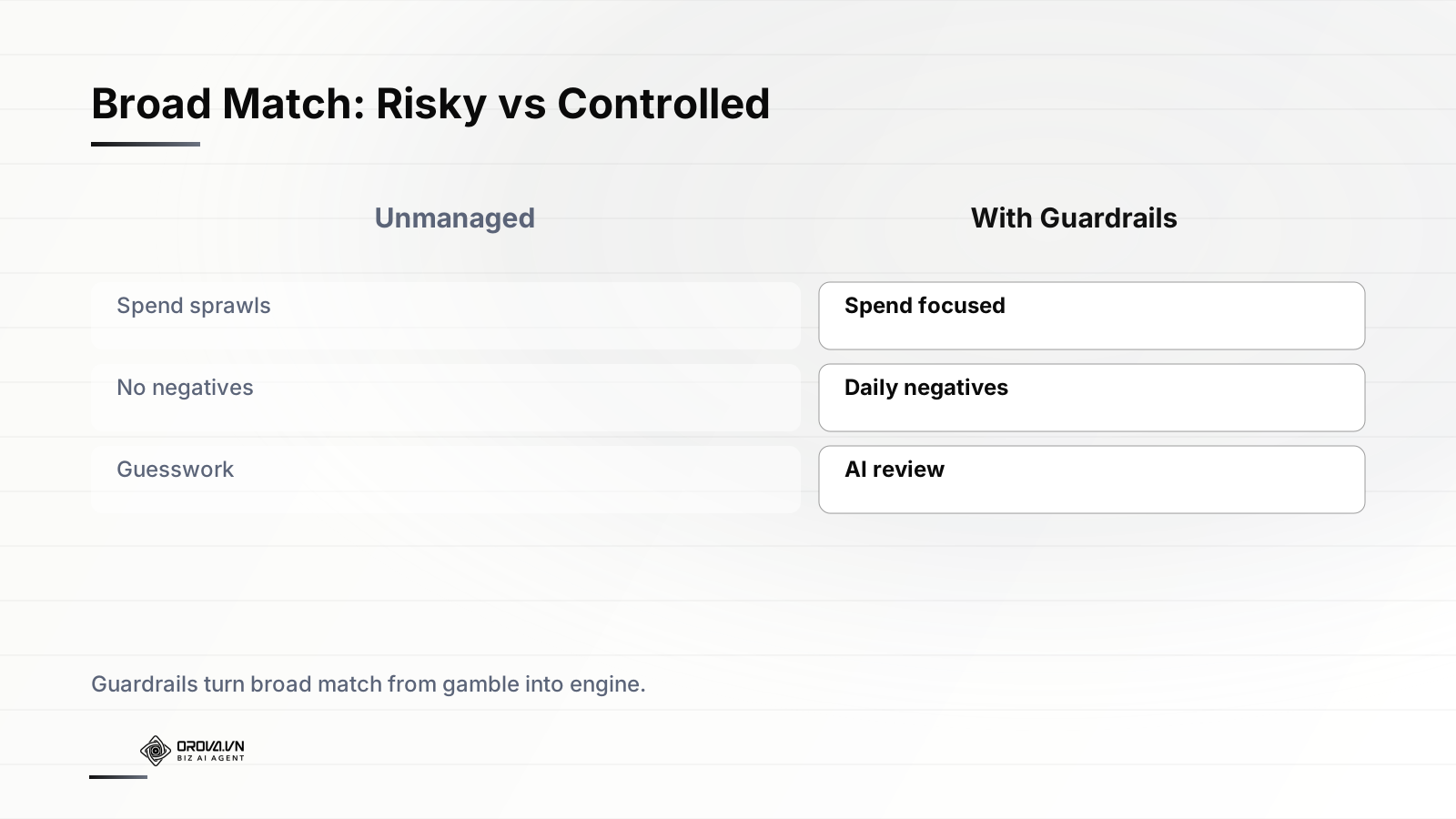
Guardrails that turn broad match from gamble into engine
Pulling the threads together, here is what a controlled broad-match-plus-Smart-Bidding system actually requires, in order:
- A trustworthy, high-volume conversion signal that reflects real business value and is measured over a window matching your sales cycle. Without this, stop; nothing downstream works.
- Enough conversion history for the bidding model to have learned, ideally well past the 30-conversions-in-30-days floor before broad match widens the field.
- A foundation of pre-built negative keyword themes applied at the account level, so every campaign starts with your accumulated knowledge.
- Daily, structured search-term review that prunes waste, promotes discoveries, and watches for intent drift and loosening match.
- Trend-based spend monitoring that catches slow leaks early, not snapshot monitoring that only notices a problem after it has compounded.
- A feedback loop that feeds today's findings back into tomorrow's negatives and structure, so each cycle starts smarter than the last.
Notice that none of these guardrails is exotic. They are all things experienced advertisers already know to do. The reason broad match gets a bad reputation is not that the guardrails are unknown; it is that they demand a level of daily, consistent execution that breaks down the moment attention wavers. The strategy is not hard to understand. It is hard to sustain.
Choosing the right Smart Bidding strategy for the job
Not every Smart Bidding strategy pairs equally well with broad match, and the choice changes how much risk you are taking on. Maximize Conversions without a target CPA cap is the most aggressive option; it will spend your full budget chasing conversions wherever it can find them, which with broad match means exploring the widest possible query space. That is useful for discovery in an account with healthy margins and tolerance for volatility, and dangerous in an account where every dollar of CPA matters. Adding a Target CPA to Maximize Conversions, or using Target CPA directly, gives the model a profitability constraint to respect, which naturally tempers how far broad match wanders into expensive territory.
Target ROAS is the most demanding pairing. Because it optimizes for conversion value rather than count, it needs not just volume but accurate, varied value data, and broad match's unfamiliar queries make value prediction harder still. Reserve Target ROAS plus broad match for accounts with strong, clean value tracking and substantial history. If your value data is thin or noisy, a conversion-count strategy with a CPA target is the safer foundation, and you can graduate to value-based bidding once the signal is solid. The point is to match the ambition of the bidding strategy to the maturity of your data, then let broad match expand within those bounds rather than outside them.
Setting expectations: the learning period is real
When you enable broad match or change a bidding strategy, the model enters a learning period during which performance is genuinely unstable. This is not a bug to be panicked over; it is the model recalibrating to a wider, noisier set of auctions. The mistake advertisers make is reacting to learning-period volatility by yanking the strategy after four days, which resets the clock and guarantees they never get past the unstable phase. Give the change one to two weeks before judging it, resist the urge to make daily bid or budget swings that disrupt learning, and separate two distinct activities in your mind: search-term review and negative additions should continue daily because those refine the inputs, while structural changes to bidding targets and budgets should be paced and deliberate so the model can actually settle. Confusing necessary daily maintenance with disruptive daily meddling is a common way to sabotage an otherwise sound rollout.
A realistic rollout sequence
If you are starting from tight match types and want to move toward this model without gambling, sequence it. Confirm your conversion tracking is clean and counting the right action. Let a single, high-converting campaign accumulate solid Smart Bidding history on its existing keywords. Apply your account-level negative lists. Then introduce broad match into that one campaign, not the whole account, and commit to daily search-term review for the first month while the bidder explores most aggressively. Watch CPA or ROAS against target, watch the wasted-spend share trend, and only expand the approach to other campaigns once the first one has demonstrably stayed in the controlled column for several weeks. Broad match rewards patience and punishes the all-at-once rollout.
Let an AI agent run the loop you cannot run by hand
Broad match plus Smart Bidding is a genuinely strong strategy, but only when something reads the search terms every day, catches spend leaks while they are still small, and keeps the negative list current without a human having to remember. Orova Ads is an AI agent that does exactly that across Google, Meta, and TikTok: it reads your account data daily, spots wasted spend and drifting queries, and recommends the budget, bid, audience, and on-off changes that keep broad match in the controlled column, executing them with your approval and a full audit trail. If you want the upside of Google's recommended pairing without the daily grind that makes or breaks it, that is the gap Orova Ads was built to close.
Orova Ads optimises campaigns for you
Connect Google, Meta and TikTok in one place. AI reads the numbers, proposes changes and executes under the rules you set.
Explore Orova Ads