
Incrementality vs Last-Click: What Your Ads Are Really Driving
Pause your retargeting campaign for two weeks and watch what happens to total sales. If the number barely moves, you have just learned something expensive: a meaningful slice of the revenue that campaign was "driving" would have arrived anyway. The shoppers it claimed credit for were already walking to the checkout. Your retargeting ads simply got in front of them on the last step and stamped their name on the receipt.
This is the central problem with last-click attribution, and it is not a small one. A 2019 incrementality study by eBay found that paying for branded search keywords produced almost no incremental sales — the people clicking those ads were searching for "eBay" and would have reached the site regardless. Yet last-click reporting had been crediting that spend with a glowing return for years. The dashboard said the campaign was a winner. The holdout test said it was a tax on traffic that was already free.
The gap between those two stories — between "who closed the sale" and "what the ad actually changed" — is the difference between last-click attribution and incrementality. If you manage paid media and you have never run a holdout test, there is a real chance some of your best-looking line items are your worst-performing ones. This article explains why that happens, how to measure true causal lift with holdout and geo-lift experiments, how to read incremental ROAS, and how to spot the spend that survives only because the math is flattering.
What last-click actually measures (and what it doesn't)
Last-click attribution assigns 100% of the credit for a conversion to the final ad or channel the user interacted with before buying. It is the default in most ad platforms because it is trivial to compute and unambiguous: there is exactly one last touch, so there is no argument about who gets the money. That simplicity is also its fatal flaw.
Last-click answers a narrow question — which touchpoint was closest to the purchase? — and then quietly lets you treat the answer as if it were a different, much more important question: which spend caused the purchase? Those are not the same thing. A conversion that would have happened with or without the ad still gets fully attributed to whatever ad happened to be last in line. The model has no concept of counterfactual. It cannot tell you what would have happened if the ad had never run, because it never looks at a world without the ad.
Consider the journey of a typical returning customer. They see a brand on TikTok, search for it on Google a week later, click an organic result, browse, leave, get served a retargeting ad on Instagram, click it, and buy. Last-click hands the entire sale to that final retargeting impression. The TikTok video that created the demand gets nothing. The organic search that showed real intent gets nothing. And critically, the question of whether the retargeting ad changed the outcome at all is never asked.
Why "easy to measure" is a trap
The seductive thing about last-click is that the numbers always reconcile. Every conversion has exactly one home. Spend divided by conversions gives you a tidy cost-per-acquisition, and the report ties out to the penny. Finance loves it. The trouble is that internal consistency is not the same as truth. A model can be perfectly self-consistent and still systematically mismeasure the thing you care about. Last-click is precise about the wrong quantity.

The two channels last-click flatters most
Last-click does not distort every channel equally. It systematically over-credits the channels that sit closest to the purchase, because those are the ones most likely to be the last touch. Two categories are chronic offenders, and they happen to be two of the easiest places to overspend.
Branded search
When someone types your brand name into Google, they have already decided to find you. They are not discovering a new product; they are navigating to one they have in mind. If you bid on your own brand term, your ad appears, they click it, and last-click credits the sale to paid search with a CPA that looks fantastic. But strip the ad away and most of those users click the organic result one line below — the same site, the same purchase, zero ad cost.
This is exactly the dynamic eBay's experiment surfaced. The incremental value of branded paid search is often a fraction of what last-click reports, sometimes near zero when your organic listing already dominates the page. There are legitimate reasons to defend brand terms — competitors bidding against you, controlling the message, occupying the top of a crowded results page — but those are strategic decisions that should be made with eyes open, not because a misleading CPA made the spend look like the bargain of the quarter.
Retargeting
Retargeting is the other great inflator. By definition, retargeting shows ads to people who have already visited your site — people who have already signalled intent. A portion of them were going to come back and buy no matter what. When a retargeting ad happens to be the last touch before that inevitable purchase, last-click gives it full credit, producing the kind of 8x or 10x ROAS that makes retargeting look like the best-performing thing in the account.
The honest question is how many of those buyers your retargeting actually recovered versus how many it merely followed. The only way to answer it is to withhold the ads from some users and compare. Teams that run this test are frequently shocked: the incremental return on retargeting can be a small fraction of the last-click number, and in some accounts the broad, undifferentiated retargeting pool is close to break-even once you remove the people who would have converted anyway. The high performers are usually narrower segments — cart abandoners within a tight window — not "everyone who touched the site in 30 days."
If a channel's job is to reach people who have already raised their hand, its last-click ROAS will always look extraordinary — and will always overstate what it changed.
What incrementality measures instead
Incrementality flips the question. Instead of asking which touch was last, it asks: how many conversions happened because of this spend that would not have happened without it? That word — because — is doing all the work. It is a causal claim, and causal claims cannot be read off a correlation in your dashboard. They require an experiment with a control group, the same logic a pharmaceutical trial uses when it gives some patients the drug and some a placebo.
The core mechanism is the holdout: a randomly selected group of users (or geographies) who are deliberately prevented from seeing your ads. Everyone else — the test group — gets the normal campaign. Because the two groups are statistically identical at the start, any difference in their conversion rates afterward must be attributable to the one thing that differed: exposure to the ads. That difference is your incremental lift. It is the only number that tells you what your spend genuinely produced.
Holdout (audience-based) tests
In an audience holdout, the platform or your own system randomly carves out, say, 10% of the addressable audience and suppresses your ads from them. You then compare the conversion rate of the 90% who saw ads against the 10% who didn't. If the exposed group converts at 4.0% and the holdout converts at 3.4%, the incremental lift is 0.6 percentage points — and you can scale that gap across the full audience to estimate how many conversions the campaign actually caused. Meta's Conversion Lift and Google's Conversion Lift studies both work on this principle, and several platforms offer "ghost ads" or PSA-equivalent placebo mechanisms so the holdout group's measurement environment matches the test group's as closely as possible.
Geo-lift (market-based) tests
When user-level holdouts aren't practical — for upper-funnel channels, for privacy-constrained environments, or when you simply can't suppress ads cleanly — geo experiments are the workhorse. You split comparable regions into test markets, where the campaign runs, and control markets, where it doesn't (or runs at a different level). You watch total sales in each set of markets, controlling for their historical relationship, and the divergence after launch is your lift. Geo tests measure the whole effect of a channel on real business outcomes, including the halo on organic and direct traffic that user-level tests can miss. They demand more discipline — clean market matching, enough geographies, a long enough window — but they answer the biggest, most strategic budget questions.
How to run a clean incrementality test
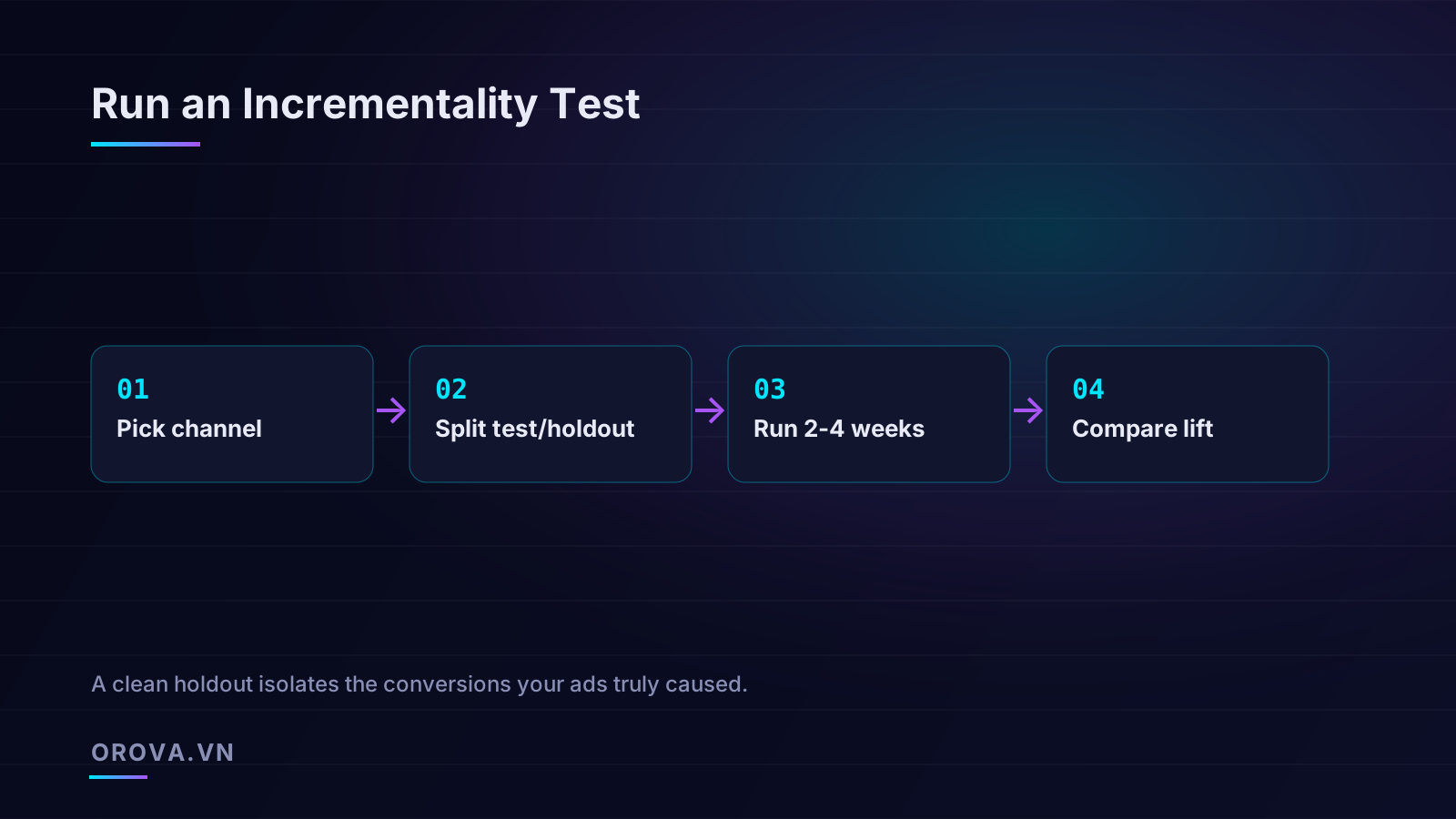
The mechanics are not complicated, but the discipline is. A sloppy test produces a confident-looking number that is just as misleading as the last-click figure you were trying to escape. Here is the sequence that keeps a test honest.
- Pick one channel or tactic to isolate. Don't try to measure everything at once. Choose the spend you most suspect of riding on free demand — branded search and broad retargeting are the usual first targets — or the upper-funnel channel you most need to justify. A test answers one question well; it answers ten questions badly.
- Split test and holdout randomly. Randomization is what makes the two groups comparable. For audience tests, let the platform randomize at the user level. For geo tests, match markets on size, historical sales, and seasonality before assigning them, and assign enough of them that one anomalous city can't swing the result.
- Run long enough to clear the conversion window. Two to four weeks is a common range, but the real rule is: run long enough for your typical purchase cycle to complete and for the sample to reach statistical significance. A considered-purchase product with a three-week sales cycle needs a longer test than an impulse buy. Ending early because the numbers look good is how teams fool themselves.
- Compare lift, not totals. The output you want is the difference between test and control, expressed as incremental conversions and incremental revenue, ideally with a confidence interval. "The test group did better" is not a finding. "We are 90% confident the campaign drove between 400 and 600 incremental orders" is.
The prerequisite nobody mentions: clean data
An incrementality test is only as trustworthy as the conversion data underneath it. If your tracking double-counts purchases, drops conversions from certain browsers, or fires events inconsistently between the test and holdout groups, the lift you measure is noise dressed as signal. Before you invest weeks in an experiment, make sure your measurement foundation is solid — deduplicated conversions, consistent event definitions, and server-side tracking where the browser falls short. We cover this groundwork in detail in our guide to treating clean conversion data as a measurement prerequisite, and it is worth doing first. A perfect experiment on dirty data is still a wrong answer delivered with confidence.
Reading incremental ROAS without fooling yourself
Once you have a lift number, the next step is turning it into a metric you can act on. Incremental ROAS (iROAS) is incremental revenue divided by the spend that produced it. It looks like ordinary ROAS, but it is built from the conversions your ads actually caused rather than the conversions they happened to be near. The two numbers can be wildly different, and the gap is the whole point.
Suppose a retargeting campaign spends $20,000 and last-click reports $180,000 in revenue — a 9x ROAS. You run a holdout and find that the incremental revenue, the sales that would not have happened without the campaign, is $60,000. Your incremental ROAS is 3x, not 9x. That is still a real, positive return, and it might well justify the spend. But you have just discovered that two-thirds of the "revenue" the campaign was credited with was riding on demand you had already created elsewhere. Budgeting decisions made on the 9x number would steer money toward the wrong channels.
Turn lift into a multiplier you can reuse
You can't run a holdout on every campaign every week — tests are expensive and they require suppressing ads, which costs revenue during the test window. The practical move is to run periodic experiments and use them to calibrate an incrementality factor for each channel: the ratio of incremental conversions to last-click conversions. If branded search comes back at 0.2 and broad retargeting at 0.35, you apply those discounts to the platform-reported numbers between tests, giving you a continuously corrected view of true performance without running an experiment every day. Re-test each channel quarterly, or whenever you make a structural change to a campaign, because the factor drifts as creative, audiences, and competition change.
Common ways teams still get it wrong
- Treating a single test as permanent truth. Incrementality is a moving target. A factor measured in Q1 may not hold after a price change, a new competitor, or a seasonal shift. Calibrate, don't carve in stone.
- Confusing statistical significance with business significance. A test can prove a real lift exists while that lift is too small to matter. Always translate the result into dollars and a confidence range, then decide whether the magnitude justifies the spend.
- Contaminating the holdout. If holdout users see your ads through another device, another channel, or a leaky audience definition, the gap between groups shrinks and you underestimate true lift. Tight suppression and clean audience boundaries protect the test.
- Stopping the test when it looks good. Peeking at results and ending early biases the outcome toward whatever random fluctuation happened to be in your favor at that moment. Decide the duration up front and hold to it.
A worked example: the budget reshuffle
To make the iROAS discount concrete, imagine a modest e-commerce account spending $100,000 a month split across four buckets: $40,000 on prospecting (cold audiences and broad search), $25,000 on broad retargeting, $20,000 on branded search, and $15,000 on a TikTok awareness campaign. Last-click reporting paints a clear hierarchy: branded search returns 12x, retargeting 9x, prospecting 2.5x, and the TikTok awareness campaign a dismal 0.6x. On those numbers, the obvious move is to cut the TikTok spend, hold prospecting, and pour money into branded search and retargeting.
Now run the tests. Branded search comes back with an incrementality factor of 0.2, dropping its real return to roughly 2.4x. Broad retargeting lands at 0.35, taking it from 9x to about 3.2x. Prospecting, which last-click undersells because it sits at the top of the journey, tests at 1.4 — its true contribution is higher than reported, around 3.5x. And the TikTok awareness campaign, when measured by a geo-lift test that captures its halo on organic and direct traffic, turns out to have driven a meaningful chunk of the very demand that branded search and retargeting were busy taking credit for. Its true contribution is not 0.6x; the demand it created simply showed up under other channels' names.
The corrected picture inverts the obvious decision. The spend you were about to cut was building the pipeline. The spend you were about to grow was harvesting it. Neither version of the truth is available from a last-click dashboard — only an experiment reveals it. This is the recurring pattern of incrementality work: the channels that look best are often the ones cashing in on demand they didn't create, and the channels that look weakest are often the ones quietly creating it.
Where an AI agent fits into causal measurement
The hardest part of incrementality is not the statistics — it is the operational discipline of running tests consistently, applying the results everywhere they matter, and resisting the pull of the flattering last-click dashboard the rest of the time. This is precisely the kind of relentless, unglamorous work that automation handles better than humans, who get busy, forget to re-test, and revert to the easy metric under deadline pressure.
An AI agent watching your accounts daily can hold the causal view in place even when nobody is looking at it. It can monitor the spread between last-click ROAS and the calibrated incremental ROAS for each campaign, and flag the line items where the two have diverged the most — the spend most likely to be claiming credit for conversions that would have happened anyway. When branded search is consuming budget at a 9x reported return but a 0.2 incrementality factor, the agent surfaces that as low-incrementality spend worth challenging, rather than celebrating it on a dashboard.
From flagging to acting
Detection is only half the value. An agent can also schedule and structure the experiments themselves — proposing a holdout for the channel it suspects, sizing the split for significance, and watching the window without ending it early because the numbers wobbled. When a test concludes, it can fold the new incrementality factor back into how it evaluates every other campaign, so the lessons of one experiment immediately sharpen the judgment applied to the whole account. And because the agent never gets bored, the quarterly re-test that humans skip simply happens.
None of this means handing over the keys without oversight. The point of causal measurement is better decisions, and the best setup keeps a human in the loop to approve the moves the data implies — pulling budget from a channel that turned out to be mostly free-riding, or doubling down on one whose incremental lift exceeded its last-click reputation. The agent does the watching, the testing, and the math; you make the call with the real numbers in front of you instead of the flattering ones.
The bottom line
Last-click attribution is not wrong so much as it is answering a question you didn't mean to ask. It tells you who was standing closest to the sale, then tempts you to spend as if proximity were causation. For the channels that live near the bottom of the funnel — branded search and retargeting above all — that confusion can route real budget toward spend that changes very little. Incrementality, measured through clean holdout and geo-lift tests and expressed as incremental ROAS, is the corrective. It is harder, slower, and occasionally humbling, and it is the only way to know what your ads are really driving rather than what they are merely standing next to.
Start with one channel you suspect. Run a clean holdout for two to four weeks. Compare the lift. The number you get back may surprise you — and it will be the first genuinely honest performance figure your account has produced.
If you'd rather not police the gap between reported and real performance by hand, that is exactly what Orova Ads is built for. It is an AI agent that manages your paid campaigns across Google, Meta, and TikTok — reading your data every day, recommending optimizations, and executing changes to budgets, bids, on/off states, and audiences, all with human-in-the-loop approval and a full audit log so every move is yours to confirm. It can flag the low-incrementality spend hiding behind a flattering last-click ROAS, so you put money where it actually moves the needle. See how Orova Ads measures and manages true performance.
Let an AI Agent handle your SEO
Orova plans, writes, optimizes, and tracks rankings on its own — you just read the results.
Try it free