
Native-Style TikTok Ads and Pangle: Making Paid Feel Like the Feed
Scroll through your own For You feed for sixty seconds and try to spot the ads. If you are a TikTok power user, you probably misjudged at least one of them. A creator filming in their kitchen, a shaky talking-head review, a messy desk with a product half-buried under cables — these are paid placements designed to look like everything else on the feed. That camouflage is not an accident. It is the single most reliable lever advertisers have on TikTok, and it is the reason a $300 phone-shot clip routinely outperforms a $30,000 brand film on the same auction.
This guide is about two things that are usually treated separately but should be managed together: native-style creative, and the Pangle placement network. Native creative is how you win attention inside TikTok. Pangle is how TikTok extends your reach to apps outside its own walls. The connection is simple — Pangle only works when your creative already behaves like content rather than an interruption. Get the creative wrong, and Pangle becomes a place where your budget quietly leaks into low-quality impressions. Get it right, and Pangle becomes cheap incremental reach. The hard part is knowing, day to day, which of those two situations you are actually in.
Why native creative is the whole game on TikTok
Every paid social platform claims to reward native creative, but on TikTok the incentive is structural rather than aspirational. The ranking system that decides whether an ad gets shown — and at what cost — is heavily weighted toward early engagement signals: hold rate in the first three seconds, completion rate, replays, shares, and the rate at which people tap the profile or comment. Those signals are the same ones that govern organic distribution. An ad and an organic clip are competing in the same attention economy, judged by roughly the same machine.
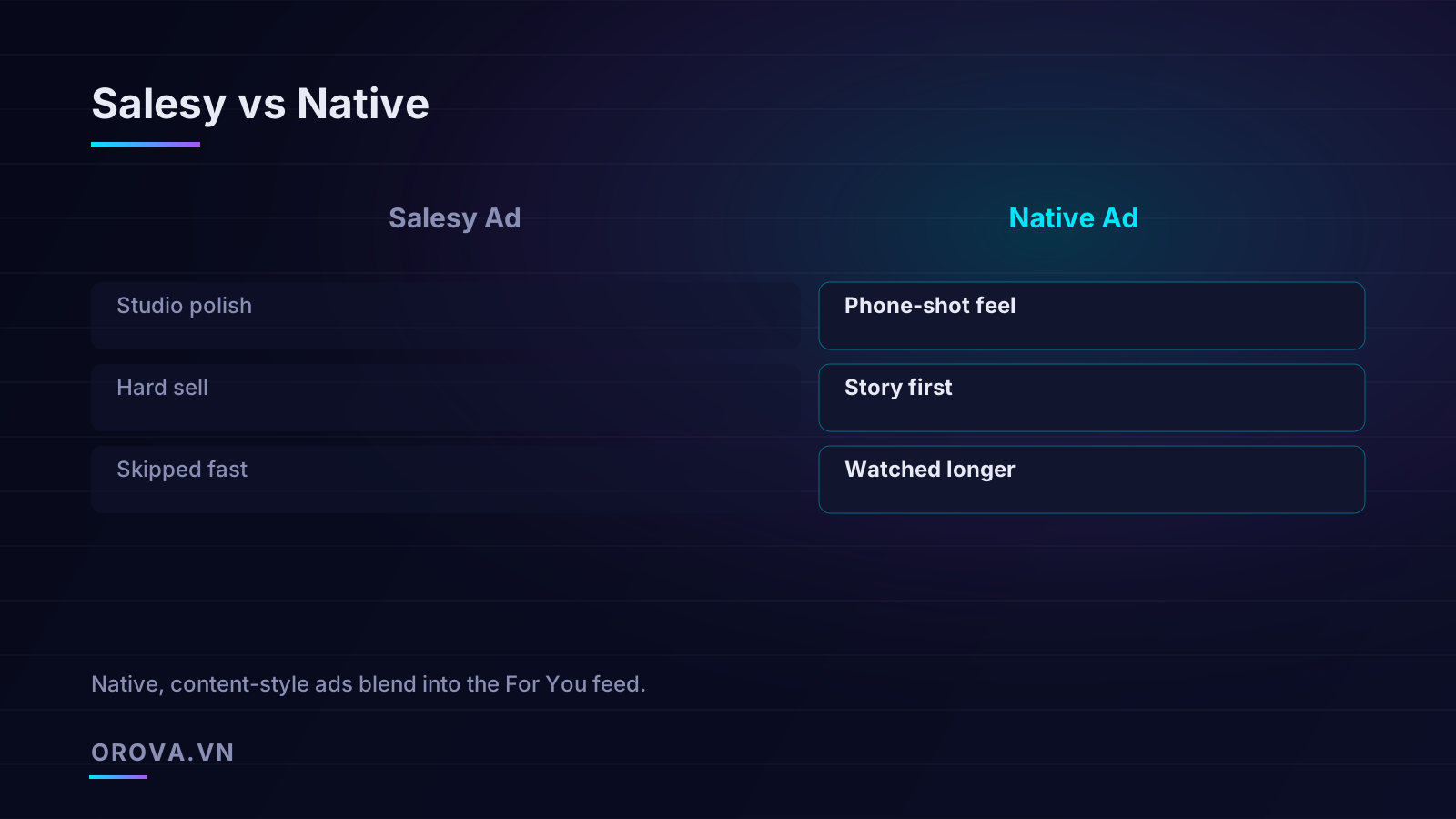
The practical consequence is that polish is often a liability. A studio-lit, color-graded, voiceover-narrated commercial signals "advertisement" within the first half-second, and the half-second is exactly when the viewer decides to keep watching or flick away. The moment they recognize an ad, hold rate collapses, the system reads that as a weak creative, and your effective CPM climbs to compensate. You end up paying a polish penalty.
Native creative inverts this. When the ad opens like a real video — a person mid-sentence, a hook overlaid in the platform's own caption style, ambient phone-quality audio — the viewer's pattern-matching does not trip the "skip the ad" reflex. They watch a beat longer. That beat is enough to feed the system a stronger signal, which lowers your cost and earns you more reach. The creative is not just the message; it is the bid efficiency.
The principles that actually move hold rate
After managing thousands of TikTok creatives, the patterns that separate native winners from skipped losers are remarkably consistent. None of them require a big budget — they require discipline.
- Hook in the first second, not the first five. The opening frame should make a promise, pose a question, or show the payoff. "I returned three of these before I found the one that works" earns more watch time than any logo animation. If your hook needs a build-up, you have already lost the people who would have converted.
- Shoot vertical and shoot it imperfectly. Slight handheld movement, natural light, a real room. The brain reads imperfection as authenticity. Over-stabilized, perfectly framed footage reads as a brand asset and gets treated like one.
- Lead with a person, not a product. Faces and voices outperform product beauty shots in nearly every test, because the feed is built around people talking to camera. Show the product through the person's hands and reactions, not on a pedestal.
- Use on-platform text style. Captions placed and styled like native TikTok text, not lower-thirds from a TV ad. This single change can lift completion meaningfully because it keeps the "this is content" illusion intact.
- Story before sell. The pitch should arrive after you have earned attention. A common structure: problem (0–3s), tension or twist (3–8s), the product as resolution (8–15s), and a soft call to action that feels like a recommendation rather than a demand.
- Sound-on by default. TikTok is a sound-first platform. Trending audio, a real voice, or a clear hook spoken aloud all outperform silent, text-only edits. Design for the speaker being on.
The contrast between these two approaches is stark enough that it is worth seeing side by side, because the difference is not subtle — it shows up in the very first frame and compounds through every metric downstream.
Spark Ads: borrowing native authenticity at scale
The cleanest way to guarantee native feel is to not fake it — to promote real organic posts. Spark Ads let you boost existing content from your own account or, with permission, from a creator's account, keeping the original handle, likes, comments and shares attached. This matters because the social proof travels with the post, and viewers see a video that looks exactly like organic because it is organic.
Spark Ads also unlock a creative supply problem that every serious TikTok advertiser eventually hits: the platform burns through creative fast. A winning ad might fatigue in days, not weeks, as the system saturates the most responsive audiences. You need a steady pipeline of fresh native assets, and creator partnerships sourced through Spark are the most sustainable way to feed it. We go deeper on building that pipeline in our piece on TikTok ad optimization and creative velocity with Spark Ads, but the headline is this: on TikTok, the team that ships the most quality native variations usually wins, regardless of who has the bigger media budget.
A practical native script template
Principles are easier to apply with a concrete skeleton in front of you. The following structure has held up across categories — from skincare to software to physical gadgets — because it respects how the feed allocates attention rather than fighting it. Adapt the words; keep the timing.
- 0–1s — the disruptive hook. Open mid-action or mid-confession. "I almost returned this until I noticed one thing." No intro, no logo, no setup. The viewer must feel they have caught the middle of something.
- 1–3s — name the problem. State the pain the viewer recognizes in themselves. Specificity beats breadth: "my foundation kept settling into my pores by lunch" outperforms "I wanted better makeup."
- 3–8s — build tension or show the twist. What did you try that failed? What was the moment of doubt? This is where most ads rush to the pitch and lose people. Resist it. Earn a few more seconds of trust.
- 8–14s — the product as resolution. Now the product appears, in hands, in use, in context. Show the result, not the spec sheet. Let the demonstration carry the claim.
- 14–20s — soft, specific call to action. "Link's in my bio if you want to try it" lands better than "Buy now, limited time." A recommendation converts; a command gets skipped.
The discipline that makes this template work is variation, not repetition. Shoot the same skeleton with five different hooks, three different creators, and two different problems, then let the data decide. The structure stays fixed; the surface stays fresh. That is how you keep the native feel while feeding the constant creative appetite the platform demands.
What Pangle actually is
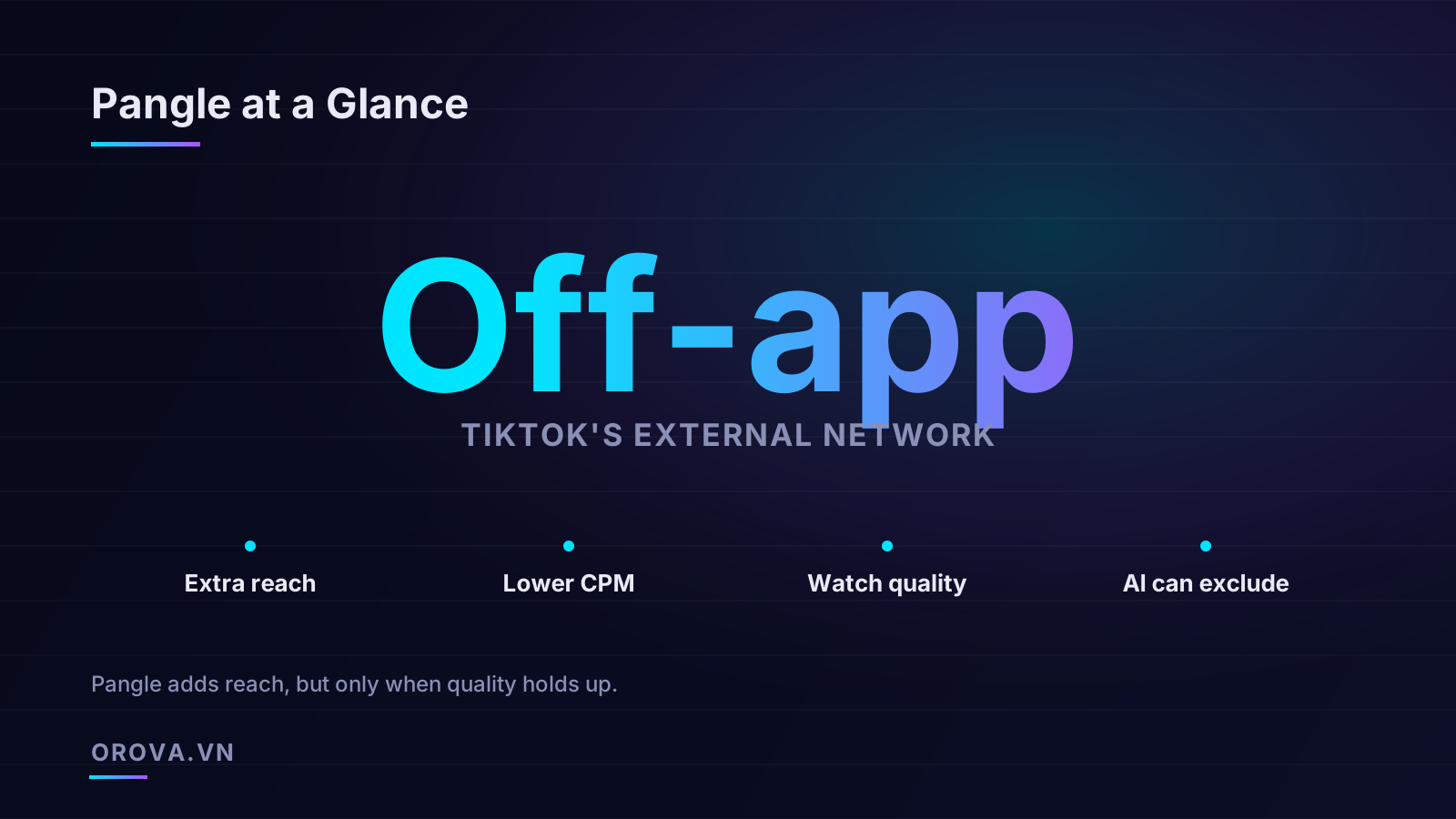
Pangle is TikTok's external advertising network — the off-app extension of its ad system. When you run a TikTok campaign with automatic placements enabled, your ads are eligible to appear not only inside TikTok itself but also inside thousands of third-party mobile apps and games that have integrated Pangle's SDK to monetize their own users. Think of casual games showing a rewarded video between levels, news apps with native in-feed slots, or utility apps running interstitials. Those are Pangle placements.
Conceptually, Pangle is to TikTok what the Audience Network is to Meta or the Display Network is to Google: a way to take the platform's targeting and creative system and project it onto inventory the platform does not own. The publisher app gets a revenue share for showing your ad; TikTok gets to sell more impressions; you get reach beyond the people currently sitting inside TikTok.
The genuine upside
- Incremental reach. Pangle puts you in front of people during moments they are not on TikTok — waiting between game levels, reading an article, using a tool. For some audiences and some campaign objectives, this is real net-new exposure rather than re-serving the same TikTok users.
- Lower nominal CPM. Pangle inventory is typically cheaper per thousand impressions than premium For You feed placement. On a pure cost-per-impression basis, it can look like a bargain.
- Volume for the algorithm. Early in a campaign, especially for objectives like app installs, the extra impression volume can help TikTok's optimization gather conversion data faster and exit the learning phase sooner.
The catch that ruins the math
Lower CPM is seductive and frequently misleading. The questions that matter are not "how cheap is the impression?" but "is anyone actually watching?" and "does this traffic convert at all?" Pangle's weak spots cluster around exactly those questions:
- Attention quality is uneven. A rewarded video inside a mobile game is shown to someone who wants a reward and will sit through anything to get it. Their "view" is technically a view, but their intent toward your product is often zero. Watch time can look fine while genuine attention is absent.
- Accidental and incentivized clicks. Interstitial placements and small close buttons generate clicks that were never meant to happen. These inflate click counts and can fool a poorly configured optimization toward chasing junk.
- Creative mismatch. An ad engineered for the sound-on, lean-in For You feed often lands poorly in a muted, distracted, between-levels game context. The same creative performs very differently across the two environments.
- Brand context risk. You have less control over exactly which app shows your ad, which matters for brands with stricter safety requirements.
The result is that Pangle's headline numbers — cheap CPM, decent click volume, reasonable watch time — can mask a placement that is bleeding budget on impressions that will never become customers. The only way to know is to separate Pangle from the core feed in your reporting and judge it on outcomes, not on impressions.
When to include Pangle, and when to cut it
There is no universal answer, but there is a reliable decision framework. The right call depends on your objective, your creative, and — above all — what the downstream data says once real spend has flowed through.
Lean toward including Pangle when
- Your objective is upper-funnel reach or app installs where volume and incremental exposure carry real value.
- Your creative is genuinely native and travels well — it still makes sense muted, and it does not depend on TikTok-specific UI cues.
- You have a clear downstream conversion signal (a purchase, a qualified lead, an in-app event beyond the install) that lets you judge Pangle on outcomes rather than installs alone.
- You are scaling and your core feed is saturating — Pangle can extend reach when the For You feed has exhausted the most responsive audience.
Lean toward excluding Pangle when
- Your objective is lower-funnel conversion and every dollar must trace to revenue. Pangle's lower intent often does not survive the trip to checkout.
- You are running a small budget where the learning phase matters more than raw reach, and noisy Pangle conversions could mislead optimization.
- Your creative leans hard on sound, trending audio, or native feed conventions that fall apart in a game or utility context.
- Brand safety requirements are strict and you need tight control over surrounding context.
- Your reporting shows Pangle delivering a worse cost per real outcome than the core feed — which, in conversion campaigns, it frequently does.
The reflex move among experienced TikTok buyers running conversion campaigns is to start with Pangle excluded, prove the campaign works on premium feed inventory alone, and only then test Pangle as a controlled, separately-measured expansion. Reach the other way — turning it on and forgetting — is how budgets quietly underperform for weeks.
The measurement discipline that makes the decision possible
None of the above guidance is actionable without proper measurement. The mistake that traps most advertisers is judging a blended campaign on blended numbers, where strong feed performance hides weak Pangle performance and the whole thing looks "fine." To make a real decision you need to:
- Break out placements in reporting. Segment performance by placement so you can see core feed, TikTok in-feed, and Pangle as distinct lines, not a single average.
- Judge on cost per outcome, not cost per impression. Compare cost per purchase, qualified lead, or meaningful in-app action across placements. A placement with a CPM half the size but a cost-per-conversion three times higher is not cheap — it is expensive in disguise.
- Watch the quality signals. Completion rate, post-click behavior, bounce rate, and time-on-site for Pangle traffic versus feed traffic will tell you whether the attention is real before the conversion data even matures.
- Give it a fair, bounded test. Pangle needs enough spend and time to be judged, but set a clear threshold in advance: if cost per real outcome exceeds the feed by some margin you have decided on, you exclude it. Decide the rule before you see the data so you are not rationalizing after the fact.
A worked example of the math
Numbers make the trap concrete. Imagine a conversion campaign spending $5,000 across feed and Pangle, blended. The dashboard shows a $9 cost per purchase and a healthy-looking 6.5-second average watch time. Leadership is pleased. Then you break it out by placement and the picture changes completely:
- Core feed: $3,500 spent, 320 purchases, $10.94 cost per purchase, but the conversions are real and the customers stick.
- Pangle: $1,500 spent, 145 "purchases" recorded, $10.34 cost per purchase on paper — which looks marginally better than the feed.
On the surface Pangle wins. But layer in the downstream signal — say, customers who are still active after thirty days, or who placed a second order — and the story flips. Suppose only 18% of Pangle's recorded conversions show real retention versus 71% of feed conversions. Suddenly the feed's true cost per durable customer is roughly $15, while Pangle's is closer to $40. The cheap placement was the expensive one all along. This is why cost per impression and even cost per recorded conversion can lie, and why the placement breakout plus a real downstream signal is non-negotiable for any campaign where the goal is revenue rather than vanity volume.
How an AI agent manages native quality and Pangle spend
Everything above is sound practice, and almost nobody does it consistently. The reason is not ignorance — it is bandwidth. Checking placement-level cost per conversion across every active campaign, every day, comparing Pangle against the feed, spotting creative fatigue before it tanks performance, and acting on all of it fast enough to matter is simply more daily labor than most teams can sustain. So the discipline slips. Pangle stays on because nobody pulled it off. Fatigued creative keeps spending because nobody rotated it. The decisions are not wrong in theory; they just never get made in time.
This is precisely the kind of high-frequency, data-heavy, rules-based monitoring where an autonomous agent earns its keep. The work is repetitive, the signals are quantitative, and the right action is usually clear once you actually look at the numbers — which is the part humans skip.
What the agent watches on the native-quality side
- Hold and completion rate trends per creative, flagging assets that are fatiguing before cost per result visibly degrades, so fresh creative can be rotated in proactively rather than reactively.
- Creative concentration risk, spotting when a single ad is carrying too much of the spend and the campaign is one fatigue cycle away from a cliff.
- Early-signal divergence, where an ad's first-day engagement predicts where its cost is heading, so weak entrants get throttled before they waste budget and strong ones get scaled while they are still cheap.
What the agent watches on the Pangle side
- Placement-level cost per real outcome, continuously comparing Pangle against core feed on the metric that actually matters, not on CPM.
- Quality-signal drift, catching when Pangle completion rates, post-click engagement, or downstream events start diverging from feed traffic — the early warning that the placement is degrading.
- Threshold breaches, where Pangle exceeds the cost-per-outcome rule you set, triggering a recommendation to exclude the placement or shift its budget to the feed.
Recommendations, executed — with a human in the loop
The difference between a dashboard and an agent is that a dashboard tells you Pangle is underperforming and then waits for you to do something about it, while an agent reads the data daily, decides what should change, and carries out the change. In practice that means adjusting budgets toward the placements and creatives that convert, shifting bids, turning fatiguing ads off and fresh ones on, refining audiences, and excluding Pangle when it stops paying its way.
The critical safeguard is that none of this should be a black box. Autonomy without oversight is how advertisers get burned by tools that "optimize" toward the wrong goal. The model that works is human-in-the-loop: the agent proposes a specific, justified change — "Pangle cost per purchase is running 2.4x the feed over the last seven days; recommend excluding Pangle and reallocating its budget" — and you approve it. Every decision is logged in a full audit trail, so you can always answer why a budget moved or a placement was cut. You keep judgment and control; the agent keeps the tedious daily vigilance that human teams cannot realistically maintain.
That combination is the point. Native creative wins attention, Pangle extends reach, and disciplined daily measurement is what keeps both honest. The first two are creative and strategic decisions only you can make. The third is exactly the kind of relentless, quantitative, never-skip-a-day work that machines do better than people. Pair the human judgment with the machine discipline, and you get the upside of TikTok's reach without quietly funding the impressions that never become customers.
Want native quality and Pangle spend watched every single day without adding it to your to-do list? Orova Ads is an AI agent that autonomously manages your paid campaigns across Google, Meta and TikTok — reading performance data daily, recommending optimizations, and executing budget, bid, on/off and audience changes with your approval and a full audit log of every move. Let it handle the relentless monitoring so your team can focus on the creative that actually wins the feed.
Let an AI Agent handle your SEO
Orova plans, writes, optimizes, and tracks rankings on its own — you just read the results.
Try it free