
Internal Linking Is the Cheapest SEO Win You're Ignoring
Walk into any SEO meeting and you will hear the same three subjects rotated endlessly: backlinks, content, and technical fixes. People will argue about outreach campaigns, debate whether to publish twice a week or four times, and spend an afternoon discussing whether a slow page is costing them rankings. What you will almost never hear is anyone propose, with real enthusiasm, that the team spend a day fixing internal links. And that silence is the single most telling thing about how the SEO industry misallocates its attention.
Internal linking is the cheapest, fastest, lowest-risk lever in the entire discipline — and it is the one most teams treat as an afterthought, a tidy-up job for an intern, a thing they will get to once the "real work" is done. This article is a deliberate argument against that ranking of priorities. The claim is simple and, I think, hard to refute once you look at it directly: most websites are leaving meaningful, compounding ranking gains on the table, every single day, because they cannot be bothered to link their own pages to each other properly.
Why internal linking gets ignored
It is worth being honest about why this happens, because the neglect is not random. There are specific, understandable reasons internal linking falls to the bottom of every list, and naming them is the first step to correcting the mistake.
The first reason is that it is unglamorous. Backlinks feel like a conquest — you persuaded another website, another human being with their own agenda, to vouch for you. There is a story in that, a small victory you can report. Adding a link from your own page to your own other page has no story. Nobody was persuaded. No relationship was built. It feels like filing, not winning, and humans systematically under-invest in work that feels like filing.
The second reason is that it is invisible to most reporting. A new backlink shows up in your backlink tool with a satisfying little notification. A new internal link shows up nowhere. There is no dashboard that congratulates you for it, no metric that ticks upward the moment you save the edit. Work that is not measured is work that is not valued, and internal linking is almost never measured.
The third reason is the most insidious: internal linking has no owner. Backlinks belong to the outreach person. Content belongs to the writers. Technical SEO belongs to whoever talks to the developers. Internal linking belongs to everyone, which in practice means it belongs to no one. Every new article should be woven into the existing site, and every existing article should be updated to point at the new one — but because that responsibility is not assigned to a specific person, it simply does not happen. Articles get published into isolation and stay there.
None of these reasons is a good reason. They are all explanations of a behaviour, not justifications for it. And once you see them clearly, the neglect starts to look less like a defensible prioritisation and more like a collective blind spot.
What internal links actually do
To argue that internal linking is undervalued, I have to be precise about what it delivers — because vague claims are easy to dismiss. Internal links do three concrete things, and each one maps directly to a ranking outcome.
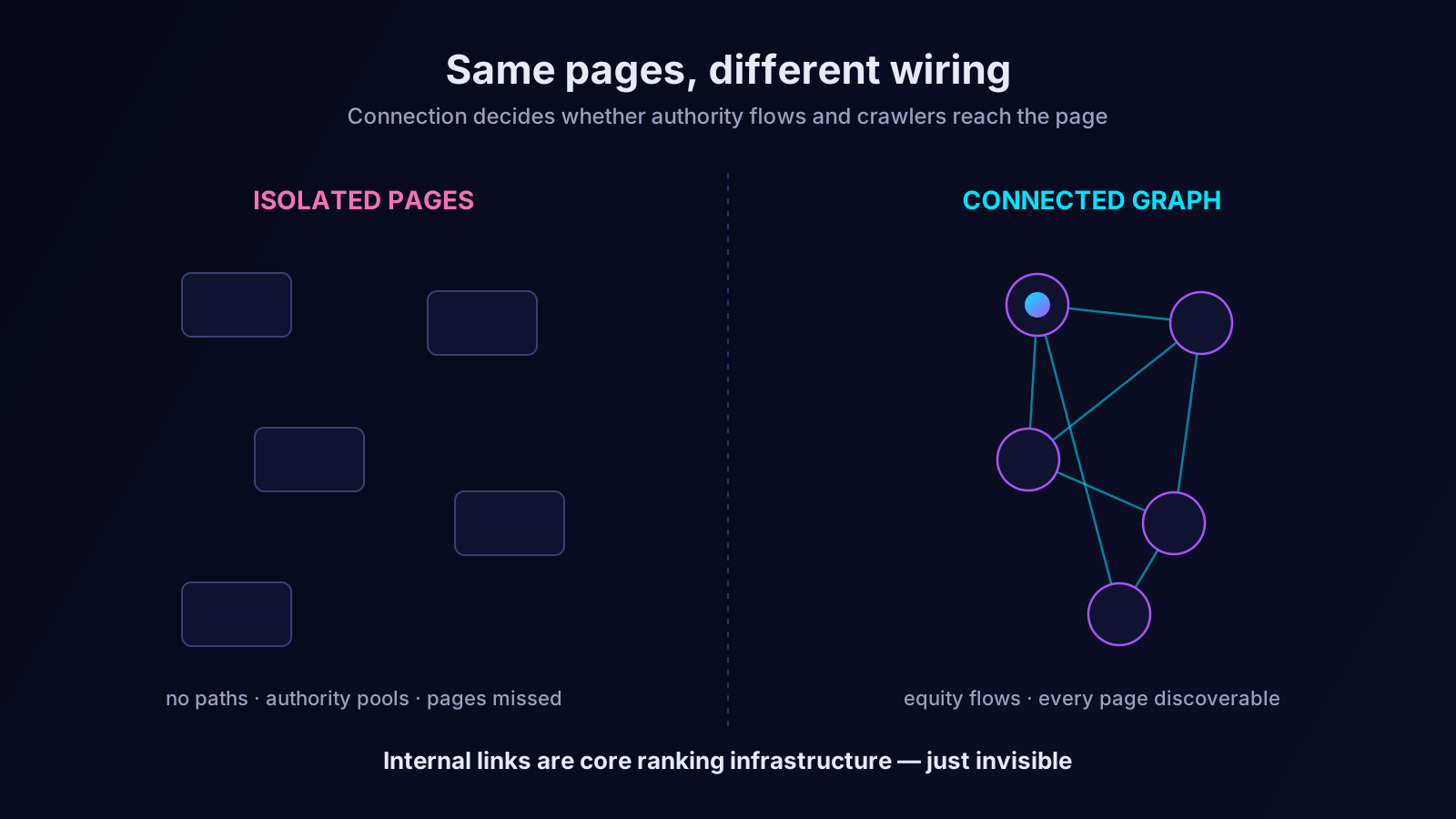
First, they distribute authority. When a page on your site earns links from elsewhere, it accumulates a kind of ranking equity. Internal links are the pipes through which that equity flows to the rest of your site. A page with no internal links pointing to it is a page cut off from the plumbing — it has to earn every scrap of its authority from scratch, externally, because none is reaching it from within. Most sites have a handful of pages that have quietly earned good external links and a long tail of pages that have earned none. Internal linking is how you move equity from the first group to the second. Do nothing, and that equity simply pools where it landed and never spreads.
Second, they tell search engines what a page is about and how important it is. The anchor text you use, and the number and prominence of links pointing at a page, are signals. A page that twenty other pages link to, using descriptive anchors, is being nominated by your own site as significant and clearly themed. A page that nothing links to is being implicitly nominated as unimportant — even if you did not mean to nominate it that way. Your internal link graph is a vote, and a page with no votes loses.
Third, they help search engines discover and re-crawl pages. A page that is well linked from active parts of your site gets found faster and revisited more often. A page buried with no paths leading to it can sit unindexed for weeks, or get crawled so rarely that updates take an age to register. Discovery is not automatic; it follows links, and internal links are the links a crawler has to follow to reach the depths of your site.
Three mechanisms, all real, all directly tied to whether and how well a page ranks. This is not a cosmetic nicety. It is core ranking infrastructure that happens to be invisible.
The cost comparison nobody runs
Here is the argument that should change how teams prioritise, and almost no team runs it explicitly. Put internal linking next to the alternatives on a simple cost-versus-control basis.
A backlink campaign is expensive. It costs hours of outreach, often money for tools or freelancers, and a great deal of patience — and you control almost none of the outcome. You can send a hundred thoughtful emails and earn three links. The other website decides whether to link, where to link, and what anchor text to use. You are a supplicant.
Producing new content is also expensive. A genuinely good article costs research, writing, editing, and design time, and then it takes months to mature in the rankings. It is worthwhile work, but it is neither cheap nor fast.
Now internal linking. It costs only your own time. It requires no one's permission. You control every variable completely — which pages link, which pages receive, the exact anchor text, the placement. There is no waiting for an external party. There is no rejection. And the effect, while smaller per link than a strong backlink, is entirely within your gift to capture. You could improve the internal linking of a mid-sized site in a focused week, with no budget and no dependencies.
When you lay the options side by side honestly, the misallocation is stark. Teams pour their scarcest resources into the lever they control least and neglect the lever they control completely. If a financial advisor told you to do that with money, you would fire them. Yet it is the default operating posture of most content teams. (For a sense of how the controlled version of this work is structured, our guide to internal linking strategy lays out the system.)
The objection: "internal links are minor"
The standard defence of the neglect is that internal links are a weak signal — that each one barely moves the needle, so the whole exercise is not worth a strategic slot. This objection deserves a direct answer, because it is half right and therefore dangerous.
It is true that one internal link, in isolation, is a small thing. But internal linking is never one link. It is a system of hundreds or thousands of links, and the effect is the aggregate. The objection is like saying a single brick is structurally insignificant and concluding that walls do not matter. The unit is weak; the structure is not.
And the objection misses the part of the effect that is not weak at all. Distributing authority to a starved page can be the difference between that page sitting on the second results page and breaking into the first. Connecting an orphaned page to the link graph can be the difference between indexed and invisible. Those are not marginal nudges. For the specific pages affected, they are step changes. The "minor signal" framing quietly assumes every page is already adequately linked and we are debating tiny optimisations at the margin. On most real sites that assumption is false. There are pages getting nothing, and giving them something is not a marginal act.
What neglect looks like in practice
If you want to see the cost of ignoring internal linking, audit your own site against three questions.
How many of your pages have fewer than three internal links pointing to them? On a neglected site the answer is "most of them," and every one of those pages is under-fed and under-discovered.
How many genuinely orphaned pages do you have — pages reachable only through the sitemap, with no editorial link from anywhere? Most teams assume the answer is zero and are unpleasantly surprised. Orphaned pages are content you paid to produce and then walled off from the very mechanism that helps it rank.
When you published your last ten articles, how many existing pages did you update to link to them? If the honest answer is "none," then every new article you publish starts its life isolated, fighting for relevance with no support from the site it lives on. You are running a content program where each new piece is handicapped from birth.
These three questions usually surface the same picture: a site that is, structurally, a loose pile of pages rather than a connected body of work — and a team that has never noticed because nothing in their reporting was ever pointed at it.
The compounding cost of waiting
There is one more reason the neglect is worse than it looks, and it is about time. Internal linking is not a problem that stays the same size while you ignore it. It compounds.
Every month you publish without weaving new pages into the site, and without updating old pages to point at the new ones, the gap between the site you have and the site you should have widens. The orphan list grows. The number of under-linked pages grows. The structural debt accumulates. A team that addresses internal linking after two years of neglect faces a far larger, far more tedious remediation than a team that simply built the habit from the start. The cheap lever does not stay cheap if you leave it long enough — neglect converts a small ongoing discipline into a large one-off project, and large one-off projects are exactly the things that never get scheduled.
How to stop ignoring it
The fix is not complicated, which is itself part of the indictment — this is not hard work being skipped because it is hard. It is easy work being skipped because it is unglamorous.
Give internal linking an owner. Make it one named person's job to ensure new pages are integrated and old pages are updated. Ownerless work does not get done.
Make it part of the publishing checklist. No article goes live until it links out to relevant existing pages and until a set of relevant existing pages has been updated to link to it. Build the discipline into the workflow so it does not depend on anyone remembering.
Run a periodic audit. Once a quarter, find the orphans and the under-linked pages and fix them. Treat it as routine maintenance, like any other recurring health check.
And consider giving the work to a system that does not get bored. Internal linking is mechanical, repetitive, and relentless — exactly the profile of work humans neglect and software handles well. An SEO AI agent can map your entire link graph, surface every orphan and under-linked page, and propose relevant, well-anchored links continuously, so the structure is maintained as a matter of course rather than rescued in an occasional panic. Orova is built for precisely this kind of unglamorous, compounding, easy-to-ignore work — the work that quietly decides how well the rest of your effort pays off. The cheapest SEO win is the one you already have the ability to claim. The only thing standing between you and it is the decision to stop ignoring it.
Let an AI Agent handle your SEO
Orova plans, writes, optimizes, and tracks rankings on its own — you just read the results.
Try it free