
CBO vs ABO: Should Meta or You Decide Where the Budget Goes?
Open the budget field on any Meta campaign and you face a quiet but consequential fork in the road. Flip a single toggle and the daily spend lives at the campaign level, where Meta's delivery system decides moment to moment which ad set deserves the next dollar. Leave it off and the budget sits inside each ad set, where you decide. Meta calls the first option Advantage Campaign Budget (the feature most advertisers still call CBO, for Campaign Budget Optimization) and the second Ad Set Budget Optimization, or ABO. The toggle takes half a second to set. The consequences play out over weeks, and the cost of getting it wrong is rarely a crash — it is the slow leak of a budget quietly flowing toward the wrong audience, or a clean test that never produces a clean answer.
I have watched a $400-a-day campaign with five ad sets pour 70% of its spend into a single ad set within 48 hours of switching to CBO — which was wonderful, because that ad set was the winner, and miserable two weeks later when that same audience fatigued and the system kept feeding it out of inertia. I have also watched advertisers leave everything in ABO out of caution, then spend three months hand-balancing budgets across twelve ad sets every Monday morning, doing by hand exactly the arithmetic Meta would have done for free. Neither group was wrong about the mechanics. Both were wrong about the timing. CBO versus ABO is not a question of which is smarter. It is a question of what you are trying to learn right now, and how much you already know.
What the two settings actually do
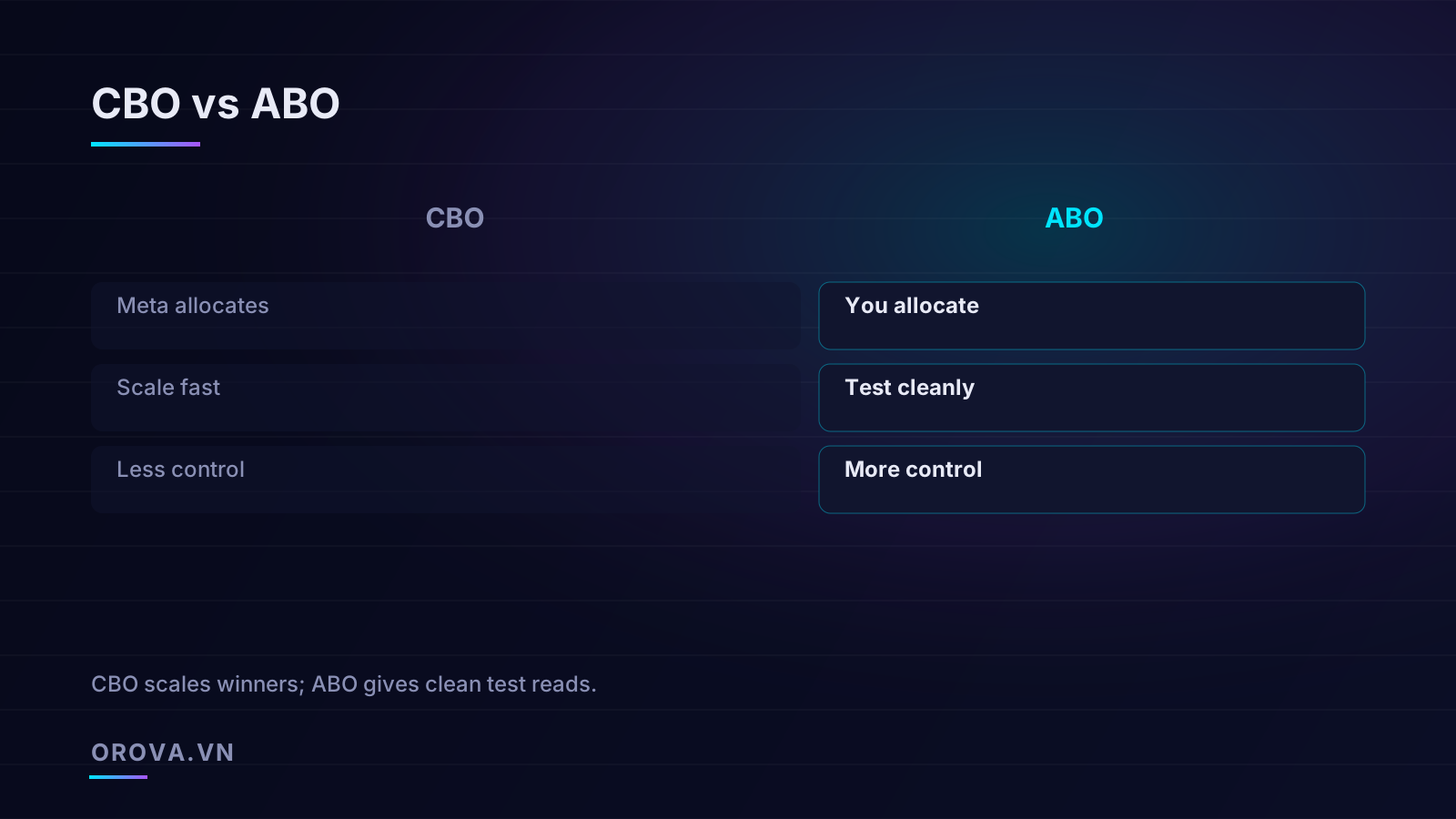
Strip away the marketing names and the difference is purely about where the money is allowed to move. In ABO, you assign a fixed daily or lifetime budget to each ad set. If you give ad set A $50 and ad set B $50, then over the course of a normal day ad set A spends roughly $50 and ad set B spends roughly $50, regardless of which one is performing better. The budgets are walled off from each other. Meta still optimizes within each ad set — choosing which user to show the ad to, which placement, which creative in a dynamic set — but it cannot reach across the wall and move dollars from the loser to the winner.
In CBO, you assign one budget at the campaign level. Say $100. The ad sets underneath become candidates competing for that pool. Meta's delivery system runs a near-continuous auction-time calculation: for each impression opportunity, which ad set is most likely to produce the outcome you optimized for (a purchase, a lead, a landing-page view) at the lowest cost? Spend flows toward whichever ad set wins that calculation most often. On a given day, ad set A might take $73 and ad set B $27, and tomorrow the split might shift again as performance signals change.
That is the entire mechanical difference. Everything else — the testing implications, the scaling behavior, the famous complaints about CBO "starving" certain ad sets — flows downstream from this one fact about where the wall sits.
Why CBO feels like it has a mind of its own
The first time most advertisers run CBO, they are alarmed by the imbalance. You build five ad sets representing five hypotheses — a lookalike, a broad interest, a retargeting pool, a stack of interests, a broad no-targeting set — and within a day or two Meta has decided two of them deserve almost everything and the other three get table scraps. This is not a bug. It is the feature working as designed. CBO is explicitly built to find the most efficient path to your outcome and pour budget into it. From Meta's point of view, spending equally across five ad sets when one is clearly cheaper per conversion would be leaving money on the table.
The problem is that "clearly cheaper" is a judgment the system makes on thin early evidence. With three conversions in ad set A and zero in ad set B after the first afternoon, CBO may conclude A is the winner and choke B before B ever had the volume to prove itself. You wanted a fair fight; CBO declared an early knockout. This is the central tension, and it is exactly why the choice between the two settings maps so cleanly onto the question of whether you are testing or scaling.
The real dividing line: are you testing or scaling?
Here is the rule that resolves most of the confusion, and it is the spine of everything below. Use ABO when your goal is to learn something — which audience, which creative angle, which offer works. Use CBO when your goal is to spend efficiently against something you already trust. ABO is a measurement instrument. CBO is an allocation engine. They are good at different jobs, and the classic mistakes happen when you use the instrument as the engine or the engine as the instrument.
Why ABO gives cleaner test reads
When you want to know whether a lookalike audience beats a broad interest audience, you need each to get a fair, comparable amount of budget and time. ABO guarantees that. Give each ad set $30 a day, let them run for the same window, and at the end you can compare cost per result on roughly equal spend. The comparison is honest because the inputs were controlled. This is the same logic as a clinical trial: you don't learn much if the control group gets a tenth of the doses the treatment group gets.
Run that same five-audience test in CBO and you sabotage your own experiment. Three of the audiences will be starved before they generate enough conversions to read, and you will end the test "knowing" that two audiences work — but you will not know whether the other three were genuinely worse or simply never funded. You will have spent real money and learned almost nothing reliable about three of your five hypotheses. That is the most expensive kind of test: one that produces a confident-looking but incomplete answer.
Why CBO scales winners better than you can
Now flip the situation. You have already run your ABO tests. You know your top two audiences and your two best creatives. You are no longer asking "what works?" — you are asking "how do I spend $500 a day on what works without babysitting it?" This is CBO's home turf. Audiences fatigue at different rates, performance swings by day of week, costs spike during sale periods and on competitive days. A human checking once a day will always be reacting to yesterday. CBO reallocates continuously, shifting spend toward whichever proven ad set is performing right now and pulling back from one that is having an off day, then reversing when conditions change. It does the boring, high-frequency rebalancing arithmetic far faster and more dispassionately than any person reviewing a dashboard each morning.
The keyword in that paragraph is proven. CBO is a force multiplier on good inputs and a fast way to overspend on bad ones. It will scale a winner and it will, with equal enthusiasm, scale a mediocre ad set if that mediocre ad set happens to be the least-bad option in a weak campaign. The setting has no opinion about whether your campaign deserves to exist. That judgment is still yours.
The minimum-spend rules that quietly run the show
This is the part most CBO guides skip, and it is where a lot of frustration actually originates. CBO is not a pure free market. Meta gives you levers to constrain how the campaign budget gets distributed, and if you ignore them you are letting the system make decisions you may not want.
Minimum and maximum spend per ad set
Inside a CBO campaign, you can set a minimum daily spend on individual ad sets — a floor that guarantees an ad set gets at least, say, $20 a day even if the system would rather starve it. This single setting solves the most common CBO complaint. If you want to keep a retargeting ad set alive because it produces your most valuable customers, but its volume is too low for CBO to favor it, a minimum spend forces the campaign to keep funding it. You can also set a maximum spend to cap how much any one ad set can swallow, which is useful when you are nervous about an audience saturating.
The trade-off is real: every floor and ceiling you add narrows the room CBO has to optimize. Set minimums on all five ad sets that sum to your whole budget and you have effectively rebuilt ABO with extra steps — you have told Meta exactly how to split the money, leaving it nothing to optimize. The art is to use minimums sparingly, as guardrails for ad sets you have a strategic reason to protect, not as a way to micromanage the entire split.
The exit-from-learning threshold
There is a second number that governs both modes and deserves more respect than it usually gets: Meta's learning phase. Every ad set needs roughly 50 optimization events (conversions, typically) within a sliding seven-day window to exit the learning phase and reach stable, efficient delivery. Below that, performance is volatile and cost per result is unreliable. This threshold is the real reason small budgets struggle with multi-ad-set campaigns of any kind.
Do the arithmetic. If your cost per purchase is $25 and an ad set needs ~50 purchases a week to stabilize, that ad set needs about $1,250 a week — roughly $180 a day — to get out of learning. Run a CBO campaign with five ad sets on a $100 daily budget and you cannot possibly get all five out of learning at once; there isn't enough budget to clear the threshold even for one or two. This is not a CBO failure. It is a budget-versus-conversion-cost math problem that exists regardless of which toggle you flip. CBO at least concentrates spend so that one or two ad sets can reach the threshold, which is one underappreciated argument for CBO at small budgets: consolidation. Spreading the same $100 across five ABO ad sets at $20 each guarantees that none of them ever exits learning, and you run forever in the volatile zone.
A practical sequence: test in ABO, graduate to CBO
The cleanest operating model I have used, and the one I recommend to almost everyone, is a two-phase lifecycle. It treats the two settings as stages rather than as rivals.
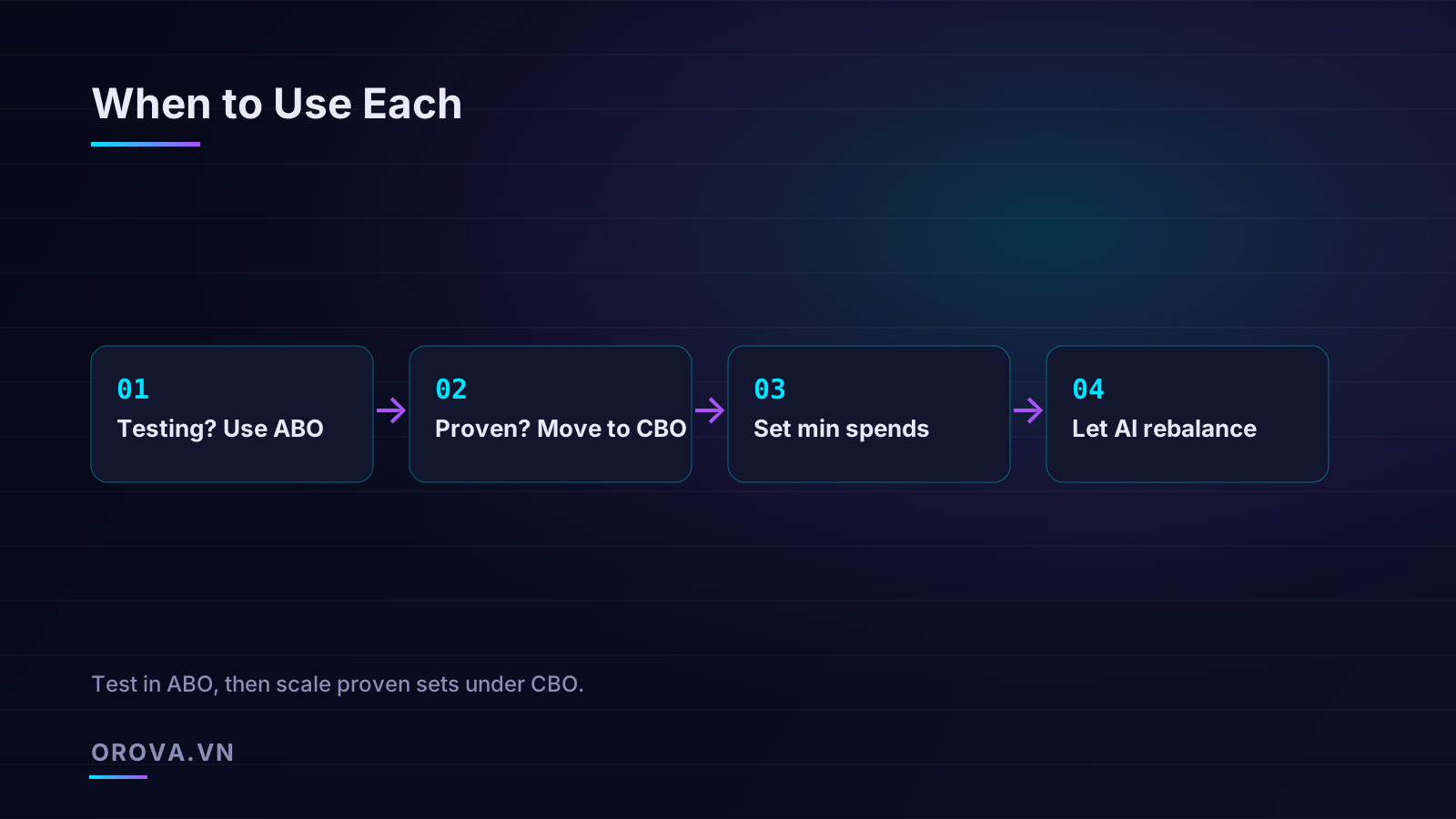
- Phase one — discovery in ABO. Build a campaign with each hypothesis as its own ad set, each with an equal, deliberately modest budget large enough to generate a readable number of conversions over your test window. Resist the urge to add too many ad sets; three to five is usually right, because you need each to clear enough volume to read. Let it run long enough to escape the first-day noise — typically a week, sometimes two — and judge by cost per result on comparable spend, not by raw conversion count.
- Phase two — consolidation in CBO. Take the winners — the audiences and creatives that proved out — and rebuild them in a single CBO campaign. Now you want Meta's allocation engine working for you, shifting spend among proven options as conditions change. Set a minimum spend only on the ad sets you have a strategic reason to protect (high-value retargeting, a new geo you are committed to). Then mostly leave it alone, because constant manual edits reset the learning phase and erase the stability you are paying for.
- Continuous — re-test on the side. Discovery never ends. Keep a small, separate ABO campaign running new hypotheses against your established winners. When something new beats your incumbents, promote it into the CBO campaign. This keeps your scaling campaign fed with fresh, validated material instead of slowly decaying as your current winners fatigue.
This sequence respects what each setting is good at. You test where testing is honest and you scale where scaling is efficient, and you never ask either tool to do the other's job. It also sidesteps the single most common operational error, which is editing a CBO campaign so frequently — bumping budgets, toggling ad sets, swapping creative — that it never stabilizes, then blaming CBO for the volatility you caused.
When to break the rule and start in CBO
The two-phase model is the default, not a law. There are legitimate cases for going straight to CBO. If your budget is genuinely small relative to your conversion cost, CBO's consolidation is the only realistic way to get any ad set out of learning, as the math above shows — spreading thin in ABO just guarantees permanent volatility. If you are running broad targeting with several creatives and trust Meta's targeting more than your own audience guesses (an increasingly defensible position as Meta's signal has improved and as detailed targeting options have narrowed), CBO with a couple of broad ad sets is a clean, low-maintenance structure. And if you are simply outnumbered — managing dozens of campaigns and physically cannot hand-balance them all — CBO's automation is not a luxury, it is the only way the work gets done at all.
The mistakes that make people blame the wrong setting
Most "CBO doesn't work for me" and "ABO is too much work" complaints trace back to a handful of avoidable errors. Recognizing them is worth more than any toggle preference.
- Testing in CBO. Already covered, but it is the number-one error, so it earns repeating: if you want a clean read on which audience or creative wins, the unequal, early-decided budget split in CBO will corrupt the experiment. Test in ABO.
- Over-constraining CBO with minimums. Setting a floor on every ad set turns CBO into a clumsy ABO and then wondering why "CBO isn't optimizing." You handcuffed it. Use minimums as targeted guardrails, not as a full allocation plan.
- Editing too often. Every meaningful change — a budget bump beyond about 20%, toggling an ad set, swapping the optimization event — can throw an ad set back into learning. Advertisers who tinker daily live in permanent volatility and then conclude the platform is unreliable. The platform is reliable; the tinkering isn't.
- Ignoring the conversion-volume math. Running five ad sets on a budget that cannot clear the learning threshold for even one of them, in either mode, and then judging "winners" off noise. Fewer ad sets with enough budget each beats many ad sets that all stay in learning forever.
- Mixing wildly different audiences in one CBO campaign. If you put a tiny, high-intent retargeting pool in the same CBO campaign as a huge cold audience, the system will usually favor the cheap-converting retargeting set and starve the cold one — even though the cold set is doing the prospecting that fills the retargeting pool in the first place. Either separate them into different campaigns or protect the cold set with a minimum spend. This is one of the most expensive silent failures in CBO, because it slowly cannibalizes your top of funnel.
How budget allocation looks when an AI agent runs it
Everything above describes a manual practitioner making structural decisions and then either trusting Meta's in-platform optimization (CBO) or hand-balancing (ABO). There is now a third operating layer that sits above both: an autonomous agent that watches performance daily across the whole account and acts on it. This is a different thing from CBO, and the distinction matters, because people conflate them.
CBO optimizes within one campaign, in real time, using only Meta's signals, toward the conversion event you selected. It cannot move budget from a weak campaign to a strong one, it cannot read your actual business outcomes (margin, lifetime value, return rates) unless you feed them in as the optimization event, and it has no memory of strategy. An AI agent operating at the account level reasons across all of that. It can decide that your prospecting campaign deserves more budget this week even though its in-platform cost per result looks worse, because it sees that prospecting is what feeds the retargeting that CBO loves. It can catch the cannibalization trap described above and recommend separating audiences or setting a floor — the structural move CBO will never make on its own, because CBO doesn't know it is part of a funnel.
In practice an agent handles the CBO-versus-ABO lifecycle as ongoing operations rather than a one-time setting. It reads cost per result, frequency, and learning-phase status across every ad set each morning; it flags when a test ad set has gathered enough volume to call a winner and graduate it to your scaling campaign; it proposes the minimum-spend guardrails that protect strategic ad sets; and it rebalances at the campaign level — the layer above CBO — so that money flows toward the campaigns and platforms that are actually working, not just toward whichever ad set wins a single internal auction. Because the same agent watches your Google and TikTok spend too, it can make the genuinely cross-platform call that no single platform's optimizer can: pulling budget from a saturated Meta audience toward a TikTok campaign that is suddenly cheaper, a decision that lives entirely outside Meta's field of view. That whole-account view — treating every platform as one budget governed by one set of goals — is the argument for running ads through a single cross-platform brain rather than three disconnected optimizers.
Human-in-the-loop, not hands-off
The right design keeps you in the decision seat. An agent that silently moves $300 a day from one campaign to another and tells you afterward is not help, it is a liability. The model that earns trust is human-in-the-loop: the agent reads the data, explains its reasoning, proposes a specific change — "shift $40/day from the saturated lookalike to the broad ad set; here is the cost-per-result trend that justifies it" — and waits for your approval. Every action it executes is logged in an audit trail you can review and reverse. You get the speed and consistency of automated allocation without surrendering the strategic judgment that, as this whole article argues, the platform's own optimizer cannot supply. CBO answers "where within this campaign?" An account-level agent answers "where across everything, and why?" — and the second question is the one that actually grows a business. If you want a system that runs that loop across Google, Meta and TikTok while leaving the final call to you, that is exactly the gap it is built to fill.
The short version
CBO and ABO are not competitors; they are tools for different jobs in a single budget lifecycle. ABO is your measurement instrument — use it to test audiences and creatives on fair, equal, comparable budgets so your reads are honest. CBO is your allocation engine — use it to scale the winners ABO surfaced, letting Meta do the continuous rebalancing no human can match in frequency. Protect the ad sets that matter with minimum spends, respect the ~50-conversions-per-week learning threshold when you size your budgets, separate audiences that would cannibalize each other, and stop editing campaigns the moment they stabilize. Do those things and the toggle stops feeling like a gamble and starts feeling like what it is: a simple choice about whether you or the machine should hold the wallet right now. The answer depends entirely on whether you are still learning or already know.
If hand-balancing ABO tests and babysitting CBO campaigns is eating your week, this is exactly the work Orova Ads is built to take off your plate. It is an AI agent that reads your Google, Meta and TikTok data every day, recommends the budget shifts, bid changes, on/off moves and audience adjustments that the numbers justify, and executes them only after you approve — with a full audit log of every action. You keep the strategy; it handles the daily allocation grind. See how it works at orova.vn/ads.
Let an AI Agent handle your SEO
Orova plans, writes, optimizes, and tracks rankings on its own — you just read the results.
Try it free