
Meta Placement Optimization: Advantage+ Placements vs Manual Control
Open any Meta Ads Manager report, break it down by placement, and you will almost always find the same uncomfortable pattern: one or two placements are quietly carrying the account, a couple are bleeding money, and the rest are rounding errors. A skincare brand I worked with last year was spending 41% of its budget on Audience Network because the campaign had been built years ago with a hand-picked placement list. That spend was generating a $14 cost per purchase. The same campaign's Reels placement was converting at $4.80. Nobody had checked the breakdown in eleven months. Switching that campaign to Advantage+ Placements cut the blended cost per purchase by 38% inside two weeks — not because Advantage+ is magic, but because the manual list had frozen a bad decision in place.
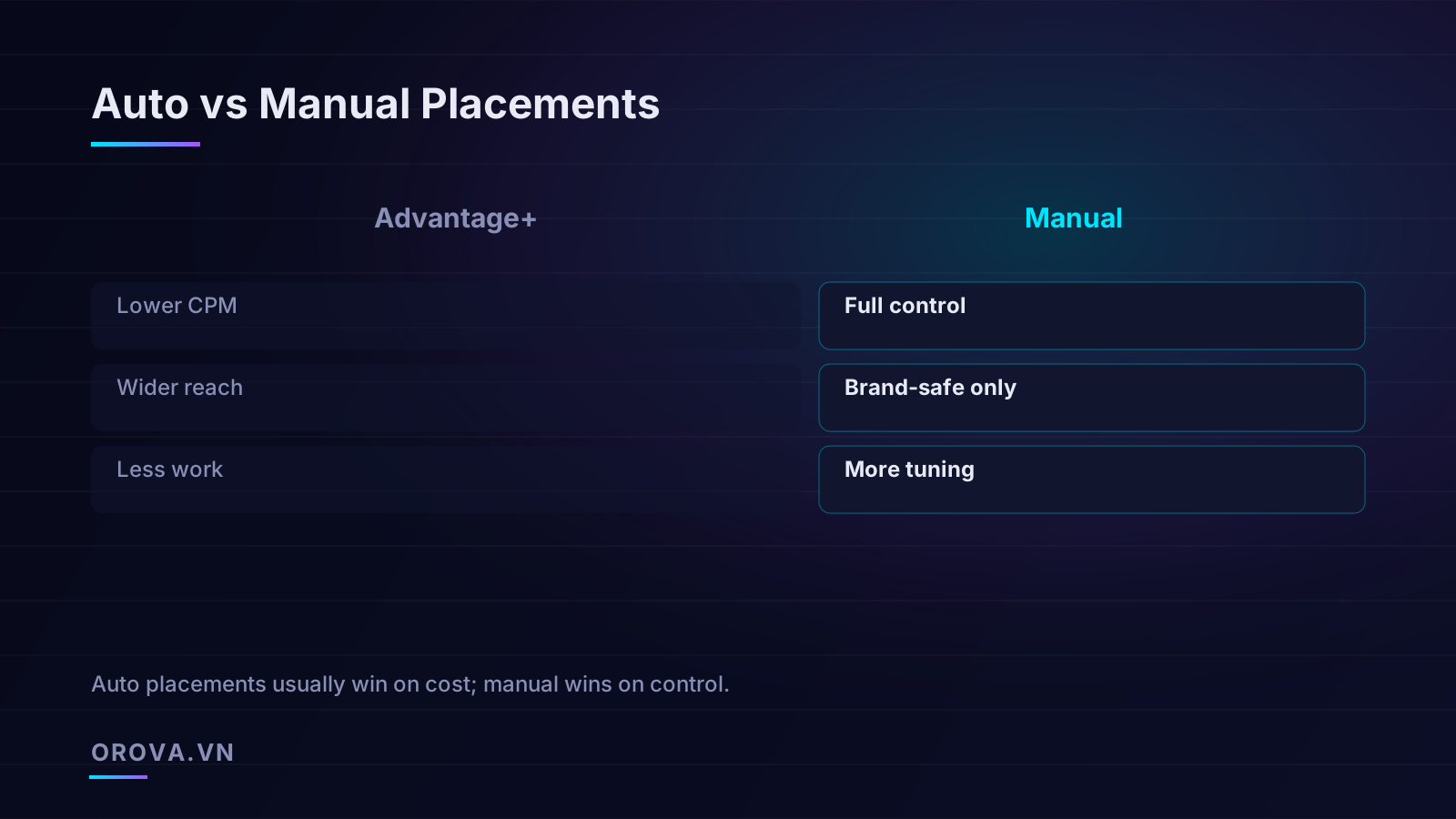
That story captures the whole tension of placement strategy on Meta. Advantage+ Placements (the feature Meta used to call Automatic Placements) lets the auction decide where each impression runs. Manual placements let you decide. Most of the time the algorithm wins on cost. But "most of the time" is not "always," and the gap between those two phrases is where real money is made or lost. This article is about reading that gap precisely: what Advantage+ Placements actually does under the hood, where manual control still earns its keep, how asset customization changes the math, and how an AI agent reads placement-level data to make the call faster than any human checking a dashboard once a quarter.
What Advantage+ Placements actually does
The first thing to understand is that placements are not audiences and they are not budgets. A placement is a slot — the Facebook Feed, Instagram Reels, Stories, the Messenger inbox, the Audience Network, the search results in Marketplace, and roughly twenty named surfaces in total. When you turn on Advantage+ Placements, you are telling Meta's delivery system that it may show your ad in any eligible slot across Facebook, Instagram, Messenger, and Audience Network, and that it should choose each impression to maximize your optimization goal at the lowest cost.
The reason this usually beats manual selection comes down to how the auction works. Meta runs a single auction across all placements simultaneously. When you restrict an ad set to, say, "Feed only," you are not making the Feed cheaper — you are removing the algorithm's ability to find a cheaper conversion somewhere else. If a Reels impression would have cost you $0.30 to reach a high-intent user and a Feed impression costs $0.55 to reach a colder one, manual Feed-only delivery forces you to buy the more expensive impression. Across millions of auctions, those small differences compound into the double-digit CPM gaps you see in real accounts.
There is a second, less obvious benefit: liquidity. Meta's machine learning needs conversion events to learn. An ad set restricted to a single placement has fewer opportunities to deliver, which means it gathers signal more slowly and is more likely to get stuck in the learning phase. Advantage+ Placements gives the system more surfaces to test against, so it exits learning faster and stabilizes sooner. For small budgets — anything under roughly 50 optimization events per week — this liquidity advantage often matters more than the raw CPM difference.
The cost story, with numbers
Meta's own aggregate data, repeated across years of case studies, claims that Advantage+ Placements lowers median cost per result by somewhere in the 5–20% range versus Feed-only delivery. Take those vendor numbers with appropriate skepticism, but the directional claim holds up in independent account audits. The mechanism is simply that the auction is allowed to buy the cheapest qualifying impression instead of the one you pre-selected.
The catch is that "cheapest result" is measured against your optimization goal, and the optimization goal is only as good as your tracking. If your pixel fires a "purchase" event that is actually a "view content" event, Advantage+ Placements will happily flood your budget toward whatever placement produces the most of that mislabeled event. The algorithm optimizes exactly what you tell it to, including your mistakes. This is why placement automation and conversion tracking hygiene are the same project, not two separate ones.
When manual placements still win
If automation usually wins on cost, why does the manual option still exist? Because cost per result is not the only thing that matters, and there are concrete situations where ceding control is the wrong move.
Brand safety and context control
The most common legitimate reason to go manual is brand safety. Audience Network shows your ads inside third-party apps and websites that Meta does not control as tightly as its own surfaces. For a consumer app selling a $9 game, an ad appearing next to questionable content is a non-event. For a private bank, an insurer, or a luxury brand whose entire value proposition is trust, that placement adjacency is a real risk. These advertisers routinely exclude Audience Network entirely, accept a slightly higher CPM, and treat the difference as an insurance premium. That is a defensible business decision, not an optimization failure.
Creative that only works in one shape
The second reason is creative format. A 16:9 horizontal video testimonial built for desktop Feed will get cropped, letterboxed, or mangled if it runs in vertical Stories and Reels. A carousel with dense text designed for considered B2B purchases makes no sense in a six-second Reels slot. If you only have one creative and it is shaped for one surface, forcing it into every placement produces ugly, low-performing impressions that drag your averages down. In that situation, restricting placements to where the creative actually fits is not fighting the algorithm — it is protecting it from bad inventory.
The better answer, which we will get to, is usually to fix the creative rather than restrict the placement. But when you are early in a campaign and have not yet produced format-native assets, manual control buys you time.
Measurement and incrementality testing
The third reason is experimental. If you want to know whether Reels is genuinely driving incremental conversions or merely taking credit for purchases that would have happened anyway, you sometimes need to isolate placements deliberately. Clean placement-level experiments require manual control because you cannot test what the auction is free to reshuffle. This is a tactical, temporary use of manual placements — you run the test, learn the answer, then hand control back to the algorithm armed with better knowledge.
Asset customization: the middle path most accounts skip
Here is the feature that resolves most of the auto-versus-manual debate and that the majority of accounts never touch: placement asset customization. Inside a single ad set with Advantage+ Placements turned on, you can supply different creative for different placement groups. You keep the auction's freedom to choose the cheapest surface, but you give it the right asset to show on each one.
In practice this means uploading a clean vertical 9:16 video for Reels and Stories, a square or 4:5 version for Feed, and a horizontal cut for in-stream video — all under the same ad. You can also customize the primary text, swap the destination, replace the call-to-action button per placement, and trim or crop video differently for each surface. Meta then assembles the right combination automatically at delivery time.
This matters because it dissolves the false choice. The reason people reach for manual placements is almost always "my creative doesn't fit everywhere." Asset customization answers that directly: keep all placements eligible, but stop showing a letterboxed horizontal video in a vertical slot. You get the cost advantages of full auction liquidity and the quality advantages of native creative, without picking one at the expense of the other.
How to set it up without breaking learning
- Start from a single ad set with Advantage+ Placements enabled, not from a placement-restricted base. You want maximum eligibility.
- Use the "Customize per placement" option at the ad level and group your assets by aspect ratio: 9:16 for Reels and Stories, 1:1 or 4:5 for Feed, 16:9 for in-stream and search.
- Resist the urge to write radically different copy per placement at first. Format and aspect ratio carry most of the gain; copy variation per placement adds complexity and dilutes your data.
- Let the ad set exit learning before you judge anything. Placement-level numbers in the first 48 hours are noise — the system is still allocating exploratory impressions.
Reading the placement breakdown like an analyst
Whether you run auto or manual, the breakdown report is where the truth lives. In Ads Manager, take any campaign, click Breakdown, choose "By Delivery → Placement," and you will see results, cost per result, CPM, and spend distribution across every surface. This single view answers the only question that matters: where is your money actually going, and what is it buying?
The trap is misreading what you see. Three mistakes recur constantly.
Mistake one: judging placements by raw conversion count
Reels will almost always show the most conversions in absolute terms simply because it receives the most impressions. That does not make it efficient. You have to read cost per result, not total results. A placement with 12 conversions at $6 each is worse than one with 4 conversions at $3 each, even though the first looks busier. Sort by cost per result, then weigh it against volume.
Mistake two: cutting a placement with too little data
A placement that has spent $11 and produced zero conversions has told you nothing. You need enough spend for the absence of conversions to be statistically meaningful — a rough rule is at least three to five times your target cost per result before you trust a zero. Cutting placements on thin data is how accounts slowly strangle their own liquidity, exclusion by exclusion, until they are back to a brittle manual list that no one remembers building.
Mistake three: ignoring the assist role of cheap placements
Stories and Audience Network often look weak on last-click attribution but play a real upper-funnel role, putting the brand in front of users who later convert through Feed or search. Before excluding a "low-performing" placement, check whether it is feeding the placements that do convert. This is exactly the kind of cross-surface interaction that gets worse over time as creative repeats — the same dynamic behind Meta ad fatigue and frequency burnout, where a placement's apparent decline is really an audience-saturation problem wearing a placement costume.
A worked example of the threshold rule
Concrete numbers make the data-threshold rule easier to apply. Suppose your target cost per purchase is $20. A placement that has spent $15 with zero purchases is not a failure — it has not yet had a fair chance, because you would not expect a purchase until somewhere around the $20 mark on average. Pulling it now is premature. The same placement at $80 spent and still zero purchases is a genuine signal: it has had four full shots at your target cost and produced nothing. The rough multiplier of three to five times your target cost gives you a defensible line between "too early to judge" and "now I know." Apply it per placement, not per campaign, because a campaign-level average can hide a placement that is silently underwater.
The reason this discipline matters so much is asymmetry. The cost of leaving a mediocre placement running for an extra week is small and bounded. The cost of excluding a good placement on thin data is unbounded, because exclusions are sticky — once a placement is off, it tends to stay off, and you lose its liquidity and its assist value indefinitely. When the downside is asymmetric, you bias toward patience. Cut late and reversibly rather than early and permanently.
A practical decision framework
Strip away the nuance and you can route almost any campaign through a short decision tree.
- Default to Advantage+ Placements. For the overwhelming majority of direct-response campaigns, start here. The cost and liquidity advantages are real and the burden of proof should be on going manual, not on staying auto.
- Add asset customization before you restrict. If your concern is creative fit, solve it with per-placement assets, not with placement exclusions. This is the single highest-leverage change in most accounts.
- Exclude only for brand safety, and only deliberately. If a placement carries genuine reputational risk for your category, exclude it knowingly and accept the cost premium. Document why, so the decision can be revisited.
- Go fully manual only to run a test. Isolate placements when you need a clean experiment, then return to auto with the answer in hand.
- Re-read the breakdown on a schedule. Placement performance drifts as creative fatigues, as Meta launches new surfaces, and as your audience saturates. A list that was optimal in January is rarely optimal in June.
That last point is where most accounts fail. Not because they choose wrong on day one, but because they never revisit. The skincare brand from the opening was not run by incompetent people — it was run by busy people who set placements once and moved on. The decision was correct when made and quietly wrong eighteen months later.
Reconciling automation with reporting
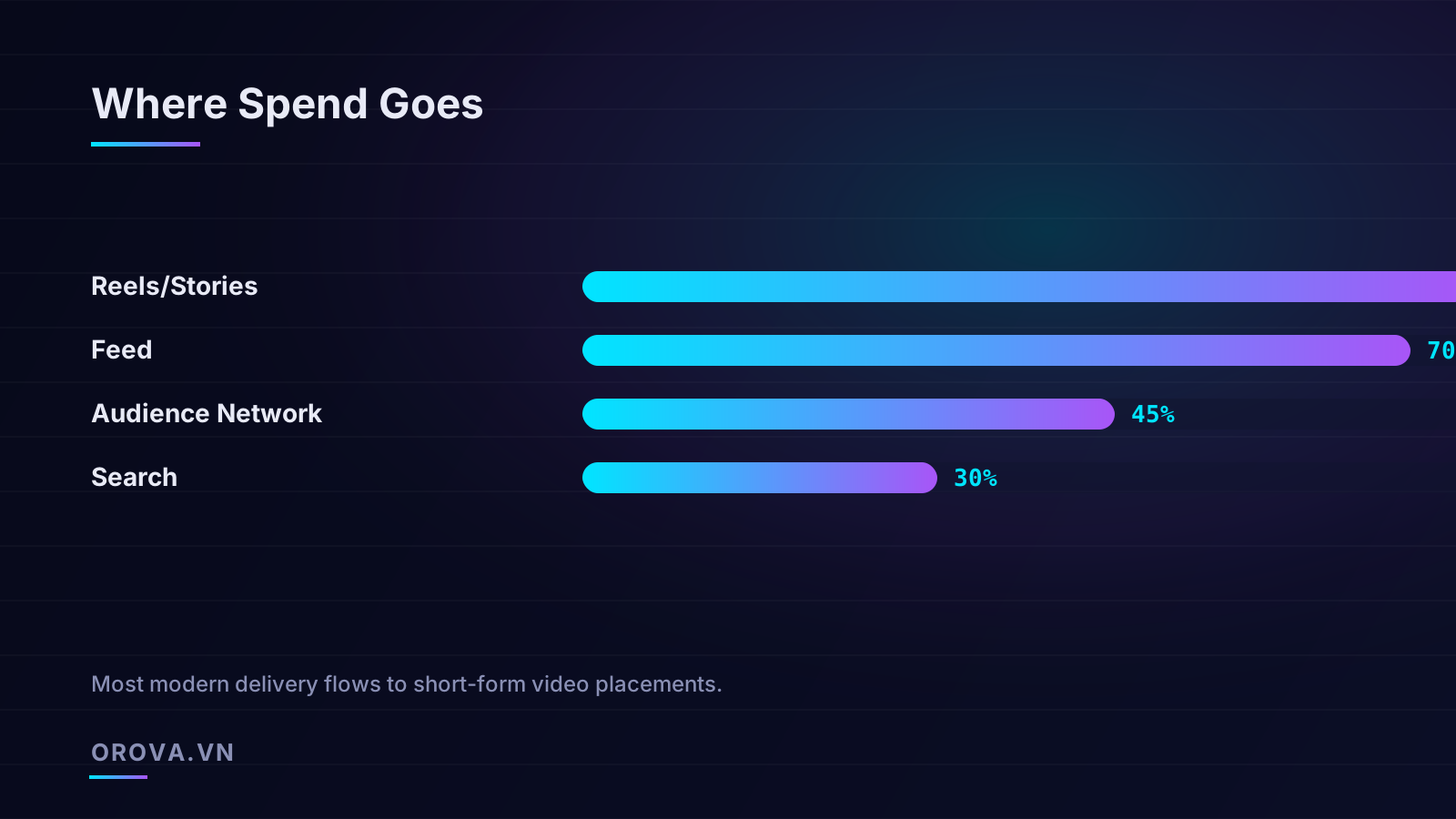
One more practical wrinkle deserves attention because it trips up even experienced buyers: the difference between how Advantage+ Placements delivers and how you read it back. When the auction is free to allocate across surfaces, your spend distribution will look lumpy and will shift over time. You might see 70% of budget land on Reels one week and 55% the next, with the slack flowing to Feed. That is the system working as designed, chasing the cheapest qualifying impression as demand and competition fluctuate hour by hour. It is not instability and it is not something to correct.
The mistake is treating that natural redistribution as a problem and trying to "rebalance" it with manual caps. Every time you pin spend to a placement that the auction was moving away from, you override a decision the system made for a reason you cannot see — usually because that placement got more expensive or its conversion rate dropped. Trust the redistribution unless the breakdown shows the cheaper placement is also producing worse results. Cheaper and worse is a real problem; cheaper and equal is exactly what you wanted.
Why placement optimization is really a monitoring problem
Notice what every recommendation above has in common: it depends on someone actually reading the placement breakdown, interpreting it correctly, and acting before the inefficiency compounds. That is not a strategy problem. It is a labor and attention problem. The strategy fits on an index card. Executing it across dozens of ad sets, every day, without missing the week a placement starts decaying — that is the part humans reliably fail at.
Consider the actual workload. To keep placement allocation efficient across a real account, you need to pull the placement breakdown per ad set, normalize cost per result against each ad set's own target, check whether zero-conversion placements have crossed the data threshold to be trusted, verify whether weak last-click placements are assisting, watch frequency by placement so you do not mistake fatigue for a placement defect, and confirm that any creative you customized is still rendering natively after Meta's periodic spec changes. Doing that thoroughly for one campaign takes twenty focused minutes. Doing it for forty campaigns, daily, is a full-time job nobody has time for.
What an AI agent reads, and how
This is precisely the kind of bounded, repetitive, data-dense analysis that an automated agent does well. An AI layer sitting on top of the Meta API can pull placement-level breakdowns every day rather than every quarter, compare each placement's cost per result to the ad set's own goal rather than to a global average, and flag a placement only once it has accumulated enough spend for the signal to be real — sidestepping the thin-data cutting mistake that humans make under time pressure.
More importantly, an agent can hold context a human dashboard cannot. It can notice that a placement's rising cost coincides with rising frequency and correctly diagnose fatigue rather than recommending an exclusion. It can see that Stories looks weak on last-click but precedes a disproportionate share of converting Feed sessions, and protect it. It can detect that a customized vertical asset stopped rendering after a spec change and surface that as a creative problem rather than a placement problem. The value is not that it makes decisions a human couldn't — it's that it makes them consistently, daily, across the whole account, and shows its reasoning.
The non-negotiable part is the guardrail. Placement exclusions and budget shifts are exactly the kind of change you do not want a black box making silently, because a wrong exclusion quietly strangles liquidity and you may not notice for weeks. The right model is human-in-the-loop: the agent reads the data, proposes the specific change with the evidence behind it, and a person approves or rejects, with every action written to an audit log you can review later. That combination — daily reading, evidence-backed recommendations, human approval, full audit trail — is what turns placement optimization from a quarterly fire drill into a steady, accountable process.
The bottom line
Advantage+ Placements should be your default because the auction allocates impressions more efficiently than a static manual list, and because liquidity helps your campaigns learn faster and stabilize sooner. Manual placements remain the right tool for genuine brand-safety exclusions, for clean incrementality tests, and as a temporary patch when you have not yet built format-native creative. But the real upgrade for most accounts is neither extreme — it is asset customization, which keeps every placement eligible while showing the right creative on each surface, dissolving the false choice that drives people to manual control in the first place.
And underneath all of it sits the same truth: placement optimization is a monitoring discipline, not a one-time setup. The accounts that win are not the ones that pick the cleverest configuration on launch day. They are the ones that re-read the breakdown often enough to catch decay early, and act on it before the waste compounds into a fourteen-dollar cost per purchase nobody noticed for a year.
If reading placement breakdowns across every campaign, every day, is more work than your team can sustain, that is exactly the gap Orova Ads is built to close. It is an AI agent that manages paid campaigns across Google, Meta, and TikTok — reading placement and performance data daily, recommending specific optimizations to budgets, bids, on/off states, and audiences, and executing them with your approval and a complete audit log. You keep control of the decisions; the agent handles the relentless daily reading that no human has time to do well.
Let an AI Agent handle your SEO
Orova plans, writes, optimizes, and tracks rankings on its own — you just read the results.
Try it free