
Spark Ads on TikTok: Turning Organic Posts Into Paid Performance
A clothing brand we worked with had a 22-second video sitting on their TikTok profile with 480,000 organic views, 31,000 likes, and a comment section full of people asking "where can I buy this?" Their media buyer's instinct was to recut the footage into a "proper" ad: add a logo bumper, drop in a price card, slap a "Shop Now" overlay on the end. The recut version, run as a standard In-Feed ad, got a 1.1% click-through rate. Then they did something different. They took the original organic post — untouched, comments intact, creator handle still attached — and ran it as a Spark Ad. Same audience, same budget. Click-through climbed to 2.9%, and cost per purchase dropped by roughly 40%. The only variable that changed was whether the ad looked like an ad.
That gap is the entire argument for Spark Ads, and it explains why they've quietly become the default ad format for serious TikTok advertisers. Spark Ads let you promote real organic posts — your own or a creator's, with their permission — as paid ads, while keeping every like, comment, share, follow, and the original poster's username. You are not building an ad from scratch and praying the algorithm likes it. You are pouring fuel on a fire that's already burning. This article walks through exactly how Spark Ads work, how to set up the authorization handshake, why preserving social proof matters more than most marketers realize, how creator partnerships plug into the format, and how an AI layer can decide which of your hundreds of organic posts actually deserve a budget.
What a Spark Ad actually is
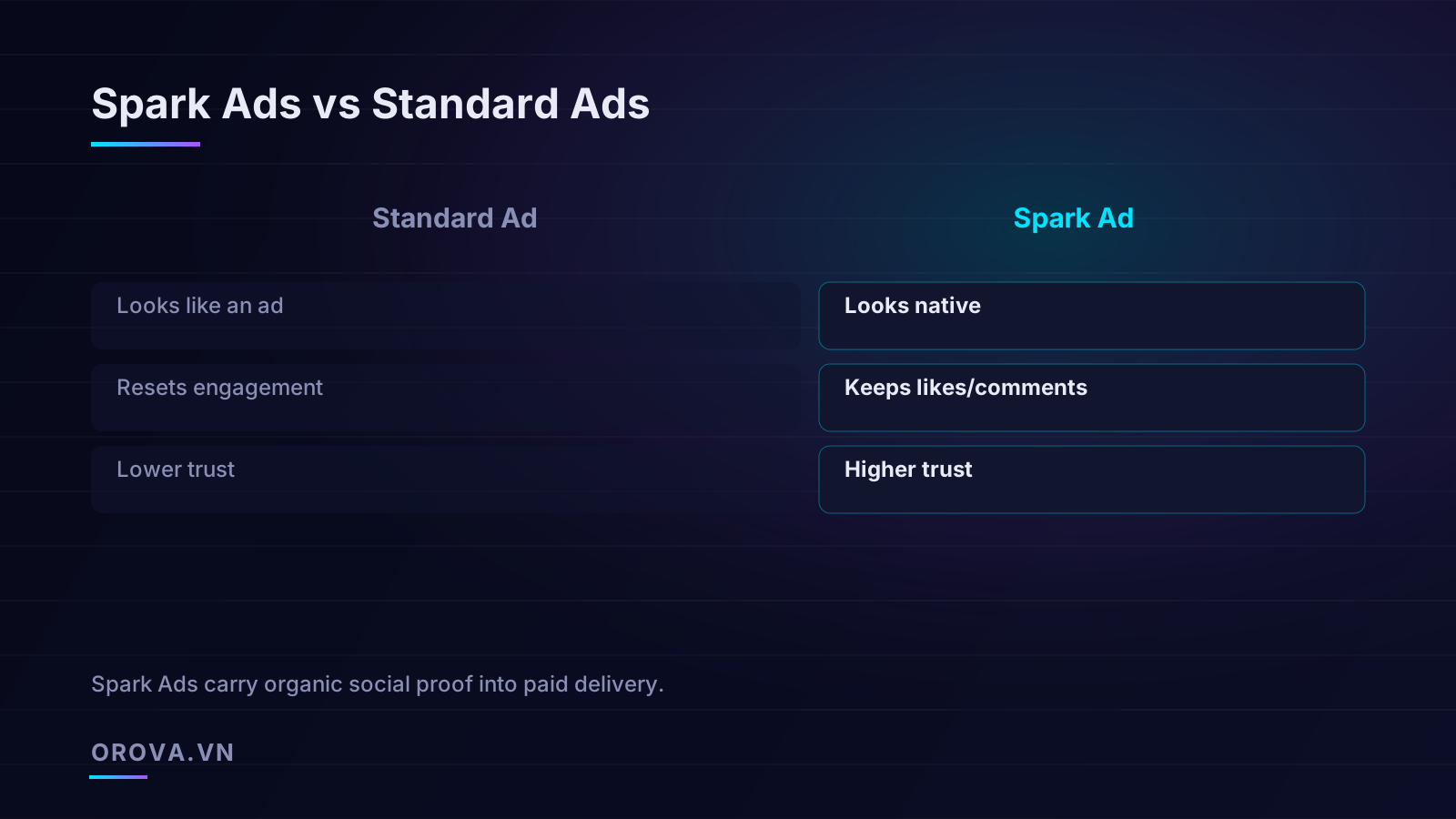
The cleanest way to understand Spark Ads is to contrast them with the format they replaced. A standard TikTok In-Feed ad — sometimes called a Non-Spark or "dark post" ad — is creative you upload directly into the ad account. It runs from the brand's ad account identity, it has no organic post behind it, and critically, every engagement it earns lives only inside the ad. When the campaign ends, the likes and comments vanish with it. If you run the same creative again next month, you start at zero engagement again. To a scrolling user, it announces itself: this is paid, this is a company talking at me.
A Spark Ad starts from a post that already exists in the organic feed. You take a TikTok video that's already published — on your brand account or on a creator's account — and you authorize it to run as an ad. The post keeps its full identity. The username displayed is the original poster's, not your ad account's. The video links to the original creator's profile. And the engagement is shared: likes, comments, shares, and even follows accumulated through the paid push roll back into the organic post. A user watching it has no reliable way to tell it apart from any other video on their For You page, because mechanically it is just another video on their For You page — one that happens to have paid reach behind it.
Why "looks native" is not a cosmetic detail
TikTok's entire culture is built on a suspicion of polish. The platform rewards content that feels like it was made by a person, in a bedroom, on a phone, with a story to tell — not content that was made by a marketing department. This is why the most-quoted piece of advice in TikTok advertising is "don't make ads, make TikToks." Spark Ads operationalize that advice at the format level. Because the unit you're promoting is a genuine organic post, it inherits the native feel automatically. You don't have to fake authenticity; you're borrowing the real thing.
There's a measurable consequence to this. When a video carries visible social proof — a high like count, a lively comment thread, shares — viewers extend more trust and watch longer before deciding to scroll past. Watch time is the single most important signal in TikTok's ranking system. A Spark Ad that opens with 31,000 likes and 900 comments already visible gets a longer hearing than an identical clip showing zero engagement, and that longer hearing feeds back into cheaper, more efficient delivery. Standard ads throw that advantage away. Spark Ads compound it.
It's also worth being precise about what "native" buys you in hard numbers, because the effect is not marginal. Across the accounts we manage, the pattern is consistent: when we take a piece of creative that performed adequately as a standard In-Feed ad and re-run the original organic version of it as a Spark Ad, the three top-of-funnel metrics — view-through rate, two-second view rate, and click-through rate — improve together rather than in isolation. That joint movement is the tell. It means you're not gaming a single metric; you're earning a fundamentally warmer reception from the audience, and that warmth propagates down the funnel into cost per click, cost per add-to-cart, and ultimately cost per purchase. A format that lifts the entire funnel at once is rare, and it's the reason experienced TikTok buyers reach for Spark Ads first and treat standard ads as the exception rather than the rule.
The authorization handshake: how the codes work
The mechanism that makes Spark Ads possible is the video authorization code. Because a Spark Ad runs a post that lives on someone's organic account, the advertiser needs explicit permission from whoever owns that account. TikTok handles this with a short-lived authorization code that the account owner generates and hands to the advertiser. There are two distinct workflows depending on whose content you're boosting.
Boosting your own brand's posts
If the post is on your own TikTok account, the simplest path is to connect that account directly to TikTok Ads Manager through your Business Center. Once the account is linked, every public post on it becomes available inside the ad account's creative library — you can select it and run it as a Spark Ad without juggling codes at all. This is the setup most brands should establish first, because it removes friction entirely and lets you boost a post within minutes of it taking off organically.
You can also use the code method on your own posts if the account isn't linked. Inside the TikTok app, open the video, go to its settings, and toggle on the "Ad authorization" or "Ad settings" option. The app generates an authorization code, which you then paste into Ads Manager when creating the ad. Codes are time-limited — they expire after a set window, commonly seven days for one-time codes, or up to 365 days for the longer-lived option — so generate the code close to when you actually plan to launch.
Boosting a creator's posts
This is where Spark Ads become genuinely powerful, and where the handshake matters most. When you partner with a creator and want to run their post — published on their account, in their voice — as a paid ad, they retain control. The creator opens their video, turns on ad authorization, generates the code, and sends it to you. You enter that code in Ads Manager, and the post becomes runnable as a Spark Ad. The creator can revoke authorization at any time, and you can only run the specific post they authorized for the duration the code permits.
Practically, this means three things every advertiser should bake into their creator agreements:
- Spell out usage rights and duration up front. The authorization code length should match what you've negotiated. If you want to run a creator's video for six months, you need the long-duration code and a contract that covers that window.
- Treat the creator's account as the publishing identity. The ad will display the creator's handle and link to their profile. That's a feature — it's the source of trust — but it also means you're renting their credibility, so the partnership terms should reflect that.
- Get the code, don't get the file. A surprising number of brands still ask creators to send raw video files so they can upload them as standard ads. That throws away every advantage of Spark Ads. Always run creator content through the authorization-code path so it stays native and keeps its engagement.
Preserving social proof is the whole point
It's worth slowing down on the engagement-preservation mechanic, because it's the difference between a clever format and a structural advantage. With a standard ad, engagement is ephemeral and siloed. With a Spark Ad, paid engagement is real and cumulative — and it pools back into the organic post.
Consider the compounding effect over a campaign's life. You boost a post that started with 5,000 organic likes. Over two weeks of paid delivery it accumulates another 40,000 likes and several hundred comments from the paid audience. Those don't disappear when you pause the campaign. The post now sits on the creator's profile — and reappears on For You pages organically — with 45,000 likes. If you relaunch the Spark Ad next quarter, you're not starting from 5,000; you're starting from 45,000, with a deeper comment thread that reads as a more established, more trusted piece of content. The paid spend bought you organic equity you keep.
The comment section is an asset, not a liability
Many brands instinctively fear comments on paid posts. They worry about negativity, about questions they can't answer, about losing control of the message. On TikTok, a managed comment section is one of your strongest conversion tools. People read comments before they buy. A thread full of "I got mine and the quality is insane" or a brand reply pinned to the top answering "does it ship internationally? — yes, we ship to 40 countries" does more selling than any voiceover.
Because Spark Ads keep the comment section live and shared with the organic post, you can actively work it: pin a helpful comment, reply to objections in the brand voice, like genuine positive feedback to surface it. You're not just running an ad; you're hosting a conversation that converts. Standard ads, with their throwaway engagement, can't do this in any durable way.
There's a discipline to running comments well on a boosted post. Assign someone — or schedule a daily slot — to read the new comments a Spark Ad generates and respond within a few hours, not a few days. Speed matters because the first wave of comments sets the tone the next thousand viewers will read. Pin the comment that best answers the most common buying question. Reply factually to skeptics rather than defensively; a calm "good question — here's the spec" reply pinned near the top neutralizes doubt for everyone scrolling. And resist the urge to delete every critical comment. A thread that's all glowing praise reads as fake; a thread where a real objection got a real, helpful answer reads as trustworthy. That trust is the conversion mechanism, and Spark Ads are the only format that lets you build it on top of paid reach.
Building a Spark Ads program, not just a Spark Ad
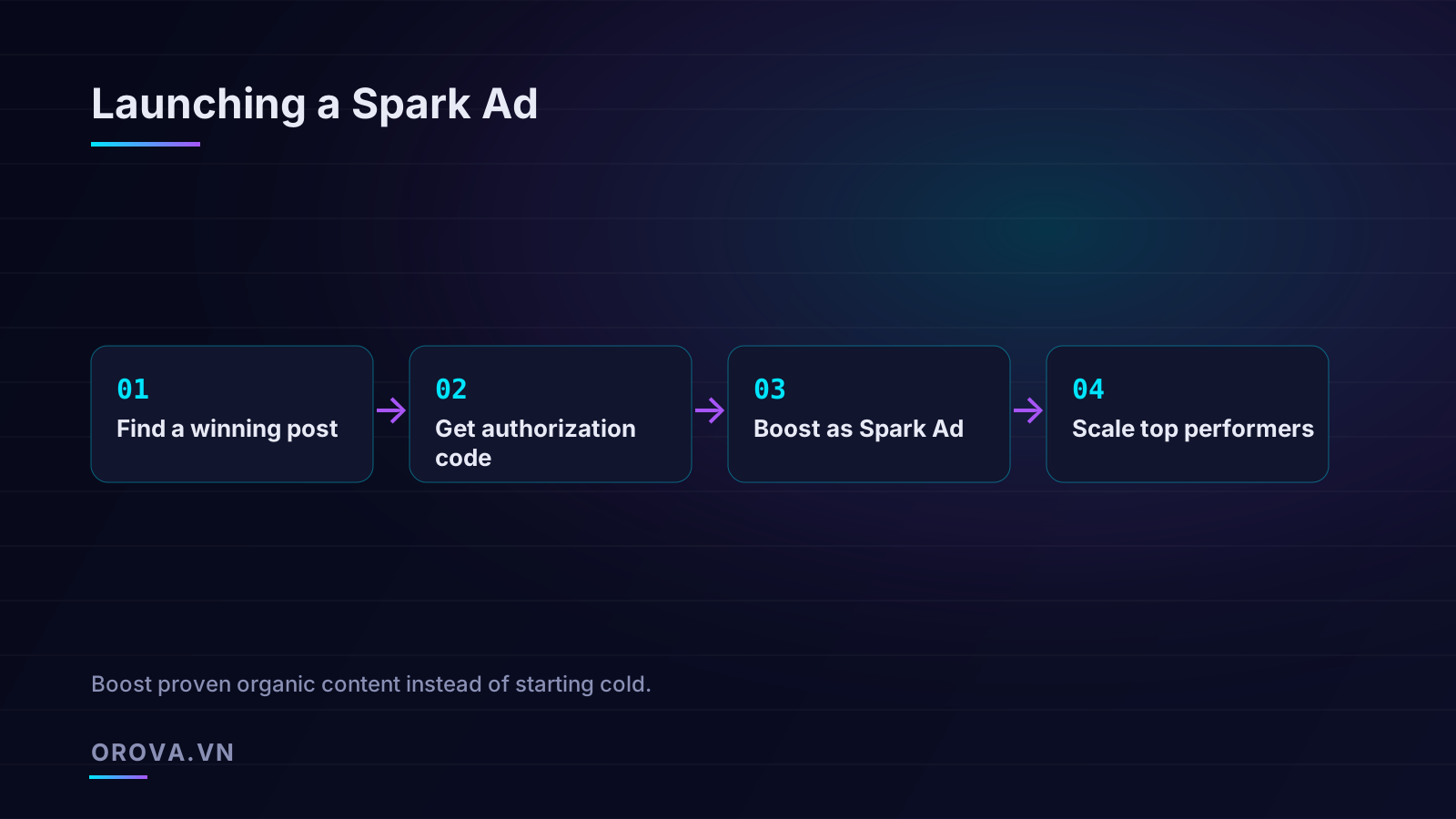
One-off boosts are fine, but the brands getting outsized results treat Spark Ads as a system with a clear pipeline. The flow looks like this: produce or source organic content at volume, let it run organically to gather real-world signal, identify the posts that are genuinely resonating, and then funnel paid budget exclusively into those proven winners. You are using the organic feed as a free, real-time testing ground, and only paying to amplify what the audience has already validated.
Step one: produce enough to have winners
This pipeline only works if you have a steady supply of candidate posts. A brand publishing one TikTok a week will rarely stumble onto a breakout. A brand publishing five to fifteen a week — a mix of in-house content and creator collaborations — generates the variance you need for a few genuine outliers to emerge. This is the creative-velocity principle: more shots on goal, more raw material to discover what the audience actually wants. We go deeper on the production side in our guide to building creative velocity around Spark Ads, but the short version is that Spark Ads reward volume because they reward selection, and you can't select from a thin catalog.
Step two: read the organic signal correctly
Not every high-view post is a good Spark Ad candidate, and not every low-view post is a bad one. The signals that actually predict paid performance are subtler than raw views:
- Completion and replay rate. A 15-second video that people watch all the way through, or rewatch, has a hook and a payoff. That structure survives the transition to paid.
- Comment quality, not just quantity. Comments asking about price, availability, or "where to buy" signal purchase intent. Comments that are just "lol" signal entertainment value but not necessarily commercial value.
- Save and share rate. Saves and shares indicate the content has utility or status value — strong predictors that a boosted version will spread.
- Watch time relative to length. A post that holds attention disproportionately to its length is doing something right that paid distribution will amplify.
Step three: boost, then scale or kill quickly
When you find a candidate, authorize it and put a controlled budget behind it. The first 48 to 72 hours tell you most of what you need to know. If the cost per result holds at or below your target as you spend, you have a winner — scale the budget deliberately, widen or duplicate audiences, and consider extending the authorization. If the metrics deteriorate the moment real money flows, kill it fast and move budget to the next candidate. The organic success was a strong signal, but paid delivery is the real test, and you respect that test by acting on it quickly rather than letting a mediocre boost bleed budget for a week.
Common mistakes that kill Spark Ad performance
The format is forgiving, but there are reliable ways to waste its advantages. We see the same handful of errors across accounts.
- Boosting on instinct instead of data. The post the founder loves is rarely the post the audience loves. Let organic signal pick the candidates, not internal taste.
- Re-uploading creator files as standard ads. As noted, this discards native feel and shared engagement. If it's a creator's content, run it through their authorization code as a Spark Ad.
- Ignoring the comment section once paid spend starts. A boosted post drives a flood of new comments, including questions and objections. Leaving them unanswered while spending money to drive more eyes to them is a missed conversion opportunity at best and reputational damage at worst.
- Letting authorization codes expire mid-campaign. If you're scaling a winner and the code lapses, the ad stops. Track expiration dates and request long-duration codes for content you intend to run for months.
- Treating one winner as the whole strategy. Creative fatigue is real on TikTok; even a great Spark Ad decays as the audience saturates. The pipeline has to keep feeding new candidates so there's always a next winner ready when the current one tires.
Where this gets hard at scale, and where AI fits
Everything above is straightforward when you're running three or four Spark Ads. It becomes genuinely difficult when you're producing fifteen posts a week, partnering with a dozen creators, and trying to monitor which boosted posts are climbing and which are quietly leaking budget across multiple ad accounts. The work that matters — reading organic signal accurately, catching a winner within hours of it breaking out, scaling budget at exactly the right pace, killing a fader before it wastes another day's spend — is precisely the work humans do slowly and inconsistently, because it requires looking at a lot of data every single day.
This is the gap an AI optimization layer is built to close. Instead of a media buyer manually scanning the organic feed and the dashboard once a day if you're lucky, an AI agent can ingest the engagement signals across all your posts and accounts continuously, surface the handful that show the predictive markers of a strong Spark Ad candidate, and flag them for boosting while they're still on the way up rather than after the peak. On the paid side, it can watch every running Spark Ad against its target cost per result and act — nudging budget into the ones that are scaling cleanly, easing off the ones that are fatiguing, adjusting bids and audiences as performance shifts through the day.
The brands that win with Spark Ads aren't the ones with the best single video. They're the ones with the best system for finding and scaling the next video, fast and consistently — which is exactly the kind of repetitive, data-heavy judgment that scales far better with an AI agent in the loop than with a human checking dashboards once a day.
The point isn't to remove the human. Creative judgment, brand voice, creator relationships, and the call on whether a comment thread is helping or hurting all still belong to people. The point is to take the relentless monitoring-and-reacting layer — the part that decides which post to boost, when to scale, when to cut — and let software handle it at a cadence no human can sustain, with the human approving the consequential moves.
Putting it together
Spark Ads work because they stop fighting the platform. TikTok rewards native, trusted, engaging content, and Spark Ads let you put paid distribution behind exactly that — real organic posts that have already proven they resonate, carrying their social proof and live comment sections into the paid feed. The setup is a simple authorization handshake, the strategy is a pipeline that uses the organic feed as a free test lab, and the discipline is to boost proven winners, scale them deliberately, and kill faders fast. Get those right and your paid TikTok performance stops being a guessing game and starts being a function of how well you select and amplify what's already working.
If you want that selection-and-scaling engine running every day without living in TikTok Ads Manager yourself, that's what Orova Ads is for. It's an AI agent that manages your paid campaigns across Google, Meta, and TikTok — reading performance data daily, recommending the optimizations that matter, and executing them on budgets, bids, on/off, and audiences with your approval and a full audit log of every move. Point it at your Spark Ads program and let it find and scale your next winner while you focus on the creative.
Let an AI Agent handle your SEO
Orova plans, writes, optimizes, and tracks rankings on its own — you just read the results.
Try it free