
"Optimize for Engines That Don't Send Traffic" — Worth It?
"Why would we optimize for engines that don't send us any traffic?" A CMO said this to us recently, and it was not a rhetorical flourish. She had the report open in front of her. Referral sessions from ChatGPT and Perplexity: a number so small it rounded to a footnote. Time being requested for generative engine optimization: real hours, from a team that already had more work than weeks. On the surface, the question answers itself. You do not buy billboards on roads nobody drives down.
It is the line you hear in budget meetings everywhere right now, in some variation. "AI search is one percent of our sessions." "Show me the GEO pipeline." "We'll revisit when the traffic shows up." And here is the thing: the question deserves a real answer, not a slogan. The honest case for GEO cannot be "AI is the future, trust us," because that is exactly the kind of argument that has burned marketing teams before — the same melody that played for QR codes in 2011, for chatbots in 2017, for the metaverse more recently. Skepticism about new acronyms is not ignorance. It is scar tissue.
So this article takes the quote seriously. We will steelman it as hard as we can, then test it against what actually happens between an AI answer and a purchase decision — and end with a framework you can use to give your own verdict for your own business, rather than borrowing ours. Because the truthful answer to "is GEO worth it" is not yes or no. It is "yes for most businesses, no for some, and you can tell which one you are in about four questions."
Is GEO worth it when AI engines send almost no traffic? Usually yes — because roughly 80% of GEO work is search fundamentals you need anyway, and AI answers shape shortlists and buying decisions far beyond the few clicks they send. But it is a prioritization question, not a religion: fold it into existing SEO unless your buyers research with AI assistants.
Steelmanning the skeptic: the quote is not wrong about the numbers
Let us start by conceding everything that is true in the objection, because a case built on denying the data deserves to lose the budget meeting.
First: AI engine referral traffic really is small for most sites today. On the sites we manage, sessions referred from chatgpt.com and perplexity.ai sit in the low single digits as a percentage of organic — and that is on content-heavy sites that actively work for citations. For many businesses it is a fraction of one percent. If you judge GEO purely as a traffic acquisition channel, on this quarter's numbers, it loses to almost everything else you could do with the same hours. The skeptic is reading the report correctly.
Second: the most visible AI search surface, Google's AI Overviews, does not merely fail to add clicks — on many informational queries it subtracts them. When the answer appears assembled at the top of the results page, a meaningful share of searchers reads it and leaves satisfied. We have written a full breakdown of that dynamic in our guide to how AI Overviews affect your click-through rates, and the summary is uncomfortable: the same optimization that earns you a citation in the Overview can coincide with fewer clicks on the blue link below it. From a pure sessions standpoint, the skeptic can argue GEO is optimizing your way into a smaller number.
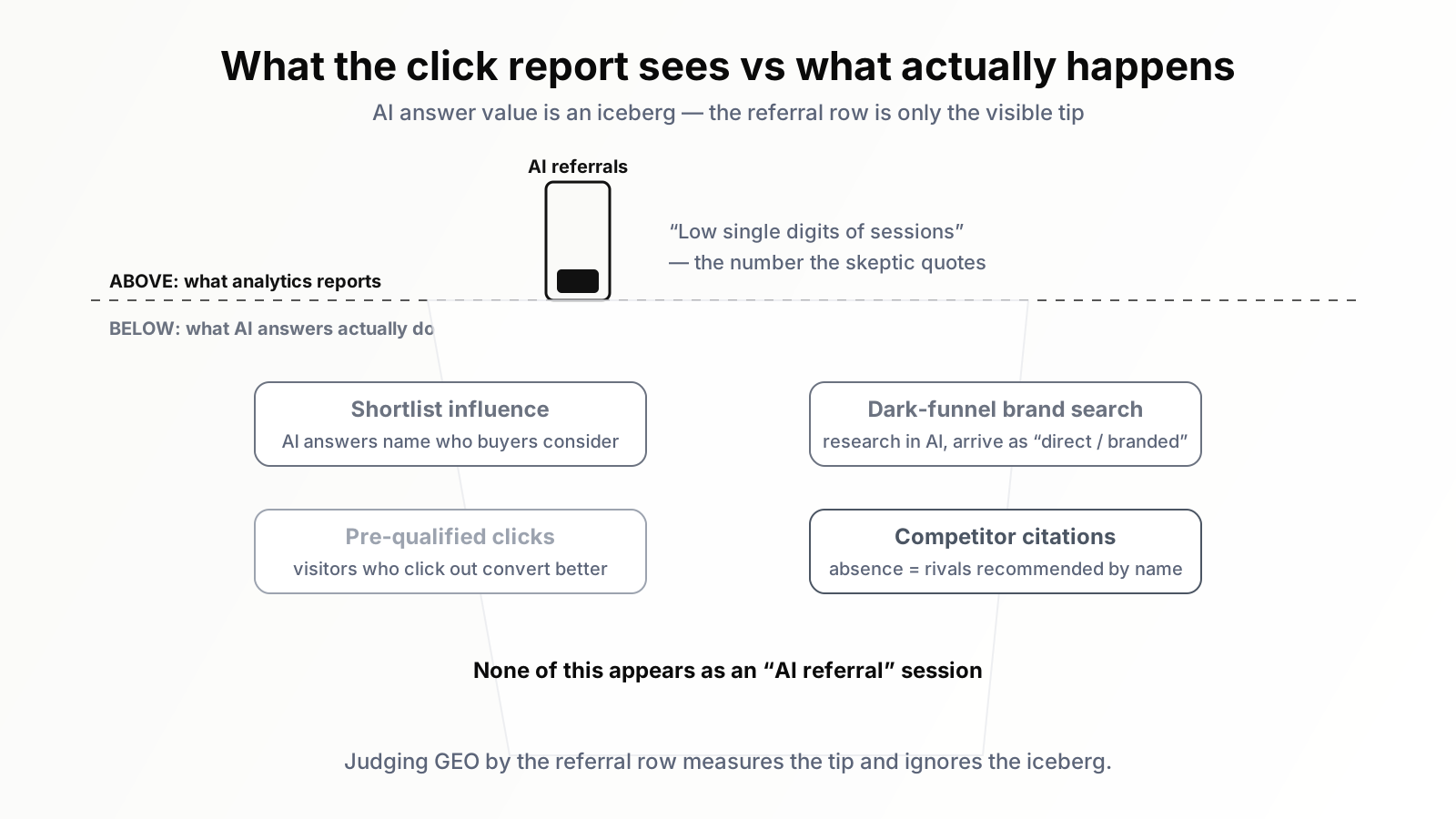
Third: attribution is genuinely murky. When someone reads about your product in a ChatGPT answer and shows up two days later by typing your brand name into Google, your analytics records a branded organic search. Nothing in the report says "an AI assistant introduced us." The influence is real but invisible, and "trust me, the influence is invisible" is precisely the kind of claim a skeptical CFO has learned to discount, because every channel that cannot prove its value says the influence is invisible.
And fourth: the industry's track record with new acronyms is poor. Marketers have been told to drop everything for a new channel many times, and several of those times the channel never matured into the revenue it promised. A team that says "we will wait until the data is undeniable" is not being lazy. It is applying a heuristic that has saved it money before.
That is the strongest version of the objection, and notice what it is built on: every plank of it measures GEO as a traffic channel, with clicks as the unit of value. That is the assumption to test. Because if AI answers create value in ways that do not arrive as referral sessions, then the report the CMO had open was answering a different question than the one she was asking.
What the click report cannot see
Influence without clicks: the citation is the new ranking
Think about what an AI answer actually does in a buying journey. Someone asks ChatGPT or Perplexity, "what are the best options for X" or "how should I solve Y," and gets back a synthesized recommendation — often with two or three sources cited and two or three vendors named. That answer does the job a results page used to do: it forms the shortlist. The user may never click a single citation. But the brands named in that answer have just been recommended, by a tool the user treats as a knowledgeable adviser, at the exact moment the user was deciding what to consider.
For a decade, "ranking #1" was shorthand for owning that moment. In an AI-mediated session, being the cited source is the equivalent position. The click was never the point of ranking #1 either — the point was being the answer the buyer encountered first and trusted most. Citations deliver that even when they deliver no session. And because users ask assistants the same kinds of questions repeatedly, a brand that is consistently cited across a topic accumulates something the click report has no column for: recall. The third time an assistant mentions the same vendor while answering related questions, the user starts to treat that vendor as a known quantity. That is brand-building, happening inside a chat window, registered nowhere in your analytics.
This is the same argument we made in our piece on why zero-click search does not mean zero value, extended to its logical end point: AI answers are the most zero-click surface ever built, which makes them the purest test of whether you believe visibility has value independent of the visit. If you believe it for featured snippets and brand campaigns, consistency requires believing it here.
The dark funnel: AI research that surfaces as "direct" and "branded organic"
Here is the attribution problem again, but viewed from the other side. The murkiness the skeptic complains about does not mean the value is absent — it means the value is being booked under other channels' names.
The behavioral pattern is consistent and easy to verify in your own habits: people research in an AI assistant, then act outside it. They ask Perplexity to compare approaches, get a recommendation, and then — because typing a URL or googling a brand name is habitual — they arrive at your site via branded search or direct entry. Your analytics credits "organic brand" or "direct." The assistant that actually introduced your brand gets credited with nothing. Marketers have long called this kind of untrackable research the dark funnel, and AI assistants are now one of its largest rooms.
The practical consequence: judging GEO by the referral row is structurally guaranteed to undercount it. The channel's mechanics route its value through other rows. That does not make the value unmeasurable — we will get to proxies like branded search lift later — but it does make "the referral number is small" a weak argument, because the referral number was never going to be where this channel shows up.
The clicks that do come are not average clicks
Now look at the small referral number itself, because even it is being misread. The few visitors who do click through from an AI answer are not equivalent to average informational traffic. They have already read a synthesized answer. They clicked anyway — which means the answer was not enough, and they wanted depth, verification, or a next step. They arrive knowing roughly what you do and why the assistant mentioned you. They are, in other words, pre-qualified, and they enter further down the funnel than a visitor who clicked a blue link off a vague query.
On the sites we manage, this shows up consistently: sessions referred from AI engines convert to meaningful actions — trials, sign-ups, contact requests — at a noticeably better rate than average informational organic traffic. We will not dress that up as an industry statistic, because it is our portfolio, not a study. But the logic travels: a click that survives an already-answered question is a higher-intent click almost by definition. Counting these sessions at face value, one row among many, prices them wrong. A hundred pre-qualified visitors are not worth the same as a hundred drive-by readers, and any team that has compared lead quality across channels knows it.
The asymmetric cost: most of GEO is work you already owe your site
Everything so far has been about the value side. The cost side is where the business case quietly closes, because the cost is far smaller than the budget meeting assumes.
Look at what GEO work actually consists of, item by item: clear and direct answers to real questions, placed where machines and people can find them. Clean heading structure. Accurate, current content with named sources and demonstrated expertise. Structured data. Crawlable pages that do not hide their substance behind scripts. Authority signals earned across the topics you want to be known for. Now ask: which of those would you skip if AI engines vanished tomorrow? None. They are the same fundamentals that modern Google rewards — the overlap is the subject of our comparison of what actually changes between GEO and SEO, and the honest answer is: less than the new acronym implies. In our experience, roughly 80% of a GEO checklist is indistinguishable from a competent technical-and-content SEO checklist.
The genuinely GEO-specific remainder is modest: verifying that AI crawlers such as OAI-SearchBot and PerplexityBot are not blocked, formatting key answers so they survive being quoted, monitoring what the engines currently say about your space, and checking how your brand is represented. That marginal 20% costs hours, not headcount. So the real budget question is not "should we fund a GEO program?" It is "should we add a thin GEO layer to the SEO work we already owe ourselves?" — and at that price, the bar the value side has to clear is very low. Most objections to GEO are priced against an imaginary standalone program nobody actually needs to run.
The cost of absence: those few slots will belong to someone
There is one more entry for the value column, and it is the one we would put in front of the skeptical CMO first: the downside of not being there.
A traditional results page degrades gracefully for the loser. Rank fifth instead of first and you still exist on the page; a determined searcher can still find you. An AI answer does not degrade gracefully. It cites a handful of sources and names a handful of options, and everything else is simply not in the answer. There is no page two of a ChatGPT response. The slots are few, and they are filling now, while most competitors in most industries are still treating this surface as ignorable.
Which means the question is not "do we get traffic from these engines?" It is "when our prospective customer asks an assistant who can solve their problem, whose names come back?" If the answer recommends your competitors — by name, with reasons, at the precise moment of consideration — that costs you deals you will never see lost, because the prospect never entered your funnel at all. No analytics report has a row for "buyers who shortlisted someone else because an AI told them to." Absence from AI answers is not neutral. It is a quiet, compounding transfer of consideration to whoever did the modest work of being citable. The mechanics of earning those slots are covered in our guide on getting cited by ChatGPT, Gemini and Perplexity; the strategic point here is simply that the seats are scarce and the music has started.
When the skeptic is right: cases where GEO is not worth extra budget
A balanced verdict requires naming the situations where the quote wins — where spending dedicated effort on AI answer engines genuinely is a misallocation. There are at least four.
Pure local walk-in business. If you run a neighborhood restaurant, a salon, a repair shop — businesses chosen by proximity, maps, and reviews — your battles are fought in local listings and review platforms. AI assistants increasingly answer local queries too, but they draw heavily on the same local data sources, so the work is the local SEO you already do. A separate GEO effort adds little.
Audiences that do not research with AI assistants. GEO's value is gated entirely on whether your buyers ask these tools questions during their journey. Some audiences barely do — segments that distrust AI tools, procurement processes locked into formal channels, demographics where assistant adoption is still thin. If honest observation of your buyers says they are not asking assistants about your category, the influence mechanism this entire article rests on is absent for you. Monitor, and revisit as adoption shifts.
Businesses whose revenue is the page view. If you monetize attention itself — advertising-supported publishing, traffic-arbitrage models — then clicks are not a proxy for value; they are the product. An AI engine that reads your reporting and serves a synthesized answer has consumed your cost and returned influence you cannot invoice. For these businesses the rational posture toward AI engines is defensive and commercial — controlling crawler access, weighing licensing, building direct-audience moats — not optimization. GEO answers a question this business model is not asking.
Teams that have not fixed basic SEO yet. If your site has crawl errors, thin pages, no analytics discipline, and no consistent content operation, GEO is dessert before dinner. The engines synthesize from sources they can find, parse, and trust; a site failing the fundamentals fails AI engines and Google alike, and the fix is the same fundamentals. Sequence matters: basics first, then the GEO layer on top — at which point, as argued above, most of the additional cost has already been paid.
The verdict framework: four questions, three outcomes
So: worth it? Stop treating it as a belief and score it. Four questions, answered honestly about your own business, sort almost every company into one of three postures.
Question 1 — Is your purchase considered? Do buyers research, compare and shortlist before buying, over days or weeks? Considered purchases — software, services, equipment, finance, education, health — are where AI-assisted research concentrates, because that is what people use assistants for. Impulse and habit purchases gain far less.
Question 2 — Do your buyers actually use AI assistants to research? Not "is AI popular," but your buyers, your category. Ask sales what prospects mention. Ask recent customers how they found and compared options. Check whether your category's typical questions return substantive AI answers at all.
Question 3 — Are citations in your category already being contested? Run the spot check: ask ChatGPT, Perplexity and Google's AI Overviews the ten questions your buyers ask before choosing a provider. If competitors are being named and cited while you are absent, the cost-of-absence clock is already running. If the answers are generic and vendor-free, you have time — and an open field.
Question 4 — Are your SEO basics done? Indexing healthy, content operation functioning, fundamentals in place. This question gates the others: a "no" here sends you to the fundamentals first regardless of how the other three score.
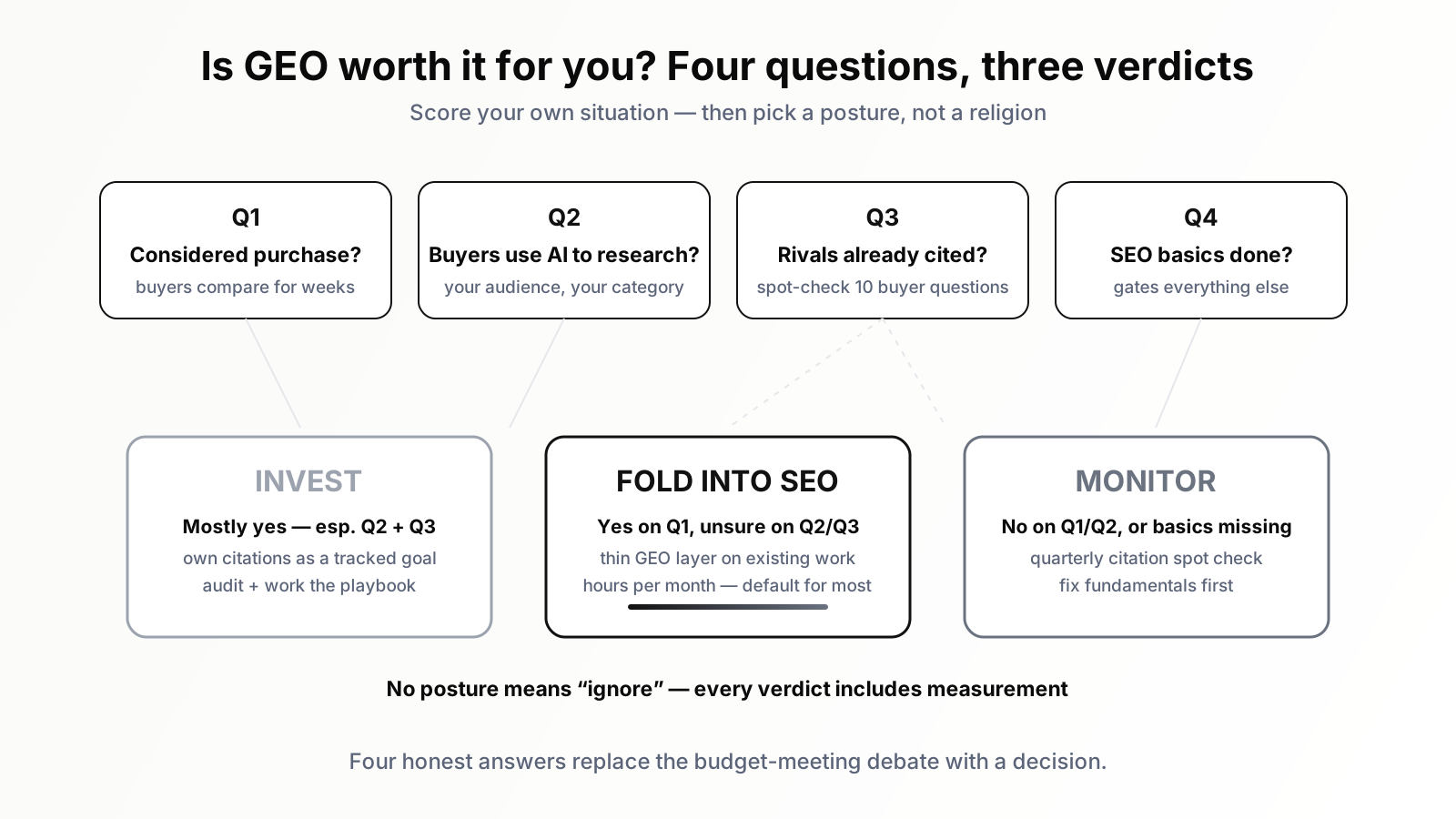
Then read the score. Invest — mostly yes, especially on questions 2 and 3: dedicate real effort. Treat citations as a tracked visibility goal, assign ownership, audit your presence across the major engines, and work the citation playbook deliberately. This is the posture for considered-purchase businesses whose buyers research with assistants and whose competitors are already being named. Fold into SEO — yes on question 1, uncertain on 2 and 3: do not stand up a program; add the thin GEO layer to existing SEO work. Confirm AI crawlers have access, keep answers quotable, add a citation spot-check to your monthly reporting. Cost: hours per month. This is the right default for most companies, and a structured pass like our 12-check GEO audit is roughly the full extent of the commitment. Wait and monitor — no on questions 1 or 2, or a hard no on 4: spend nothing beyond a quarterly spot check and, if basics are missing, fix those first. Waiting with open eyes is a legitimate strategy; waiting blind is how you discover the slots filled two years after they mattered.
Note what the framework refuses to output: "ignore." Even the weakest GEO case earns a recurring fifteen-minute check, because the cost is trivial and the failure mode of skipping it — discovering too late that assistants recommend your competitors by default — is expensive precisely because it is silent.
Measure it, so next year's meeting has data instead of vibes
Whichever posture you choose, instrument it now. The skeptic's strongest weapon is the absence of evidence, and most teams cannot rebut it because they never set up the three measurements that would. None takes more than an afternoon.
First: an AI referral segment in GA4. Build a segment or exploration that isolates sessions referred from AI engine domains — chatgpt.com, perplexity.ai, copilot.microsoft.com, gemini.google.com and peers. Track two things: the trend (the absolute number is small; the slope is the story) and the conversion rate versus your organic average. If those visitors convert better — as they do on the sites we manage — you now have a quality argument that survives a small quantity.
Second: branded search as the dark-funnel proxy. If AI answers are introducing your brand, the next step for most users is a branded Google search, and that is measurable in Search Console. Watch branded impressions and clicks over time, and annotate when your citation presence visibly improves. It is a proxy, not proof — branded search moves for many reasons — but a sustained branded lift alongside growing citations is exactly the corroborating pattern a future budget meeting will take seriously, and the connection between AI surfaces and branded behavior is one we explore further in our complete guide to AI Overviews.
Third: a citation spot-check log. Once a month, run your fixed list of ten to fifteen buyer questions through the major engines and record three columns: were we cited, who else was, what did the answer claim about us. Twelve months of this turns "are we visible in AI answers?" from speculation into a trend line — and doubles as competitive intelligence and an error-correction system, since it catches the moment an engine starts saying something wrong about your product.
Together these three give next year's version of the budget conversation an entirely different shape. Instead of "trust us, the influence is invisible," you can show: referral quality versus site average, branded demand trending against citation presence, and share-of-voice in the answers your buyers actually read. That is a language skeptics speak.
So: worth it?
Back to the CMO and her footnote-sized referral number. The number was real. The conclusion drawn from it was not, because it priced an influence channel as a traffic channel and priced a shared cost as a standalone one. The honest answer to "why optimize for engines that don't send traffic?" runs: because they are not traffic engines, they are recommendation engines standing between your buyers and their shortlists; because most of the optimization is SEO work you owe your site anyway, making the marginal cost a rounding error; because the few clicks they do send are worth more apiece than the average; and because the citation slots are scarce enough that your absence is, functionally, a donation to whoever shows up instead. And where those conditions fail — walk-in trade, non-AI audiences, page-view businesses, unfinished basics — the honest answer is "not yet," held with open eyes and a quarterly check rather than a closed door.
If you take one thing into your own budget meeting, make it the framework: four questions, three postures, measurement under all of them. And if the verdict is invest or fold-in, start with the fundamentals laid out in our complete guide to generative engine optimization rather than improvising. The monitoring half of the work — referral segments, branded-lift tracking, recurring citation checks across engines — is exactly the kind of structured, repetitive watching that machines do better than marketers, and it is the part Orova automates so that your team only spends human hours on the judgment calls. The engines may not send you traffic yet. They are already sending your buyers opinions. Worth it is the wrong question; worth ignoring is the one with the expensive answer.
Run your business with AI Agents
Orova is the always-on Biz AI Agent — it plans, runs, and optimizes the work for you. Save time, unlock productivity.
Try it free