
How to Rank for a Product Category That Doesn't Exist Yet

SEO has a comfortable assumption baked into every keyword tool: demand already exists, and your job is to capture a share of it. You search for a term, the tool reports its volume, and you decide whether the traffic is worth chasing. The whole discipline is built around picking from a menu of searches that people are already making.
But some of the most valuable SaaS companies are not picking from that menu. They are creating a new product category — a way of working that did not have a name until they named it. And a brand-new category has a brutal SEO property: nobody searches for it. The keyword volume is zero, because the words do not exist in anyone's vocabulary yet. The standard playbook, which sorts keywords by existing volume, declares the entire opportunity worthless. So how do you do SEO for something nobody is searching for? This article is an analytical breakdown of that problem and the strategy that actually solves it.
The core paradox, stated plainly
Let us be precise about the trap, because naming it clearly is half the solution. You have a product that defines a new category. You want organic search to bring you buyers. But your category name has no search volume — and it has no search volume because the category is new, and it stays new in part because nobody discovers it, and nobody discovers it because there is no content ranking for a term nobody searches. It is circular. Demand cannot be captured because demand has not formed, and demand will not form on its own.
The mistake most category-creating companies make is to attack the wrong end of this loop. They invest heavily in content about their new category name, optimise it beautifully, and then watch it generate almost nothing — because they have built a perfect answer to a question no one is asking yet. Ranking number one for a zero-volume term is still zero traffic. The strategy that works does not start with the category name at all. It starts somewhere else entirely.
The reframe: people search the problem, not your solution
Here is the insight the whole strategy rests on. Your category is new and unsearched. But the problem your category solves is old, real, and searched constantly. People do not yet have words for your solution — but they have always had words for their pain.
Consider what it must have been like before "marketing automation" or "customer relationship management" or "product analytics" were established phrases. Nobody searched those terms, because they had not been coined. But people absolutely searched "how to keep track of follow-up emails," "how to stop leads falling through the cracks," "how to see which features customers actually use." The problem-language existed long before the solution-language did. It always does. A new category is a new answer; the questions it answers are old and have search volume right now.
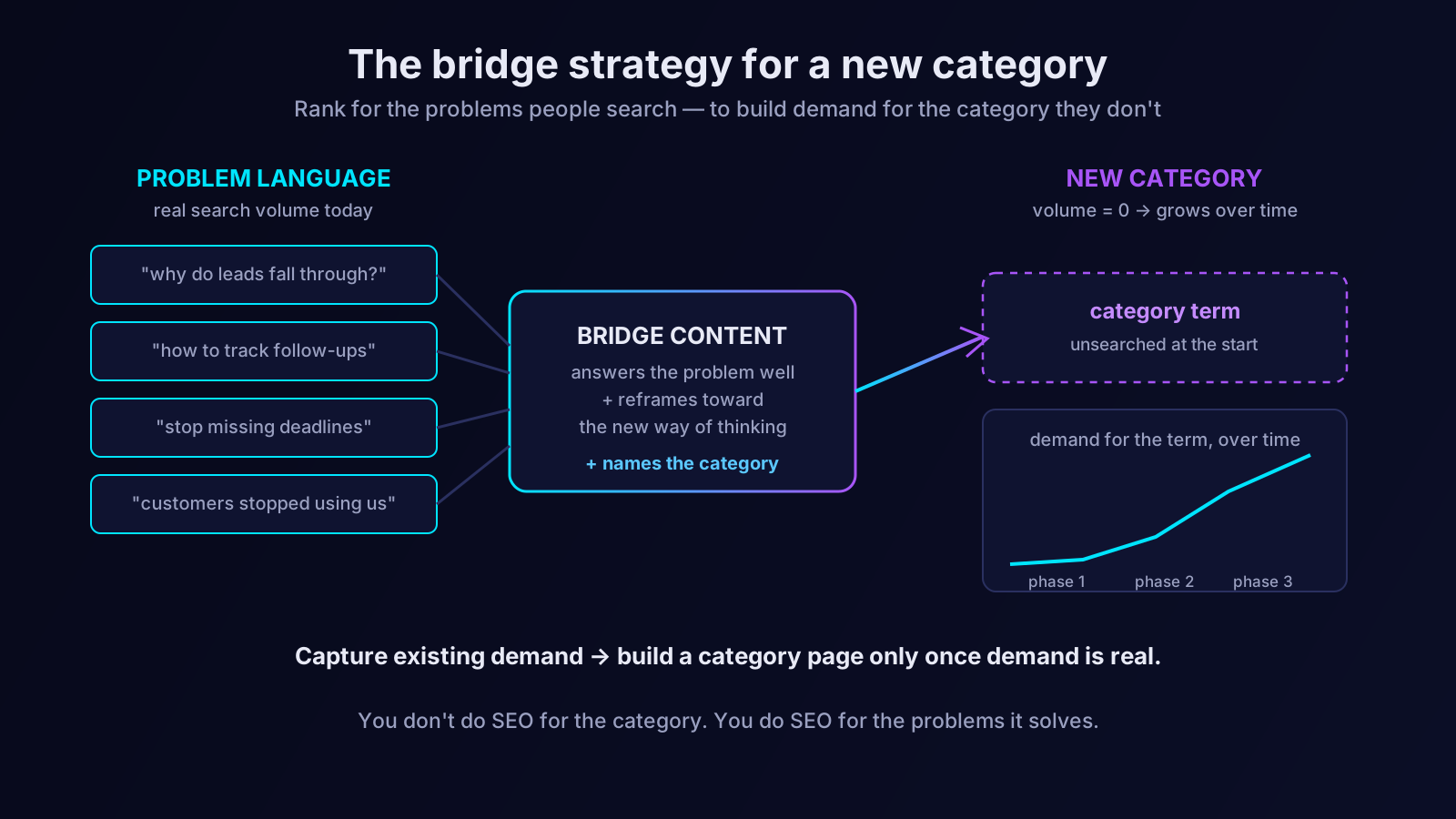
This reframe dissolves the paradox. You do not do SEO for your unsearched category. You do SEO for the searched problems your category solves — and you use that problem-stage traffic as the ground on which you slowly build awareness of the new category. You meet people at the pain they are already searching for, and from there you introduce the new way of thinking about it.
Step one: map the problem space your category serves
The strategy begins with research, but a different kind of research than usual. You are not researching your category — there is nothing there to research. You are researching the problem space your category addresses.
Work backwards from your product. What painful situations does it resolve? What does a person's life look like before they have your kind of solution — what is frustrating, slow, error-prone, or impossible for them? Now find the language that person uses for those frustrations. Not your language — theirs. They do not know your category exists, so they describe the problem in everyday, pre-category terms. Those descriptions are real searches with real volume. They are your foothold.
You will typically find a layered problem space: broad pains people search a lot, and specific frustrations they search less but more urgently. The full set of those problem-language searches is your actual keyword universe — not the category term, which has none, but the wide and genuine demand around the pain. This is where standard keyword research and a category-creation strategy converge: in both cases, you are mapping real searches. The difference is that you are mapping searches for the problem rather than for the solution. (Our walkthrough of turning keywords into a content plan applies directly here, with the problem space as your starting point.)
Step two: build the bridge content
Now you create content, and its job is specific. Each piece has to do two things at once. It must be a genuinely excellent answer to a problem-stage search — so it ranks and earns traffic on demand that already exists. And it must, within that answer, introduce the new way of thinking that leads toward your category — so the reader leaves with a new frame, not just a tactical fix.
This is bridge content, and the structure is consistent. It opens on the problem in the reader's own language — the pain they searched for, described faithfully. It teaches a real, useful answer to that problem, generously, because that is what earns the ranking and the trust. And as it teaches, it reframes — it shows that the conventional way of addressing this pain has limits, that there is a better way of thinking about it, and it gives that better way a name: your category. The reader arrived searching for a fix to a familiar problem. They leave understanding that the problem belongs to a class of problems with a coherent new kind of solution — and that the solution has a name.
What you do not do is lead with the category name or build your content around it. The category is the destination of the content, not its entry point. Lead with the problem, because that is what has the traffic; arrive at the category, because that is what you are trying to establish.
Step three: let the category name graduate into a real keyword
Here is the part that requires patience. As your bridge content reaches more people, something gradual happens. Readers absorb the new frame and the new name. They start using the term. They search it. They mention it. The category name, which began at zero volume, slowly acquires real volume — because you are the one creating the demand for it, one reader at a time.
This is the long arc of category creation through SEO. In the early phase, essentially all your traffic comes from problem-language searches; the category term is dead. In the middle phase, the category term begins showing faint signs of life — a trickle of searches, the first impressions in Search Console — because the people you educated are beginning to look for it by name. In the mature phase, the category term is a genuine keyword with its own volume, and now the conventional playbook finally applies: you build the definitive page for the category and rank for it, capturing demand that did not exist before you manufactured it.
The critical discipline is to sequence these phases correctly and not skip ahead. Building your category page first, before the demand exists, is the classic failure. Build the problem content first. Let it create the demand. Build the category page to capture demand once it is real. The category page is the finish line, not the starting block.
The honest difficulties
An analytical breakdown should be honest about what makes this hard, because the difficulties are real and pretending otherwise sets teams up to quit too early.
It is slow. Creating demand takes far longer than capturing existing demand. You are not redirecting a river; you are waiting for rain. Expect the category term to stay near zero for a long stretch while problem content does all the work, and budget patience accordingly.
It is hard to measure early. Conventional SEO reporting tracks rankings for target keywords — and your most important target keyword has no volume to rank for. Early on you must measure leading indicators instead: problem-content traffic, engagement, the first faint impressions for the category term, branded and category-term search trends inching upward. The lagging indicator — ranking for the category — only becomes measurable once the strategy has already largely worked.
It carries a real risk: you may successfully create the category and then fail to own it, educating a market that a faster or better-resourced competitor goes on to capture. Mitigating that means moving deliberately to claim the category term the moment it shows real volume, and building enough content depth around it that you are the obvious authority when demand arrives. Creating a category you do not own is an expensive gift to a rival.
Why this is worth the difficulty
Given the slowness, the measurement problem, and the risk, why attempt category creation through SEO at all? Because the payoff, when it works, is structurally superior to competing for existing demand.
When you compete for an existing category's keywords, you are one of many — fighting entrenched competitors for a share of fixed demand, and the best you can realistically do is take a slice. When you create a category, you are, for a meaningful window, the only credible answer for the term you established. You are not taking a slice of a market; you are the market, until competitors arrive. The content you built to create the category becomes a deep, authoritative moat that late entrants have to climb. You also shape the category's definition itself — what it includes, what good looks like, which criteria matter — and a definition written around your product's strengths is a quiet, durable advantage. Capturing demand makes you a competitor. Creating demand, done well, makes you the default.
How to write a single piece of bridge content
The strategy lives or dies on the quality of individual articles, so it helps to be concrete about how one bridge piece is built. The structure is consistent and repeatable once you have done it a few times.
Open on the problem in the reader's own words. The headline and first paragraphs should match the problem-language query exactly — the pain the reader actually searched, described faithfully and without your category's vocabulary anywhere in sight yet. If the reader searched "why do leads keep falling through the cracks," the article opens on leads falling through the cracks, not on your category. This is what earns the ranking and signals to the reader that they have found the right page.
Then teach a real, complete answer. This is non-negotiable: the article must genuinely solve the problem the reader came with, generously, even using conventional methods. A bridge article that withholds the real answer to manufacture a reason to introduce your category reads as a bait-and-switch and destroys the trust the whole strategy depends on. Be the most useful answer to the problem-stage query, full stop.
As you teach, reframe. Within the genuinely helpful answer, show the limits of the conventional approach — the point where doing it the old way gets slow, error-prone, or impossible at scale. This is where you introduce the new way of thinking, and where, naturally, you name the category. The reader experiences the new frame as the logical conclusion of the problem they came to solve, not as a pitch dropped on top of unrelated content.
Close by pointing forward. End with a route to the next piece of content — a deeper article that explores the new approach, or, once it exists, the category page itself. The reader arrived to fix a familiar problem and leaves with a new frame, a new name for it, and somewhere to go next. Repeat that structure across the problem space and you have a body of bridge content all pulling in the same direction.
What category creation through SEO is not
Because category creation is fashionable language, it is worth drawing a few boundaries so the strategy is not misapplied.
It is not an excuse to invent a category you do not deserve. Renaming an existing, well-served category with a fresh buzzword is not category creation — it is marketing varnish, and searchers and search engines both see through it. The strategy in this article only works if your product genuinely represents a new way of solving a problem. If it is a solid entry in an existing category, do existing-category SEO; do not pretend the category is new to dodge the competition.
It is not a reason to ignore conventional SEO fundamentals. Bridge content still has to satisfy search intent, still has to be well-structured, still benefits from sound internal linking and technical health. Category creation changes which keywords you target and how you frame the content — it does not exempt you from doing SEO well. The problem-stage articles that do the heavy lifting are, mechanically, ordinary SEO content; they just carry an extra job.
And it is not a fast track. Some teams hear "create a category" and imagine a shortcut around competitive keywords. It is the opposite of fast — manufacturing demand is slower than capturing it. The reward is a more defensible position, not a quicker one. Choose this path because the long-term position is worth it, not because you are impatient with the competition.
Where an SEO AI agent fits
Category-creation SEO is demanding in a particular way. It requires mapping a whole problem space in the customer's own pre-category language, producing a sustained body of bridge content that ranks on problem demand while consistently reframing toward your category, watching for the first faint signals that the category term is gaining volume, and then moving decisively to claim it. That is a long, patient, multi-stage program — and the most common failure is not strategic but operational: teams lose stamina before demand has time to form.
This is where an SEO AI agent provides leverage. Orova can help map the problem space around a new category in the language real searchers use, sustain a steady flow of bridge content that earns problem-stage rankings while reinforcing the new frame, monitor Search Console for the first impressions of the category term as demand begins to form, and signal when the term has matured enough to justify building the definitive category page. The strategy and the patience stay yours. The agent supplies the operational consistency that category creation demands — so the slow work of manufacturing demand actually gets sustained long enough to pay off. You cannot rank for a category that does not exist. But you can build one — by ranking, first, for the problems that already do.
Let an AI Agent handle your SEO
Orova plans, writes, optimizes, and tracks rankings on its own — you just read the results.
Try it free