
The Real Cost of Managing Ads Manually (and the Hidden Hours)
Pull up the invoice for any paid media program and you will see a single tidy number labeled "ad spend." A marketing manager running $40,000 a month across Google, Meta, and TikTok looks at that figure, compares it to revenue, and calls it the cost of doing business. But that number is a lie of omission. The real cost of running those campaigns is not on the invoice at all. It is buried in calendars, in browser tabs, in the slow erosion of a person's attention across eleven-hour days, and — most expensively — in the optimizations that were obvious, were correct, and never got made because nobody had a free half hour.
This is the part of paid media that finance never models and that most teams have simply learned to accept. A senior performance marketer in a major metro earns somewhere between $70,000 and $120,000 a year. Load that with benefits and overhead and you are paying roughly $50 to $80 per working hour for their time. If that person spends fifteen hours a week keeping campaigns alive — checking dashboards, pulling numbers into a deck, switching between three ad platforms with three different logins and three different definitions of "conversion" — you are spending somewhere north of $40,000 a year on labor just to keep the lights on. And that is before you count the cost of the work they did not have time to do.
This article is an attempt to put real numbers on the invisible. We will walk through a typical manual week hour by hour, name the costs that hide inside it, and look honestly at what gets dropped first when the week gets tight. The conclusion is uncomfortable but useful: the largest cost of managing ads by hand is not the hours you spend. It is the optimizations that never happen.
The number on the invoice is the smallest number
Let us start with a deliberately conservative scenario. A direct-to-consumer brand spends $40,000 a month — about $480,000 a year — split across three platforms. One in-house marketer owns the program, supported occasionally by a designer and a junior analyst. By the standards of mid-market advertising, this is a lean, well-run operation. No agency markup, no bloated headcount. The kind of setup a founder would point to as efficient.
Now layer in the costs that do not appear in any platform's billing tab.
The labor cost
The marketer spends, by honest accounting, about fifteen hours a week on this program. At a fully loaded rate of $65 an hour, that is $975 a week, or roughly $50,000 a year, to manage $480,000 in spend. That is a 10% management overhead — and it is invisible because it is salary, not a line item tagged to the campaign. Add the analyst's time pulling weekly reports and the designer's time spinning up new creative, and the true operating cost of the program climbs well past $60,000 before a single optimization decision is made.
The context-switching cost
Three platforms means three mental models. Google Ads thinks in keywords, match types, and Quality Score. Meta thinks in audiences, placements, and a learning phase that resets every time you breathe on a campaign. TikTok thinks in creative velocity and a feed that rewards yesterday's hook and punishes last month's. Every time a marketer moves from one platform to another, there is a reload — not just a browser tab, but a cognitive one. Research on knowledge work has consistently found that it takes far longer than people expect to fully re-engage with a task after an interruption; some studies put the recovery cost at well over twenty minutes per switch. Across a day of platform-hopping, that tax is enormous and almost entirely uncounted.
The decision-fatigue cost
This one never shows up in any model because it is a tax on quality, not time. Paid media is a stream of micro-decisions: bump this budget, pause that ad set, change this bid, kill this keyword. Each is small. None is hard in isolation. But the human capacity for good judgment degrades over the course of a day. The pause-or-keep decision a marketer makes at 9:15 a.m. is sharper than the one they make at 5:45 p.m. after forty other calls. By Thursday afternoon the decisions are not wrong, exactly — they are just defaulted. "Leave it, I'll look Monday." That default is a cost, and it compounds.
The invoice measures the money you chose to spend. It says nothing about the money you spent badly because you were the fourth-busiest person in your own job that afternoon.
A manual week, hour by hour
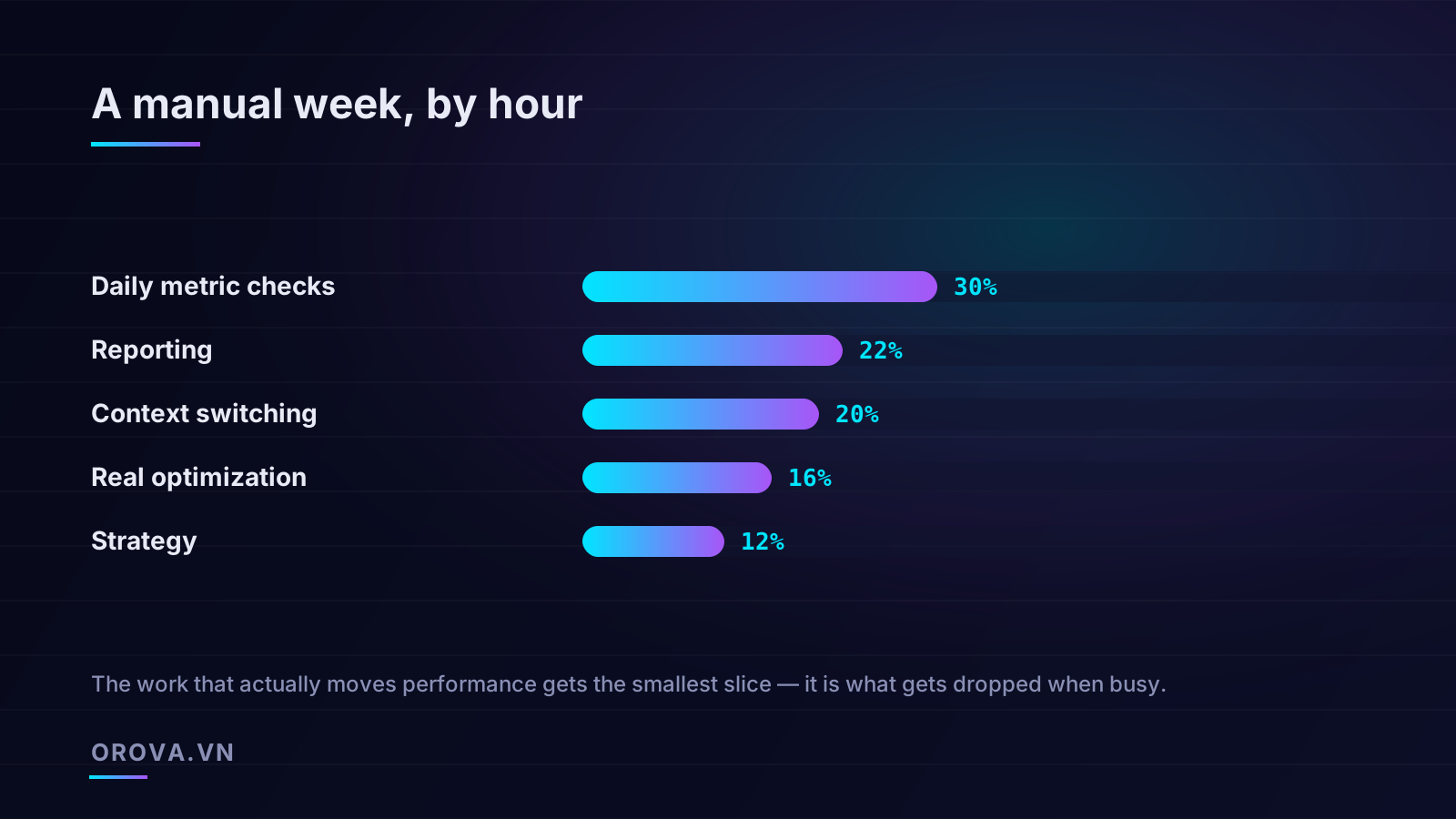
To make this concrete, here is how a representative week actually breaks down for that one marketer. These are not aspirational hours — they are observed hours, the kind you would see if you shadowed the role for five days. Together they add up to roughly the fifteen hours a week the program consumes.
Daily metric checks: the biggest slice, the least value
The single largest consumer of time is the daily check-in. Every morning, the marketer logs into three platforms, scans yesterday's spend and conversions, eyeballs anything that looks off, and forms a vague sense of whether things are okay. This is necessary — you cannot manage what you do not look at — but it is staggeringly low-leverage. The vast majority of these checks end in "looks fine," which means the time produced no decision and no change. It is monitoring, not management. And it cannot be skipped, because the one morning you skip it is the morning a campaign's budget runs away or a top ad gets disapproved.
Reporting: the work that creates no performance
The second-largest slice is reporting — assembling numbers into a format other people can read. A weekly performance deck, a monthly review, an ad-hoc "how are we doing" Slack message that turns into an hour of pulling figures. None of this reporting changes a single campaign. It informs, it reassures, it justifies budget. All legitimate. But measured against the question "did this move performance?" the answer is always no. The marketer is spending a fifth of their program time describing the work instead of doing it.
Context switching: the tax nobody budgets for
A full slice of the week simply evaporates into the seams between platforms and between this work and everything else the marketer owns. Toggling logins, re-orienting to each platform's logic, reconciling that Google counted 412 conversions while the CRM shows 380, getting interrupted by a meeting and having to rebuild the mental thread afterward. This time produces nothing. It is pure friction, and it is the most underestimated cost in the entire model precisely because it never feels like work — it feels like the unavoidable connective tissue of the job.
Real optimization: the small slice that actually pays
Here is the uncomfortable finding. The work that genuinely moves the number — reallocating budget toward what is converting, pausing what is bleeding, adjusting bids to the data, refreshing fatigued audiences — gets one of the smallest slices of the week. This is the highest-leverage activity in paid media, the entire reason the role exists, and it routinely loses the calendar fight to monitoring and reporting. It is also, not coincidentally, the first thing to get dropped when the week gets busy. More on that in a moment.
Strategy: the slice that disappears entirely
And strategy — the thinking about which channels to test next, what the creative angle should be next quarter, whether the whole account structure still makes sense — gets the thinnest slice of all. In a calm week it gets a sliver. In a normal week it gets nothing, deferred to a "planning offsite" that may or may not happen. The work with the longest-term payoff is the work with the least protected time. If you want a single sentence that explains why so many ad accounts plateau, it is this one.
What gets dropped first
When a week compresses — a product launch, a sick day, a fire in another part of the business — the time does not shrink proportionally across all five categories. It collapses in a specific, predictable order, and that order is the heart of the hidden cost.
The daily metric check survives, because it is anxiety-driven and habitual; skipping it feels reckless. Reporting survives, because someone is waiting for it and there is social accountability attached. What gets cut is the work with no external deadline and no one asking for it directly: real optimization and strategy. Nobody messages you on Tuesday to ask whether you reallocated budget from the underperforming TikTok ad set to the Meta one that is crushing it. So that decision waits. And waits.
This is the cruel inversion at the center of manual ad management. The activities ranked by how much they move performance are almost perfectly inverted from the activities ranked by how reliably they survive a busy week. The lowest-value work is the most protected. The highest-value work is the most expendable. You are running a system that, under stress, automatically sacrifices exactly the work you are paying for.
This is also where the case for unifying platform management becomes obvious. When the daily check and the reporting are spread across three disconnected systems, they consume so much of the week that optimization is permanently starved. Consolidating the monitoring layer — getting one brain across Google, Meta, and TikTok instead of three siloed dashboards — is not a convenience feature. It is the only way to claw back the hours that optimization needs.
The optimization that never happens
Now we arrive at the real number, the one that dwarfs everything we have discussed. It is not the hours spent. It is the optimizations never made.
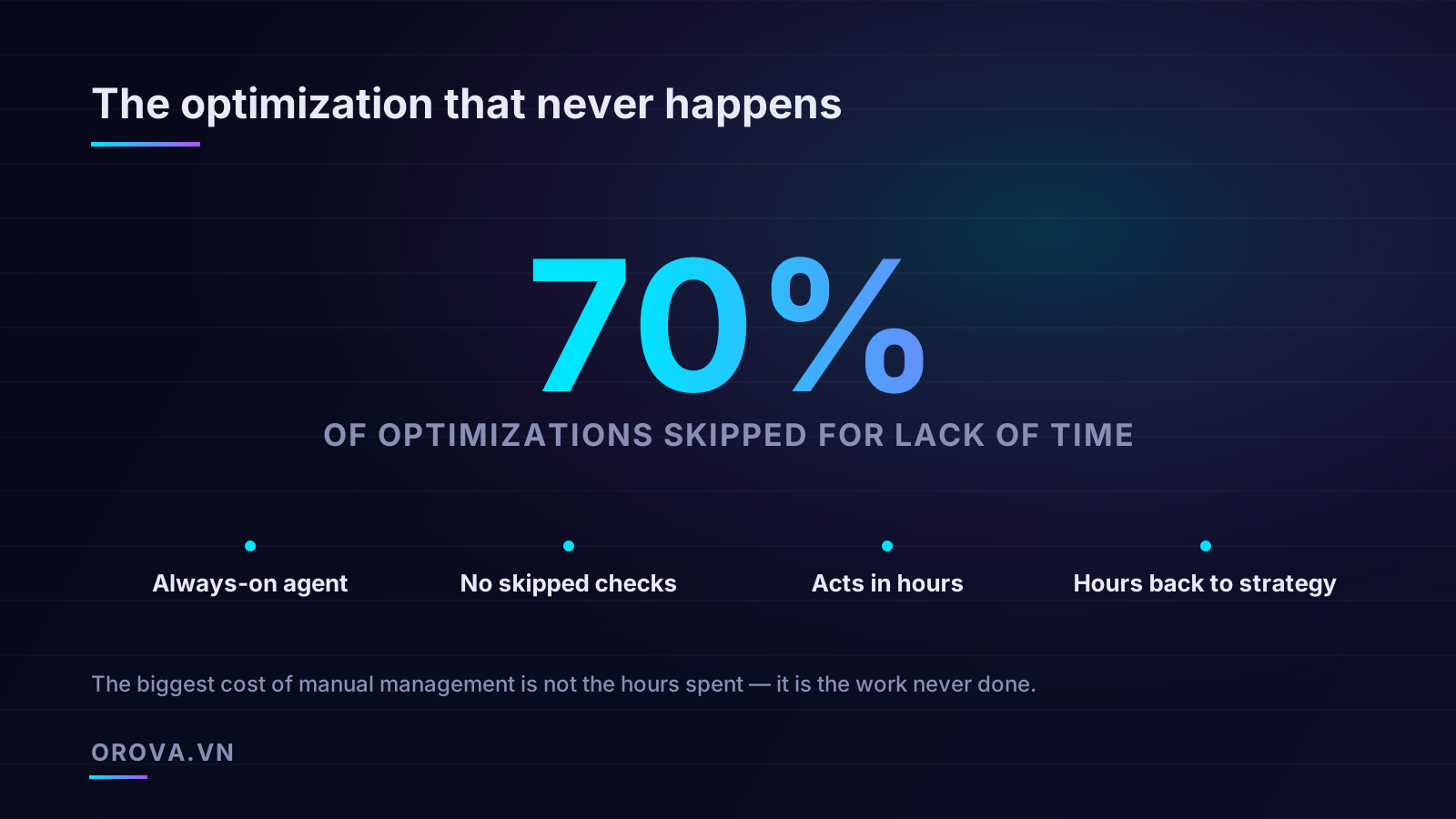
Ask any honest performance marketer how many of the optimizations they know they should make actually get made each week, and the number is humbling. They can see, on Monday morning, that a campaign is overspending on a converting-poorly audience. They know the fix. And then the week happens, and by the time they look again it is Thursday and the moment has passed and $1,800 has been spent on the thing they meant to pause Monday. A realistic estimate is that the majority of identified optimizations — call it seven in ten — never get executed, or get executed days late, simply for lack of time.
Put a dollar figure on that. If even 10% of a $40,000 monthly budget is misallocated at any given time — spend sitting on the wrong audience, the wrong keyword, the wrong creative — that is $4,000 a month, $48,000 a year, leaking out the bottom of the program. Not because anyone made a bad decision, but because the good decision arrived too late or never got made at all. That $48,000 dwarfs the $50,000 in labor. It dwarfs the context-switching tax. It is, by a wide margin, the most expensive thing about managing ads manually, and it is the single cost that never appears in any spreadsheet because you cannot invoice for a decision you never made.
The compounding effect
The worst part is that this cost compounds. A skipped optimization is not a one-time loss; it is a recurring tax until someone finally fixes it. A budget left on a losing campaign bleeds every single day. An audience left un-refreshed fatigues a little more each week, so your cost per result drifts upward so gradually that you barely notice — until one day you look up and your blended acquisition cost is 40% higher than it was two quarters ago and nobody can quite say when it happened. It happened in the gaps. It happened on all the Thursdays.
And it compounds across platforms. Each platform's algorithm is constantly re-learning based on what you feed it. A delayed decision does not just cost the spend it wastes; it sends a worse signal to the optimizer, which then allocates future impressions less efficiently. The lateness is not neutral. It actively trains the machine on your bad week.
So what actually frees the time?
The instinct, when faced with these numbers, is to hire. Add a second marketer, split the platforms, buy back some hours. This helps, but it scales the cost linearly — you have doubled the labor line to address an optimization problem — and it adds its own coordination overhead. Two people managing three platforms now have to stay in sync, which is its own context-switching tax.
The more honest answer is to look hard at the work itself and ask which parts genuinely require human judgment and which parts are just a person doing what a tireless, consistent system could do better.
Monitoring does not need a human
The daily metric check — the single biggest slice of the week — is almost entirely mechanical. Look at every campaign, compare to expectation, flag anomalies. There is nothing in that loop that benefits from a human doing it manually at 9 a.m. across three logins. It benefits enormously from being done continuously, automatically, without a single skipped morning, with alerts that surface only what actually needs attention.
Most optimizations are pattern-matching, not artistry
The hard truth that experienced marketers eventually accept is that the bulk of day-to-day optimization is not creative genius. It is disciplined pattern-matching: this is converting above target, move budget toward it; this has spent three times the target cost-per-result with no conversions, pause it; this bid is leaving volume on the table, raise it. These are exactly the decisions that get dropped on busy weeks, and they are exactly the decisions a system can make reliably, every day, in minutes instead of days.
The point is not to remove the human — it is to re-aim them
This is the part people get wrong when they hear "automation." The goal is not to eliminate the marketer. The goal is to stop spending the marketer on monitoring and routine reallocation so they can spend on the two things only a human does well: strategy and creative judgment. The slices that currently get nothing. Imagine the inverted week — where the machine handles the daily checks and the routine optimizations, and the human's protected time goes to channel strategy, creative direction, and the bets that actually grow the business. That is not a fantasy of fewer people. It is the same person, finally doing the job you hired them for.
Consistency is a feature humans cannot offer
There is one quality of automated management that deserves its own mention because it is so easy to overlook: consistency. A human marketer is brilliant on Tuesday morning and depleted on Friday afternoon. They are sharp before the budget meeting and foggy after it. They take a week of vacation and the account coasts on autopilot, drifting, with nobody at the wheel. A well-built agent does not have good days and bad days. It applies the same standard to the 9 a.m. check and the 9 p.m. check, to the Monday after a long weekend and the Thursday before a launch. For a discipline where the cost of inconsistency compounds daily, this is not a minor virtue. It is arguably the whole point. The accounts that quietly outperform over a year are rarely the ones with the most brilliant single decisions; they are the ones where nothing was ever left to bleed for a week because someone was busy.
The opportunity cost is the one that hurts later
Everything above is a cost you can, with effort, put a number on. The opportunity cost is harder and larger. Every hour spent on monitoring and reporting is an hour not spent on the test that would have found your next winning channel, the creative angle that would have halved your acquisition cost, the landing-page experiment that would have lifted conversion across every campaign at once. These are the step-changes, the things that do not improve a program by 5% but reset its entire economics. They require sustained, unhurried thought — exactly the resource that manual operations consume first. You will never see this cost on an invoice. You will see it two years from now, when a competitor who automated the busywork has out-tested you on every front and you cannot quite explain how they got ahead.
Doing the honest math
Before you decide whether any of this applies to you, do the arithmetic for your own program. It takes ten minutes and it is the most clarifying exercise in paid media operations.
- Count the monitoring hours. How many hours a week does someone spend simply looking at dashboards without making a change? Multiply by their loaded hourly rate, then by 52. That is your annual cost of looking.
- Count the reporting hours. Same calculation. This is your annual cost of describing.
- Estimate the misallocation. Look at your spend right now and ask honestly: what fraction is sitting on something you already know underperforms? Even 8 to 10% is normal. Annualize it. That is your cost of lateness.
- Add the strategy gap. This one you cannot easily price, but ask the question: what would one extra focused day a week on strategy and creative be worth to growth? That is the opportunity you are currently spending on logins.
For most mid-market programs, the sum of the second and third numbers — the cost of describing and the cost of lateness — comfortably exceeds the entire ad-spend management labor budget. The work that produces nothing plus the work that never happened, together, cost more than all the work that does happen. Once you see that on paper it is very hard to unsee.
The bottom line
The invoice was never the cost. It was the cheapest, most visible, most carefully tracked part of a system whose largest expenses are deliberately invisible. The fifteen hours a week, the context-switching tax, the decision fatigue, and — towering above all of it — the optimizations that were correct and obvious and never got made: that is the real cost of managing ads manually. And because it is invisible, it goes unmanaged, year after year, a steady leak that everyone has learned to call normal.
The fix is not to work harder or check the dashboards more often. The fix is to stop asking a finite, fatigue-prone human to do the infinite, repetitive, never-skip work of continuous monitoring and routine optimization, and to free them for the work that only they can do. That reallocation is where the money actually is.
That is exactly the problem Orova Ads was built to solve. It is an AI agent that manages your paid campaigns across Google, Meta, and TikTok the way you would if you had unlimited time and never lost focus — reading your data every single day, surfacing the optimizations that matter, and executing them (budgets, bids, on/off decisions, audiences) the moment they are needed, with your approval on every change and a full audit log of everything it does. The hours go back to strategy. The optimizations stop getting skipped. See how it works at orova.vn/ads.
Let an AI Agent handle your SEO
Orova plans, writes, optimizes, and tracks rankings on its own — you just read the results.
Try it free