
SEO Attribution Is Messy — Here's a Model That Works
Attribution is the part of SEO that everyone agrees is broken and almost nobody fixes. The default model in most analytics setups credits the last click before a conversion, which means a channel like SEO — whose entire job is to introduce people who buy much later through some other route — looks like a minor contributor on paper while doing major work in reality. This is a practical guide to building an attribution model for SEO that is honest about its limits, defensible in front of finance, and actually usable week to week. Not a perfect model. There is no perfect model. A working one.
Why attribution is structurally messy
Before building anything, it helps to be precise about why attribution resists a clean answer, because a model that pretends the mess away will be wrong in ways you cannot predict.
The core problem is that a modern buyer journey has many touchpoints spread over a long time. Someone discovers you through an organic search, leaves, comes back days later via a branded search, sees a social post, clicks a retargeting ad, reads three more articles, asks a colleague, signs up for a webinar, and finally converts after a sales conversation. Attribution is the question of how to divide one conversion's credit across all of those touches. There is no objectively correct division, because the touches genuinely interacted — remove any one and the outcome might change, or might not, and you can never rerun it to find out.
Layered on top is the measurement problem. Cross-device journeys break tracking. Cookie restrictions and consent rules erase touchpoints. Dark social — the link shared in a private message that shows up as direct traffic — is invisible. Offline conversations leave no trace at all. So even if you settled on a fair division of credit, you would be dividing an incomplete picture. Any attribution model is a model of partial data, not of reality.
This is why the goal is not accuracy in the scientific sense. The goal is a consistent, reasonable framework that lets you make better decisions than you would with the broken default. A working model is one that points you the right direction more often than the alternative — that is the entire bar.
What's wrong with the common models
Most teams pick one attribution model and treat its output as truth. Each common model has a specific blind spot, and knowing them prevents you from being misled by your own dashboard.
Last-click attribution gives all credit to the final touch. It systematically overcredits branded search, direct traffic, and bottom-funnel paid, and systematically undercredits discovery channels like SEO and content. It is the worst possible model for evaluating SEO, and it is the most common default.
First-click attribution gives all credit to the first touch. It overcorrects in SEO's favour and ignores everything that did the closing work, so while it flatters content, it is not a fair basis for a decision either.
Linear attribution splits credit evenly across all touches. It is fairer than the single-touch models but pretends every touch mattered equally, which is rarely true — the introduction and the close usually matter more than the middle.
Time-decay attribution gives more credit to touches closer to conversion. It is reasonable for short cycles but quietly punishes SEO, because SEO's defining contribution — the first introduction — is usually the touch furthest from the sale.
Data-driven or algorithmic attribution uses modelling to assign credit based on observed patterns. It is the most sophisticated, but it needs significant conversion volume to be stable, it is a black box that is hard to explain to a CFO, and it still only sees the touchpoints that were tracked.
The lesson is not that one of these is right. It is that each one is a lens with a known distortion. A working model uses several lenses on purpose and reads them against each other.
The model that works: a three-layer view
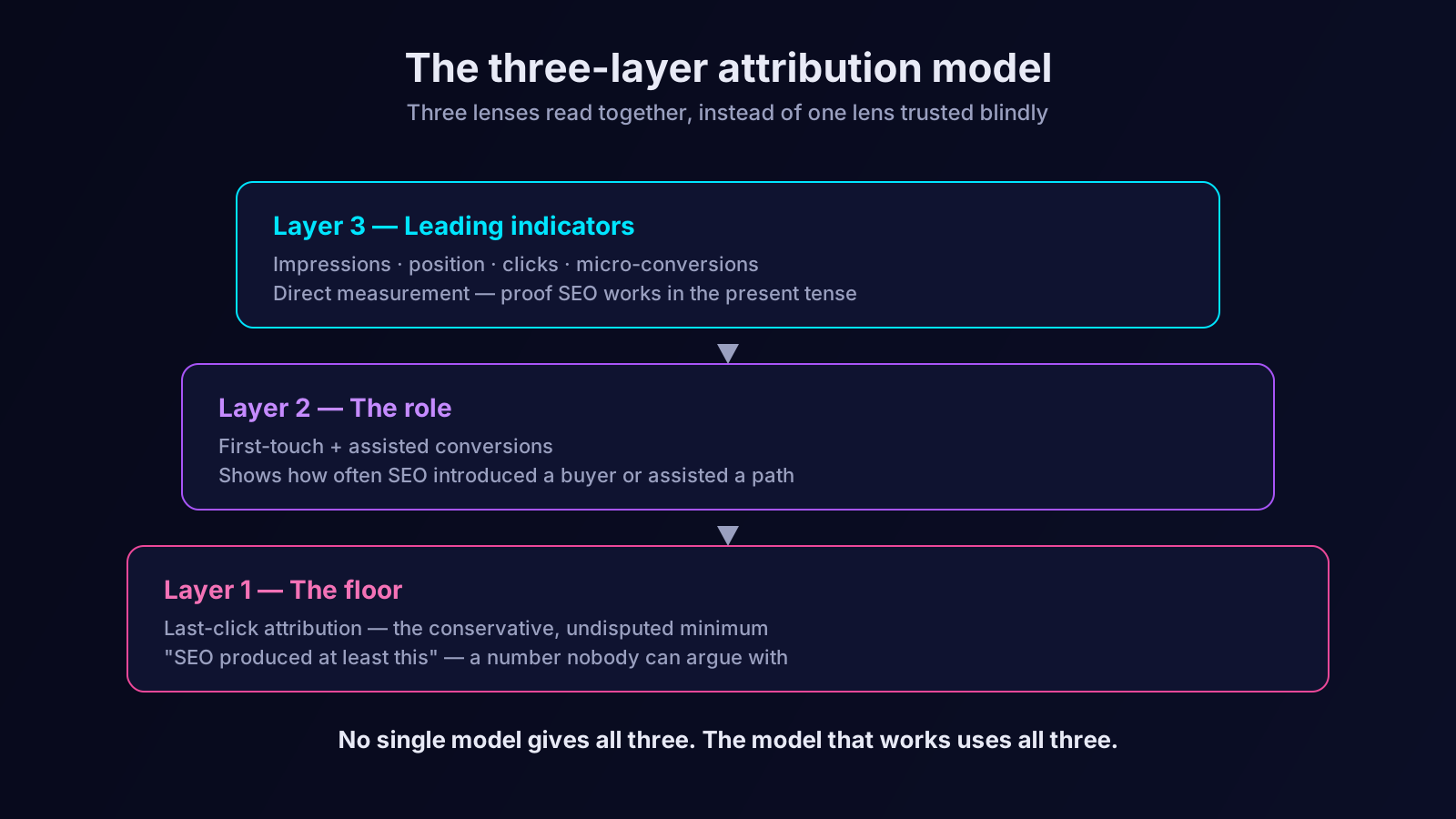
Here is the practical model. Instead of choosing one attribution model, build a three-layer view, where each layer answers a different question and the three together give a picture no single model can.
The first layer is the floor. Use last-click attribution and treat its SEO number as the conservative minimum — the contribution nobody can dispute, because it counts only conversions where organic search was literally the last touch. When you present this number, you can say with total confidence: "SEO produced at least this." A defensible floor is enormously valuable in a skeptical room.
The second layer is the role. Use first-touch and assisted-conversion data to show how often SEO introduced a buyer or appeared somewhere on a winning path. This layer is not about claiming the revenue; it is about showing the function. It answers "what job does SEO do in the journey?" — and the answer is almost always "it opens far more journeys than the floor number suggests."
The third layer is the leading indicators. Step away from conversion attribution entirely and track non-branded organic impressions, position, clicks, and micro-conversions. These cannot be argued about, because they are direct measurements, not allocations of credit. They show SEO working in the present tense, which is exactly what the lagging conversion data cannot do.
Presented together, these three layers tell a complete and honest story: here is the minimum SEO definitely produced, here is the much larger role it plays in journeys, and here is the live evidence it is still working. No single attribution model delivers all three. The three-layer view is the model that works because it stops asking one tool to do three jobs.
Add a branded-search correction
One specific distortion deserves its own fix, because it quietly inflates the wrong channel. When someone discovers you through a non-branded organic search, leaves, and later returns by searching your brand name, last-click attribution credits the branded search and erases the original non-branded discovery. But the branded search only happened because the earlier non-branded search introduced your name. The brand became searchable because SEO made it known.
The correction is to monitor branded-search volume as an SEO outcome, not a separate channel. When non-branded SEO and content efforts increase, branded search typically rises afterward — people who discovered you later come looking for you by name. Tracking that relationship lets you argue, with evidence, that a meaningful share of "branded search" conversions are really delayed SEO conversions wearing a different label. This single correction often recovers a large, otherwise invisible chunk of SEO's true contribution.
Define micro-conversions before macro-conversions
For long sales cycles, waiting for the macro-conversion — the closed deal — makes attribution slow and noisy. The working model leans on micro-conversions: the meaningful intermediate steps a visitor takes that reliably precede revenue.
Identify the micro-conversions that matter for your business: a trial start, a demo request, a pricing-page visit, a documentation deep-dive, a newsletter signup, an account creation. Attribute these to SEO first, because they happen close to the organic visit and inside a measurable window. Then, separately, track the historical rate at which each micro-conversion turns into revenue. This decomposes the impossible question — "which dollar came from SEO?" — into two answerable ones: "how many micro-conversions did SEO drive?" and "what is each micro-conversion historically worth?" Multiply, and you have an estimate built from two measured numbers rather than one heroic guess.
Handle the data you cannot see
A working model is honest about its blind spots rather than silent about them. You will lose touchpoints to cross-device journeys, consent rejections, dark social, and offline conversations. Pretending the tracked data is complete will eventually get you caught out.
The professional move is to state the known gaps explicitly in every report and to note that they almost all run in the same direction — they hide touchpoints, which means they cause undercounting. Direct traffic that is really dark-social SEO shares. Conversions on a second device that broke the journey link. Word-of-mouth that started with one person reading your article. Naming these gaps does two things: it makes you more credible, because you are clearly not overclaiming, and it lets you frame your numbers as conservative estimates with upside, rather than precise figures that will be wrong in unpredictable ways.
Make the model usable, not just correct
A model that is theoretically sound but takes a week to produce will not survive contact with a busy quarter. Usability is a design requirement, not an afterthought.
Keep the model to a fixed, repeatable structure: the three layers, the branded-search correction, the micro-conversion bridge, and a stated list of known gaps. Report it on the same cadence and in the same format every time, so stakeholders learn to read it and watch the story build. Resist the temptation to redesign it every quarter — a stable model that everyone understands beats a brilliant model that nobody can follow. The point of attribution is to inform decisions, and a model only informs decisions if people actually look at it and trust it.
Use attribution to decide, not just to report
The final test of a working model is whether it changes what you do. Attribution that only feeds a monthly slide is a vanity exercise. Attribution that is working tells you which clusters introduce the most eventual buyers, which pages assist conversions even when they never close them, and which content earns rankings but never appears on any path to revenue.
That last category is the most actionable: pages that rank and get traffic but never assist a single conversion are candidates for rethinking or pruning. Pages that quietly assist many journeys without ever getting last-click credit are candidates for protection and investment, even though a naive report would call them underperformers. A working attribution model, read this way, becomes a content strategy tool — see our guide to internal linking strategy for how to route authority toward the pages attribution proves are doing the work.
Set the model's time horizon to match the buyer
One detail quietly breaks more attribution models than any algorithm choice: the lookback window. Most analytics tools default to a thirty- or ninety-day window, meaning a conversion is only attributed to touchpoints that occurred inside that span. For a fast, low-consideration purchase that is fine. For a considered B2B or SaaS purchase with a sales cycle measured in months, it is quietly disastrous, because the original organic discovery — SEO's defining contribution — happened outside the window and is therefore invisible to the model.
The working fix is to set the attribution horizon to match how your buyers actually behave, not how the tool ships out of the box. If your typical journey from first touch to closed deal runs several months, the lookback window has to be at least that long, or the model is structurally blind to the very channel you are trying to evaluate. Where the tool will not allow a long enough window, this is a strong argument for leaning harder on the leading-indicator layer and the micro-conversion bridge, because those measure SEO close to the moment it acts rather than relying on a window that has already closed by the time revenue lands.
State the window you used in every report. A stakeholder who knows the model used a ninety-day window can correctly read the SEO figure as a floor that excludes longer journeys. A stakeholder who does not know will read the same figure as the whole truth — and the whole truth is exactly what a too-short window cannot deliver.
Audit the model against reality, periodically
A model is a set of assumptions, and assumptions drift. The buyer journey changes, new channels appear, tracking conditions shift as privacy rules tighten. An attribution model that was reasonable two years ago can quietly become misleading without anyone noticing, because the dashboard keeps producing numbers and numbers feel like facts.
Build in a periodic reality check. Once or twice a year, take a sample of actual closed deals and trace their real journeys by hand — talk to sales, look at CRM notes, ask customers how they first heard of you. Compare those real, narrated journeys against what the attribution model claims happened. Where they agree, your confidence in the model is earned. Where they diverge — and they will, somewhere — you have found exactly which assumption needs revisiting.
This manual audit is slow and unglamorous, but it is the only thing that keeps an attribution model honest over time. It also produces something the dashboard never can: real stories of buyers who found you through search, which are far more persuasive in a leadership meeting than any allocation percentage. A model that is checked against reality is a model people can trust; a model that runs unexamined for years is just a confident guess wearing a chart.
Where an AI agent helps
Maintaining a three-layer model with a branded-search correction and a micro-conversion bridge is more measurement work than most teams can sustain by hand. It means reconciling several attribution views, watching branded-search trends against non-branded effort, mapping micro-conversions to landing pages, and keeping a known-gaps list current — every reporting cycle, without fail. That sustained discipline is exactly what tends to lapse first when the team gets busy.
This is where an SEO AI agent is genuinely useful. Orova keeps the multi-layer attribution picture continuously assembled — tracking leading indicators, tying organic landing pages to the micro-conversions they generate, watching the branded-search relationship, and flagging which pages assist journeys versus which only collect traffic. The model stays current and consistent instead of being rebuilt under deadline pressure. To see how this connects to the bigger shift in the discipline, read our piece on what an SEO AI agent is and why it changes content marketing.
Attribution will never be tidy. The buyer journey is genuinely tangled, the data is genuinely incomplete, and the perfect model does not exist. But messy is not the same as unmanageable. A three-layer view, an honest branded-search correction, a micro-conversion bridge, and a frank list of what you cannot see — that is a model that works. Not because it is precise, but because it is honest, consistent, and good enough to make better decisions than the broken default. And in attribution, better decisions are the only prize worth chasing.
Let an AI Agent handle your SEO
Orova plans, writes, optimizes, and tracks rankings on its own — you just read the results.
Try it free