
TikTok Creative Hooks: The First Three Seconds That Decide Your CPA
Pull the analytics on any TikTok ad account and sort the creatives by cost per result. Then look at one number almost nobody puts on the same screen: the percentage of viewers still watching at the three-second mark. The correlation is uncomfortable. The ads with the lowest CPA almost always hold a larger share of viewers past second three, and the expensive ones leak audience before the first sentence finishes. The hook is not a creative nicety on TikTok. It is the single lever that quietly sets the price of everything you buy downstream.
This is different from how most advertisers were trained to think. On search, intent does the heavy lifting and the ad mostly needs to not get in the way. On Meta, the thumbnail and the first line of primary text matter, but the feed still gives a slower, more forgiving scroll. TikTok is a full-screen, sound-on, infinitely-replenishing river of content where the viewer's thumb is already moving before your ad finishes loading. You are not competing for attention against other ads. You are competing against the next video, which is one flick away and statistically more entertaining than yours. The first three seconds decide whether you get to make your pitch at all.
That single fact reshapes the whole production and testing process. If the opening determines watch time, and watch time determines how the algorithm prices and distributes your ad, then the hook is the highest-leverage thing you will produce all quarter. A brilliant offer behind a weak hook is a brilliant offer nobody sees. A mediocre offer behind a hook that stops the thumb at least gets a hearing. This piece breaks down why the three-second window matters mechanically, the hook patterns that consistently earn their keep, how to test openings at a velocity that actually moves your numbers, and how an AI agent can rank creatives by early retention faster than a human scrubbing through reports.
Why the first three seconds set your cost per result
To understand the hook's leverage you have to understand how TikTok decides whether to keep spending your money on a given creative. The platform's delivery system is fundamentally a prediction engine. Every time it shows your ad, it watches what happens and updates its estimate of how valuable that ad is for the kind of person it just served. Early signals are weighted heavily because they arrive first and in volume. The earliest signal of all is whether someone keeps watching or swipes away.
Watch time is the currency the algorithm actually trades in
When a viewer abandons your ad in the first second, that is a strong negative signal. Do it at scale and the system concludes the creative is not engaging for that audience, lowers its quality estimate, and either raises your effective cost to keep showing it or simply stops showing it as often. When viewers stay, the opposite happens: the system gains confidence, expands delivery, and finds you cheaper impressions because the auction rewards content people don't flee. Watch-through rate, average watch time, and the share of completed views are not vanity metrics on TikTok. They are inputs to the price you pay.
This is why two creatives with the same offer, same landing page, and same audience can post wildly different CPAs. The difference is upstream. The cheaper one survived the scroll, banked enough watch time to earn cheap distribution, and delivered its clicks at a discount. The expensive one bled viewers in the opening and spent the rest of its short life fighting an algorithm that had already downgraded it.
The funnel collapses backward from the hook
Think of a TikTok ad as a chain of survival events. The viewer has to not scroll past. Then the hook has to stop the thumb. Then the body has to hold them through the message. Then the offer has to earn a click. Then the landing page has to convert. Every stage multiplies against the ones before it, which means the very first stage caps everything that follows. If only 30 percent of people make it past the hook, your conversion math is permanently working with 30 percent of the audience the impression bought you. You can have the best landing page on the internet and it changes nothing for the 70 percent who already left.
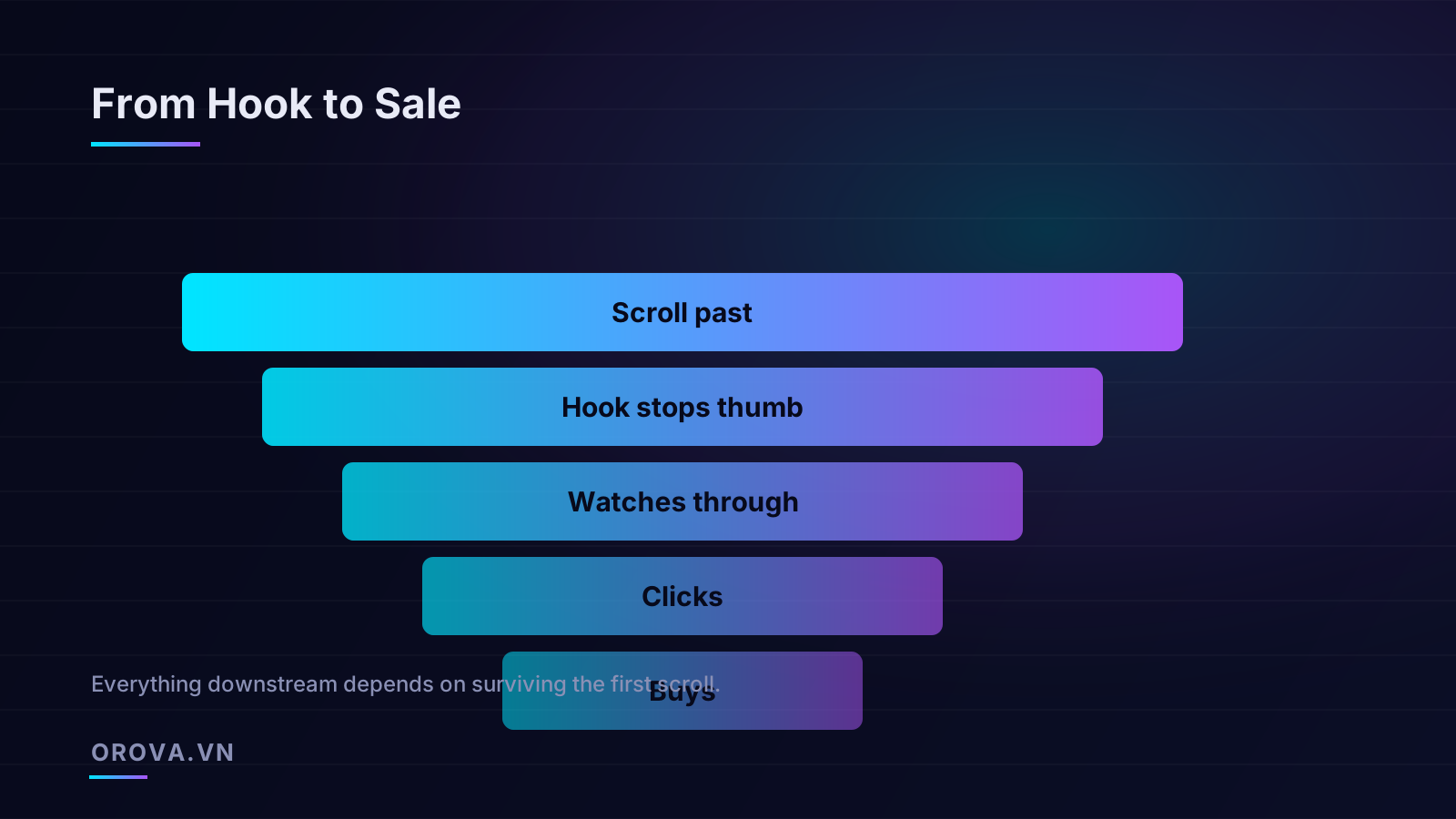
The practical consequence is brutal and clarifying. Optimizing the hook gives you compounding returns because it widens the mouth of the funnel that every other stage drains from. Optimizing the landing page only helps the survivors. When advertisers complain that TikTok "doesn't work" for them, the failure is usually concentrated in the first three seconds, not in the targeting or the bid. They built ads for a platform that gives you a slow reveal, and TikTok gives you no such grace.
Hook patterns that consistently stop the thumb
There is no magic line, but there are reliable structures. Across thousands of creatives, certain opening patterns earn disproportionately better early retention because they exploit something specific about how the brain handles a fast-moving feed. The brain is a prediction machine running idle, and it pays attention when a prediction breaks. Good hooks break predictions on purpose.
The bold question
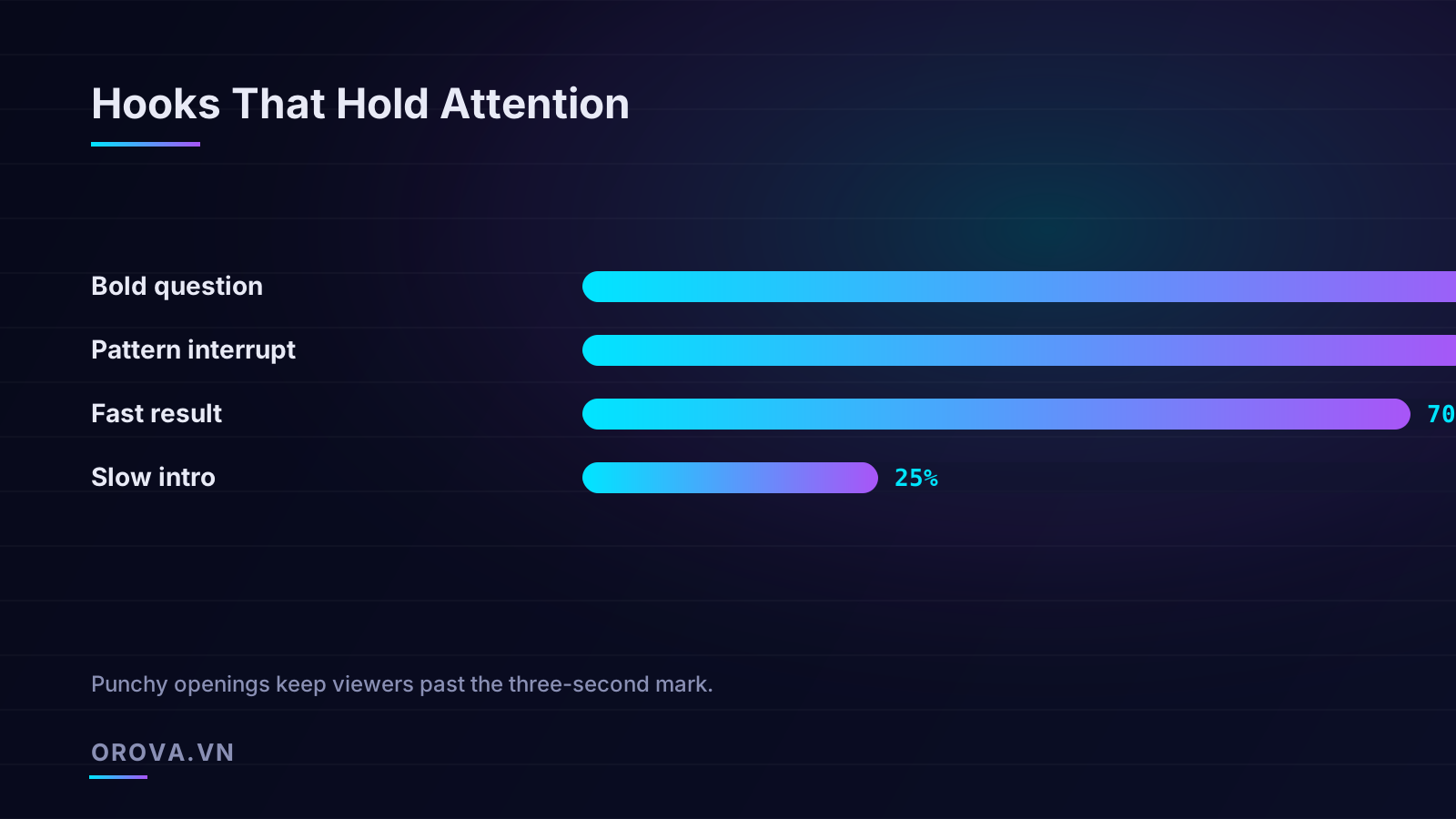
Opening with a direct, slightly provocative question forces the brain into answer-seeking mode. "Why is your skin still breaking out after three products?" "What if your sleep tracker has been lying to you?" The question has to be specific to the viewer's world and ideally challenge an assumption they hold. Generic questions fail because the brain answers "don't care" instantly. Sharp, contrarian questions create an open loop the viewer wants closed, and closing the loop requires watching. In retention data, bold questions tend to hold attention better than almost any other opener because the cost of leaving is an unanswered question, which the brain dislikes.
The pattern interrupt
A pattern interrupt does something the eye and ear did not expect in the first frame: an abrupt visual cut, an unusual setting, a person speaking mid-sentence as if you walked in on a conversation, a sound that doesn't match the image, motion where stillness was expected. The point is to violate the visual grammar of the feed for half a second so the thumb hesitates. TikTok's own aesthetic rewards this because native content is full of jump cuts and unpolished energy. A glossy brand intro reads as an ad and triggers the scroll reflex; a jarring, native-feeling open buys you a beat of curiosity.
The fast result
Show the payoff first, then explain. The transformation, the finished dish, the cleaned surface, the before-and-after compressed into the first frame. People scroll past process and stop for outcomes. "Here's what my kitchen looked like 20 minutes after I used this" beats "Today I'm going to show you a cleaning product." The fast-result hook works because it front-loads the reward and makes the rest of the video the proof, reversing the slow build that kills watch time. It pairs especially well with products that have a visible, dramatic before-and-after.
The specific stakes
State a concrete number, a deadline, or a consequence in the first line. "I wasted 4,000 dollars on ads before I learned this in one afternoon." "You have 48 hours before this rate disappears." Specificity reads as truth; round numbers and vague urgency read as marketing. The brain treats precise figures as evidence that a real person with real knowledge is talking, which lowers the resistance that the word "ad" usually raises.
The openers that quietly destroy your CPA
For balance, the patterns that consistently underperform deserve naming, because most weak ads share them. The slow intro is the worst offender: a logo animation, a "hi everyone, welcome back," or a leisurely establishing shot. On a platform where you have under a second to justify the next two, a slow intro is an explicit instruction to scroll. Equally damaging is the buried lede, where the interesting part lives at second eight and the open is throat-clearing. And the overproduced hero shot, the kind that looks like a TV commercial, signals "skippable ad" to an audience that has been trained to flee polish. None of these are bad on other channels. All of them bleed watch time on TikTok.
The fastest way to lower your TikTok CPA is rarely a new audience or a new bid strategy. It is a new first second.
Testing hooks at the velocity TikTok rewards
Knowing the patterns is necessary but not sufficient, because you cannot reliably predict which specific hook will win for your product and audience. The brain that reacts to your video is not yours; it is your customer's, shaped by their feed, their problems, and a thousand variables you can't see. The only honest answer to "which hook works" is to test, and the advertisers who win on TikTok are the ones who test openings faster than everyone else. This is the discipline of creative velocity, and it is as much an operating model as a creative skill. We have written more about treating the feed as a creative testing engine in our guide to TikTok ads optimization through Spark Ads and creative velocity, which pairs naturally with everything here.
Isolate the hook as the test variable
The cleanest way to test openings is to hold the body and offer constant and swap only the first three seconds. Produce one strong piece of mid-roll content and attach four, six, or ten different hooks to it. Now your test measures exactly the thing you care about, because the only difference between variants is the opening. When one hook posts double the three-second retention of the others, you know it was the hook and not some confound. This modular approach also slashes production cost, because the expensive part of the video is reused and only the cheap part, the first few seconds, changes.
Read the metric that matters first
Most accounts judge creatives on CPA, which is the right destination but the wrong early read. CPA needs conversions to stabilize, and conversions are slow and sparse, so by the time CPA tells you a hook is bad you have already overspent. Early retention is a leading indicator that fills in within hours. Watch the three-second view rate and the average watch time first. A hook that loses the audience in the opening will never recover at the bottom of the funnel, so you can kill it on the retention signal alone and reallocate budget to the survivors days before CPA would have told you the same thing.
Run enough variants to find the outlier
Hook performance is not normally distributed. Most variants cluster around mediocre, a few are bad, and occasionally one is dramatically better than the rest. You cannot find the outlier by testing two variants; you find it by testing many. Accounts that ship two creatives a month are sampling a tiny slice of the possibility space and wondering why nothing breaks out. Accounts that ship ten to twenty hook variants a week are running a wider search and routinely surface a winner that resets their CPA. The volume is not waste. It is the search itself, and the modular hook-swap approach is what makes the volume affordable.
Refresh before fatigue, not after
Even a winning hook decays. TikTok audiences burn through creative fast, and a hook that stopped thumbs in week one becomes wallpaper by week four as the same people see it repeatedly. Frequency creeps up, retention slides, and CPA follows. The mistake is waiting for the metrics to crater before acting. The discipline is to keep the testing engine running so that fresh winners are queued before the current champion fades, treating creative as a perishable inventory you continuously restock rather than a fixed asset you set and forget.
How an AI agent ranks creatives by early retention
The bottleneck in all of this is rarely ideas and almost always execution speed. A human managing a TikTok account has to pull reports, line up retention curves, decide which hooks are leading and which are dying, shift budget toward winners, pause losers before they overspend, and do it across dozens of creatives, every single day, without getting tired or playing favorites. That is exactly the kind of high-frequency, data-dense, emotionally neutral work that a machine does better than a person.
Daily reads instead of weekly reviews
Creative velocity only pays off if the feedback loop is tight, and human review cadence is the usual choke point. Most teams check performance weekly, which means a hook that is dying on Tuesday keeps spending until Friday's review. An AI agent reads the data every day, so the lag between a creative going bad and the budget moving away from it shrinks from days to roughly one. Over a month of testing, that compounding speed is the difference between a tight CPA and a leaky one, because waste is a function of how long bad creatives are allowed to keep spending.
Ranking by leading indicators, not lagging ones
An agent built for this watches the early-retention signals first, exactly as a sharp media buyer would, but without the temptation to wait for CPA to feel certain. It can rank every live creative by three-second view rate and watch-through, flag the ones whose openings are failing while they have spent very little, and surface the emerging winners worth scaling before their CPA has even finished settling. The ranking is the same judgment a human makes; the agent simply makes it continuously and consistently across the whole account.
Acting on the ranking with a human in the loop
Reading the data is half the job. The other half is doing something about it, and an agent earns its place by executing: shifting budget toward the hooks that hold attention, pausing the slow-intro losers, adjusting bids and audiences around the creatives that are working. The right design keeps a person in control. The agent proposes or executes the change, you approve the meaningful moves, and every action lands in an audit log you can review later. You get the speed and consistency of automation without surrendering judgment on the decisions that matter, which is the only sustainable way to run paid social at scale.
What the human keeps
None of this removes the creative work. A machine can rank a hook by retention and reallocate spend, but it cannot invent the contrarian question or stage the pattern interrupt that stops the thumb in the first place. The division of labor that works is humans owning the creative bets and the strategy, and the agent owning the relentless measurement and reallocation that turns those bets into a tuned account. You bring the hooks; the agent finds out which ones the audience actually rewards and pushes your budget there before the slow process of manual review would have caught up.
Building a hook library you can draw from
Testing at velocity is hard if every variant starts from a blank page. The teams that ship ten hooks a week are not having ten fresh strokes of genius; they are working from a structured library of opening formats that they recombine against new products and angles. Building that library is one of the highest-return investments you can make in a TikTok program, because it turns hook creation from an act of inspiration into a repeatable process.
Catalog winners as reusable templates
Every time a hook beats the field on retention, document it as a template, not just a one-off video. Strip it down to its structure: what kind of opening was it, what assumption did it break, what was the visual in the first frame, what was the first line of dialogue. "Contrarian question challenging a common belief, talking head, mid-sentence start" is a template you can apply to a dozen products. "Finished result in frame one, hands entering from the side, no intro" is another. Over a few months you accumulate a stable of structures that have proven they can stop a thumb, and new creative becomes a matter of mapping a fresh product onto a proven shape.
Mine your comments and your competitors
The best hooks often come straight from your audience's language. Read the comments on your organic posts and your ads, and watch for the phrases people use to describe their problem or their reaction. A comment like "I had no idea you were supposed to do it this way" is a hook waiting to be filmed. Competitor ads are the other free source: TikTok's ad library lets you see what others in your category are running, and the openings that have clearly been scaled are openings that worked for someone with the same audience you want. You are not copying the offer; you are studying the structure of openings that have already survived a real auction.
Match the hook to the awareness stage
Not every hook fits every audience. A viewer who has never heard of your product needs an opening that earns attention with curiosity or a relatable problem; a viewer who already knows you and is close to buying responds to an opening built around the offer or social proof. A common mistake is running offer-led hooks at cold audiences, where the viewer has no reason to care about your discount because they don't yet care about your product. Map your hook templates to the awareness stage of the audience they will reach, and you stop wasting strong offers on people who scrolled past before the offer mattered.
Common mistakes that quietly inflate your CPA
Even teams that understand the hook in principle leak performance through a handful of recurring errors. Naming them makes them easier to avoid, and avoiding them is often worth more than any new tactic.
Optimizing the wrong end of the funnel
The most expensive mistake is spending optimization energy where it has the least leverage. Teams will rebuild a landing page, retest five bid strategies, and reshuffle audiences while running the same tired hook that loses 70 percent of viewers in the first second. Every one of those downstream fixes only operates on the survivors of the hook, so the ceiling is fixed low no matter how good the rest gets. When CPA is stubbornly high, the first place to look is the three-second retention curve, not the bid.
Killing creatives too early or too late
There is a timing discipline that separates tight accounts from leaky ones. Kill a hook before it has accumulated enough impressions to read its retention honestly and you may be discarding a winner on noise. Let a clearly failing hook keep spending because you are waiting for CPA to confirm what retention already told you, and you bleed budget for days. The fix is to set retention thresholds and impression minimums in advance, then act on them without negotiation. Decisions made by rule are faster and less biased than decisions made by gut in the moment, which is precisely why automating them pays off.
Confusing production value with performance
Teams from a traditional marketing background instinctively equate higher production value with better results, and on TikTok the relationship often inverts. The most polished, most expensive creative in the account is frequently the worst performer because it reads as an ad and triggers the scroll reflex, while a rough phone-shot video with a sharp hook outperforms it at a fraction of the cost. This is liberating once you accept it: you do not need a studio budget to win on TikTok, you need a better first second, and a better first second is cheap to produce and quick to test.
Putting it to work
TikTok punishes advertisers who treat the hook as an afterthought and rewards the ones who treat it as the main event. The mechanics are not mysterious. Early watch time drives delivery, delivery drives cost, and the first three seconds drive early watch time, so the opening sets the price of every result you buy. The patterns that work, bold questions, pattern interrupts, fast results, and specific stakes, all share one trait: they break a prediction fast enough to stop a moving thumb. The advertisers who win are the ones who test those openings at high velocity, read the retention signal before the CPA signal, and refresh winners before fatigue sets in.
The hard part is sustaining that loop day after day across a growing pile of creatives, and that is the gap worth closing. Orova Ads is an AI agent that manages your paid campaigns across Google, Meta, and TikTok: it reads your data every day, ranks creatives by the signals that actually predict cost, recommends and executes the budget shifts, bid changes, on-off toggles, and audience moves that follow, all with human-in-the-loop approval and a full audit log so nothing happens behind your back. Bring the hooks, and let the agent find out which ones the feed rewards. See how it works at orova.vn/ads.
Let an AI Agent handle your SEO
Orova plans, writes, optimizes, and tracks rankings on its own — you just read the results.
Try it free