
TikTok Shop and GMV Max: Automated Commerce Ads, Explained
For most of the past decade, running ads on TikTok meant building campaigns the same way you would on any other platform: pick an objective, define audiences, set bids, write ad copy, and babysit a dozen ad groups while you tried to keep cost-per-result from creeping up. Then TikTok Shop sellers got handed something different. GMV Max collapses that entire workflow into a single setting. You tell it which products to sell and what return you want, and TikTok's system decides how to spend, where to place the ad, and how hard to push — across both your organic feed and paid placements at the same time. Sellers who flip it on for the first time often watch a campaign that took an afternoon to build get replaced by two fields and a slider.
That sounds like a dream until you realize what you've given up: granular control over where every dollar goes. GMV Max is optimizing toward gross merchandise value — total sales — and it will happily spend more to generate more revenue even when the incremental revenue costs you margin you can't afford. This article explains exactly what GMV Max controls, how the blended organic-plus-paid optimization actually works, how to set ROI targets that protect your business, and where automated oversight matters most so that hands-off scale doesn't quietly turn into hands-off losses.
What GMV Max actually is
GMV Max is TikTok's automated campaign type built specifically for TikTok Shop sellers. The name is literal: it is designed to maximize gross merchandise value, which is the total dollar value of products sold through your shop attributable to TikTok. Unlike a standard performance campaign where you choose an objective like conversions or traffic and then construct the targeting and creative scaffolding yourself, GMV Max consolidates the moving parts into one product-centric setting and lets TikTok's optimization engine manage the rest.
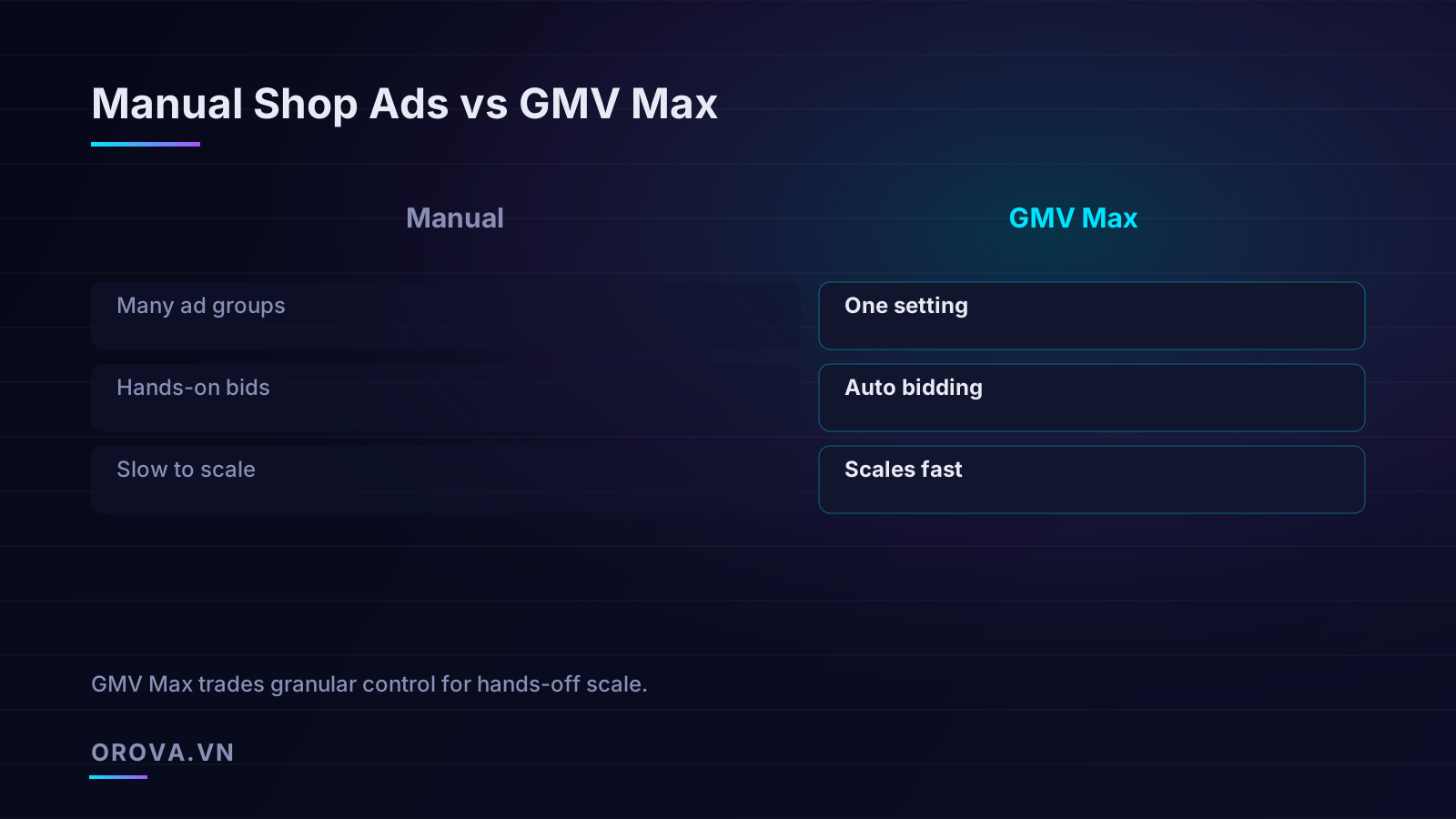
The simplest way to understand it is to compare what you used to do by hand against what the system now does for you. In a manual TikTok Shop setup, you might run several ad groups — one for a cold prospecting audience, one for retargeting people who viewed a product, another for past purchasers, each with its own bid strategy and budget. You'd monitor them daily, shift money toward the ones working, pause the ones that weren't, and constantly test new creatives. GMV Max removes nearly all of that. You select the products you want to promote, set a target return, and the system handles audience selection, bidding, placement, and even which of your videos and live streams to amplify.
The four-step loop under the hood
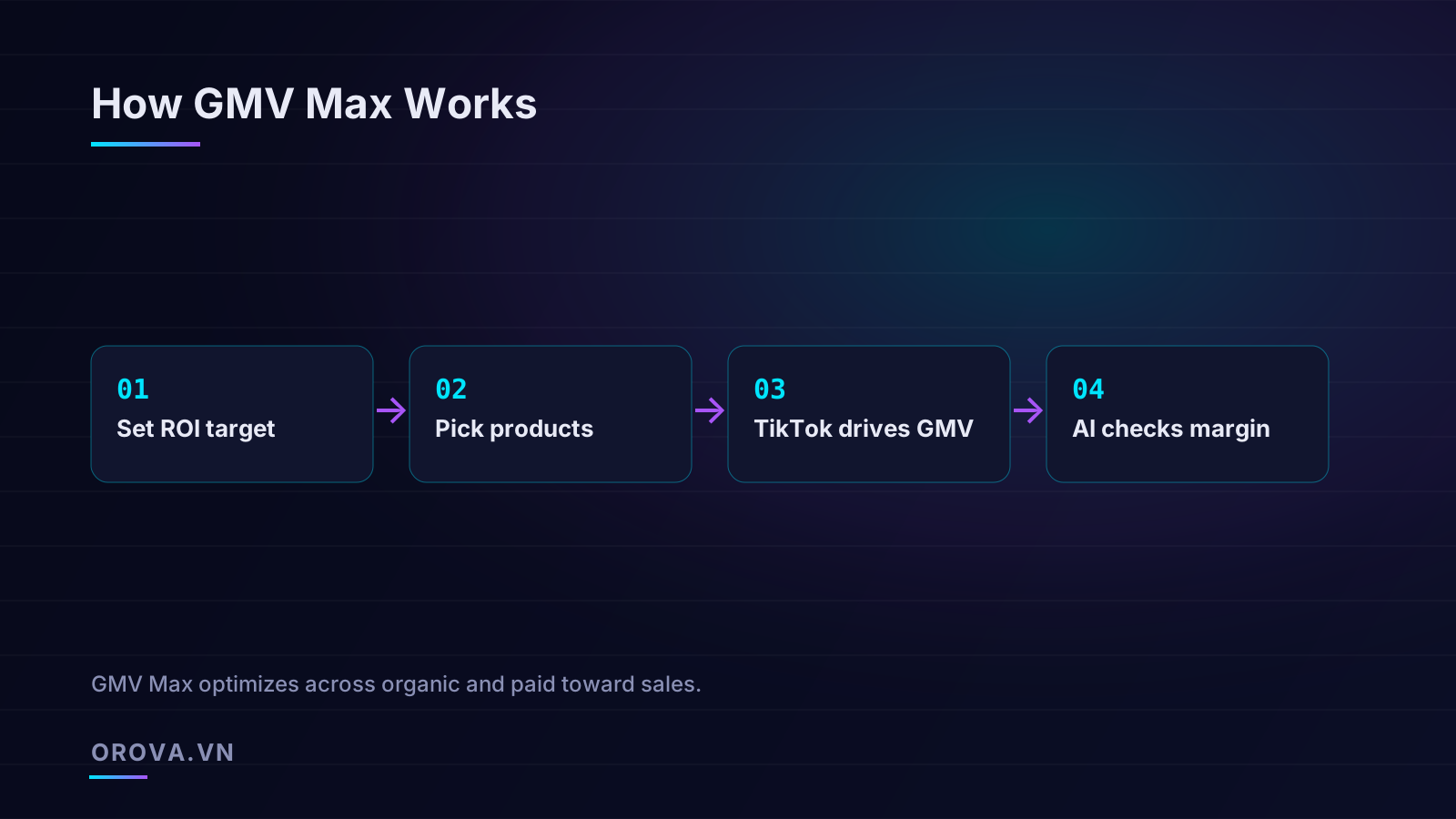
It helps to think of GMV Max as a continuous loop rather than a static campaign. The cycle looks like this:
- You set an ROI target. This is the single most important input you control. It tells the system how much revenue you expect per dollar of ad spend — your minimum acceptable return on ad spend, expressed as ROAS or its inverse.
- You pick products. You choose which SKUs from your TikTok Shop catalog the campaign is allowed to promote. The system then looks across all your available creative and shopping signals for those products.
- TikTok drives GMV. The optimization engine spends your budget across paid placements, decides which audiences to reach, sets bids in real time, and amplifies your best-performing organic content — all aimed at producing the most sales it can while respecting your target.
- You (and ideally an AI layer) check margin. Because the system optimizes toward revenue, not profit, the closing step is verifying that the revenue it generated actually left you better off after product cost, fees, shipping, and returns.
That last step is the one sellers most often skip, and it's where the real risk lives. GMV is a top-line number. It says nothing about whether a sale was profitable. We'll come back to this repeatedly, because it's the difference between GMV Max being a growth engine and being a slow leak.
How blended organic and paid optimization works
The feature that genuinely sets GMV Max apart from a normal shopping campaign is that it optimizes across organic and paid placements together, in one setting, toward the same goal. This is unusual. On most ad platforms, organic reach and paid reach live in separate worlds — you create content for the algorithm to distribute for free, and separately you buy placements with ad dollars. TikTok blurs that line on purpose.
When GMV Max evaluates how to generate the next dollar of GMV, it considers your entire content surface. If one of your product videos is already getting strong organic traction — high watch time, good click-through to the product page, a healthy conversion rate — the system can pour paid budget behind that exact video to push it further than organic distribution alone would carry it. Conversely, if a piece of content is converting poorly, it won't waste paid spend amplifying it just because you uploaded it. The result is that your best organic creative and your paid spend reinforce each other instead of competing for attention in two disconnected systems.
The mental shift is this: with GMV Max you are no longer buying ad placements, you are funding sales. The system treats every video, live session, and product card as raw material and decides which combination of organic momentum and paid amplification produces the most revenue per dollar.
This blending has two practical consequences worth internalizing. First, your organic content strategy is now part of your ad performance. If you starve the campaign of fresh, varied creative, GMV Max has less material to amplify and will lean harder on a smaller set of videos — which fatigues audiences faster and drives costs up. Sellers who win with GMV Max tend to maintain high creative velocity, shipping new product videos and Spark-style content continuously so the system always has fresh winners to scale. If you want a deeper treatment of why a steady stream of creative matters so much on TikTok, our guide to TikTok ads optimization and creative velocity covers the mechanics of feeding the algorithm.
Second, attribution gets murkier. Because organic and paid are fused, it becomes harder to say cleanly "this sale came from an ad" versus "this sale would have happened organically anyway." TikTok reports the GMV the campaign is credited with, but incrementality — how much of that GMV is genuinely additional because you ran the campaign — is something the platform's own dashboard won't isolate for you. This is a recurring theme in automated commerce ads, and it's another reason an independent check on the numbers earns its keep.
Setting ROI targets that protect your business
The ROI target is your steering wheel. Get it right and GMV Max scales your profitable sales while staying within a return you can live with. Get it wrong and you either choke the campaign so tightly it barely spends, or you open it so wide that it buys revenue at a loss. Most of the mistakes sellers make with GMV Max trace back to a target that was set on instinct rather than on the actual economics of the product.
Start from your contribution margin, not a round number
A common error is picking a ROAS target like "I want 4x" because it sounds healthy, without checking whether 4x is even break-even for the specific product. The right starting point is your contribution margin — what's left from the sale price after the costs that vary with each unit sold:
- Cost of goods sold — what you pay for the product itself.
- TikTok Shop fees and commissions — platform take rate, payment processing, and any affiliate or creator commissions.
- Fulfillment and shipping — packaging, postage, and any free-shipping subsidy you absorb.
- Expected returns and refunds — a realistic return rate, because gross sales overstate what you keep.
Once you know your true contribution margin per sale, you can compute the break-even ROAS — the return at which ad spend exactly equals contribution. Your GMV Max target should sit comfortably above break-even so the campaign produces actual profit, not just activity. A product with a 30% contribution margin breaks even around a 3.3x return; setting your target at 3x would mean you're paying to lose money on every incremental sale, even as the GMV column climbs and the campaign looks like it's "working."
Account for the cost stack GMV hides
This is worth dwelling on because GMV Max's entire reporting frame is gross merchandise value, and GMV is the most flattering number in the whole funnel. It is revenue before nearly every cost. A campaign showing a 5x "ROAS" against GMV can still be unprofitable once you strip out a 20% platform take, a 15% return rate, a 10% creator commission, and your product cost. The number on the dashboard goes up and to the right while your bank balance goes the other way.
The discipline here is simple to state and hard to maintain: translate every GMV figure back into contribution dollars before you decide whether the campaign is succeeding. Do it weekly at minimum, and do it per product, because a blended average across SKUs with different margins will mask the products that are quietly bleeding.
Give the system room to learn, then tighten
Automated campaigns need a learning phase. If you set an aggressive target and tiny budget on day one, GMV Max won't gather enough conversion signal to optimize well, and you'll see erratic spend and weak results. A more reliable approach is to launch with a target slightly looser than your eventual goal, let the system accumulate conversions for a week or two, then gradually tighten the target toward your true profitability line. Tightening in small steps lets you find the point where additional spend stops being worth it without slamming the brakes and resetting the learning.
Where automation helps — and where it bites
GMV Max is, fundamentally, a trade. You hand over granular control in exchange for hands-off scale. Understanding both sides of that trade is the difference between using the tool well and getting used by it.
What you gain
- Speed to scale. Because there are no ad groups to build or bids to manage, you can go from catalog to live campaign in minutes, and the system can scale spend far faster than a human shifting budgets by hand.
- Less manual labor. One setting replaces dozens of ad groups and the daily ritual of pausing losers and feeding winners. For a small team running a busy shop, that reclaimed time is real.
- Better creative leverage. The organic-plus-paid blending means your strongest content does double duty, and the system finds amplification opportunities you might miss managing things manually.
- Real-time bidding at a scale humans can't match. The engine adjusts bids continuously across millions of micro-decisions, something no manual operator can replicate.
What you give up
- Granular control. You can't carve out specific audiences, cap spend on a particular placement, or hand-tune bids the way you could with manual ad groups. You set the target and the products; the system decides the rest.
- Profit awareness. The optimization is blind to your margin structure. It cannot know that SKU A nets you $12 and SKU B nets you $2; it sees GMV and pursues it. If a low-margin product happens to convert well, the system will pour spend into it precisely because it generates GMV cheaply — even though it generates almost no profit.
- Attribution clarity. The blended model and platform-reported GMV make incrementality hard to judge from inside TikTok's own tools.
- Inventory and operations alignment. The system will scale a product as long as it's profitable to TikTok's eyes, with no awareness of your stock levels, lead times, or whether you can fulfill the surge.
The margin-loss traps to watch for
Most GMV Max failures aren't dramatic blowups; they're slow erosions that look fine on the dashboard until you reconcile the month. Here are the patterns that catch sellers most often.
The low-margin product magnet
When you give GMV Max a basket of products with different margins under one target, the system gravitates toward whichever products produce GMV most cheaply. Frequently those are your lowest-priced, lowest-margin items — the impulse buys that convert easily. The campaign reports a strong GMV-based return while quietly concentrating spend on the products you make the least money on. The fix is to segment: run high-margin and low-margin products under separate GMV Max campaigns with targets calibrated to each product's real economics, rather than letting one blended target average away the difference.
The return-rate blind spot
GMV is booked at the moment of sale. Returns come later. A product category with a high return rate — apparel and fashion are notorious — can show a beautiful GMV-based ROAS in week one and a grim contribution picture in week four once the returns land. Because GMV Max optimizes on the early signal, it can scale a product that looks great precisely during the window before its returns show up. You have to feed return-adjusted economics back into your target setting, not the gross numbers the dashboard celebrates.
Runaway scaling past your real ceiling
The same speed that makes GMV Max attractive makes it dangerous when something shifts. If a creative goes viral or a seasonal spike hits, the system can ramp spend aggressively. That's wonderful when margins hold, but if your target was set loosely or your cost assumptions were optimistic, the system can scale a marginally-profitable position into a large unprofitable one before your weekly review catches it. Hands-off scale means losses can also be hands-off.
Creative fatigue masked by automation
Because the system manages amplification for you, it's easy to stop paying attention to creative health. But as winning videos fatigue, the system either keeps paying more to reach the same audiences or shifts to weaker content, and your costs drift up. The dashboard's blended numbers can hide this for a while. Maintaining a steady supply of fresh creative isn't optional with GMV Max; it's the fuel the whole engine runs on.
Building a margin-aware oversight layer
The throughline of every trap above is the same: GMV Max optimizes toward a number that isn't profit, and it does so faster than a human reviewing dashboards weekly can keep up with. The answer isn't to avoid the tool — the scale and labor savings are genuinely valuable — it's to wrap it in an oversight layer that watches the things the platform won't.
What good oversight checks daily
- Contribution per campaign, not GMV. Translate reported GMV into real contribution dollars using each product's actual cost stack, including platform fees, commissions, shipping, and a return reserve.
- Spend concentration by SKU. Flag when a campaign is funneling a disproportionate share of budget into low-margin products, even if the blended ROAS looks healthy.
- Return-adjusted ROAS. Recompute returns against a rolling return rate so the early GMV signal doesn't paint an overly rosy picture.
- Pace versus ceiling. Watch the rate of spend increase and compare it against the point where additional sales stop being incrementally profitable, so a viral spike doesn't outrun your economics.
- Creative freshness. Track whether new creative is entering the system fast enough to replace fatiguing winners before costs climb.
Why daily, and why automated
GMV Max moves at machine speed. A weekly manual review is a reasonable cadence for a hand-managed campaign where spend changes slowly, but it's far too slow for a system that can double a product's spend in a day. By the time a Monday review catches a Tuesday-through-Sunday margin slide, you've already absorbed nearly a week of unprofitable scale. The oversight has to run at least daily, and ideally it should be automated, because the calculations — pulling spend, mapping it to SKU-level cost data, adjusting for returns, comparing against targets — are exactly the kind of repetitive reconciliation that humans do inconsistently and machines do reliably.
This is the natural complement to GMV Max. TikTok's system is brilliant at finding GMV; it is structurally indifferent to your profit. A separate layer that understands your margin and acts on it — adjusting targets, pausing products that drift below break-even, reallocating toward your high-contribution SKUs — turns a top-line optimizer into a bottom-line one. The same principle applies across every automated ad product on Meta and Google, but it's especially acute with GMV Max precisely because the headline metric is so far removed from profit.
A practical playbook for getting started
If you're rolling out GMV Max for the first time, here's a sequence that captures the upside while guarding the downside.
- Calculate true contribution margin per SKU before you touch the campaign builder. You can't set a sane target without it.
- Segment products by margin tier and run separate campaigns rather than one blended basket, so high-margin items don't get starved by cheap-GMV low-margin ones.
- Set initial ROI targets above break-even with a learning buffer — looser than your final goal for the first week or two, then tighten in small steps.
- Maintain creative velocity. Keep new product videos and Spark-style content flowing so the organic-plus-paid engine always has fresh winners to amplify.
- Install a daily margin check that converts GMV to contribution, adjusts for returns, and flags spend concentration and runaway pacing.
- Review and adjust targets weekly at the strategic level, using the daily checks to spot problems early and make small corrections rather than big reactive swings.
Done this way, GMV Max becomes what it should be: a way to scale profitable TikTok Shop sales with a fraction of the manual labor, rather than a fast way to grow revenue you don't get to keep. The platform handles the speed and the bidding; you handle the economics; and an automated oversight layer makes sure the two never drift apart.
If you'd rather not build that margin-aware oversight layer by hand, that's exactly the gap Orova Ads is built to close. It's an AI agent that autonomously manages paid campaigns across Google, Meta, and TikTok — reading your data daily, recommending optimizations, and executing changes to budgets, bids, on/off states, and audiences, all with human-in-the-loop approval and a full audit log of every action. For GMV Max sellers, that means a system watching your real contribution margin every day, not just the GMV the dashboard shows. See how it works at orova.vn/ads.
Let an AI Agent handle your SEO
Orova plans, writes, optimizes, and tracks rankings on its own — you just read the results.
Try it free