
TikTok Smart Performance Campaign: How Much Automation Is Too Much?
The first time most advertisers open a TikTok Smart Performance Campaign, they expect to see the familiar wall of controls: ad groups, audience segments, placement toggles, bid caps, day-parting schedules. Instead they get a screen that asks for almost nothing. Pick an objective. Set a daily budget. Upload some videos. Type a destination URL. That's it. The campaign builds itself. For a marketer who has spent years hand-tuning Meta ad sets or building Google Search match-type matrices, this can feel less like an upgrade and more like a loss of the steering wheel.
That reaction is understandable, and it's also the wrong frame. Smart Performance Campaign (SPC) is TikTok's answer to the same machine-learning consolidation that produced Google Performance Max and Meta Advantage+ Shopping. The trade is explicit: you surrender the granular levers, and in return TikTok's models get more freedom to find conversions across its entire signal graph. The campaigns that win on SPC are not the ones run by people who fight this trade. They are run by people who understand exactly which inputs the algorithm still cannot supply for itself, and who pour their effort there. This article is about identifying those inputs, understanding the mechanics underneath the simple interface, and knowing where automation genuinely helps versus where it quietly burns budget if left unsupervised.
What a Smart Performance Campaign actually automates
To use SPC well you have to be precise about what it takes over, because the marketing copy ("just set a goal and let TikTok do the rest") obscures the real division of labor. SPC consolidates four decisions that you used to make manually into a single optimization loop.
Targeting
In a manual TikTok campaign you build audiences: interest categories, behavioral signals, custom audiences from your pixel, lookalikes, geographic and demographic filters. In SPC, almost all of this disappears. You can still set country and a broad age floor for compliance and brand-safety reasons, but you do not pick interests, you do not layer behaviors, and you do not build lookalike percentages. TikTok decides who sees the ad based on who its model believes will convert, using the signals flowing back from your pixel or events API. The practical consequence is that your audience is no longer something you author; it is something the system discovers by watching who responds to your creative.
Bidding
Manual campaigns let you choose a bid strategy and, in many cases, set a specific bid or cost cap. SPC strips this down. You typically express intent through the budget and, depending on the optimization setting, a target cost-per-action. There is no bid you type per ad group. The system bids in each auction on your behalf, pacing spend to hit the conversion goal you defined. This is the lever marketers miss most, because cost caps were how they used to enforce discipline. On SPC, discipline has to come from elsewhere — from the budget itself and from external monitoring.
Creative selection
You upload multiple videos into one campaign, and TikTok decides which ones to serve, how often, and to whom. It will rotate aggressively toward the creatives that produce conversions and starve the ones that don't. There is no manual A/B split where you carve traffic 50/50 and wait. The model does the allocation continuously, and it does it per-audience-pocket, which is something no human could do at scale. One video might win with younger urban viewers while another wins with a different cohort, and SPC can serve both simultaneously without you ever defining those cohorts.
Optimization
The fourth thing it automates is the ongoing adjustment — the constant re-weighting of who, what, and how much, as new conversion data arrives. This is the part that runs invisibly. Every conversion event teaches the model something, and the model rebalances. In a manual campaign you'd be the one looking at yesterday's numbers and shifting spend. In SPC that happens automatically and far faster than a person checking a dashboard once a day.
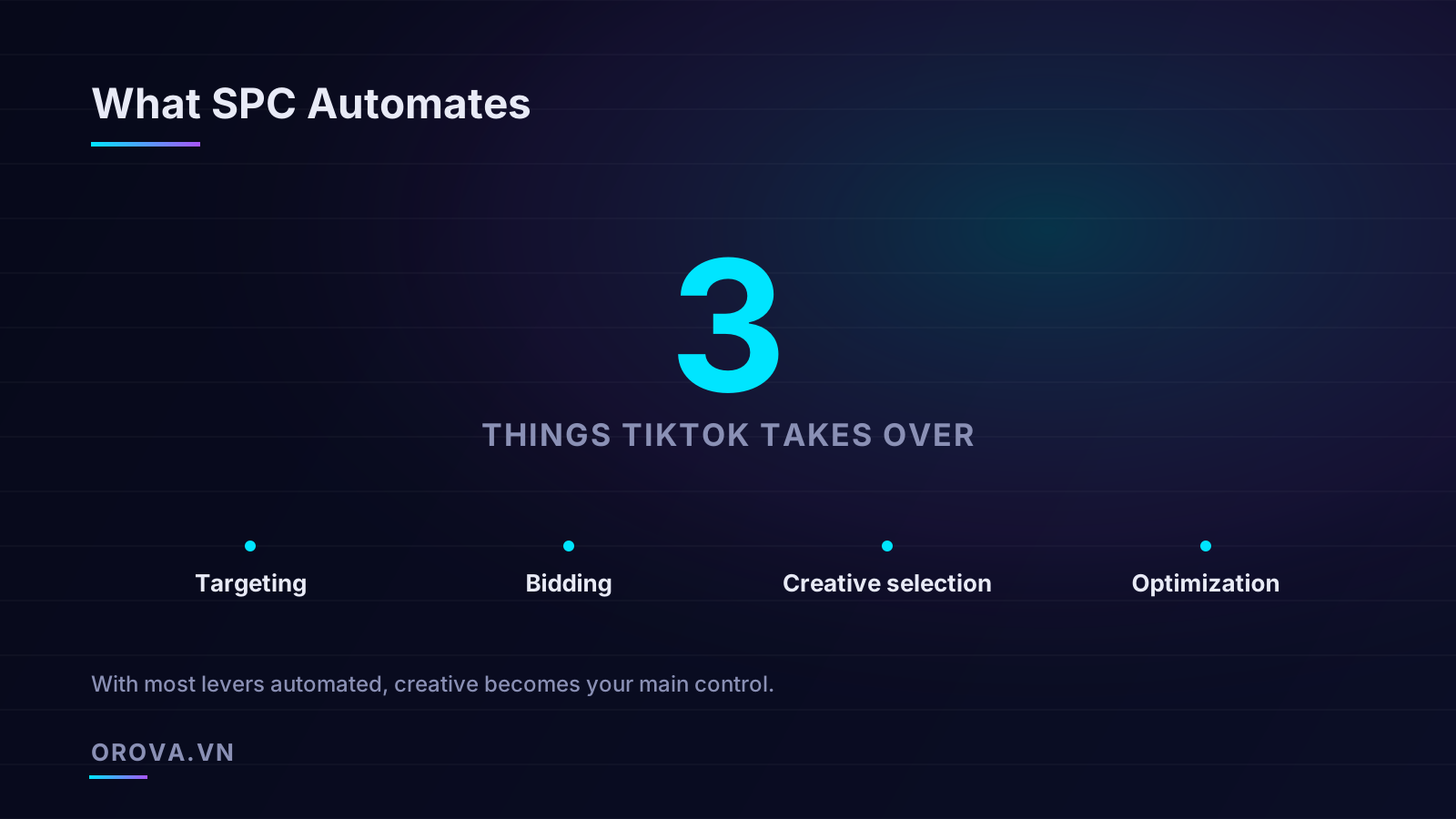
Lay these four out side by side and a pattern emerges. Three of them — targeting, bidding, optimization — are decisions about distribution: who gets the ad and at what price. The fourth, creative selection, is also a distribution decision in form, but it depends entirely on something you must supply: the creatives themselves. The algorithm can choose the best video from your set, but it cannot make a good video that isn't there. This is the single most important insight about SPC. You have not lost control. You have had your control concentrated into one place, and that place is creative.
Why SPC is a creative-led format
On older ad formats, a mediocre creative could be rescued by sharp targeting. If your video was forgettable but you put it in front of an exquisitely defined audience — past purchasers, high-intent retargeting pools — you could still squeeze out a respectable cost-per-acquisition. The targeting did the heavy lifting. SPC removes that crutch. When the system controls distribution, the only variable left that distinguishes a winning campaign from a losing one is the quality and variety of the videos you feed it.
This is why experienced TikTok buyers describe SPC as a "creative engine" rather than a "targeting engine." The model is a sorting and serving machine. It is extremely good at finding the audience for a piece of content, but it is only as good as the content it has to work with. If you give it three near-identical videos, it has almost nothing to optimize against — it will find the marginally better one and ride it until fatigue, then have nowhere to go. If you give it fifteen genuinely different concepts, hooks, formats, and angles, you have given it a real search space, and the odds that one or two of them resonate with a profitable audience pocket rise dramatically.
The right mental model: SPC doesn't optimize your campaign, it optimizes your creative portfolio. Your job is to keep that portfolio deep, fresh, and varied. The algorithm's job is to figure out where each piece belongs.
Creative velocity beats creative perfection
One of the harder lessons for advertisers coming from polished, high-production-value channels is that on TikTok, the cadence of new creative matters more than the polish of any single asset. Creatives fatigue fast — a winning video might run hot for a week or two before its conversion rate decays as the most responsive viewers are exhausted. If you have nothing new in the pipeline when that happens, performance falls off a cliff and the model has nothing to pivot to. The advertisers who sustain results on SPC are the ones who treat creative as a continuous production line, not a quarterly project. We've written more about this in our guide to TikTok ads optimization and Spark Ads creative velocity, but the headline is simple: feed the machine constantly.
This reframes the skill of TikTok advertising. It is less about the auction and more about a production process: ideation, scripting, shooting (or sourcing creators), editing into multiple variants, and feeding them in batches. A team that can ship ten new concepts a week will outperform a team that ships one beautiful video a month, almost regardless of who's better at media buying, because on SPC media buying has been largely abstracted away.
Variety, not just volume
Volume alone isn't the goal — variety within that volume is. Fifteen videos that are all the same talking-head format with a different first line are not fifteen creatives in any meaningful sense; they are one creative with cosmetic changes. The model can't discover new audiences from them because they all appeal to the same kind of viewer. Real variety means different hooks (problem-first, curiosity, social proof, demonstration), different formats (UGC testimonial, founder explainer, product close-up, before-after, listicle, trend remix), different pacing, different on-screen people, and different opening three seconds. Each genuinely distinct concept is a probe into a different part of the audience graph. The more probes you send, the more pockets of profitable demand the algorithm can surface.
The manual levers that remain — and how to use them
SPC takes a lot off your plate, but it is not a vending machine where you insert budget and receive customers. A handful of inputs remain firmly in your control, and because there are so few of them, each one carries enormous weight. Treat these as the few dials that actually move your outcome.
The objective and the conversion event
The most consequential decision you make in SPC happens before any video is uploaded: what you tell the system to optimize toward. If you optimize for landing-page views, the model will get very good at producing cheap clicks from people who never buy. If you optimize for a deep, valuable conversion event — a completed purchase, a qualified lead, a subscription — the model will hunt for the people likely to do that, even if it means fewer, more expensive clicks. The algorithm is ruthlessly literal. It optimizes for exactly what you ask, so the integrity of your event tracking and the choice of which event to optimize are not technical afterthoughts; they are the campaign's strategy. Getting the pixel and events API configured correctly, deduplicating server and browser events, and choosing a conversion that genuinely correlates with revenue is where a disproportionate share of SPC success or failure is decided.
Budget and the learning phase
Your budget is no longer just a spending limit — on SPC it is a primary input to the optimization itself. The model needs a minimum volume of conversion events to exit the learning phase and stabilize, typically on the order of dozens of conversions over a rolling window. If your budget is too low to generate that volume, the campaign stays stuck in learning, performance stays volatile, and costs stay high because the model never accumulates enough signal to get efficient. This creates a counterintuitive rule: starving an SPC of budget often makes it less efficient, not more, because it can't learn. You have to fund it to the point where it gathers enough events, then judge it. Equally, you must avoid the temptation to make large, frequent budget changes, because each significant change can reset or destabilize learning. Smooth, deliberate budget management is one of the few genuine craft skills left on the format.
Target cost-per-action
Depending on the optimization mode you select, you may set a target cost-per-action — your aim for what each conversion should cost. This is influence rather than a hard cap. Set it too aggressively below what the market will bear and the system simply can't find enough qualifying auctions, so it under-delivers and spend stalls. Set it loose and you'll get volume at a higher cost. The art is to give the model a target that's ambitious but achievable, then adjust it in small increments as you observe real performance rather than yanking it around in panic.
Creative — the lever that is really four levers
And then there is creative, which we've already established is the dominant input. Within creative you control the hook, the format, the message, the offer presentation, the creator or talent, the captions, and the pace of new uploads. Every one of these is a manual decision. So while it's true that SPC automates "creative selection," it does not automate creative creation, and creation is where almost all your leverage lives.
How much automation is too much?
This is the question in the title, and the honest answer is: it depends on what you keep watching. Automation isn't inherently too much or too little. The danger isn't that TikTok automates targeting and bidding — that's genuinely valuable, and most humans were never as good at those tasks as they believed. The danger is the gap that opens up when automation removes the levers that used to force you to look at your account. When you had to set bids manually, you logged in and saw your numbers. When the system bids for you, it's easy to go a week without looking, and a lot can go wrong in a week.
The failure modes nobody warns you about
SPC fails quietly and in specific ways. Knowing them lets you watch for them deliberately rather than discovering them in a bad invoice.
- Silent CPA drift. Your cost-per-acquisition creeps up day by day as creatives fatigue, but no single day looks alarming. By the time the cumulative number looks bad, you've already overspent for two weeks at a degraded rate.
- Budget concentration on a fragile winner. The model funnels spend into one creative that happens to be working. That creative fatigues, and because so much budget was riding on it, the whole campaign's performance collapses overnight rather than gracefully.
- Learning-phase thrash. Well-meaning manual edits — a budget bump here, a target-CPA tweak there — keep resetting the learning phase, so the campaign never stabilizes and you blame the format when the cause is your own fiddling.
- Tracking degradation. A pixel breaks, an events-API integration drops conversions, or attribution settings shift. The model keeps optimizing toward a signal that's now wrong, and spend chases phantom outcomes.
- Audience saturation. In a smaller market, SPC can exhaust the responsive audience for your current creative set, frequency climbs, and efficiency falls — a problem that only shows up if you're watching frequency alongside cost.
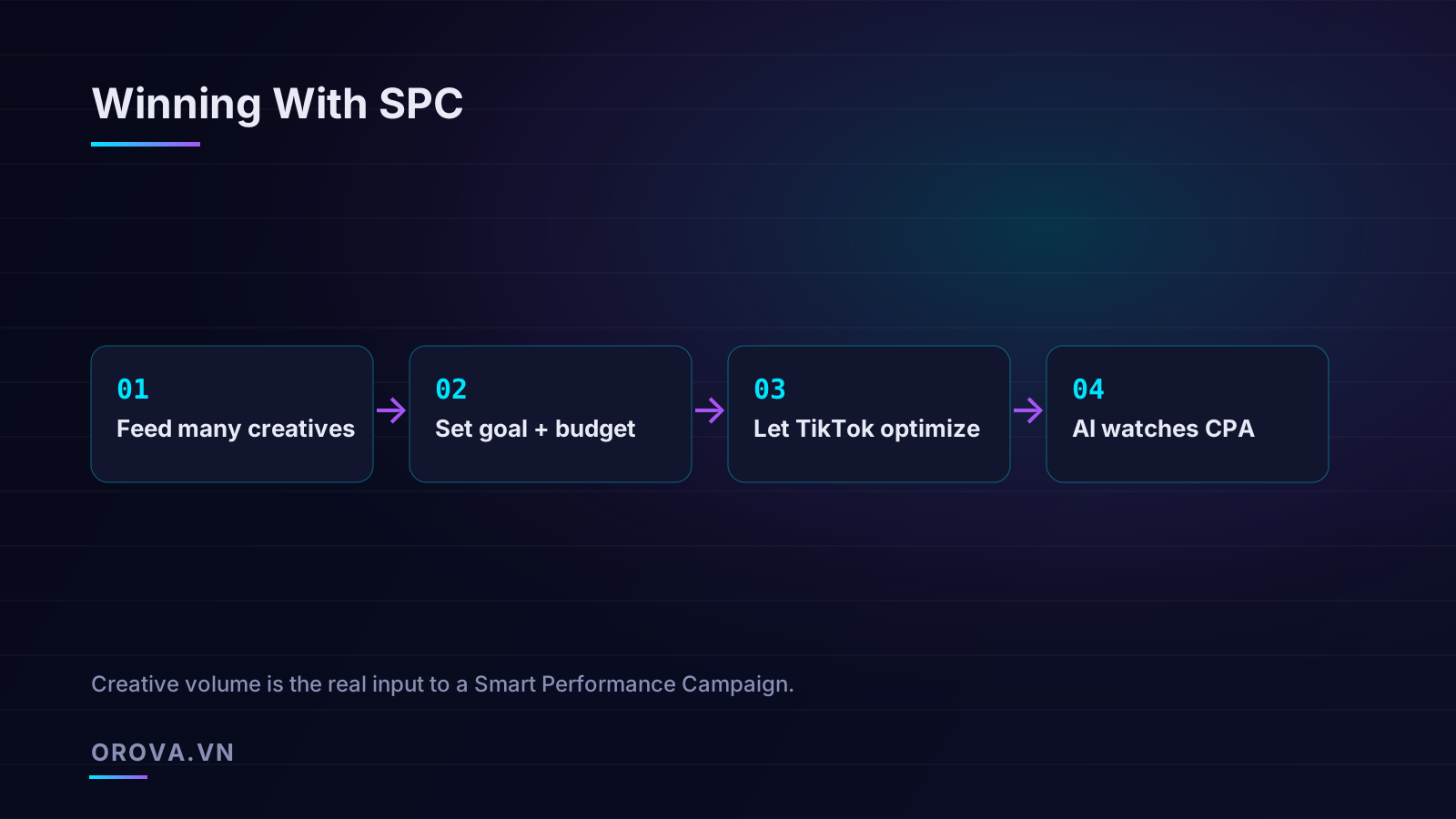
None of these are arguments against automation. They are arguments for supervision. The correct posture toward SPC is not "set and forget" and it is not "micromanage." It is "automate the execution, supervise the economics." Let TikTok run the auction. You watch whether the auction is producing profitable outcomes, and you intervene at the level of budget, target, and — above all — creative.
A practical supervision rhythm
For most accounts, a workable cadence looks like this. Daily: a quick check of spend pace and CPA trend, watching for drift rather than reacting to single-day noise. A few times a week: an assessment of creative health — which videos are carrying the campaign, whether the winners are fatiguing, and whether the new-creative pipeline is keeping up. Weekly: a deliberate review of budget and target-CPA settings, making at most small, considered adjustments and then leaving them alone long enough to read the effect. And continuously, in the background: monitoring that tracking is intact, because a broken signal corrupts everything downstream.
The trouble is that this rhythm is genuinely hard to sustain by hand, especially across multiple campaigns and especially because the most important checks — slow CPA drift, gradual creative fatigue, budget over-concentration — are exactly the kind of trend a daily human glance tends to miss. We are good at spotting sudden breaks and bad at spotting slow erosion. That gap, between what SPC requires you to watch and what humans are naturally good at watching, is precisely where supervision tooling earns its keep.
Where an AI agent fits on top of SPC
There's a useful distinction between two kinds of automation that get lumped together. TikTok's SPC is execution automation: it runs the auction, picks the audience, allocates between your creatives. What it does not do is oversight automation: it won't tell you that your blended CPA across all campaigns has drifted 18% over ten days, it won't flag that one creative now eats 70% of spend and is fatiguing, and it certainly won't compare your TikTok economics against your Meta and Google results to tell you where the next dollar belongs. SPC optimizes within its own walls toward the goal you gave it. It has no view of your business, your margins, or your other channels.
This is the layer an AI agent occupies. Instead of replacing TikTok's automation, it sits above it and supplies the supervision that the format demands but that humans struggle to deliver consistently. A well-built agent reads the campaign data every day, tracks the slow-moving trends that matter — CPA drift, spend concentration, frequency creep, creative fatigue curves — and surfaces them before they become expensive. It can watch the learning-phase status and warn you off changes that would reset it. It can monitor whether your tracking is still firing. And critically, it can do this across TikTok, Meta, and Google at once, which is the comparison SPC structurally cannot make for you.
Human-in-the-loop, not hands-off
The right way to deploy this is not to hand the keys to another black box on top of TikTok's black box. The supervision agent should propose and explain — "CPA on this campaign has risen 15% as your top creative fatigues; recommend uploading new variants and reducing budget 20% until they're tested" — and then let you approve before anything executes, with a full record of what was changed and why. That keeps the marketer in the position automation should leave them in: making the economic and creative judgments that require business context, while the machine handles the watching, the math, and the execution. Used this way, "how much automation is too much" stops being a worry. You automate everything that is mechanical, and you keep human judgment exactly where it adds value.
Putting it together
A Smart Performance Campaign is a fair deal once you understand its terms. TikTok takes targeting, bidding, creative selection, and ongoing optimization off your hands. In exchange, it asks you to do three things exceptionally well: define the right conversion goal and track it cleanly, fund the campaign enough to learn and then manage that budget with a steady hand, and — most of all — feed it a deep, varied, constantly refreshed stream of creative. Do those three things and the automation works for you. Neglect any of them and the same automation will efficiently spend your money on the wrong outcomes.
The format is not too automated. It is automated in the places where machines beat people, and it leaves you in charge of the places where judgment and creativity still win. The only real risk is the supervision gap — the slow drifts and quiet fatigues that automation introduces and that a once-a-day login won't catch. Close that gap, with discipline or with tooling, and SPC becomes one of the most efficient acquisition channels available to anyone willing to keep the creative engine running.
If you want that supervision layer without checking dashboards every morning, Orova Ads is an AI agent that manages paid campaigns across Google, Meta, and TikTok for you. It reads your account data daily, catches the slow CPA drift and creative fatigue that human glances miss, recommends the budget, bid, audience, and on/off changes that make sense, and executes them only after you approve — with full audit logs of everything it touches. Let TikTok run the auction; let Orova watch the economics.
Let an AI Agent handle your SEO
Orova plans, writes, optimizes, and tracks rankings on its own — you just read the results.
Try it free