
Why Your SaaS Blog Has Traffic but No Signups
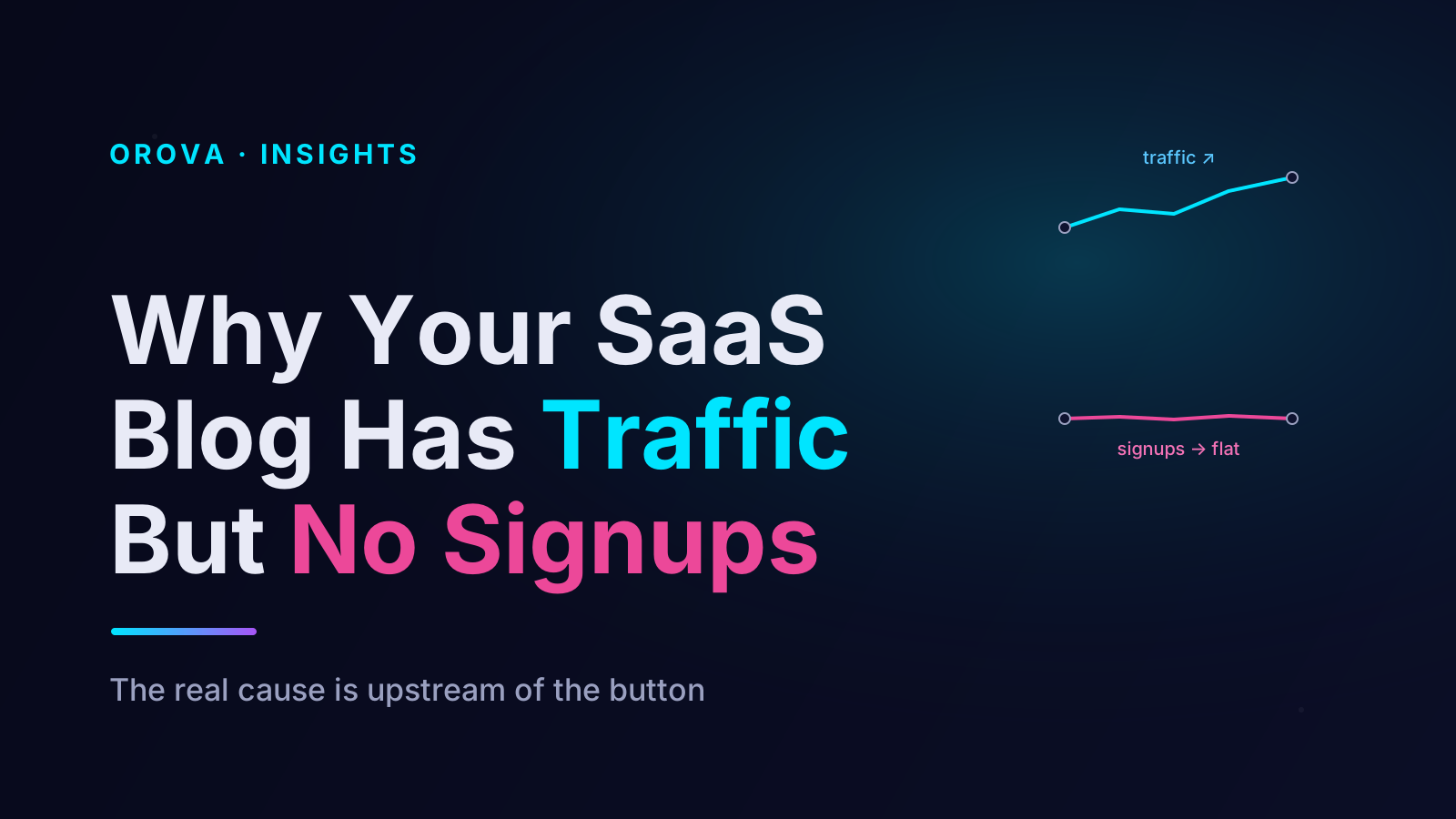
It is one of the most common situations in SaaS marketing, and one of the most quietly demoralising. The blog is working. Traffic charts climb every quarter. Articles rank. The content calendar is full and the team is shipping. By every measure on the marketing dashboard, the blog is a success. And yet, when someone in a meeting asks how many signups the blog actually drove last quarter, the room goes quiet. The honest answer is: almost none.
This is the traffic-but-no-signups problem, and it is not rare — it is close to the default outcome for SaaS blogs run on conventional SEO advice. It is also widely misdiagnosed. Teams assume the problem is somewhere it is not, fix the wrong thing, and end up with even more traffic and still no signups. This article is a critique of the usual explanations and a clearer account of what is actually broken — because the real cause is uncomfortable, and the comfortable explanations are why the problem persists.
The comfortable misdiagnoses
When a SaaS blog has traffic but no conversions, teams reach for a predictable set of explanations. Each one is appealing because each one points at a fixable surface detail rather than a structural mistake. And each one is, mostly, wrong.
The first misdiagnosis: the call-to-action is the problem. "We just need better CTAs — a stronger button, a brighter colour, a more compelling line." So the team rewrites every CTA, A/B tests button shades, adds banners. Conversions do not move. Because a CTA is the last link in a chain, and if everything before it is wrong, no button copy can rescue it.
The second misdiagnosis: the product or pricing page is the problem. "People click through, but the landing page does not close them." So the team rebuilds the pricing page. Conversions still do not move — because the tiny fraction of blog readers who ever reach a product page were never the issue. The issue is everyone who never gets close.
The third misdiagnosis: we just need more traffic. "Conversion is a numbers game; double the traffic and we double the signups." So the team chases more volume. Traffic doubles. Signups do not — because if your conversion rate is near zero, any multiple of near-zero is still near-zero. More of the wrong traffic is just a bigger version of the same problem.
What unites these three is that they all treat the symptom as a tuning problem — a button, a page, a volume dial. The real cause is not a tuning problem. It is structural, and it sits much further upstream.
The real cause: the traffic is the wrong traffic, doing the wrong job
Here is the uncomfortable diagnosis. Your blog has traffic but no signups because the traffic was never capable of converting in the first place, and no amount of CTA polish, landing-page work, or volume can change what the traffic fundamentally is.
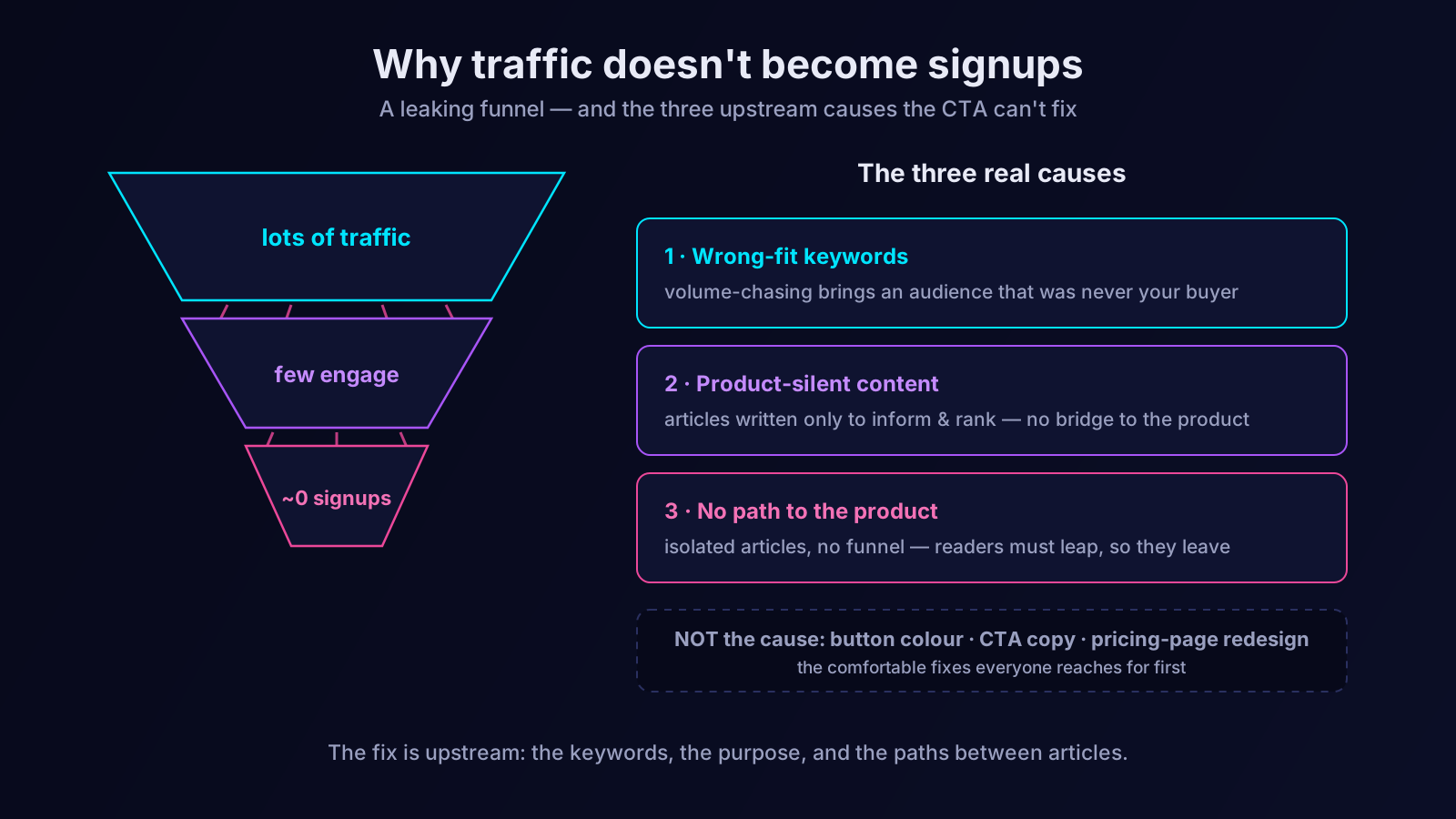
This breaks down into two linked failures. The first is a keyword selection failure: the blog ranks for terms searched by people who are not your buyers, or who are so far from a buying decision that expecting them to sign up is unreasonable. The second is a content-purpose failure: even where the right people do arrive, the articles were written purely to inform and rank — they were never built to move anyone toward your product. The traffic is the wrong people, and the content does the wrong job. Until you accept that, you will keep optimising buttons on pages that were doomed before the button existed.
The keyword failure, examined
Start with the traffic itself. A SaaS blog run on generic SEO advice optimises for volume — find the high-volume keywords, rank for them, watch the traffic grow. We have argued elsewhere that volume is the wrong target for SaaS, but here is the specific consequence: the highest-volume keywords in any subject are the broadest, most introductory, often most consumer-flavoured queries. Optimising for volume systematically fills your blog with content for the widest possible audience — which is, by definition, mostly not your buyers.
Walk through what that produces. A project-management SaaS optimises for volume and ends up ranking for "free to-do list template" and "best productivity quotes." These pull enormous traffic. They also pull students, hobbyists, and people who will never buy team software — searchers with no fit and no intent. The blog's traffic chart looks spectacular and its audience is composed almost entirely of non-buyers. You could have the most persuasive CTA ever written on those articles and conversions would still be near zero, because you cannot persuade someone to buy team software when they came looking for an inspirational quote. The keyword choice decided the outcome long before anyone reached for a button. (Choosing keywords by buyer fit instead of volume is the subject of our keywords-to-content-plan workflow.)
The content-purpose failure, examined
Now suppose some of the traffic is the right people — genuine potential buyers landing on your articles. They still do not convert, and here is the second failure: the content was written with the wrong purpose.
Most SaaS blog articles are written to do two things: be informative and rank. Both are fine goals. Neither is the same as being built to convert. An article written purely to inform and rank teaches its topic well, satisfies the reader's immediate question completely, and then... stops. It never connects the topic to your product. It never shows the reader that there is a faster or better way to do what they just learned. It never gives them a reason or a route to take a next step. The reader gets exactly what they came for, feels satisfied, and leaves — converted into a happy non-customer.
This is the product-silence problem. The article and the product live in separate worlds. The article is genuinely helpful and the help has no bridge to the thing you sell. A good potential buyer reads it, learns something, and exits — not because they were unconvinced, but because they were never invited, never shown the connection, never given anywhere to go. The CTA at the bottom does not fix this, because a CTA is an invitation with no build-up. By the time the reader reaches it, the article has spent its entire length being about something other than a reason to try your product.
The missing middle: no path from article to product
There is a third structural gap, and it compounds the first two. Even when the right reader lands on a well-intentioned article, there is usually no path from where they are to where a signup happens.
Think about what a real buyer journey requires. A reader lands on a problem-stage article. To convert, they need to travel — from understanding the problem, to exploring how it is solved, to comparing tools, to choosing yours. That is several steps. On most SaaS blogs, the article they landed on is an island. It does not link onward to the next stage. It does not escort the reader anywhere. The only exit offered is a single CTA that asks them to leap from "just learned about a problem" straight to "start a trial" — skipping every step in between.
Almost nobody makes that leap, because it is not how buying decisions work. The reader is not ready to start a trial; they have just begun. With no signposted path to the middle-of-funnel content that would move them along, they have no option but to leave. The blog has no funnel — it has a pile of disconnected articles, each hoping a reader will vault from first contact to purchase in one move. (The remedy is deliberate internal linking that connects each stage to the next.)
The honest fix is upstream and uncomfortable
The real fix for traffic-but-no-signups is the one teams resist, because it means admitting the existing program was aimed wrong — and it will, at least at first, make the celebrated traffic chart grow more slowly.
Fix the keywords. Stop choosing topics by volume and start choosing them by buyer fit — who searches this, and how close are they to needing what we sell. This shifts the blog toward lower-traffic, higher-fit topics. The traffic number may flatten. The quality of the traffic transforms.
Fix the content's purpose. Stop writing articles only to inform and rank. Write them to inform, rank, and move the reader toward the product — by genuinely connecting the topic to what you sell, by showing the better way, by being honestly product-relevant rather than product-silent. Not interruptive selling; relevant connection.
Fix the path. Stop publishing islands. Build the funnel — problem-stage content that links onward to solution-stage content that links onward to decision-stage content — so a reader has a route to travel rather than a single impossible leap to make.
Notice what is absent from this list: button colours, CTA copy, pricing-page redesigns. Those are not the fix. The fix is upstream — the keywords you target, the purpose you write with, the paths you build between articles. It is harder than tuning a button, and it temporarily costs you the comfort of a fast-rising traffic chart. That trade is the whole point.
How to diagnose your own blog honestly
Before you fix anything, you need to confirm which of the three structural causes is actually hurting you — guessing leads straight back to button-polishing. Here is a practical, honest self-diagnosis you can run on your own blog.
Start with the keyword question. Pull your top traffic-driving articles and, for each one, ask plainly: is the person who searched this term someone who could realistically buy what we sell? Not "could they conceivably benefit" — could they buy. If your highest-traffic articles rank for broad, introductory, or consumer-flavoured queries that your actual buyers would rarely search, you have confirmed the keyword failure. The tell is a blog whose most successful pages, judged by traffic, have almost nothing to do with the specific problem your product solves.
Next, audit content purpose. Read your best-intentioned articles — the ones aimed at the right audience — and ask whether each one ever connects to your product. Does it show the reader a faster or better way to do what it just taught? Does it acknowledge that a tool exists for this? Or does it teach the topic, satisfy the question, and stop dead? If your articles are uniformly product-silent — helpful and disconnected — you have confirmed the content-purpose failure.
Finally, test the path. Pick a problem-stage article a real buyer might land on and try to travel from it to a signup using only the links on the page. Can you get to solution-stage content? From there to a comparison or decision page? Or does the trail go cold, leaving a single bottom-of-funnel CTA as the only exit? If your articles are islands with no onward route, you have confirmed the missing-path failure. Most struggling SaaS blogs will recognise all three. Confirming them — rather than assuming — is what keeps the fix aimed at the real causes.
What a fixed SaaS blog looks like
It helps to know what you are aiming at, because a properly fixed blog looks different from the one most teams are proud of — and at first it can even look worse on the one chart everybody watches.
A fixed blog has, often, less traffic than its volume-chasing predecessor — or traffic that grows more slowly — because it has stopped ranking for broad terms searched by non-buyers. That is not a regression; it is the deliberate result of choosing fit over volume. The traffic that remains is composed of people who could actually become customers.
A fixed blog has content that is product-aware without being product-obsessed. Articles still teach generously and still rank, but they no longer pretend the product does not exist. Where it is honestly relevant, the content connects the topic to the tool — so a reader who finds the article useful also discovers there is a faster way, and a route to it.
A fixed blog has a visible funnel. Problem-stage articles link onward to solution-stage content; solution-stage content links onward to decision-stage pages. A reader who lands anywhere has a signposted path toward a decision, and the blog actively escorts them along it rather than hoping they leap.
And a fixed blog is measured by signups, trials, and influenced pipeline — not by the traffic chart that masked the problem for so long. The new dashboard is less flattering and far more honest. The traffic line may be flatter; the signup line, over a couple of quarters, finally moves. That trade — a calmer traffic chart for a working signup chart — is the entire definition of a fixed SaaS blog.
Why this problem is so persistent
If the diagnosis is this clear, why does traffic-but-no-signups stay so common? Because every incentive pushes teams toward the comfortable misdiagnoses. The real fix requires admitting the previous strategy was misdirected, and it requires accepting a slower-growing traffic chart in exchange for traffic that converts — and a traffic chart that grows is the easiest thing in the world to keep showing leadership. Polishing a CTA feels like progress and risks nothing. Rebuilding the keyword strategy feels like an admission and threatens the one chart everyone has been applauding. So teams tune buttons, chase more volume, and the structural problem rolls forward into another quarter, intact.
Where an SEO AI agent fits
The honest fix for traffic-but-no-signups is upstream work, and upstream work is demanding to sustain: scoring every keyword for buyer fit instead of reaching for volume, making sure every article is written with a real connection to the product, and building and maintaining the internal-linking paths that turn a pile of articles into a funnel. That is a lot of consistent discipline — and discipline is exactly what erodes when a faster, more flattering option is available.
This is where an SEO AI agent helps. Orova can score keywords by buyer fit and funnel stage rather than raw volume, flag articles that are product-silent and have no honest bridge to what you sell, identify the missing internal links between funnel stages, and report against signups and conversions rather than the traffic chart that has been hiding the problem. It will not make the uncomfortable decision for you — choosing converting traffic over a vanity chart is a strategic call. But it makes the right work sustainable, so the fix does not quietly relapse into button-polishing the moment a deadline appears. Traffic with no signups is not bad luck. It is the predictable result of optimising for the wrong things — and it stays fixed only when you optimise for the right ones, consistently.
Let an AI Agent handle your SEO
Orova plans, writes, optimizes, and tracks rankings on its own — you just read the results.
Try it free