
Traffic Dropped Overnight — A Calm, Step-by-Step Diagnosis

There is a particular kind of morning in SEO that nobody warns you about. You open your analytics, the way you have a hundred times before, and the line that has spent months drifting gently upward has done something else entirely. It has fallen off a cliff. Yesterday looked normal. Today looks like a different website. And your first instinct — almost everyone's first instinct — is to do something immediately, anything, because action feels safer than uncertainty.
That instinct is the single most expensive thing about a traffic drop. Not the drop itself, which may turn out to be small, temporary, or even imaginary, but the panicked response to it. This article is a calm, ordered, step-by-step diagnosis you can run when the line falls. It is deliberately unhurried, because the right answer to a sudden traffic drop is almost never a fast one. It is a correct one.
Before you touch anything: the rule that saves you
The first rule of diagnosing a traffic drop is the hardest to follow, and it is this: change nothing until you understand what happened. The temptation is overwhelming to roll back yesterday's deployment, rewrite a page, disavow a batch of links, or submit a dozen URLs for re-indexing — to do something. Resist all of it.
The reason is simple. If you make three changes while you are still confused, and traffic recovers, you will never know which change helped — or whether anything you did mattered at all. If traffic falls further, you will not know whether your changes hurt or whether the original cause was still unfolding. You will have spent your effort and learned nothing, which leaves you exactly as exposed to the next drop as you were to this one. Diagnosis has to come before treatment. A doctor who prescribes before examining is not being decisive; they are guessing with a prescription pad. Treat the first hour of a traffic drop as examination time only.
Step one: confirm the drop is real
An astonishing share of "traffic drops" are not drops at all. Before you investigate a cause, you must rule out the possibility that nothing actually happened. This step costs ten minutes and saves entire afternoons.
Start with the most common illusion: the reporting window. If your dashboard is showing "last 7 days" and today is partway through, today's incomplete data is being compared against complete days. The line always looks like it is collapsing in the final segment, because the final segment is not finished. Look at fully completed days only, and ideally compare week-over-week — this day last week versus this day the week before — so you are comparing like with like.
Then check whether the drop appears in more than one place. Analytics platforms can break. Tags can be removed by a well-meaning developer. A consent banner change can quietly stop a measurement script from firing. If your analytics shows a fall but Google Search Console shows clicks and impressions holding steady, you do not have a traffic problem — you have a measurement problem, and that is a very different, and frankly much better, situation to be in. Two independent sources agreeing is the threshold for treating a drop as real. One source alone is a rumour.
Step two: locate the drop precisely
Once you have confirmed something genuinely fell, the next job is not to ask why — it is to ask where and when, with as much precision as your data allows. A vague drop is undiagnosable. A precisely located drop often diagnoses itself.
Pin the date. Did traffic fall on a single, identifiable day, or did it erode gradually over a week or two? A sharp single-day cliff points toward a discrete event: a deployment, a technical break, an algorithm update rolling out. A slow slide points toward something cumulative: seasonality, gradual ranking decay, a competitor steadily overtaking you. The shape of the fall is your first real clue, and it costs nothing to read.
Then segment everything. Did the drop hit all channels, or only organic search? An all-channel drop almost always means a tracking or site-wide problem, because an algorithm update cannot reduce your direct or email traffic. An organic-only drop is a genuine SEO signal. Within organic, narrow further: did every page lose traffic evenly, or did the loss concentrate on a handful of pages, one section, or one template? Did it hit one country, one device type, one language? A drop concentrated on your blog while your product pages are untouched is telling you something specific. A drop spread perfectly evenly across the whole site is telling you something else entirely. The more precisely you can describe the drop, the shorter your list of possible causes becomes.
Step three: rule out the technical causes first
Technical problems are the best possible explanation for a traffic drop, because they are usually fast to find and fast to fix. They are also the most common cause of sudden, sharp, single-day falls. Check them before you reach for anything more dramatic.
Begin with indexing. In Google Search Console, look at whether the number of indexed pages has fallen. If pages have dropped out of the index, your traffic drop is fully explained — pages that are not indexed cannot rank, and pages that do not rank send no traffic. Then ask the obvious follow-up: why did they leave the index?
Walk the usual suspects. A robots.txt file that was changed and now blocks a directory it should not. A noindex tag that a developer added to a staging environment and that was accidentally pushed to production — this is a genuinely common, genuinely catastrophic mistake. Canonical tags suddenly pointing every page at the homepage. A site migration where redirects were set up incompletely. A server returning 5xx errors when Googlebot crawls, so the crawler backs off. A spike in page load time severe enough to interfere with crawling. An expired certificate. A new firewall or bot-protection rule that is, with the best of intentions, blocking Googlebot itself. Any one of these can cause a clean, sharp, frightening drop — and any one of them is fixable in an afternoon once identified. This is why you check technical causes first: they are the cheapest mystery to solve.
Step four: check whether your rankings actually moved
If the technical layer is clean — pages indexed, no crawl errors, no accidental noindex — then the question becomes whether you are still ranking where you were. There is a crucial distinction here that many teams miss, and getting it right reshapes the whole investigation.
You can lose traffic in two completely different ways. You can lose rankings — your pages slip from position three to position eight, and the clicks follow them down. Or you can keep your rankings and lose clicks anyway, because the search results page changed shape around you: an AI-generated answer now sits above you, a new pack of features pushed the classic results down, or the intent behind the query shifted toward something you no longer satisfy.
Search Console's performance report tells you which of these happened. Compare the period before the drop with the period after. If average position got noticeably worse, you have a ranking problem and the next question is why you fell. If average position held steady but clicks fell while impressions stayed flat, you have a click-through problem — you are still being shown, but fewer people are choosing you, which points at the results page changing around you rather than at your pages getting worse. These two diagnoses lead to entirely different treatments, which is exactly why you must separate them before doing anything.
Step five: consider the world outside your site
It is a quiet form of vanity to assume every traffic drop is something you did. Sometimes the cause is entirely external, and no amount of auditing your own site will surface it, because the answer is not on your site at all.
Seasonality is the most underrated explanation in all of SEO. A great many businesses have demand that genuinely rises and falls across the year, and if your traffic fell at the same time it fell last year and the year before, you may simply be looking at a normal seasonal trough rather than a problem. Always compare against the same period in prior years before you panic. Year-over-year is the comparison that exposes seasonality; week-over-week hides it.
Then there is search demand itself. The number of people searching for your topic can fall — interest fades, news cycles move on, a category cools — and when fewer people search, fewer people click, even though your rankings have not moved an inch. Google's own data on search interest can confirm this. Finally, there is the competitive picture: a competitor may have published something stronger, earned links, or improved a page, and quietly overtaken you. That shows as a position loss in Search Console, but the cause lives on their site, not yours. Look outward before you conclude the fault must be inward.
Step six: the algorithm update question
Eventually, every traffic-drop investigation reaches the question everyone wants to ask first: was it an algorithm update? It belongs near the end, not the beginning, because it is the hardest cause to confirm and the easiest to blame lazily.
The honest test is this. Find the exact date your traffic dropped. Then check whether a confirmed search algorithm update was rolling out on or around that date. If your drop lines up cleanly with a known update window, that is meaningful evidence. If it does not line up with anything, "it was probably an update" is not a diagnosis — it is a way of avoiding one. Updates are a convenient thing to blame precisely because they are vague, external, and absolve you of responsibility. Hold yourself to the date test before you accept that explanation.
And even when an update genuinely is the cause, that is the start of the work, not the end of it. Updates do not lower traffic at random; they re-weight what search rewards. The recovery path is to understand what the update was rewarding — usually more genuine helpfulness, stronger demonstrated expertise, better intent matching — and to improve your content against that bar. There is no rollback for an algorithm update. There is only being better than you were.
Step seven: write down what you found
The final step in a calm diagnosis is the one that gets skipped most often, and skipping it is why the same teams panic identically every single time traffic falls. Write it down.
Record the date the drop started, what you confirmed in each step, what you ruled out, what the evidence pointed to, what you changed in response, and what happened afterward. This record turns a frightening event into an asset. The next time the line falls — and it will fall again, because traffic is not a straight line — you will not start from raw fear. You will start from a document that says, in effect, "last time this looked like a catastrophe and turned out to be seasonality, and here is exactly how we proved it." Diagnosis written down becomes institutional calm. Diagnosis left in someone's head evaporates the moment they take a holiday.
The mindset that holds it all together
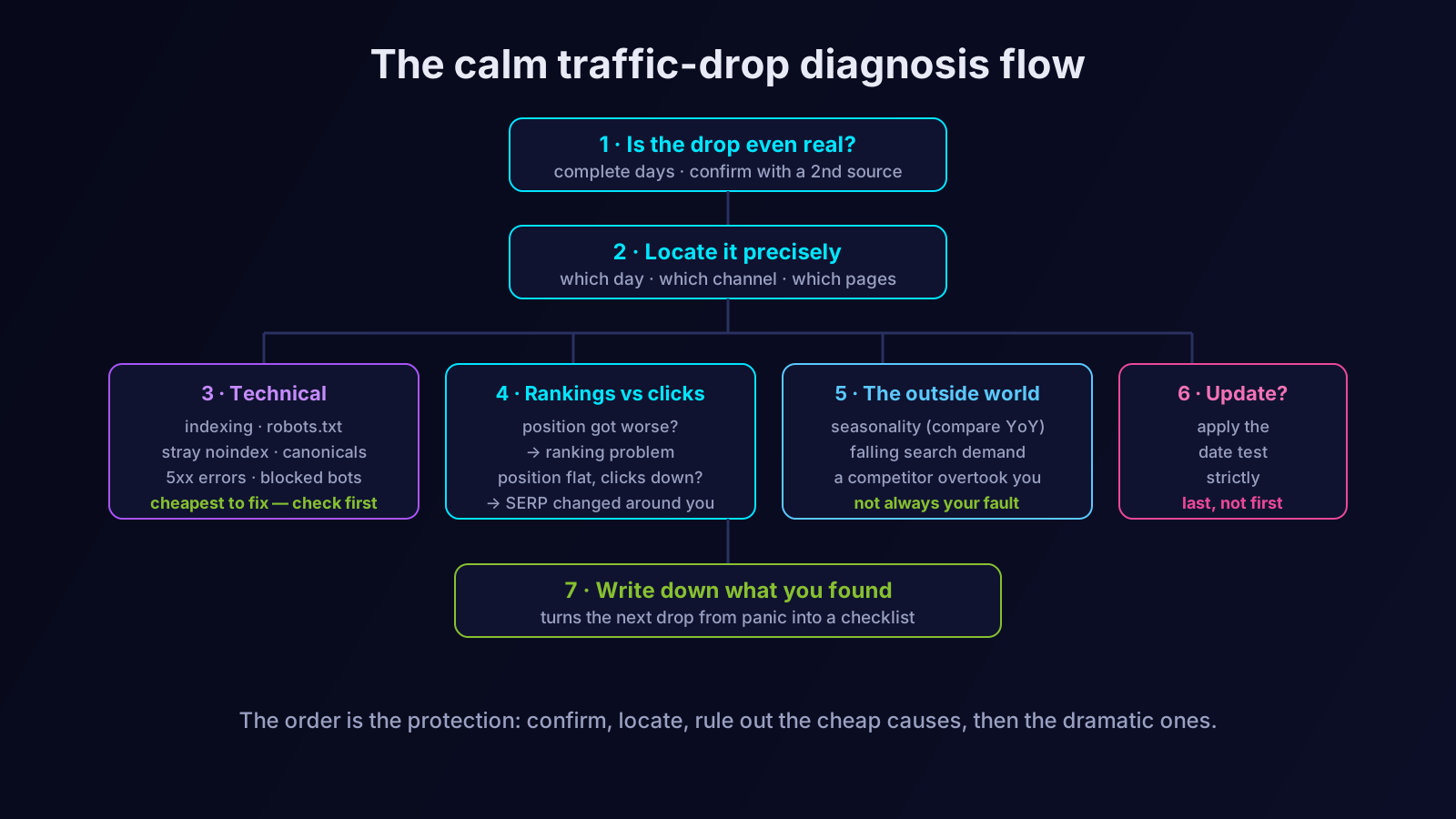
If you take only one thing from this, let it be the order, not the individual steps. The steps matter, but the order is what protects you. Confirm the drop is real before you investigate a cause. Locate it precisely before you guess. Rule out the cheap technical explanations before you reach for the dramatic ones. Separate ranking loss from click loss before choosing a treatment. Look outside your own site before you assume the fault is inside it. Save the algorithm question for last, and hold it to the date test. And then write down what you learned.
A traffic drop feels like an emergency, and the feeling is what causes the damage. The fall itself is just data — sometimes serious, sometimes trivial, sometimes not even real. Panic is what turns a manageable diagnosis into a chaotic week of changes that teach you nothing. Calm is not a personality trait here; it is a process. Follow the steps in order and the panic has nowhere to live.
Where an AI agent helps
The reason traffic-drop diagnosis goes badly is rarely that the steps are hard to understand. It is that, on the morning the line falls, doing them is slow and the pressure to act is immediate. Pulling the data, segmenting it by channel and page and country, lining the drop date up against deployments and update windows, checking indexing and crawl status, comparing this year against last year — that is a lot of careful work, and panic does not wait for it.
This is where an SEO AI agent earns its place. Orova watches your traffic and rankings continuously, so a drop is flagged the moment it forms rather than discovered by accident days later. It runs the calm diagnosis automatically — confirming the drop is real across sources, locating it precisely in time and scope, checking the technical layer, separating ranking loss from click-through loss, and noting whether the timing aligns with a known update — and hands you an ordered picture instead of a blank, frightening chart. The diagnosis still has to be understood by a human, and the treatment still requires judgement. But the slow, panicky scramble at the start, the part where most of the expensive mistakes are made, is exactly the part an agent can carry for you. For more on building this kind of measurement discipline, see our guide on structuring content for SEO, and on what an SEO AI agent actually changes.
Traffic will drop. It is not a question of whether but of when, and how many times. The teams that handle it well are not the ones with the best luck. They are the ones who replaced the panic with a process — and then made sure the process ran before the panic could.
Let an AI Agent handle your SEO
Orova plans, writes, optimizes, and tracks rankings on its own — you just read the results.
Try it free