
Buy vs Build: Should You Build Your Own AI Agent Stack?
Right now, someone on your marketing team just watched a demo of an AI agent drafting reports, checking ad spend, and flagging problems overnight, and they said the line every founder eventually hears: "We could probably just build this ourselves." It sounds reasonable. Your team already uses AI tools daily, the technology seems simple enough from the outside, and hiring outside help feels expensive. So the buy vs build question lands on your desk, usually framed as a quick yes-or-no decision to make in one meeting.
The problem is that this decision rarely gets the honest math it deserves. Teams compare "buy this tool" against "have someone smart build it in a few weeks," without counting what happens after launch — the ongoing fixes, the babysitting when something breaks, the slow bleed of engineering hours that were supposed to go toward your actual product. That comparison isn't wrong on purpose; it's just incomplete, because nobody in the room has watched an internal build limp along for months before quietly getting shelved.
This article walks through that decision properly, without the sales pitch on either side. You'll see what a "simple" agent build actually requires once it's running in production, a way to run the real numbers before you commit budget or headcount, and the specific situations where building genuinely makes sense versus where it quietly drains your team. By the end, you'll have a short list of questions to bring into your own meeting — and, if you decide to buy, a way to shop for a platform without getting oversold.
Why the build option suddenly looks so reachable
First, credit where due: the build case is stronger than it was two years ago, and pretending otherwise insults your audience's intelligence. Frontier language models are accessible through well-documented APIs. Open-source agent frameworks hand you orchestration scaffolding for free. Every major ad and analytics platform exposes an official API. A capable engineer really can wire a model to your Search Console and ad accounts and produce something demo-shaped in a week or two: ask it about performance, get articulate answers, even let it draft a campaign change. The room watches the demo and concludes the project is two months from done.
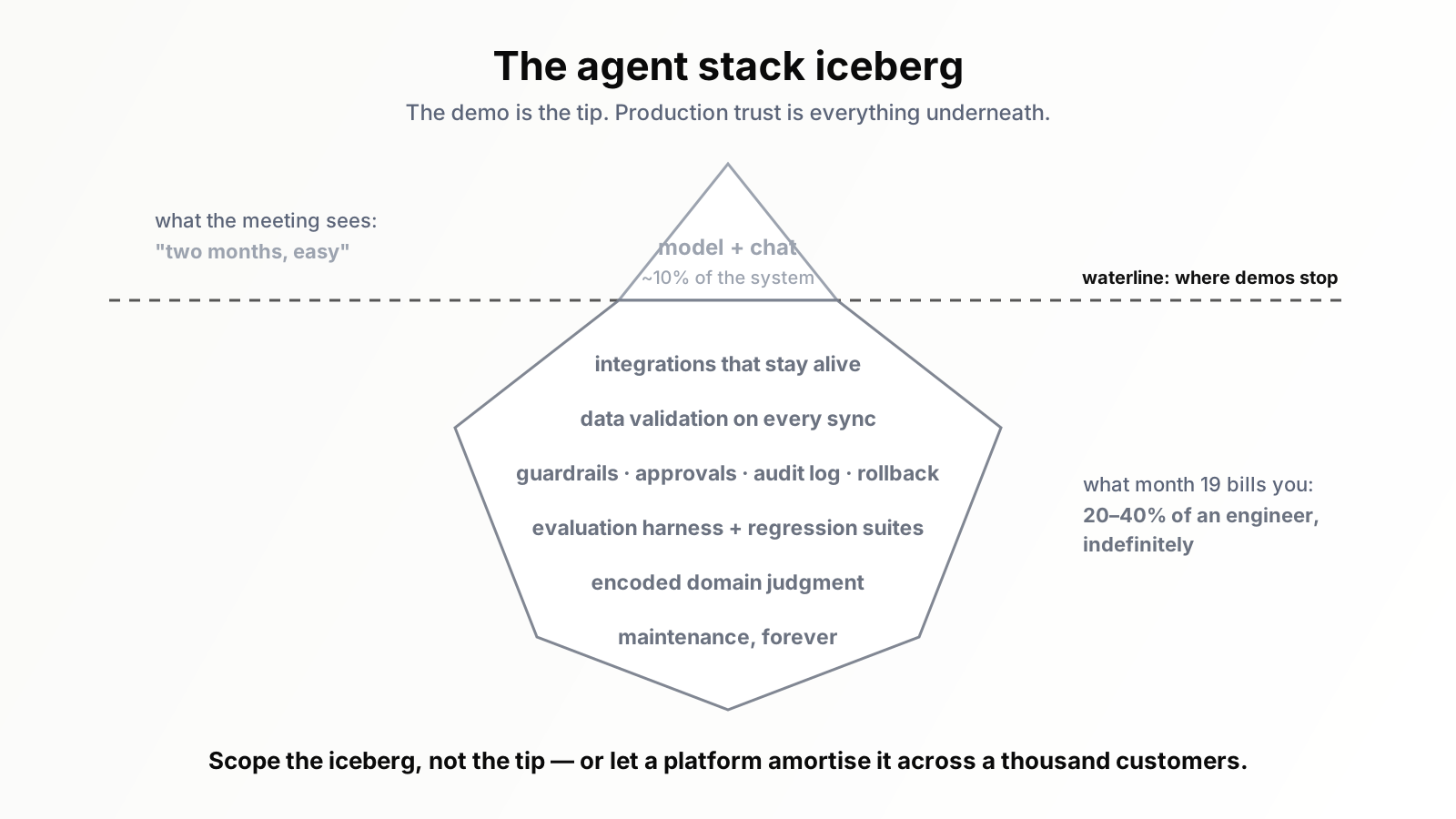
That conclusion is where the trouble starts, because an agent that demos well and an agent your team trusts with production budgets are separated by precisely the layers that never appear in demos. The mistake is not technical optimism — the optimism about the models is justified. The mistake is scoping: believing the agent is the model, when in production the model is maybe a tenth of the system. The other nine-tenths is the part this article is really about.
The iceberg: what production agents are actually made of
Walk through what sits below the waterline of any agent that operates on real marketing accounts, day after day, without supervision-by-engineer.
Integrations that stay alive. Connecting one API once is a sprint task. Keeping connections healthy across Search Console, analytics, your CMS, and two or three ad platforms is a permanent job: tokens expire, scopes change, platforms version and deprecate their APIs on their own schedules, rate limits shift, and every one of those events is silent until your agent is reasoning over stale or partial data. Mature platforms run validation on every sync — checking that the data arrived complete and plausible before anything downstream consumes it. Builders discover this layer the hard way: not when the integration breaks, but weeks later, when someone notices the agent has been confidently optimising against a feed that died in March.
Guardrails and permissions. The moment an agent can act — change a budget, edit a page — you need the machinery of restraint: action tiers, approval queues, spend caps, protected scopes ("never touch these pages, never bid on these terms"), full audit logs, and one-click rollback. None of this is exotic computer science. All of it is unglamorous engineering that takes months to get right, and it is the difference between a system your CFO tolerates and one she shuts down after the first surprise. We have argued elsewhere that the approval loop is the load-bearing wall of the whole category — see our analysis of closing the loop between dashboards and decisions — and it is exactly the wall demos skip.
Evaluation, or knowing whether it works. Here is the layer almost every internal build forgets until it is embarrassing: how do you know the agent's judgments are any good? Production platforms maintain evaluation harnesses — libraries of scenarios with known-good answers, regression suites that run when models or prompts change, verification loops that compare each action's predicted effect with what actually happened. Without this, every model update is a gamble and "the agent seems fine" is your quality assurance. With it, quality is a number you track. Building the harness is comfortably as much work as building the agent.
Domain knowledge, encoded. A general model knows what SEO is. It does not know your hard-won operational rules: which fixes are safe to batch, how long to wait before judging a content change, when a spend anomaly is a platform learning phase rather than a problem, what a sensible cadence of campaign edits looks like so you do not thrash the auction. Purpose-built platforms ship years of this encoded judgment — what an agent's day should actually consist of, hour by hour, as we detailed in what an AI marketing agent does all day. Builders must encode it themselves, mistake by mistake, on their own accounts.
The arithmetic nobody runs in the meeting
Now the money, because "we could build it" is secretly a budget sentence wearing an engineering costume.
Price the build honestly. A minimal credible team is one to two engineers carrying the project as their primary work — integrations, guardrails, evaluation, the lot — for one to two quarters to reach a trustworthy production loop, not a demo. At fully loaded engineering cost, you are into six figures before the agent has approved its first real action. Then comes the number everyone forgets: maintenance is not a tail, it is a tithe. Platform APIs change continuously; models improve and regress; your own marketing stack evolves. Teams that build commit, in practice, twenty to forty per cent of an engineer indefinitely just to keep the system at parity. The build is never finished. It is adopted, like a pet that eats roadmap.
Against that, a purpose-built platform charges a subscription that typically amounts to a low single-digit percentage of the build's first-year cost, delivers the below-the-waterline layers on day one, and absorbs the maintenance tithe across its entire customer base — which is the boring economic reason buying usually wins: maintenance amortised over a thousand customers will always undercut maintenance amortised over one.
And do not leave out the subtlest line item: opportunity cost measured in latency. Every week of building is a week of running the open loop — signals decaying unanswered in your data while the stack that would catch them sits at sixty per cent complete. If the agent's value proposition is collapsing decision latency from weeks to hours, spending two quarters to acquire that capability is a self-refuting plan when the alternative ships it this week.
How internal builds actually die: a composite autopsy
Because abstractions about maintenance never land the way a story does, here is the composite life of the in-house marketing agent — assembled from a pattern we have watched repeat, with the details generic because the pattern is the point.
Month one is glorious. The engineer ships the demo; the agent answers questions about last week's traffic in fluent paragraphs; someone screenshots it for the all-hands. Month two delivers the first real action — a batch of title rewrites pushed through the CMS API — and the team is rightly proud. Month three is when the iceberg starts taxing: an ad platform deprecates an endpoint, the token refresh fails silently over a holiday weekend, and the agent spends nine days reasoning over a frozen snapshot before anyone notices the numbers stopped moving. The fix takes a day. The trust takes longer.
Month four, the model provider ships an improved version; the team upgrades, and the agent's drafting tone changes subtly everywhere at once. With no evaluation harness, nobody can say whether it got better or worse — there is just a vague unease and a meeting about it. Month five, the engineer who built it is pulled onto the product roadmap fire of the quarter, and the agent enters hospice: running, unowned, edited by no one. Month seven, a budget proposal misfires on an edge case the guardrails never covered — nothing catastrophic, but enough that the CFO asks who signs off on this system, and the honest answer is a Slack channel. The agent is quietly powered down "for a rework" that never gets scheduled.
Total damage: two quarters of senior engineering, a marketing team that ran the open loop the entire time, and — the cruellest part — an organisation now more sceptical of agents than before it started, having met only its own unfinished one. No single decision in that story was stupid. The project failed because everyone scoped the tip and nobody scoped the iceberg. If you recognise your own roadmap in month one of that story, the cheapest moment to change course is now, before month three teaches it to you with your own accounts.
The honest cases where building wins
A sales pitch you should trust is one that can describe the customers it loses, so here is where build genuinely beats buy — no winking.
Build when agent infrastructure is the product. If you are an agency whose pitch is proprietary optimisation technology, or a marketplace whose unit economics turn on a bidding edge no vendor offers, then the stack is not tooling — it is differentiation, and you should own your differentiation. The test is brutal and clarifying: would a customer pay you more, or a competitor struggle to copy you, specifically because of your in-house agent? If yes, build. If the honest answer is "it would be cool," that is a hobby wearing a strategy's badge.
Build when your constraints make vendors impossible. Some organisations operate under data-residency, procurement or compliance regimes that no available platform satisfies, or run marketing systems so bespoke that integration is the whole project anyway. Fewer teams live here than believe they do — "our setup is unique" is the most common false belief in software — but the residents are real.
Build when you have genuinely idle, genuinely senior engineering capacity and a culture that sustains internal platforms for years. Some companies have this. Most have engineers who are already late on the product roadmap, which is precisely why the marketing-built agent so often dies at month five, orphaned at the first reorg, leaving the team worse off than if it had never started: months gone, loop still open, and a graveyard repo nobody dares touch.
One more honourable mention: build small things freely. A script that pulls a weekly report, a notebook that clusters queries — these are healthy team hygiene, not an agent stack, and nothing in this article argues against them. The line is crossed when the thing can spend money or edit production pages. That is when the iceberg applies.
The hybrid most teams actually end up choosing
In practice, the mature answer for most teams is not a pure pole but a layered one: buy the engine, own the judgment.
Buy the production loop — the integrations, the drafting, the approval queue, the verification machinery — because it is undifferentiated heavy lifting that a platform amortises better than you ever will. Then invest your team's energy where it compounds and cannot be bought: the objectives and constraints you configure, the standing rules you accumulate from rejections, the protected scopes, the review culture, the strategic reading of the verification log. Two companies on the same platform diverge enormously on exactly these inputs. Your competitive edge was never going to be the plumbing; it is what your editors do with it — the judgment work we mapped in the marketer's job in 2027.
This split also future-proofs the decision. Models will keep changing; platforms absorb those transitions invisibly, while internal builds re-litigate them quarterly. Meanwhile the assets you accumulate on top — rules, history, verified cause-and-effect on your accounts — travel with your team's understanding of the business, which no model update deprecates.
The five questions to take into the meeting
Here is the framework, compressed to fit on the whiteboard before the technical person finishes saying "how hard can it be."
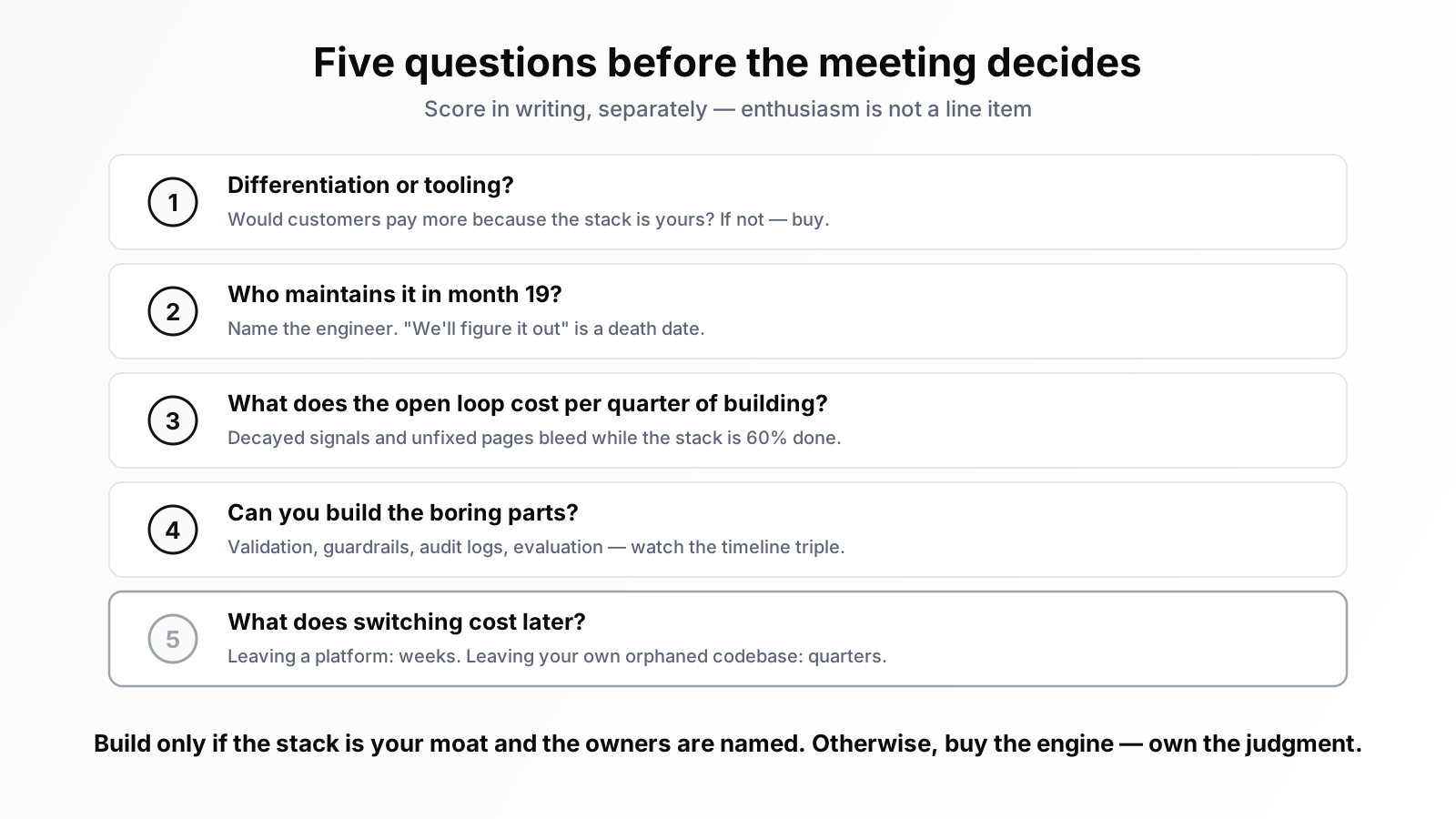
One: is this differentiation or tooling? Would customers pay more because the stack is yours? If not, it is tooling, and tooling is for buying. Two: who maintains it in month nineteen? Name the engineer. If the name is "we'll figure it out," the project already has a death date. Three: what does the open loop cost you per quarter of building? Estimate the decayed signals, the unfixed pages, the drifting campaigns — then ask whether the build's advantages outrun two quarters of that bleeding. Four: can you build the boring parts? Not the chat — the validation, guardrails, audit logs and evaluation harness. Demand the build plan covers them explicitly; watch how the timeline triples. Five: what would make you switch later? If you buy and outgrow it, you migrate configuration — weeks. If you build and it fails, you migrate off your own orphaned codebase — quarters. Asymmetric downside belongs in the decision.
A practical note on running this conversation: score each question in writing, separately, before the meeting discusses any of them — because the build option carries an emotional gravity in the room that the buy option never will. Building is interesting; maintaining is invisible; and the engineer who says "how hard can it be" is volunteering for the fun month, not the nineteenth one. Written scores keep the decision attached to the economics instead of the enthusiasm.
Score those five honestly and the answer usually writes itself. Teams whose stack is their moat, with named long-term owners, build — and should. Everyone else discovers that the question was never really "can we build an agent?" It was "is building agent infrastructure the best use of the next two quarters of our scarcest people?" — and once it is phrased that way, the meeting gets much shorter.
If you buy: how to be a demanding customer
Choosing to buy does not mean choosing to be passive, and the teams that extract the most from agent platforms shop like engineers even when they are not.
Run a real trial, not a demo tour. Connect an actual property and an actual ad account — a modest one, if nerves require — and let the platform run its loop for two or three weeks. You are not evaluating the chat experience; you are evaluating the queue. Are the proposals specific, reasoned, and right for your account, or generic best practice with your logo on it? Reject a few with reasons and watch whether the proposals adapt. A platform that learns from your rejections is a colleague; one that repeats them is a brochure.
Interrogate the boring layers with the iceberg list. What happens when a token expires — who is told, and how fast? Where is the audit log, and can you export it? What is the rollback story, action type by action type? Which permission tiers exist, and can you redraw them, or are they fixed by the vendor's idea of prudence? How does the platform behave during a model upgrade — is there a regression suite standing between a new model and your accounts? Vendors who answer these crisply have been burned in the right ways. Vendors who pivot to the roadmap slide have not been burned yet, and you do not want to be present when they are.
Finally, negotiate for exit before entry. Ask what leaves with you if you cancel: configuration, standing rules, logs, verification history. The good answer is "all of it, exported." This question costs you nothing and tells you whether the platform's confidence comes from lock-in or from being worth keeping — and asking it signals that you are the kind of customer who reads the log, which, not coincidentally, is the kind of customer agents serve best.
The destination matters more than the route
Step back from the buy-build skirmish and keep the prize in view: a marketing operation where the data is read every day, the routine fixes draft themselves, every consequential change carries a human signature, and a verification log slowly turns your marketing folklore into evidence. That operating model — the full picture of what an SEO AI agent changes about content marketing and what an ads agent does for paid accounts — is coming to your category either way. The only question the meeting actually decides is whether you reach it this month or next year, and what you burn on the way.
If the framework lands you on "buy" — as it will for most teams reading this — then evaluate vendors with the iceberg checklist from this article: show me the data validation, the approval tiers, the audit log, the rollback, the verification of past actions. Orova will happily sit that exam; its SEO and Ads agents for Google, Meta and TikTok were built review-first precisely for teams that want the closed loop without hiring a platform crew to maintain it. And if the framework lands you on "build" — genuinely, with the moat and the named engineers — then build it properly, budget for the tithe, and we will see you in the market. The loop does not care who closes it. It only punishes the teams that leave it open.
Make the buy vs build call without the guesswork
Whichever way you lean, the real cost of this decision shows up later — in the hours your team spends maintaining integrations, chasing down why an agent stopped working, or manually checking its work because nobody fully trusts it yet. That's the part most teams underestimate, and it's exactly where a "quick build" quietly turns into a permanent job.
If you'd rather skip that maintenance burden entirely, Orova SEO is built to handle this kind of ongoing agent work for marketing teams automatically, so you're not the one keeping it running. It's worth a look if you want the outcome without owning the upkeep — feel free to try it out and see if it fits how your team works.
Let Orova SEO handle the repetitive part
Keyword research, drafting, refreshing old posts and rank tracking — running automatically on your own site.
Explore Orova SEO