
SEO Report and Ads Report: Why They Belong in One Place
Every Monday, the SEO report says one thing and the paid media report says another, and nobody in the room can put them together to answer a basic question: what did it actually cost to get a customer this month? You are looking at rankings and organic sessions in one file, cost per click and campaign names in another, describing the same customers who searched the same words and clicked both a paid ad and an organic result before buying anything. This is exactly the blind spot that shows up when a business brings in seo consulting help but keeps the paid side in a completely separate conversation.
The old way of handling this is manual: someone opens both exports, copies numbers into a spreadsheet, and tries to line them up by hand. It is slow, it has to be redone every single reporting cycle, and it still misses the real overlap — the paid keywords you are already ranking for organically, or the content that quietly helps paid ads convert without ever getting credit. Nobody budgets time for this stitching work, so it either gets skipped or done badly under deadline pressure. The stakes are higher than a messy spreadsheet suggests, too: roughly a quarter of programmatic ad spend is wasted on inefficient buying and invalid impressions (nghiên cứu của ANA Programmatic Transparency Study), which is exactly the kind of waste a blended report would catch before it repeats for another month.
This article shows you how to stop guessing. You will see why organic and paid need to live in one report, which numbers actually change meaning once you blend the two channels, what the manual version of this is really costing your team in hours, and how to set up an automated view you can read in minutes instead of building from scratch every week.
Why organic and paid belong in the same report
The case for combining the two is not aesthetic. It comes down to a basic fact about how people buy: a single purchase decision routinely involves both channels. Someone Googles "best CRM for small teams," clicks an organic blog post, leaves, comes back a week later by clicking a branded paid ad, and converts. In your siloed reports, the organic team claims the assist and the paid team claims the conversion. Both are partly right and both are misleading on their own.
When you look at the channels separately you make three predictable mistakes. First, you double-count or mis-attribute, because each report uses its own attribution window and its own definition of a conversion. Second, you optimize each channel toward its own vanity metric instead of toward shared business outcomes. The SEO team chases rankings, the paid team chases ROAS, and nobody is accountable for the blended number that the business actually pays out of the bank account. Third, you miss the trades you could make between channels: shifting budget away from a head term you already own organically, or pouring content effort into a topic where paid is carrying expensive, uncontested demand.
The funnel is one thing; your reports should be too
Think of a prospect's path as a single funnel with two on-ramps. Organic search tends to do the heavy lifting at the top and middle: informational queries, comparison content, the slow build of trust. Paid tends to capture intent at the bottom and to defend it: branded terms, retargeting, high-commercial-intent keywords where being above the fold matters. The same person frequently uses both on-ramps. If your reporting treats them as two separate roads to two separate destinations, you will never see the merge.
A combined report reframes the question from "how did SEO do?" and "how did Ads do?" to "how did the funnel do, and what role did each channel play in it?" That reframe is the entire point. It changes the conversation from defending a channel to allocating a budget.
The metrics that only make sense when you blend
Some numbers are perfectly readable in a single-channel report. Click-through rate, average position, cost per click, organic impressions: these live happily on their own. The interesting metrics are the ones that are meaningless until you put paid and organic side by side. These are the reasons to do the work.
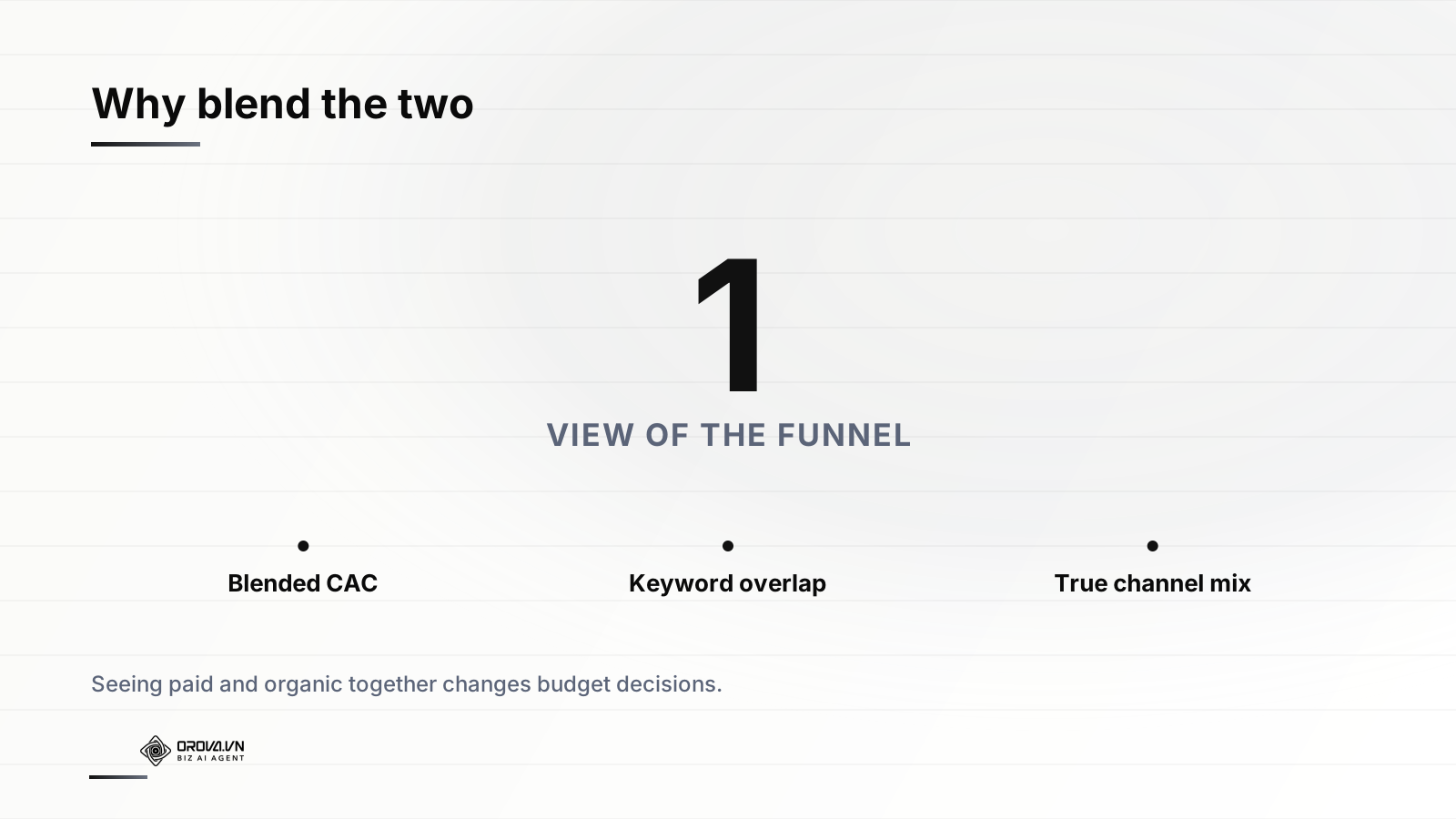
Blended customer acquisition cost
Blended CAC is the headline number and the one your finance team already thinks in. The formula is brutally simple: total spend that drove acquisition divided by customers acquired. The trick is deciding what goes into "total spend." A defensible blended CAC includes paid media spend plus a reasonable share of the cost of producing and maintaining organic content. Organic is not free; it has a real cost in writer time, tooling, and link building. Pretending it is free makes organic look infinitely efficient and paid look wasteful, which distorts every budget conversation.
Here is why blended CAC changes decisions. Suppose paid CAC reads $90 and you are tempted to cut the budget. But a chunk of those paid conversions were assisted by organic content that brought the visitor in earlier, and a chunk of your "free" organic conversions were nudged over the line by a retargeting ad. The honest blended number might be $62. Cutting paid would not save you $90 per avoided customer; it would lose you customers that organic was never going to close alone. You can only see that when both channels sit in the same model.
The single most expensive reporting error is treating organic conversions as free and paid conversions as fully paid. The truth is almost always somewhere in between, and only a blended view reveals where.
Keyword overlap between organic and paid
This is where combined reporting pays for itself fastest. Pull the list of queries you rank for in the top three organic positions, then pull the list of keywords you are actively bidding on. Overlay them. The intersection is your opportunity zone, and it cuts both ways.
- Terms you own organically and still pay for. If you sit at organic position one for "invoice software" and also buy that exact term, you may be paying for clicks you would capture for free. The honest answer is "test it" rather than "cut it" — branded and category defense sometimes justifies the spend, especially when competitors bid on your turf. But you cannot run that test if you never see the overlap.
- Terms you pay for and rank nowhere organically. These are the keywords where paid is carrying 100 percent of the demand. Each one is a content brief waiting to be written. If a term costs you $4 a click and you buy 2,000 clicks a month, ranking organically for even part of that volume is worth a serious content investment.
- Terms where you rank on page two and bid heavily. The high-leverage middle. A modest push to move from position 12 to position 4 can shave thousands off paid spend on the same intent.
None of this analysis exists in either silo. It only appears when the two keyword lists meet. Automating that overlap — refreshing it weekly rather than once a quarter when someone has a spare afternoon — turns it from a one-off audit into a standing optimization habit.
True channel mix and assisted conversions
The last blended metric is the honest channel mix: not "organic drove 60 percent of conversions and paid drove 40 percent," but a multi-touch picture of how the two cooperate. Most conversions involve more than one touch, and a large share involve both channels. A combined report can show you, for example, that 30 percent of your paid conversions had an organic touch earlier in the journey, and that 18 percent of your organic conversions had a paid retargeting touch near the end.
Those numbers reshape strategy. If organic is feeding paid, then cutting content production will quietly raise your paid CAC three months later, long after anyone connects cause to effect. If paid retargeting is closing organic traffic, then your "free" organic channel is partly subsidized by ad spend. The point is not to assign credit perfectly — perfect attribution is a fantasy — but to stop pretending the channels are independent when they demonstrably are not.
What manual stitching actually costs you
Ask any analyst who has built a combined report by hand and they will describe the same grim ritual. Export the Search Console data. Export the Google Ads report. Export the Meta and TikTok reports. Reconcile three different date ranges and three different definitions of a "conversion." Paste it all into a spreadsheet. Build the pivot tables. Discover that someone renamed a campaign and broke the lookup. Rebuild the lookup. Write the commentary. Format it for the deck. Do it all again next month.
Conservatively, a thorough combined report assembled manually costs a competent analyst the better part of a working day, every reporting cycle. For a team reporting weekly, that is roughly four days a month — a fifth of one person's time — spent moving numbers between cells rather than acting on them. And the manual version is fragile. Every export is a chance to grab the wrong date range. Every paste is a chance to misalign a column. The report that takes the longest to build is also the one people trust the least, because everyone has seen it break.
The hidden tax beyond the hours
The lost hours are the obvious cost. The subtler tax is latency. A report that takes a day to build gets built infrequently, which means insights arrive late. By the time the monthly deck reveals that a paid keyword has been climbing in cost for three weeks while you quietly started ranking for it organically, you have burned three weeks of avoidable spend. Reporting that is expensive to produce is reporting you produce rarely, and rare reporting means slow decisions.
There is also a trust tax. When the combined view is a hand-built artifact, its conclusions are only as credible as the analyst's spreadsheet hygiene that day. Stakeholders learn to discount the numbers, hedge their decisions, and ask for "one more cut" — which costs another day. Automation does not just save time; it makes the numbers boring and reliable enough that people act on them without re-litigating the methodology every meeting.
Building the automated pipeline
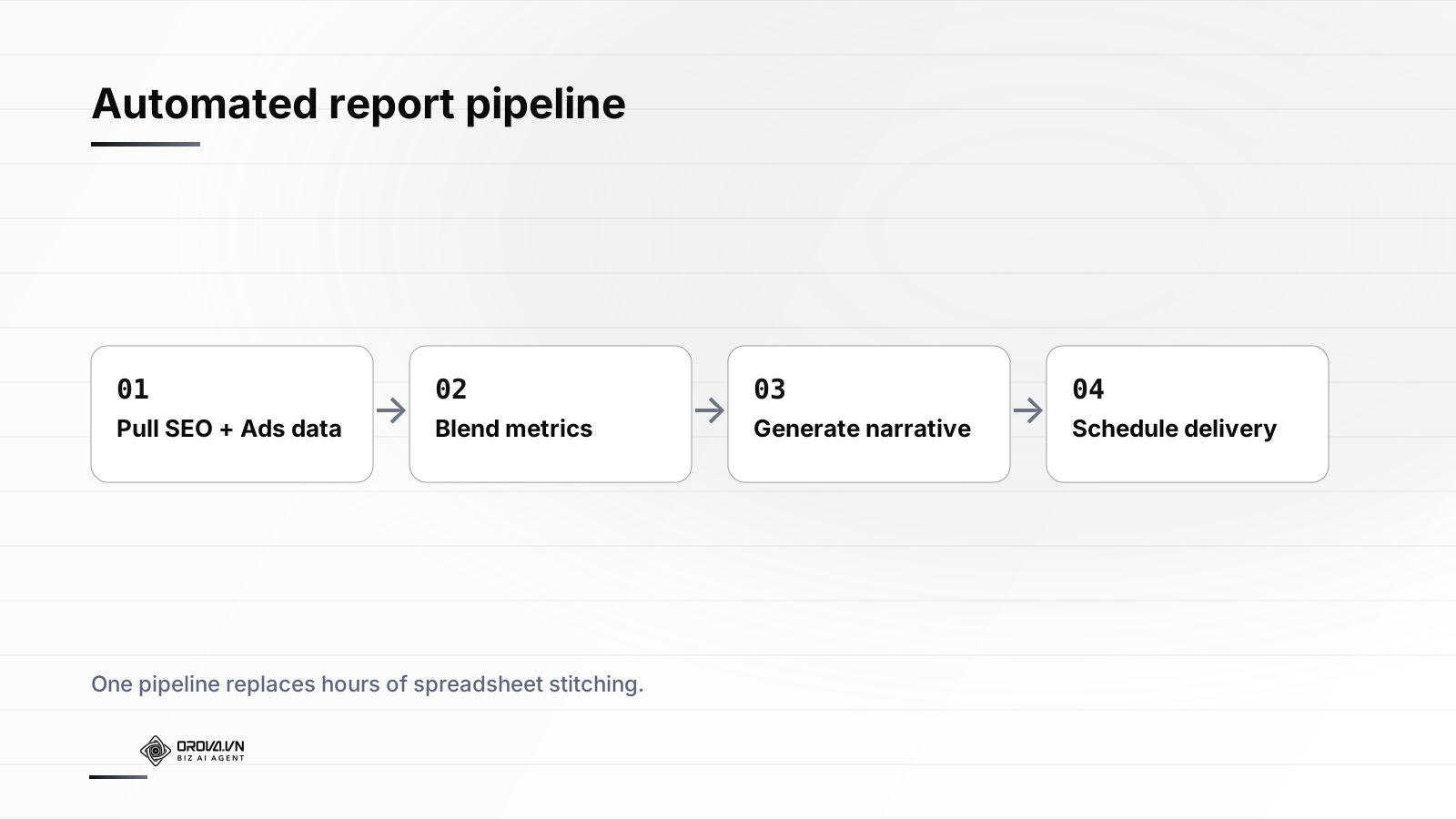
An automated combined report is a small data pipeline with four stages. You can build it with a scheduled script and a BI tool, or use a platform that ships it out of the box. The shape is the same either way, and understanding the shape helps you evaluate any tool you consider.
Stage one: pull the data on a schedule
The pipeline connects to each source through its API rather than through manual exports: Search Console and your analytics platform for organic, and the ad platforms — Google, Meta, TikTok — for paid. Pulling through APIs is what makes the rest of the chain possible, because it removes the human from the most error-prone step. The data arrives on a schedule, in a consistent shape, with the same date logic applied to every source. The first time you watch a report refresh itself at 6 a.m. without anyone touching it, you understand what you were really paying for with all those manual exports.
Stage two: blend the metrics into one model
Raw data from five sources does not combine itself. Blending means reconciling the definitions: aligning attribution windows, mapping each platform's conversion events to your canonical list, normalizing currencies and time zones, and joining organic queries to paid keywords so the overlap analysis becomes possible. This is the stage that ate most of the analyst's day, and it is the stage that benefits most from being codified once and run forever. Define the blending rules deliberately — write down what counts as a conversion, what share of content cost you allocate to organic CAC — and the model produces the same trustworthy numbers every cycle.
Stage three: generate the narrative
A table of blended numbers still needs a human-readable story: what changed, why it probably changed, and what to do about it. This used to be the analyst's commentary, written from scratch each time. Modern tooling can draft that narrative automatically — "blended CAC fell 8 percent because organic captured three terms previously carried by paid, freeing budget that was reallocated to retargeting" — and leave a human to review and sharpen it. The narrative is what turns a dashboard from a wall of numbers into a decision document. The same logic that powers condition-action rules for automating ad operations applies here: encode the patterns you would look for by hand, and let the system surface them so you spend your time deciding rather than detecting.
Stage four: schedule delivery
The final stage puts the finished report in front of the people who need it, on a cadence they can rely on, without anyone remembering to send it. Weekly to the marketing team, monthly to leadership, in the inbox or the shared workspace where decisions actually happen. Scheduled delivery is the quiet feature that changes behavior most, because it converts reporting from a task someone has to remember into a rhythm the team simply has. When the blended view shows up reliably every Monday, the question "should we shift budget?" gets asked weekly instead of quarterly.
Reading a combined report without fooling yourself
A blended report is powerful, which also means it is easy to misread. A few disciplines keep it honest.
Decide your attribution stance and stick to it
There is no single correct attribution model, only models that are useful for different questions. Last-click flatters bottom-funnel paid; first-click flatters top-funnel organic; data-driven and position-based models split the difference. The mistake is switching models to suit whichever story you want to tell this month. Pick a primary model, document it in the report, and keep a second model visible as a sanity check. The goal is a consistent yardstick, not a perfect one.
Watch for cannibalization, but test before you cut
The overlap analysis will tempt you to immediately stop bidding on terms you rank for organically. Resist the reflex to cut blindly. Run a controlled pause — turn off the paid term in one region or for a couple of weeks — and measure whether total conversions for that intent hold steady or drop. Sometimes organic fully absorbs the demand and you save real money. Sometimes the paid result was doing work the organic result was not, especially on crowded results pages where competitors occupy the top. The combined report tells you where to test; it does not excuse you from testing.
Allocate organic cost honestly
If your blended CAC treats organic as free, every conclusion that follows is skewed toward over-investing in content and under-crediting paid. Put a real, if approximate, cost on organic: content production, SEO tooling, the loaded time of the people doing the work. It does not have to be precise to the dollar. A rough but consistent allocation beats a precise zero every time.
Look at trends, not single snapshots
One month of blended CAC is a data point; six months is a signal. Channel cooperation plays out over weeks — content published today assists paid conversions next quarter. Judge the blended view on its trajectory, and be suspicious of any single-month swing large enough to trigger a panicked budget change. The value of automated, scheduled reporting is precisely that it accumulates a clean trend line instead of a folder of inconsistent one-offs.
Seasonality compounds this. Many businesses see organic demand peak in different months than paid demand, and a blended report read without seasonal context will misattribute a normal cycle to a strategy change you made. Annotate your trend line with the things you actually did — a campaign launch, a content push, a budget cut — so that when a number moves, you can tell the difference between cause and calendar. A report that remembers what you changed is worth far more than one that only shows what happened.
A practical rollout, in order
You do not need to build the whole pipeline before you get value. Sequence it so each step earns the next.
- Agree on definitions first. Before any tooling, get the SEO and paid teams to agree on what counts as a conversion, which attribution model is primary, and how you will cost organic. Disagreement here will poison every report; settle it once.
- Connect the data sources. Wire up Search Console, analytics, and your ad platforms through their APIs so data flows automatically. This kills the export-and-paste step that causes most errors.
- Build the keyword overlap view. It is the fastest source of concrete savings and the easiest to act on. Ship it before the fancier blended models; it will fund the rest of the project in saved spend.
- Add blended CAC and channel mix. Once definitions and data are stable, layer in the metrics that require the full blend. These are the numbers leadership cares about.
- Automate the narrative and the schedule. Last, turn the whole thing into a recurring, self-delivering report so the insights arrive without anyone assembling them. This is what converts a project into a habit.
What good looks like after a quarter
Run this for three months and the change is tangible. The Monday report assembles itself. The keyword overlap view has already redirected spend away from a handful of terms you owned organically and toward content briefs for terms paid was carrying alone. Blended CAC is a number everyone in the room recognizes and trusts, because it is the same number every cycle, built the same way. Budget conversations stop being turf wars between SEO and paid and start being allocation decisions across one funnel. And the analyst who used to lose a day a week to spreadsheets is doing analysis instead of assembly.
That is the real return on combined reporting. Not a prettier dashboard, but faster, better-informed decisions made by a team that finally sees the whole funnel at once instead of two halves that pretend the other does not exist.
If you want the blended view without building the pipeline yourself, this is exactly the kind of work Orova Ads is built to take off your plate. It is an AI agent that manages paid campaigns across Google, Meta, and TikTok — reading your data every day, surfacing the overlap and optimization opportunities, and executing the changes to budgets, bids, audiences, and on/off states with your approval and a full audit trail. Connect your accounts, set your guardrails, and let the agent keep the whole funnel in view so you can spend your time deciding rather than stitching spreadsheets together.
Stop stitching reports by hand every week
Pulling SEO and Ads data into one view by hand is not a five-minute job. It means exporting from two or three platforms, matching campaign names to keywords, cleaning up mismatched date ranges, and rebuilding the same spreadsheet the following week because nothing here updates on its own. That is hours of skilled time spent on formatting instead of decisions.
Orova Insight is built to take that part off your plate, pulling organic and paid data together automatically so you get one combined view without the manual copy-and-paste routine. If your team is still stitching reports together every Monday, it might be worth seeing what that same report looks like when it builds itself.
Related reading: Local SEO for SaaS and Service Businesses: A 2026 Guide
Build your reporting with Orova Insight
Pull data from every platform into one dashboard. Ask in plain language and let the AI draw the chart.
Explore Orova Insight