
Content Strategy Framework: 5 Pillars to Build Yours
You are publishing content constantly, but nothing seems to add up to anything. Blog posts go out, social updates go out, and yet leads still trickle in the same way they always have. If you stopped and asked "what is all this content actually building toward," you probably would not have a clean answer.
That is because most teams work off a content calendar, not a real content strategy framework (a structured plan that ties every piece of content to a business goal). A calendar just tells you what to publish and when. It does not tell you why a piece exists, who it is for, or what it is supposed to move someone toward doing next. Without that backbone, you end up producing plenty of content that keeps everyone busy but does not compound into results. This gap matters even more now that SparkToro found 68% of US Google searches in the first four months of 2026 ended without a click at all, meaning content built without a clear strategic purpose has less room than ever to earn attention.
This post walks you through the five pillars that make up a working content strategy framework, and how to actually build one for your business. By the end, you will know how to line up your content with the way customers actually move from first hearing about you to buying, and how to decide what to write first instead of guessing.
Rowing hard — with no compass
Picture two people rowing out to sea. The first rows diligently, every day, but has no idea where they're going — any direction will do. The second rows less, but has a compass and a clear destination. After a month, who reaches port? The second, of course. The first, however strong and diligent, may have rowed in circles or drifted farther away — because effort without direction is just motion, not progress.
Doing content with no strategy is the first rower: publishing steadily, spending effort and money, but getting nowhere — because you don't know who you're writing for, what you're trying to achieve, or how you'll measure it. Many teams mistake "having a publishing calendar" for "having a strategy". They're not the same. A calendar tells you WHEN you publish; a strategy tells you WHAT you publish, for WHOM, and WHY. The calendar is the oar; the strategy is the compass.
This guide builds that compass: what a content strategy is (and how it differs from a calendar), the five pillars, how to map content to the customer journey, the priority matrix to choose what to write first, and the process to build a strategy from zero.
What is a content strategy? A plan answering four core questions before you write any article: (1) which business goal this content serves, (2) who you're writing for, (3) which topics it revolves around, (4) how you'll measure success. It's entirely different from a "content calendar" — which just slots articles into days.
Compass vs oar: strategy versus calendar
Confusing the two is the most common mistake. Let's separate them:
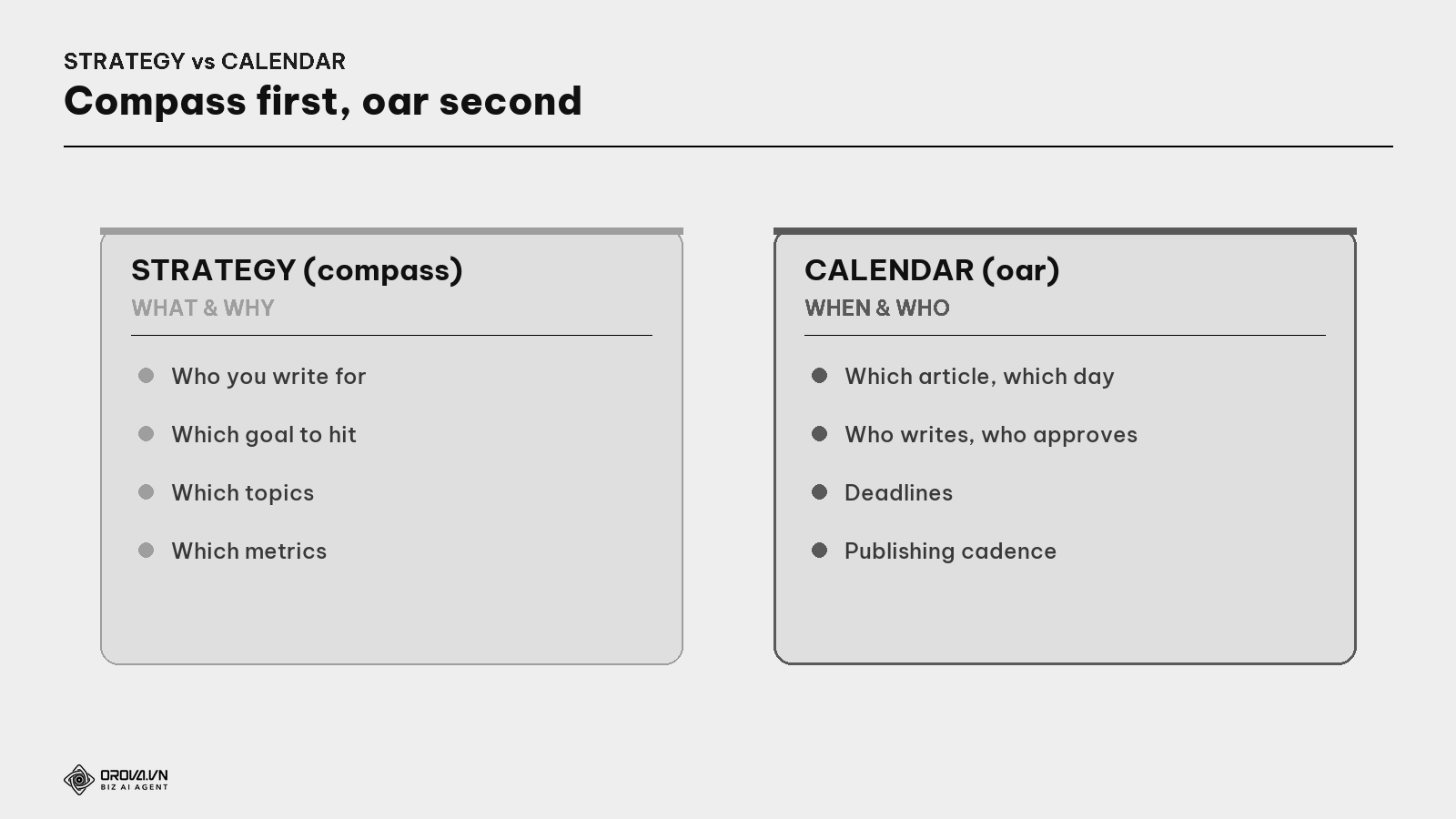
What is a content calendar? A schedule of which article on which day, who writes, deadlines. It answers "when & who" — the execution part. Necessary, but meaningless without a strategy in front of it saying "what to publish & why".
You need both, but in order: strategy first, calendar second. Get the compass before you start rowing. Building a calendar with no strategy is rowing hard in a random direction.
The five pillars of a content strategy
A lean but complete strategy stands on five pillars. Miss any one and the content drifts.
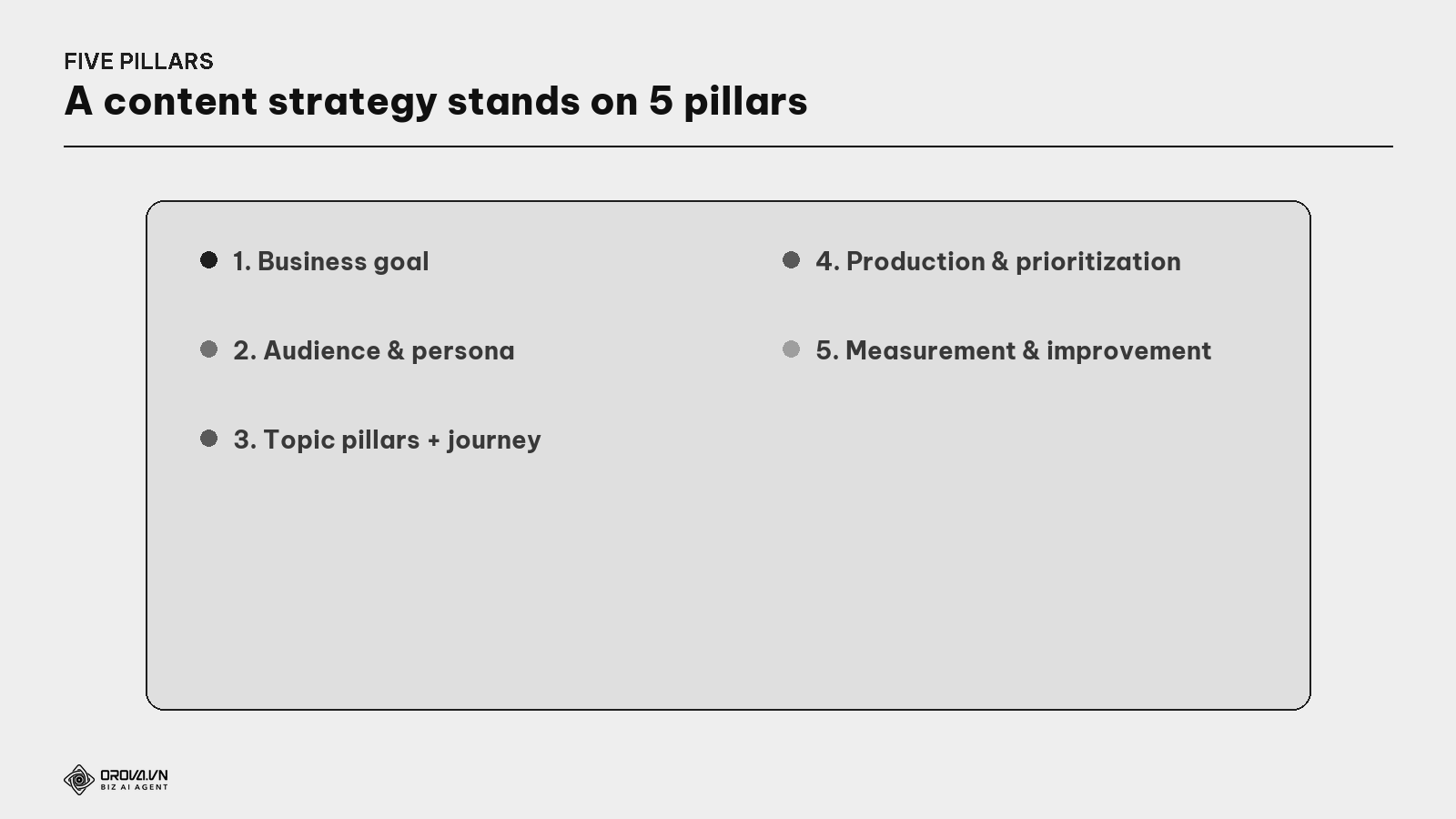
Pillar 1 — Business goal. What does content serve: leads, sales, brand, or retention? Every article must connect to a goal — otherwise it's just words.
Pillar 2 — Audience & persona.
What is a persona? A sketch of your "ideal customer" — who they are, what problem they have, what words they search with. Writing for one specific person in your head always lands better than writing for "everyone".
Pillar 3 — Topic pillars mapped to the journey. Pick a few big topic clusters (topic pillars — see the Topic Cluster guide) you want to be known for, and cover every stage your customer passes through.
Pillar 4 — Production & prioritization. Resources are finite, so you must choose what to write first (see the matrix below) and have a steady production process (brief → write → edit → publish — see the Content Brief guide).
Pillar 5 — Measurement & improvement. Lock in how you'll measure (traffic, rankings, leads, revenue — see the Measuring SEO guide) so you know what works to scale and what doesn't to cut.
Map content to the customer journey
Customers don't buy the first time they hear your name. They pass through stages — and each stage needs a different type of content.
What is the customer journey? The path a person takes from "knows nothing" to "becomes a customer": Awareness (just noticed a problem) → Consideration (comparing solutions) → Decision (choosing to buy). At each stage they search differently, so the content must differ (see the Search Intent guide).
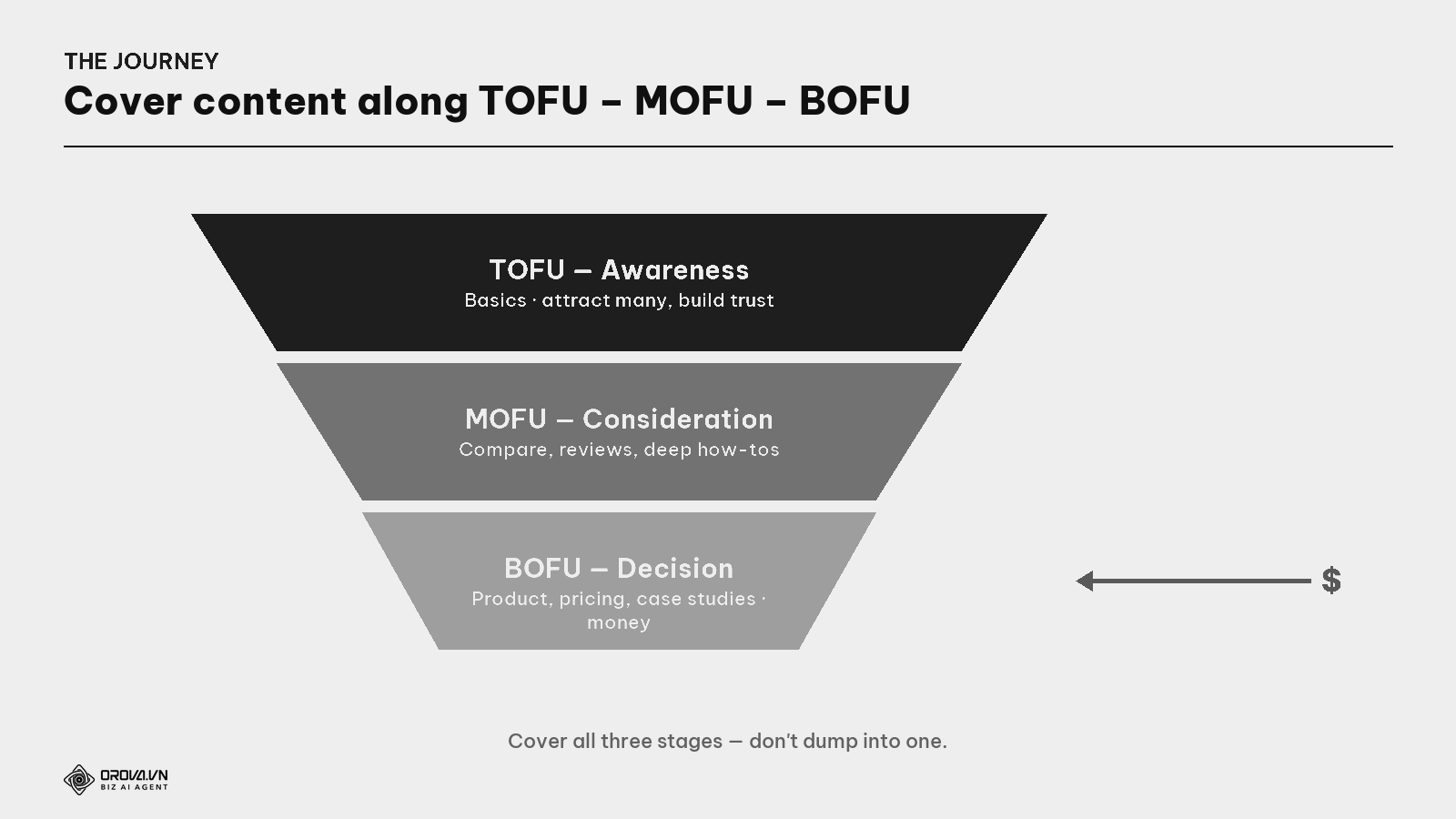
A good strategy covers all three stages, not just one:
- Awareness (TOFU) — explainers, "what is", basic guides. Attract many, build trust.
- Consideration (MOFU) — comparisons, reviews, deep how-tos. Help the undecided.
- Decision (BOFU) — product pages, pricing, case studies. Fewer people but the revenue.
The common mistake: only writing "awareness" articles for traffic while neglecting "decision" content — where deals actually close.
Choose what to write first: the priority matrix
You always have more ideas than resources. The smart way: rank each idea by impact (how much value it brings) and effort (how much it costs to make).
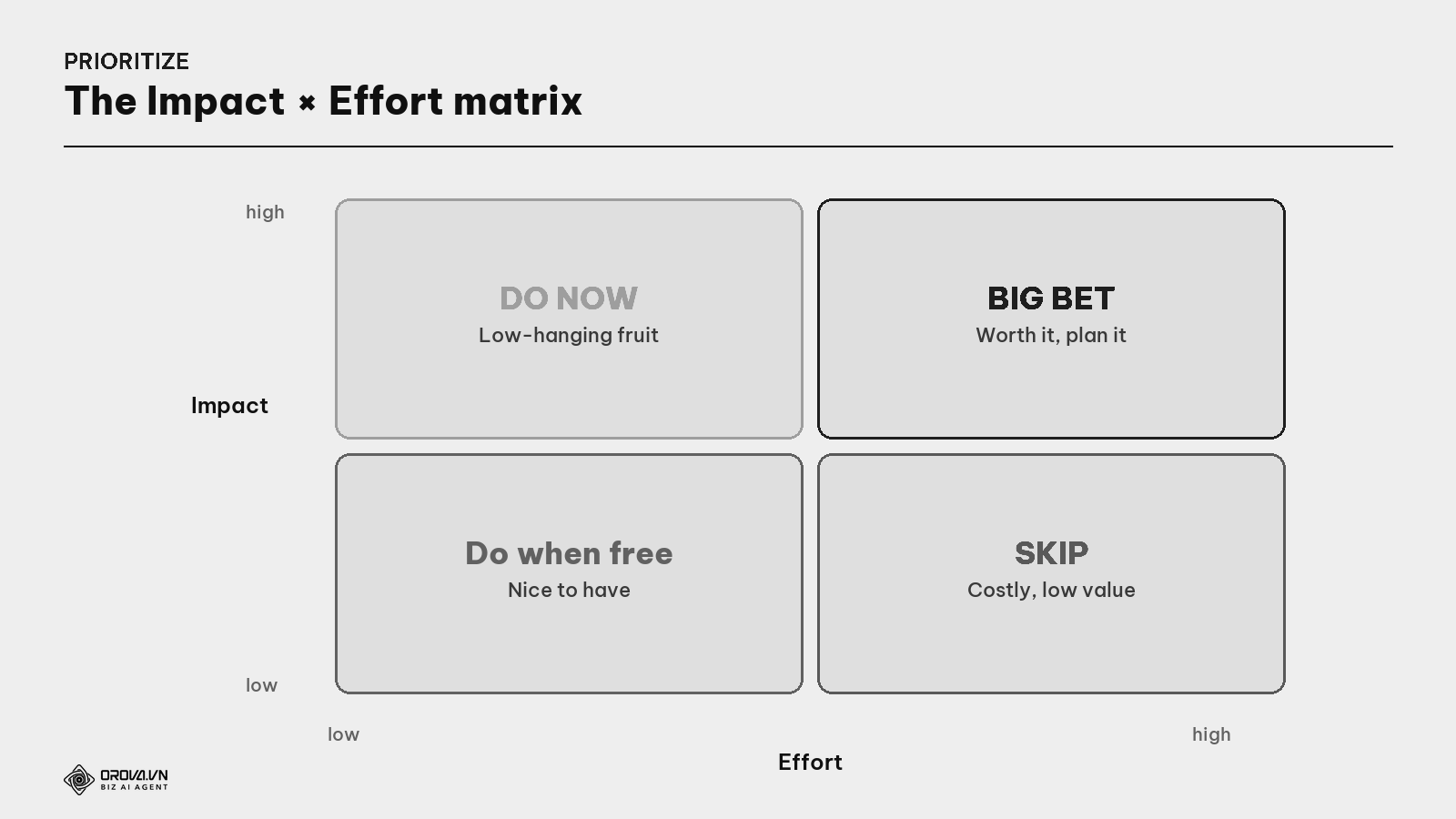
- High impact, low effort → Do now. The "low-hanging fruit" — top priority (e.g., refreshing a near-top article, or an easy-to-win keyword).
- High impact, high effort → Big bet. Worth doing but needs planning (e.g., a major pillar article).
- Low impact, low effort → Do when free. Nice to have.
- Low impact, high effort → Skip. Lots of effort, little value.
The process to build a content strategy
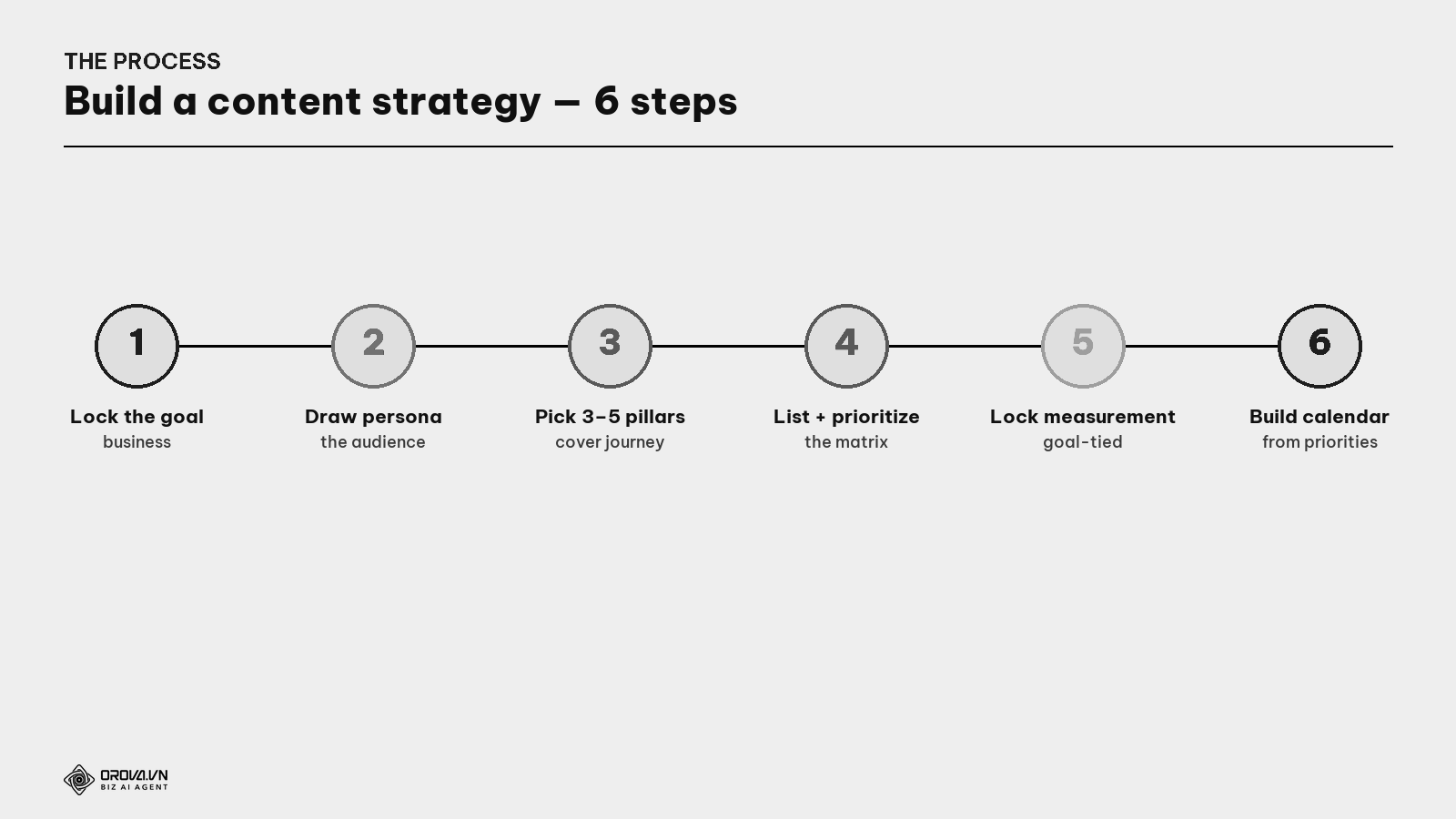
- Lock the business goal content serves (leads? sales? brand?).
- Draw the persona you're targeting.
- Pick 3–5 topic pillars you want to be known for, covering all three journey stages.
- List article ideas per pillar + stage, then place them in the priority matrix.
- Lock the measurement (goal-tied metrics) and a regular review cadence.
- Then build the calendar — drop the prioritized articles onto specific days.
"Pass" standard
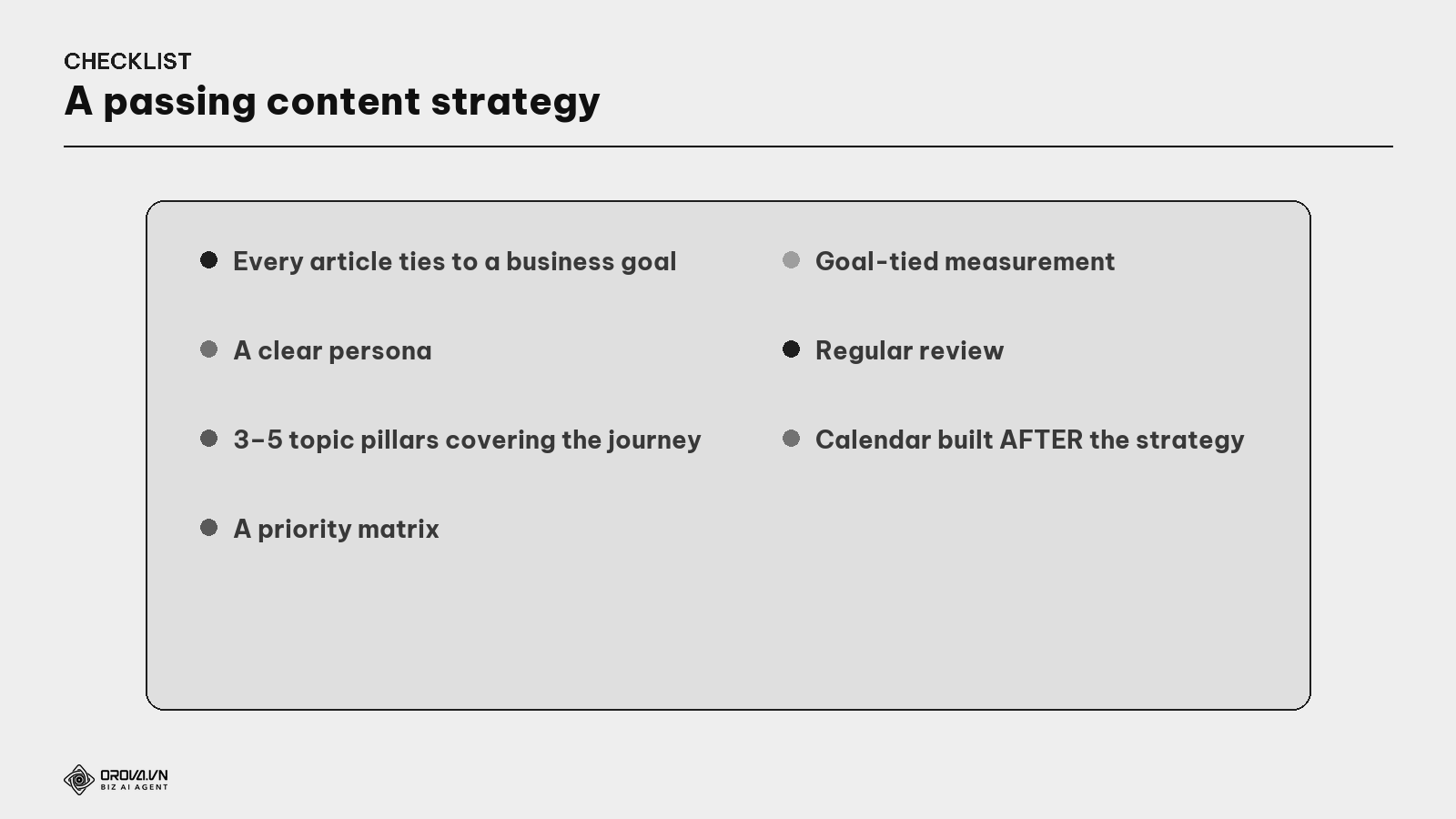
"Pass" standard: for any article in the plan, you can answer who it's for, which goal it serves, which topic pillar & stage it belongs to, how it's measured. If an article can't answer those — it's "aimless rowing", so cut or fix it. You have a clear persona, 3–5 topic pillars covering the journey, a priority matrix, goal-tied measurement, and a calendar built after the strategy. At this level, every article you write has a clear place in a bigger picture leading to the goal.
Benefit: a content strategy turns writing from "publishing for the sake of it" into "purposeful steps toward a destination". It keeps you from wasting resources on aimless articles, covers the whole funnel to both attract and close, and tells you what works to scale. The more limited your resources, the more important the strategy — it ensures every shot hits the target.
FAQ
How do a content strategy and a publishing calendar differ? The strategy is the compass (for whom, what goal, which topics, measured how); the calendar is the oar (which article on which day). You need both, but strategy comes first — a calendar with no strategy is rowing hard in a random direction.
Do small businesses need a strategy, or just write? The smaller you are, the more you need it — fewer resources means no room to waste. A strategy + priority matrix ensures every article aims at the most worthwhile thing, not thin and aimless.
How often should I review the strategy? Quarterly: check metrics (Pillar 5) to see which topic pillars work (scale them) and which don't (cut them). A strategy is a living document, not a framed poster.
How many topic pillars should I have? For most businesses, 3–5 pillars balances focus and coverage. Too many spreads you thin, so no pillar gets deep enough for Google to recognize you as an expert (see the Topic Cluster guide).
How detailed should a persona be? Enough to guide content: who they are, what problem they have, what words they search with, which journey stage. No need to fabricate names/photos for show — you need to truly understand their needs and language.
Are content strategy and SEO different? Content strategy is broader: it decides what to do, for whom, to achieve what. SEO is how that content gets found. A good content strategy uses SEO (keywords, intent, topic clusters) as the backbone for choosing topics and structure.
I've already published many articles with no strategy — how do I add one? Step back and do the five pillars: define the goal, persona, group old articles into 3–5 topic pillars, see which work (Pillar 5) to scale, which are off to refresh/prune (see the Content Refresh guide). You needn't delete and restart — just put a compass on what you have.
Back to the two rowers
Remember the two rowers? The one rowing hard with no compass, and the one rowing less but with a clear direction. The second reached port not because they were stronger — but because they knew where they were going. Effort only becomes progress with a right direction.
A content strategy is that compass for your content. Before asking "what should I post today", ask "where am I rowing — for whom, to achieve what goal, measured by what". Answer that, and every article you write is a stroke in the right direction, bringing you closer to port. Skip it, and you're the diligent rower lost at sea — lots of motion, no arrival. In SEO as at sea: direction matters more than rowing power.
This article is part of Orova's complete SEO guide series. It's a deep-dive within the cluster — see the overview "SEO in 2026", "Topic Clusters", "Search Intent", "Content Brief", and "Measuring SEO" for the full picture. Get started with Orova at orova.vn/en/seo.
Sources
Content Marketing Institute (content strategy frameworks) · HubSpot (content strategy & the customer journey) · Google Search Central (creating helpful topic-based content) · common impact/effort prioritization frameworks.
Stop Guessing, Start Following a Plan
Building a content strategy framework by hand is doable, but it takes real work: mapping the customer journey, auditing what you already have, scoring topics against a priority matrix, and keeping it all updated as your business shifts. Most business owners get through the first pass and then quietly let it slide because there is no time to maintain it alongside everything else.
This is exactly the kind of ongoing work Orova SEO is built to take off your plate, using tools that automate the mapping, prioritization, and upkeep of your content strategy so it stays current without you having to manage it by hand. If that sounds useful, feel free to take a look and see how it fits your business.
Let Orova SEO handle the repetitive part
Keyword research, drafting, refreshing old posts and rank tracking — running automatically on your own site.
Explore Orova SEO