
Creative Fatigue vs Velocity: How Often to Refresh Ad Creative
Pull the daily report on any winning ad set that has been live for six weeks and you will see the same shape: a clean ramp for the first ten days, a plateau that feels like success, and then a slow, almost imperceptible slide. Cost per acquisition that sat at $18 drifts to $23, then $29. Click-through rate that opened at 1.9% settles at 1.1%. Nothing broke. The targeting is identical, the landing page is identical, the offer is identical. The only thing that changed is that the same people have now seen the same picture eleven times, and they have quietly stopped caring.
This is creative fatigue, and it is the single most predictable force in paid media. It is not a bug, not a platform conspiracy, and not a sign that your creative was bad. Good creative fatigues too — often faster, because it scales harder and burns through its audience quicker. The mistake almost every advertiser makes is treating fatigue as an event to react to rather than a constant to plan around. They wait for the slide, panic, and scramble to ship a replacement. By the time the replacement is live, they have already paid the fatigue tax for two or three weeks.
The advertisers who beat fatigue are not the ones with better individual ads. They are the ones who have built a system that ships fresh creative faster than their audience tires of the old. That system has a name worth borrowing: creative velocity. This article is about the difference between the two, why the decay is mathematically inevitable, and how to build a refresh engine that keeps new creative ready before the old creative fades.
What creative fatigue actually is
Creative fatigue is the decline in an ad's performance caused by repeated exposure to the same audience over time. It is a function of three things working together: how many people are in your addressable audience, how fast you are spending against them, and how distinctive the creative is. Shrink the audience, raise the spend, or make the creative forgettable, and fatigue arrives sooner.
The mechanism is human, not technical. The first time someone sees your ad in their feed, it is novel — it interrupts the scroll because it is unexpected. The third time, it is familiar. The eighth time, it is wallpaper. Their brain has already decided whether the offer is for them, and seeing it again does not change that decision; it just lowers the odds they engage, because there is nothing left to discover. Platforms then amplify this: as engagement drops, the auction reads your ad as less relevant, your relevance or quality score slips, and your effective cost to reach the same person rises. Fatigue compounds. It does not decay linearly — it accelerates.
The signals that tell you fatigue is here
You do not have to guess. Fatigue announces itself through a consistent cluster of metrics, and learning to read them early is the difference between a $200 problem and a $4,000 one.
- Rising frequency. The clearest leading indicator. On Meta, average frequency creeping past 2.5–3.5 inside a 7-day window for a prospecting audience usually means you are recycling the same eyeballs. High-intent retargeting tolerates more; cold prospecting tolerates less.
- Falling click-through rate with stable impressions. If you are still being shown but fewer people click, the creative has stopped earning attention. This is the cleanest fatigue signal because it isolates the creative from delivery.
- Rising CPM on the same audience. When relevance drops, the auction charges you more to reach the same people. A steadily climbing CPM with no change in targeting or competition is fatigue dressed up as a cost problem.
- Widening gap between CTR and conversion rate. Sometimes the hook still works but the body has gone stale — people click out of dull habit and bounce. The reverse also happens.
- First-time impression ratio dropping. If your platform exposes it, the share of impressions going to people seeing the ad for the first time is the purest fatigue gauge there is. When it falls below roughly half, you are mostly paying to re-show.
None of these signals are useful in isolation, and none are useful as a single-day snapshot. Feeds are noisy; a bad Tuesday is not fatigue. What you are looking for is a sustained, multi-day trend across two or three of these at once. That is the pattern that says decay, not variance. If you want a deeper treatment of the frequency side of this specifically — how burnout shows up on Meta and where the thresholds sit — we covered it in detail in our piece on Meta ad fatigue and frequency burnout.
The decay curve, and why every ad rides it
Picture performance — pick your north-star metric, return on ad spend or cost per acquisition — plotted against cumulative spend on a single creative. The curve has four distinct phases, and recognizing which phase you are in tells you exactly what to do.
- The learning phase. The platform is still figuring out who responds. Performance is volatile and usually below your eventual peak. Spend is small. Patience matters here; killing a creative during learning is the most common avoidable mistake in paid media.
- The peak. Delivery stabilizes, the algorithm has found the responsive pocket of your audience, and efficiency hits its best level. This is the window you are paying for. It is also shorter than people expect — often a week to three weeks for an aggressively scaled creative.
- The slide. Frequency has climbed, novelty is spent, and efficiency erodes. This is the dangerous phase because it is gradual. You can run a creative deep into the slide and convince yourself it is "still working" while it quietly drags your blended numbers down.
- The floor. The creative now performs worse than your account average and is actively a tax on your budget. Every dollar here would do more work somewhere else.
The crucial insight is that the peak is not where you should be planning your next move — it is already too late by then. You need the replacement queued during phase two, tested at the start of phase three, and scaling before the old creative hits the floor. The goal is to make the handoff invisible: as one creative slides, another ramps, and your blended account performance stays flat or climbs while individual creatives rise and fall underneath it like pistons.
Creative velocity: the system that beats the curve
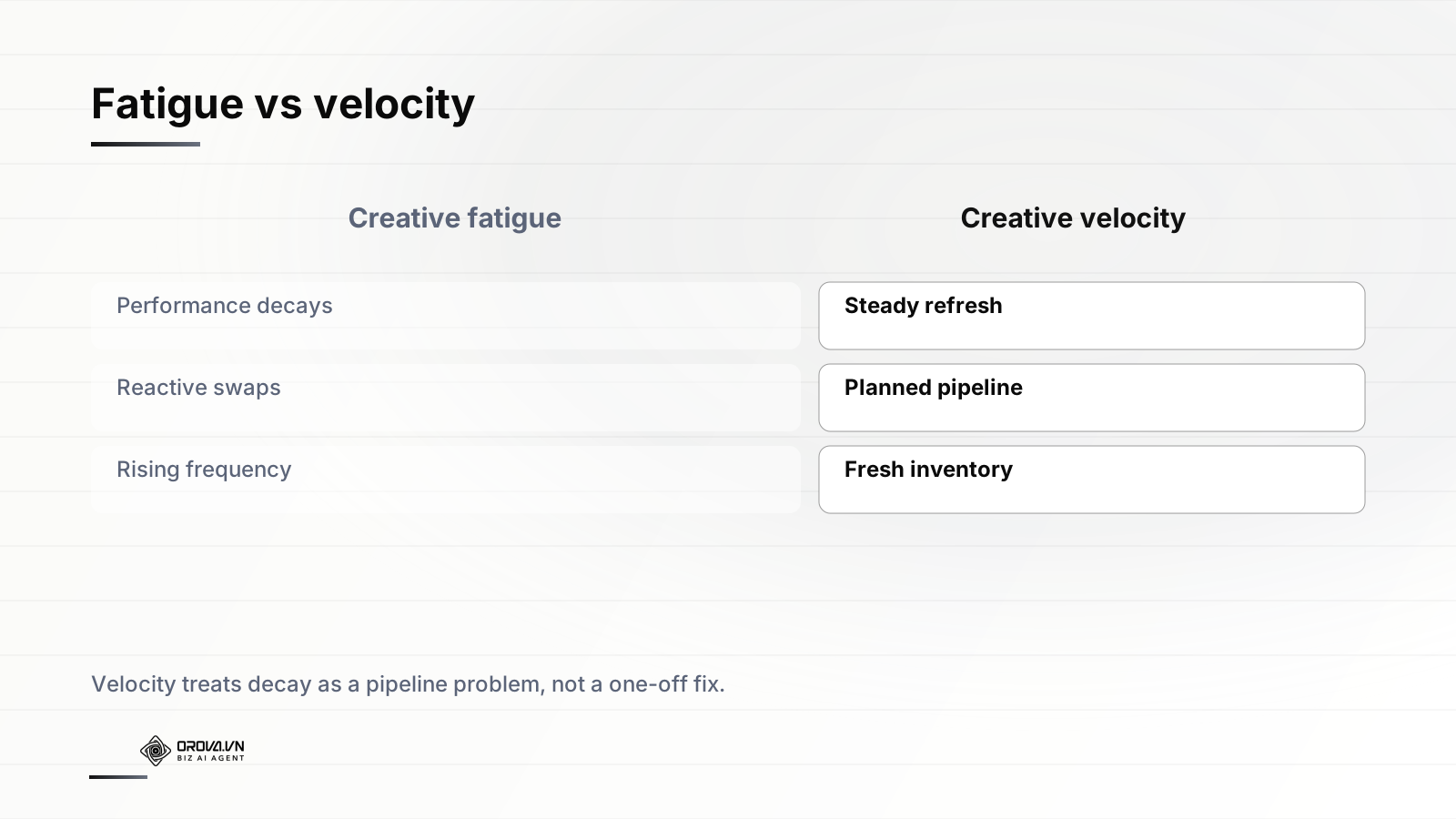
Creative velocity is the rate at which you can conceive, produce, launch, and learn from new creative. It is a throughput metric, not a quality metric — and that distinction trips people up. A team obsessed with quality polishes one perfect ad for three weeks and ships it just as the previous winner hits the floor. A team that understands velocity ships eight rough-but-distinct concepts in the same three weeks, lets the auction tell them which two work, and scales those while the next batch is already in production.
The two teams are not in opposition. High velocity does not mean low quality; it means you have decoupled the question of "is this good?" from your gut and handed it to the market, which answers faster and more honestly than any creative review. Your job shifts from picking winners to feeding the pipeline and reading the results.
You cannot fix a fatigue problem with a better single creative. You can only fix it with a steady supply of new creative arriving faster than your audience tires of the last one. Fatigue is a flow problem, and flow problems are solved with systems, not with hero assets.
Why velocity wins the math
Consider two accounts spending the same $30,000 a month. Account A runs three creatives at a time, refreshing one every four weeks — a velocity of roughly one new concept a week. Account B runs the same budget but ships six new concepts a week, killing losers within 72 hours. Account B will find more winners simply because it takes more shots, and it will retire its winners before they slide into the floor because it always has a replacement ready. Over a quarter, Account B's blended efficiency will sit meaningfully above Account A's — not because anyone on that team is more talented, but because the system surfaces more winners and wastes less spend on fatigued losers.
This is the part worth internalizing: in creative, volume is a quality strategy. Most concepts fail. That is normal and expected — even strong creative teams hit a winner perhaps one time in five or six. If most concepts fail, then the number of winners you find is a direct function of how many concepts you ship. The only way to find more winners is to ship more attempts and kill the failures cheaply and quickly.
Building a creative refresh engine
A refresh engine is the operational machinery that produces creative velocity. It has four stages that run continuously and in parallel — not as a one-time campaign but as a standing loop. The mistake is to treat refresh as something you do when performance drops. The point of an engine is that it runs whether or not anything is currently on fire, so that when fatigue arrives the replacement is already built, tested, and waiting.
Stage 1 — Track fatigue signals
The engine starts with measurement, because you cannot time a refresh you cannot see coming. Set up a daily view of the signals above — frequency, CTR trend, CPM trend, first-time impression ratio — at the individual creative level, not just the campaign level. Campaign averages hide the truth; a campaign can look stable while one creative carries it and three others are at the floor.
Define your thresholds in advance, in writing, so the decision is made before you are emotionally attached to a creative. For example: "any prospecting creative whose 3-day frequency exceeds 3.0 and whose CTR has fallen more than 25% from its peak goes on the retirement watchlist." Thresholds turn a judgment call into a rule, and rules scale where judgment does not.
Stage 2 — Queue new concepts
The reserve is what separates an engine from a fire drill. At all times you should have a queue of new concepts in production, so that the moment a creative hits the watchlist, the replacement is ready to launch rather than ready to start being designed. A useful rule of thumb: keep at least as many concepts in the pipeline as you have active creatives, so you can replace your entire roster on short notice if a platform change or a fatigue cliff forces your hand.
Concepts should be genuinely distinct, not cosmetic variations. Changing a button color or swapping a stock photo produces a "new" ad ID but not new novelty — the audience recognizes it instantly and the fatigue carries over. Real refresh means a new hook, a new format, a new angle, or a new proof point. Vary the things the viewer actually notices:
- Angle. Same product, different reason to care — speed this week, price next, social proof after that.
- Format. Static, then video, then carousel, then user-generated style. Format changes reset novelty hard because they change how the ad occupies the feed.
- Hook. The first three seconds or the headline. This is where most of the attention battle is won or lost, so it is where most of your variation should live.
- Proof. A testimonial, a number, a demo, a before-and-after. Swapping the evidence changes the persuasion even when the offer is identical.
Stage 3 — Launch and test
New concepts enter the account as controlled tests, not as immediate full-budget bets. Launch them with enough budget to clear the learning phase and gather a statistically meaningful read, but not so much that a dud costs you a fortune before you can see it failing. Give each concept a fair, fixed window — long enough to exit learning, short enough that you are not bleeding on a loser. Resist the urge to judge a creative on its first day; resist equally the urge to nurse a clear failure for a week out of hope.
Run tests against a clear baseline — usually your current best performer — so "better" means something concrete. The output of this stage is a ranked verdict: which new concepts beat the baseline, which matched it, and which fell short. The winners graduate to scaling and join the active roster. Everything else gets retired without sentiment.
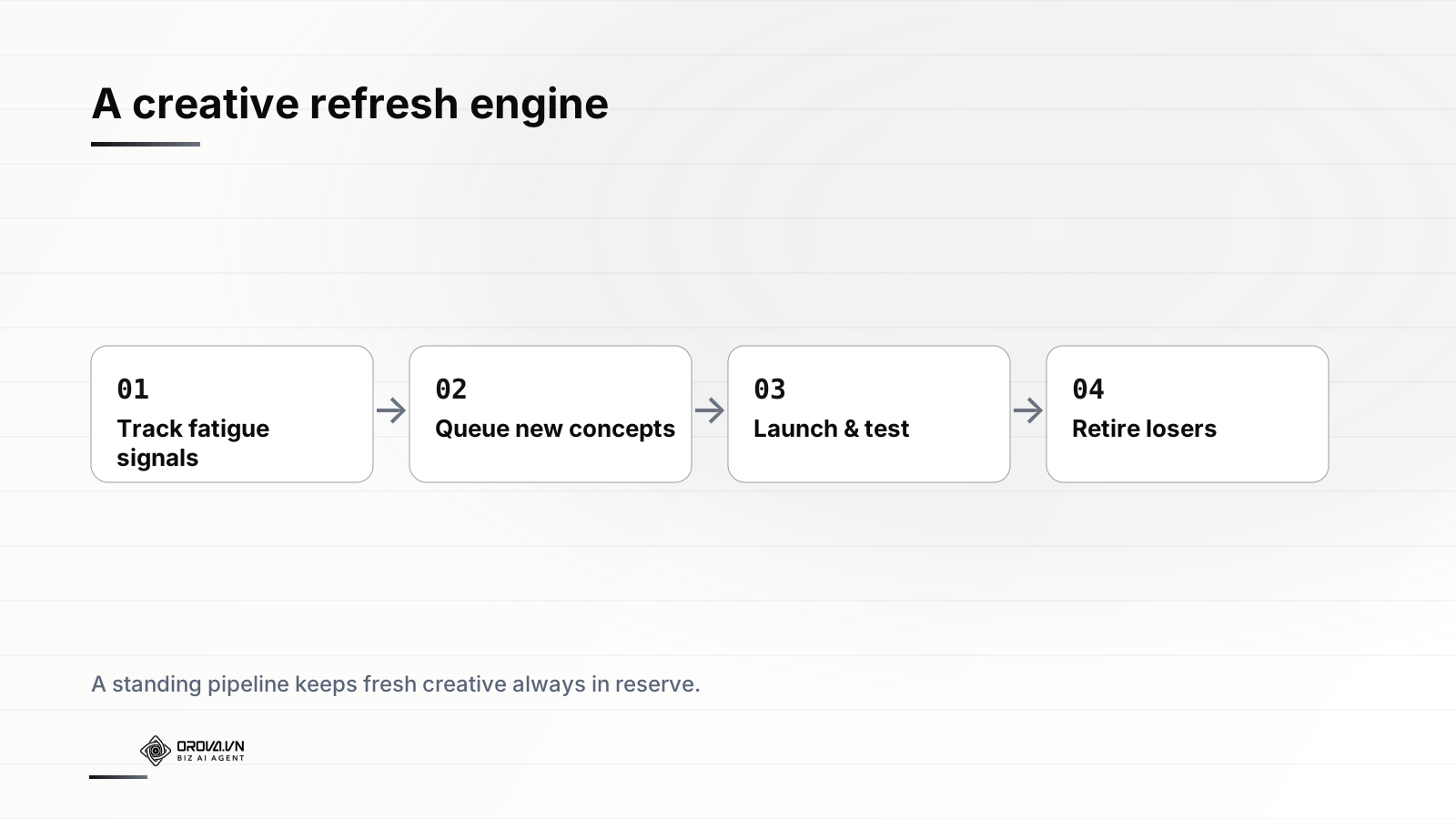
Stage 4 — Retire losers (and faded winners)
The least glamorous stage is the one that protects your budget. Two kinds of creative get retired: concepts that lost their test, and former winners that have slid past the floor. Retiring losers is easy in principle and hard in practice, because teams grow attached to creatives they spent effort making and to winners that earned them money last month. The engine's job is to make retirement mechanical: when a creative crosses your floor threshold, it comes down, full stop. Last month's hero is this month's tax.
Retirement also feeds back into stage one. Every retired creative is data: the angles that fatigued fastest, the formats that lasted longest, the hooks that never landed. A mature refresh engine gets smarter over time because it remembers what worked and what did not, and it tilts the next batch of concepts toward the patterns that have earned their place.
Setting a refresh cadence you can actually hold
Cadence is the heartbeat of the engine — the regular rhythm at which new creative enters and old creative leaves. The right cadence depends on your spend and your audience size, but the principle is universal: your refresh rate must exceed your fatigue rate. If your creative fatigues in three weeks and you refresh every four, you are permanently behind, paying the fatigue tax every single cycle.
To find your number, look at your historical decay curves. How long, on average, from launch to the slide for your account? That interval is your fatigue horizon. Your cadence should put a fresh, tested creative into scaling before that horizon arrives. Some practical anchors:
- High spend, narrow audience. You burn through your audience fast — fatigue can hit in days to a couple of weeks. You need the most aggressive cadence: multiple new concepts a week, tested constantly. This is where refresh engines pay off most dramatically.
- Moderate spend, broad audience. A weekly or biweekly drop of new concepts is usually enough to stay ahead, with retargeting refreshed more often than prospecting because small audiences fatigue first.
- Low spend, broad audience. You have the longest runway, but do not mistake a slow fatigue rate for no fatigue. Even here, a monthly refresh beats waiting for the slide, and the habit of always having a reserve protects you when you eventually scale.
Whatever the numbers, write the cadence down and treat it as a commitment, not an aspiration. The reason refresh engines fail is almost never that the strategy was wrong — it is that the cadence quietly slipped because no one owned it and there was always something more urgent. A cadence you hold mechanically beats a brilliant plan you abandon the first busy week.
Distinguishing fatigue from everything else
One trap worth naming: not every performance drop is creative fatigue, and refreshing creative will not fix the ones that are not. Before you assume fatigue, rule out the imposters. Seasonality — a holiday, a payday cycle, a quiet August — can mimic decay across your whole account at once, which fatigue rarely does because fatigue hits creatives individually on their own clocks. A landing page change, a tracking break, a stockout, a competitor's price cut, or a platform-wide CPM spike can all look like fatigue from the dashboard and have nothing to do with your ads.
The tell for genuine fatigue is specificity: it shows up creative by creative, correlates with rising frequency on that specific creative, and resolves when you ship a genuinely new concept to the same audience. If a fresh, distinct creative to the same people restores performance, it was fatigue. If the new creative struggles too, the problem lives somewhere other than your creative, and a refresh engine — however good — will not save you. Diagnose first, refresh second.
What a mature refresh engine feels like to run
When the engine is working, the experience of managing the account changes in a specific way. You stop reacting to bad news. The dreaded Monday-morning discovery that your best ad set fell off a cliff over the weekend simply stops happening, because you saw the frequency climbing on Wednesday and the replacement was already in test by Friday. Your blended account metrics flatten out and trend gently upward, even though if you zoom into any single creative you see the same brutal rise-and-fall as always. The volatility moves down to the creative level, where it belongs, and the account level becomes calm.
You also stop arguing about whether a creative is "good." The market settles those arguments faster and more honestly than any meeting. Energy that used to go into defending favorite ads goes into generating the next batch of concepts, which is the only activity that actually moves the throughput number that matters. The team's identity shifts from "we make great ads" to "we run a great engine" — and the engine, not any single ad, becomes the durable competitive advantage. Ads are copyable; a system that out-ships your competitor's system, week after week, is not.
That shift is the whole point. Fatigue is permanent and universal; no one escapes the decay curve. The advertisers who win are simply the ones who accepted that early, stopped trying to build the one perfect immortal ad, and built the machine that makes the next ad, and the next, faster than their audience can grow tired.
If running that machine by hand sounds like a lot of daily watching and tuning, that is because it is — and it is exactly the kind of relentless, unglamorous loop software handles better than people. Orova Ads is an AI agent that runs the engine for you across Google, Meta and TikTok: it reads your performance data every day, spots fatigue signals before they cost you, and recommends and executes the moves — budgets, bids, turning creatives on and off, adjusting audiences — with your approval on every change and a full audit log of what it did and why. You keep the strategy and the final say; it keeps the cadence you would otherwise let slip.
Orova Ads optimises campaigns for you
Connect Google, Meta and TikTok in one place. AI reads the numbers, proposes changes and executes under the rules you set.
Explore Orova Ads