
Dynamic & Responsive Ad Creative: How AI Assembles Ads
You are probably about to sign up for an ads creative ai tool because a rep or a case study promised it would "automatically improve" your ad performance. Meanwhile your team is still manually building each ad version by hand — new headline, new image crop, new button color — and testing them one at a time while the campaign budget quietly leaks out. You upload a handful of polished ads, the platform serves them, and results come back mixed, with no clear sense of why one version works and another doesn't.
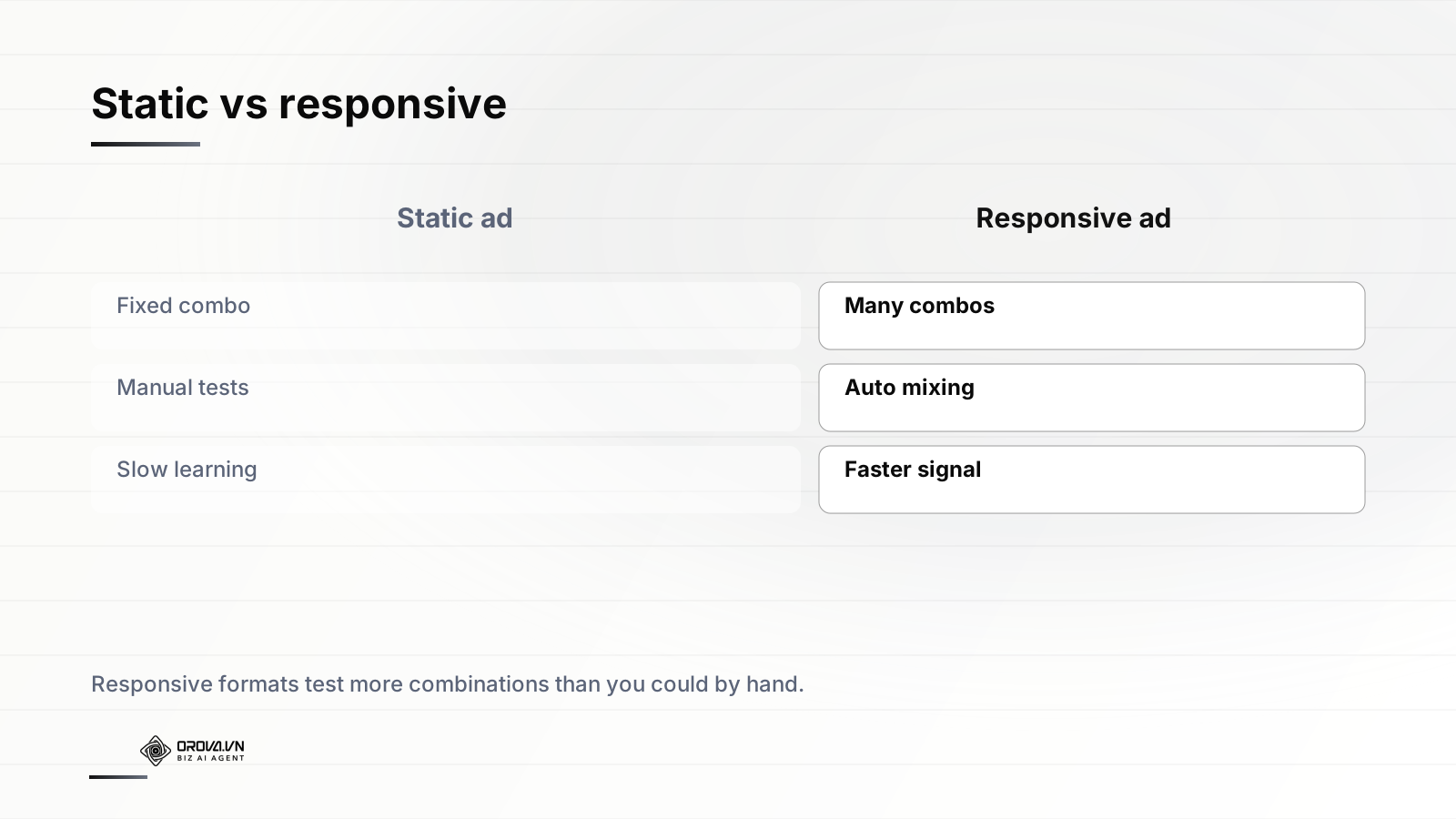
The old way — hand-building a small set of "perfect" ads — feels careful, but it's actually slow and narrow. A small team can only realistically test a few combinations before time or budget runs out, while the platform itself can quietly try far more pairings than any human team would ever attempt. This gap matters more than most teams realize: roughly a quarter of programmatic ad spend is already wasted on inefficient buying and invalid impressions, according to the ANA Programmatic Transparency Study, so feeding a black-box system a handful of untested creative assets only compounds the problem. The real issue isn't creativity or design skill; it's that manual testing simply can't keep up with how these systems actually decide what to show.
This article breaks down what's actually happening behind "responsive" and "dynamic" ad tools, in plain terms, so you stop treating them like a black box. By the end, you'll know exactly what kind of assets to hand the system, how to tell if it's working well or just producing mediocre results, and where you — not the algorithm — still need to make the call.
What "responsive" and "dynamic" actually mean
The terminology is a mess across platforms, so let's pin it down before going further. Three distinct things often get lumped together, and treating them as the same thing is where most mistakes start.
Responsive ads (asset combination)
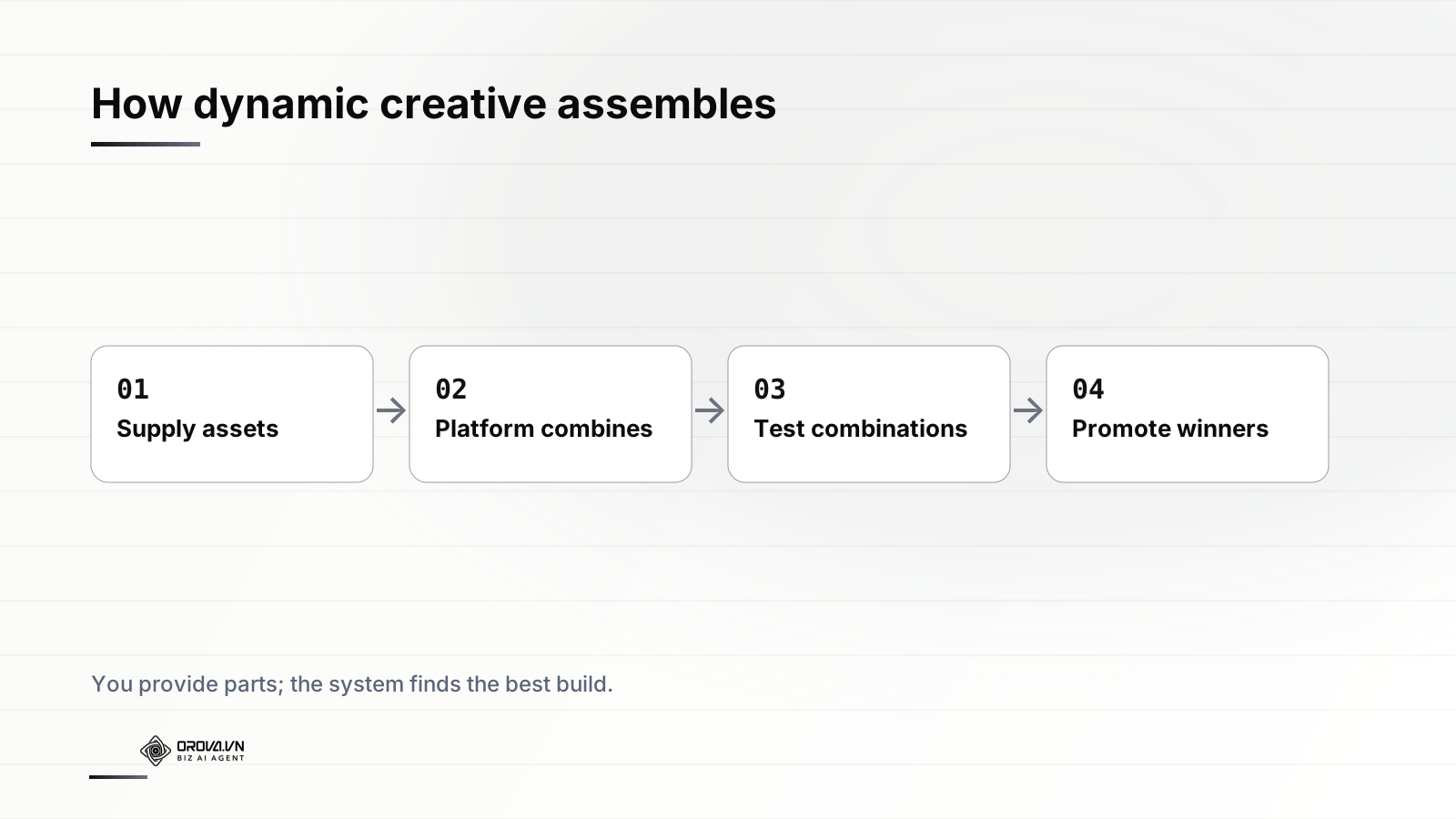
A responsive ad is one where you provide a pool of interchangeable assets and the platform mixes them. On Google Search, this is the Responsive Search Ad (RSA): you supply up to 15 headlines and 4 descriptions, and Google assembles them into combinations of up to three headlines and two descriptions, tailored to the query and the device. On the Display network, the Responsive Display Ad takes images, logos, headlines, long headlines, and descriptions and auto-resizes them to fit nearly any placement, from a 300x250 box to a native in-feed slot. The defining trait: you supply the raw material, the platform decides the arrangement, and the arrangement adapts to context in real time.
Dynamic creative (per-user assembly)
Dynamic creative optimization (DCO) goes a step further: the combination is chosen per impression, often personalized to the individual user or audience segment. Meta's Dynamic Creative feature, for example, takes multiple images, videos, headlines, primary texts, and CTAs, then tests combinations and increasingly serves the mix most likely to convert that particular person. True DCO can also pull in feed data — showing the exact product someone viewed, with its live price and image, via a product catalog. The distinction from responsive ads is subtle but real: responsive ads optimize the combination toward aggregate performance; dynamic creative leans toward individualized assembly.
Advantage+ creative and platform "enhancements"
Then there is the newer layer of automated creative modification. Meta's Advantage+ creative can apply enhancements on top of your assets: brightness and contrast adjustments, automatic cropping for different placements, music, text overlays, even relighting or generating background variations. TikTok offers similar automated optimization through its creative tools. These are not just combining your assets — they are altering them. This is powerful and slightly dangerous, because it means the ad a user sees may differ from the asset you uploaded. We'll return to the control implications later.
The mental model that works: responsive = the platform arranges your parts; dynamic = it arranges them per person; Advantage+/enhancements = it also edits the parts. Each layer adds reach and removes a little of your control.
Why the algorithm beats your hand-built ad (most of the time)
It is worth being precise about why these formats win, because the reason dictates how you should feed them. It comes down to three mechanical advantages that no human team can replicate at scale.
Combinatorial coverage
With 15 headlines and 4 descriptions, an RSA can draw from thousands of theoretically possible combinations. You could never A/B test that many manually — each test needs enough impressions to reach significance, and you'd run out of budget and calendar long before you covered the space. The platform tests in parallel against live auctions, using contextual signals (the search query, time of day, device, audience) to pick the arrangement most likely to win each specific impression. It is not running one big experiment; it is running a continuous, context-aware bandit across the whole asset pool.
The math here is worth sitting with for a second, because it explains why manual testing simply cannot compete. Suppose you wanted to A/B test ten headline variants against each other to a real statistical conclusion. A clean test needs each variant to accumulate enough conversions to distinguish it from the others — often a few hundred conversions per arm before the confidence interval tightens. Ten arms running sequentially, at a typical small-account conversion volume, can take months, by which point the market, your offer, and the season have all moved and the result is stale. The bandit approach the platform uses sidesteps the whole problem: it never commits to a fixed split, it continuously reallocates impressions toward the variants that look promising, and it does so per context rather than in aggregate. You trade the clean, interpretable result of a formal A/B test for a messier but far faster and more profitable allocation. For creative selection — where you care about the outcome more than the explanation — that is almost always the right trade.
Contextual matching
A single static ad shows the same headline to a price-sensitive shopper at 11pm on a phone and an enterprise buyer at 9am on a desktop. A responsive ad can lead with "Free 14-day trial" for the first and "Trusted by 2,000+ teams" for the second — from the same asset pool, chosen on the fly. This contextual matching is where a lot of the lift comes from, and it is invisible if you only look at campaign-level numbers.
Faster, denser learning signal
Because the system is constantly varying the creative, it gathers signal on which messages and visuals work much faster than a sequence of discrete manual tests would. Each impression contributes to the model's understanding of asset-level performance. This is the same logic that underpins broader campaign automation, and it pairs naturally with the question of how rule-based automation differs from genuine AI agents — responsive creative is essentially a narrow, creative-only optimization loop, and understanding where simple rules end and adaptive systems begin helps you set expectations correctly.
The real job: feeding the machine well
Here is the uncomfortable truth that gets buried under platform marketing. The algorithm is only as good as the asset pool you give it. If your 15 headlines are 15 paraphrases of "Best CRM Software," the combinatorial machine has nothing meaningful to combine — every permutation says the same thing, so there is no signal to optimize against. The lift comes from diversity, not volume. Your task is to give the system genuinely different angles, formats, and emotional registers so it has real choices to make.
Asset diversity is the whole game
Think of your asset pool as a research portfolio. Each asset should test a distinct hypothesis about why someone would care. For a project management tool, a strong headline pool might span:
- Benefit-led: "Ship projects 30% faster"
- Pain-led: "Stop chasing status updates"
- Proof-led: "Trusted by 12,000 teams"
- Feature-led: "Gantt, kanban, and timeline in one"
- Offer-led: "Free for teams under 5"
- Audience-led: "Built for remote engineering teams"
- Objection-handling: "Set up in under 10 minutes"
That pool gives the algorithm seven fundamentally different arguments to test. If query intent leans toward research, the proof and feature headlines may win; if it leans toward action, the offer and benefit headlines surface. Each angle covers a different slice of the demand. The same diversity discipline applies to images and video: vary the format (product screenshot vs. lifestyle vs. abstract), the dominant color, the presence or absence of people, the aspect ratio, and the first three seconds for video. Monotone pools produce monotone results.
Quality floor, not just quantity
Diversity does not mean dumping in weak assets to fill slots. Every asset will eventually be shown to real people, and a genuinely bad one can drag down combinations it appears in before the system learns to suppress it. The right standard is: every asset should be one you'd be comfortable running on its own. Use the volume to express different good ideas, not to pad the pool with filler. On Meta especially, where Dynamic Creative can mix any image with any text, a mismatched pairing (a celebratory headline over a somber image) can slip through, so keep your assets compatible enough that no combination embarrasses the brand.
Pinning, when you must
Google's RSAs let you "pin" specific headlines or descriptions to fixed positions — useful for legal disclaimers, required brand names, or compliance language that must always appear. But pinning is a constraint, and every pin shrinks the combination space the algorithm can explore. The general guidance holds: pin only what you are legally or operationally required to pin. If you pin most of your headlines, you've rebuilt a static ad with extra steps and thrown away the format's core advantage. Pin sparingly; let the system breathe.
Reading asset-level signals (the part most people skip)
This is where responsive creative pays off or quietly wastes your money, and it is the step the majority of accounts never properly do. The platforms expose asset-level performance ratings and metrics — Google labels individual RSA assets "Low," "Good," or "Best," and Meta and TikTok surface per-asset and per-combination impression and conversion data. These signals are the feedback loop that lets you improve the pool over time. Ignoring them means you set the campaign and walk away, and the system optimizes within a pool you never refine.
What the ratings actually tell you
An asset marked "Low" is not necessarily bad in isolation — it may simply be losing the combination auction against stronger siblings, or it may not have accumulated enough impressions to be judged. The useful interpretation is comparative and directional:
- Consistent "Low" with sufficient impressions: this asset is genuinely underperforming. Replace it with a new angle, not a paraphrase of the survivors.
- "Best" performers clustering around one angle: the market is telling you which argument resonates. Double down by writing more variations around that theme while keeping a couple of contrasting angles to avoid overfitting.
- "Learning" or unrated for a long time: the asset isn't getting served. Check whether pins, low ad strength, or a tiny audience are starving it of impressions.
The swap-and-refresh discipline
The professional workflow is a continuous loop, not a launch event. Roughly every two to four weeks, depending on volume: pull the asset-level report, identify the persistently weak assets, and swap them out for fresh ideas — ideally new angles rather than minor edits. Keep your "Best" performers as the stable core. This rolling refresh does two things at once: it removes dead weight from the combination space and it combats creative fatigue, where even good assets decay as the same audience sees them repeatedly. A pool that never changes will see CTR and conversion rates erode over a quarter even if nothing else changes.
One discipline that separates good operators here: change one variable at a time when you can. If you swap five headlines and three images simultaneously and performance jumps, you've learned nothing about which change drove it. Stagger refreshes so the platform — and you — can attribute the lift.
A worked example: building and tuning one RSA
Abstractions only get you so far, so let's walk through a single Responsive Search Ad end to end, the way it actually plays out over a month. Imagine you're running Search for a mid-market accounting software product, bidding on terms like "accounting software for small business." Here is the sequence.
- Draft the pool against a checklist of angles. Rather than free-associating 15 headlines, you start from the angle list and force coverage: two benefit headlines ("Close your books in half the time," "Automate invoices and reminders"), two proof headlines ("Used by 9,000+ small businesses," "Rated 4.8 on G2"), two offer headlines ("Free for your first 3 months," "No credit card to start"), two objection headlines ("Migrate from spreadsheets in a day," "Bank-grade security, SOC 2 certified"), two feature headlines ("Invoicing, payroll, and tax in one place," "Connects to your bank automatically"), one audience headline ("Built for small business owners, not accountants"), and a few brand-and-keyword headlines that include the term "accounting software." That's a full pool where every entry argues something different.
- Write four genuinely different descriptions. One leads with the offer, one with proof, one with the headline benefit, one handling the migration objection. Descriptions get less testing weight than headlines, but four distinct ones still give the system room.
- Pin only what's required. Your legal team wants the disclaimer "Terms apply" to always appear, so you pin that single description to position 2. Nothing else is pinned. Ad Strength reads "Good" — you could push to "Excellent" by adding more keyword headlines, but you deliberately don't, because that would crowd out angle diversity, and you trust performance over the strength meter.
- Launch and wait. For the first ten days you resist the urge to read asset ratings. Volume is still thin, several assets show "Learning," and any conclusion would be noise. You check only that the ad is actually serving and spending.
- First read, around day 14. Now the report has signal. The two proof headlines and one offer headline are marked "Best." Both audience and feature headlines sit at "Good." One benefit headline ("Close your books in half the time") and one objection headline are "Low" despite plenty of impressions. The pattern is informative: this market responds to trust and price more than to speed claims.
- Make a small, attributable change. You swap out the two "Low" headlines for two new ones — but you don't write more speed claims. You write a third proof angle ("Trusted by accountants and owners alike") and a sharper offer ("Save 20% on annual plans"), leaning into what's already winning while keeping the contrasting feature and audience headlines intact. You change nothing else, so when you read the report again you'll know exactly what the swap did.
- Second read, around day 28. The new offer headline is now "Best." CTR is up modestly, cost per acquisition down. You repeat the loop: retire the weakest current asset, add one new idea around the winning theme, leave the rest. Over three or four cycles the pool converges on a strong, trust-and-offer-led core with enough variety to keep matching different queries.
Notice what made this work: you never tried to guess the winning headline up front. You supplied breadth, let the platform vote with real traffic, and then used the votes to steer the next round. The human contribution was the quality of the angles and the discipline of the read — not the prediction.
Common mistakes that quietly kill performance
Most underperforming responsive campaigns fail in a handful of predictable ways. If a campaign is disappointing, walk this list before you conclude the format doesn't work for you.
The paraphrase pool
By far the most common mistake: 15 headlines that all say the same thing in slightly different words. "Best accounting software," "Top accounting software," "Leading accounting software," and so on. The combination machine has nothing real to optimize, so it behaves like an expensive random shuffle. The fix is the angle checklist above — force coverage of distinct arguments, not synonyms.
Over-pinning into a static ad
Pin three headlines and two descriptions and you've reduced thousands of possible combinations to a handful. People do this out of a desire for control, then wonder why the format isn't beating their old static ads. It can't — you've handcuffed it. Reserve pinning for genuine legal or brand requirements and let everything else compete.
Judging too early
Reading asset ratings on day two and pausing the "Low" ones is self-sabotage. Those assets haven't had the impressions to prove themselves; you're acting on noise and shrinking the pool before learning has happened. Give the system a meaningful conversion volume — typically a week or two — before you touch anything.
Never reading the report at all
The opposite failure, and equally common: launch and forget. The platform optimizes diligently within whatever pool you gave it, including the dead weight and the stale winners, forever. Without the periodic swap-and-refresh, creative fatigue sets in and performance erodes month over month while you assume the automation has it handled.
Changing everything at once
A panicked overhaul — swap every headline, every image, change the audience, all in one afternoon — destroys your ability to learn. Performance might jump or crater, and you'll have no idea why, so you can't repeat the win or avoid the loss. Move in increments you can attribute.
Letting enhancements run unsupervised
On Meta, leaving every Advantage+ enhancement on and never reviewing the output means the system may serve auto-cropped, relit, or text-overlaid versions that clash with your brand. Enable enhancements deliberately and spot-check what's actually being shown.
Platform-by-platform: what to supply
The principles are universal, but the mechanics differ enough that you need to tailor your asset pool to each platform's machinery.
Google Search — Responsive Search Ads
Supply close to the full 15 headlines and 4 descriptions, with maximum angle diversity. Aim for an "Excellent" or "Good" Ad Strength rating, which Google ties to headline count, uniqueness, and keyword inclusion — but treat Ad Strength as a hygiene indicator, not a performance guarantee. Include your main keyword in two or three headlines (not all of them, or you lose diversity), and use the rest for benefits, proof, and offers. Pin only legally required text. Watch the asset ratings and the combinations report monthly.
Meta — Dynamic Creative and Advantage+
Meta's Dynamic Creative wants several images and/or videos, multiple primary texts, headlines, and CTAs. Keep texts compatible across all images so no pairing breaks. Advantage+ creative enhancements (cropping, brightness, text overlays, music) can be toggled per enhancement — enable them selectively and review what they produce, because automated edits occasionally clash with brand guidelines. For e-commerce, the highest-leverage version is the catalog-driven Advantage+ shopping campaign, where the "asset" is your product feed and the system assembles per-user product ads at scale.
TikTok — Smart Creative and native formats
TikTok rewards native, sound-on, fast-hook video far more than repurposed horizontal assets. Supply multiple short videos with different opening seconds, varied text overlays, and a mix of creator-style and polished cuts. TikTok's automated creative tools will test combinations and optimize delivery, but the format penalty for non-native creative is severe — a beautifully produced TV spot will often lose to a rough, well-hooked vertical clip. Feed the algorithm assets that already look like organic TikTok content.
Where humans still earn their keep
It would be easy to read all this as "the machine does the work now." It does not. The automation handles assembly and selection; it does not generate strategy, brand voice, or the underlying ideas. Several jobs remain stubbornly human.
Generating genuinely different angles
The algorithm can only combine what it's given. It cannot invent a new value proposition or notice that your entire pool is missing the angle your best customers actually care about. Coming up with seven truly distinct arguments — and knowing which seven matter for this audience — is creative and strategic work. The machine optimizes the pool; you decide what's in it.
Guarding the brand
Automated enhancements and free combination mean the system can produce an ad you never explicitly approved. Someone has to review what's being served, catch off-brand crops or tone mismatches, and set the guardrails — pinned compliance text, enhancement opt-outs, excluded combinations. This is risk management, and it's irreducibly human judgment.
Reading signals across the whole account
Asset ratings tell you about one ad group. Connecting "the proof-led angle wins on Search but the pain-led angle wins on Meta" into a coherent creative strategy across platforms requires synthesis no single platform dashboard provides. The platforms optimize within their walls; they don't talk to each other.
How an AI agent manages dynamic creative at scale
The operating rhythm described above is straightforward for one campaign. The problem is that almost nobody runs one campaign. A real account has dozens of ad groups across Google, Meta, and TikTok, each with its own asset pool, its own ratings, its own fatigue curve. The "read every two to four weeks and act" discipline that's easy to describe for a single RSA becomes a part-time job nobody has time for when multiplied by forty. This is exactly the gap that an AI agent fills — not by being more creative, but by being relentless and consistent where humans get tired and inconsistent.
Continuous reading instead of periodic batches
A human reads asset reports when they remember to, which in practice means when a campaign is already in trouble. An agent reads them on a fixed daily cadence across every campaign and every platform at once. It pulls per-asset ratings from Google, per-combination conversion data from Meta, and delivery signals from TikTok, normalizes them into one view, and flags the assets that have crossed from "still learning" into "genuinely underperforming with enough impressions to judge." The two-week feedback loop becomes a daily one, and crucially it runs on the campaigns you'd otherwise neglect, not just the ones you happen to be looking at.
Pattern recognition across the account
Because an agent sees every campaign simultaneously, it can spot cross-cutting patterns a human staring at one dashboard cannot. If the proof-led angle is winning on Search across five different product lines while the pain-led angle wins on Meta across the same five, that's a strategic signal worth acting on everywhere — and it's the kind of synthesis that only emerges when one system holds the whole account in view at the same moment. The agent can surface "your trust-based messaging is consistently outperforming your speed-based messaging account-wide" as a finding, which is far more valuable than ten separate ad-group reports nobody connects.
Detecting fatigue before it shows in the totals
Creative fatigue is gradual and easy to miss in campaign-level numbers, where a slow CTR decline hides inside seasonal noise and budget changes. An agent tracks the trend per asset and per audience, so it can catch the early downward drift on a previously strong asset and recommend a refresh while there's still performance to protect — rather than after the cost per result has already crept up for a month.
Recommend, then execute under guardrails
Spotting the problem is only half the value; closing the loop is the rest. A well-designed agent doesn't just report "headline 7 is underperforming" — it proposes the specific action (retire this asset, add a new angle around the winning theme, shift budget toward the combination that's converting) and, with your approval, executes it through the platform APIs: pausing assets, adjusting bids and budgets, refining audiences. The non-negotiable parts are human oversight and an audit trail: every recommendation should be reviewable, every executed change should be logged with what changed, when, and why, and you should be able to set the boundaries the agent operates within. The goal is not to remove the human from the loop but to remove the busywork from the loop, so your judgment is spent on strategy and brand rather than on pulling reports.
What it doesn't do
It's worth being honest about the limits, because overclaiming here erodes trust. An agent does not invent your next great value proposition, write your brand voice, or decide which seven angles matter for a new audience — those remain the human creative and strategic contributions described earlier. What it does is take the tireless, mechanical, easy-to-postpone work of reading signals and acting on them across many campaigns, and actually do it every day. That division of labor — humans on ideas and guardrails, the agent on relentless execution — is where dynamic creative at scale finally becomes manageable.
A practical operating rhythm
Pulling it together, here is a workflow that consistently gets the most out of these formats without drowning in busywork.
- Build a diverse pool at launch. For each campaign, draft assets across at least five distinct angles. Fill the available slots with genuinely different ideas, not paraphrases. Set a quality floor: every asset stands on its own.
- Set guardrails before going live. Pin only required text. Decide which Advantage+ enhancements to allow. Confirm no text-image pairing can embarrass the brand.
- Let it learn. Give the system enough conversions and time — typically a week or two — before judging asset ratings. Early "Low" labels are often just insufficient data.
- Read asset-level reports on a cadence. Every two to four weeks, pull per-asset ratings and combination data across platforms. Identify persistent winners and losers.
- Swap, don't overhaul. Replace the weakest assets with new angles. Keep the proven core. Change few enough things that you can attribute the result.
- Watch for fatigue. When CTR or conversion rate drifts down on a stable pool, it's time for a creative refresh even if individual assets still rate well.
- Synthesize across platforms. Note which angles win where, and feed that learning back into the next round of asset generation.
Run this loop for a few cycles and the compounding effect is real: each refresh starts from a smarter baseline, the winning angles get clearer, and your cost per result tends to drift down while the platforms do the moment-to-moment heavy lifting. The work doesn't disappear — it moves up a level, from making ads to managing a living portfolio of creative ideas.
The bottom line
Responsive and dynamic creative are not a way to make worse ads faster. They're a way to test more good ideas than you ever could by hand, and to match the right idea to the right moment automatically. The format does the combinatorics; you supply the diversity and read the signals. Teams that win with these formats treat the asset pool like a portfolio — diverse, high-quality, continuously refreshed based on real asset-level feedback — and treat the platform as a tireless tester rather than a creative director. Get the inputs right and the algorithm will out-test your best manual efforts every time. Get them wrong and no amount of automation will save a pool of seven paraphrases of the same dull headline.
Reading asset-level signals across Google, Meta, and TikTok — and acting on them every two weeks for every campaign — is exactly the kind of relentless, cross-platform work that's easy to describe and hard to sustain by hand. Orova Ads is an AI agent built for it: it reads your ad data every day across all three platforms, spots the weak assets and tiring creative, recommends the swaps and budget shifts, and executes them — on/off, bids, budgets, audiences — with your approval and a full audit log of every change. If you want the optimization loop running daily instead of whenever you remember to log in, that's what it's for.
Let the System Handle the Combinations, Not Your Team
The part that eats the most time by hand isn't writing one good headline or picking one good image — it's producing enough varied, quality pieces and then actually checking which combinations are pulling their weight. Most teams either skip that step or drown in spreadsheets trying to track it manually.
Orova Ads is built to take that grind off your plate — feeding your assets into the system properly and helping you read what's actually working, without you having to babysit every combination. If this sounds like the piece of your ad process that's been draining time for no clear payoff, it's worth taking a look at how Orova Ads handles it.
Orova Ads optimises campaigns for you
Connect Google, Meta and TikTok in one place. AI reads the numbers, proposes changes and executes under the rules you set.
Explore Orova Ads