
UGC Ads at Scale: A Playbook for Volume Without Burnout
A direct-to-consumer skincare brand we worked with spent six weeks and roughly $9,000 producing a single polished video ad: studio lighting, a hired actor, a motion-graphics package, three rounds of revisions. It launched, ran for nine days, and quietly died at a 1.3x return on ad spend. The same brand later handed $150 and a one-page brief to a 24-year-old who films herself on an iPhone in her bathroom. Her unscripted, slightly-shaky 38-second clip about "the only sunscreen that doesn't pill under my makeup" carried the entire account for the next quarter at 3.1x. That gap is not an accident, and it is not luck. It is the structural reason user-generated content keeps winning on paid social: it looks like the feed it interrupts, so the brain stops treating it as an ad.
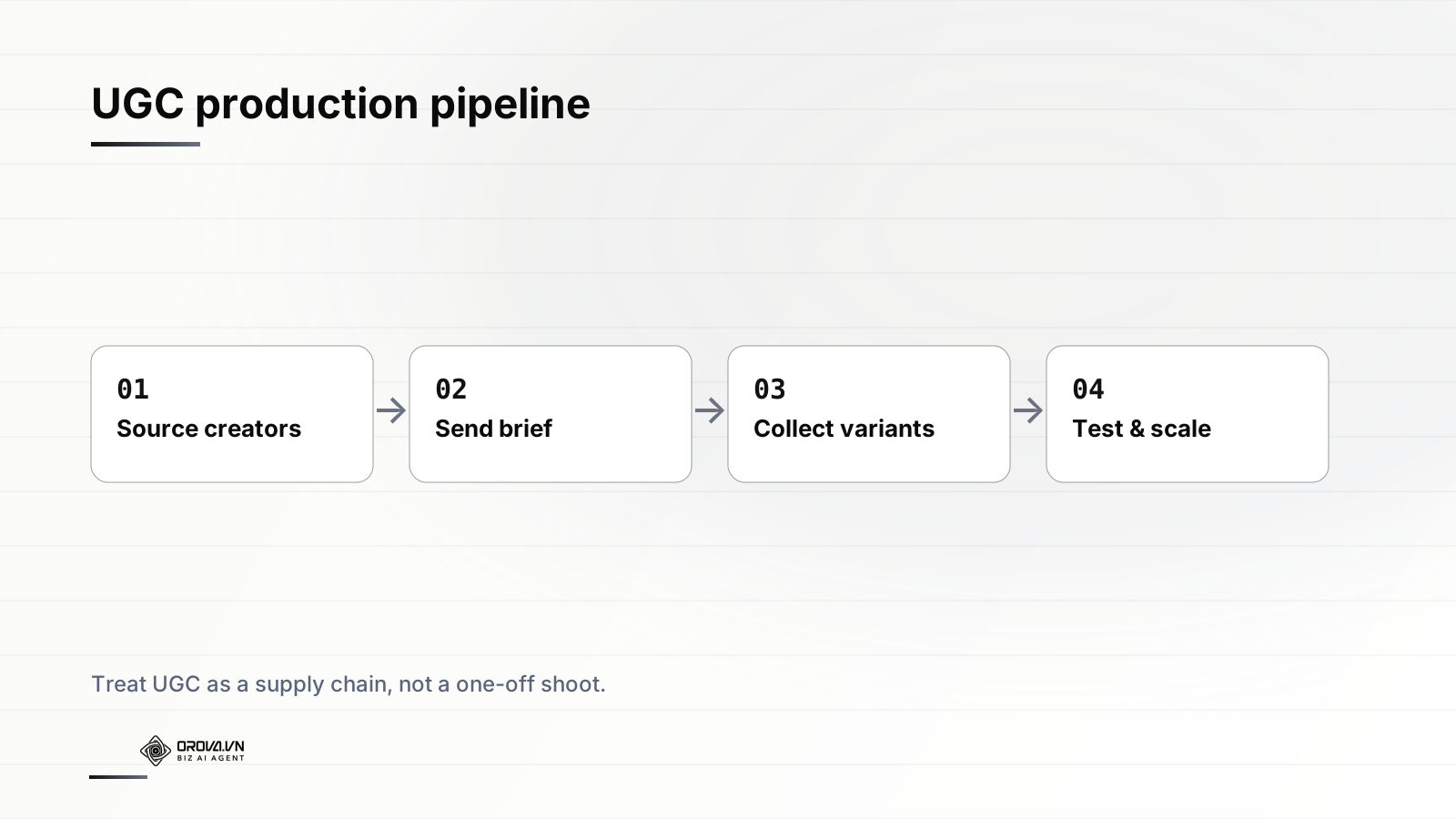
The catch is that one good UGC clip is a fluke. A system that reliably produces dozens of them every month is a competitive advantage. Most teams never build the system. They commission a handful of creator videos, run them until they tire out, and then scramble. This article is about the opposite approach: treating UGC as a supply chain with predictable inputs, throughput and quality control, so you always have fresh user-style creative in the pipeline before the current batch fatigues. We will cover where to source creators, how to brief them so the output is usable, how much variant volume you actually need, and how this all plugs into a creative-velocity strategy that fights ad fatigue instead of reacting to it.
Why user-style creative resists fatigue in the first place
Before building the machine, it helps to be precise about why UGC works, because the mechanism dictates how you should produce it. There are three forces at play, and none of them is "UGC is cheap."
It clears the ad-blindness filter
Feed-based platforms train users to scroll past anything that reads as advertising within a fraction of a second. High production values are, ironically, a tell. Perfect lighting, a logo lockup in the first frame, a voiceover that sounds like a commercial — these signal "skip me" before the message lands. User-style footage shot on a phone, with imperfect framing and a real person talking to the camera, mimics the content the user came to see. The thumb-stop happens because the brain has not yet flagged it as a pitch. You are buying an extra second or two of attention, and on platforms where the first three seconds decide everything, that is the whole game.
It carries social proof natively
A person saying "I bought this and here's what happened" is a fundamentally different message than a brand saying "buy this." The format itself is the testimonial. Viewers extend more trust to peer-shaped content, and that trust shows up in the metrics that matter downstream of the click: higher add-to-cart rates, lower bounce, better post-click conversion. The creative is doing persuasion work that a slick brand film cannot do at any budget, because the credibility comes from the format, not the production.
It is cheap to vary, which is the actual superpower
This is the point most teams miss. The strategic value of UGC is not that one clip is cheaper than one studio production. It is that the marginal cost of the next variation is almost zero. Once you have a working hook-and-angle combination, you can produce ten more versions — different opener, different creator, different first-line text — for a fraction of what a single brand shoot costs. Fatigue is a volume problem, and UGC is the only creative format where volume is genuinely affordable. If you remember one thing from this piece, remember that the pipeline exists to manufacture variation, not to manufacture single hits.
The reason to invest in UGC is not that one video is cheap. It is that the second, third and tenth video are nearly free — and fatigue is beaten with volume, not with brilliance.
Sourcing creators: building a roster, not casting a shoot
The single biggest mistake brands make is treating creator sourcing as an event — "we need three videos for the spring launch" — rather than an ongoing intake process. A roster you maintain continuously will always outperform a panic-cast scramble, because the best creators are relationship-driven and the worst ones are the only people available at short notice. Here is how to build supply that does not run dry.
Where the creators actually come from
- Your own customers. This is the highest-quality, lowest-cost source and almost everyone underuses it. People who already bought and love the product make the most believable creators because the enthusiasm is real. Mine your reviews, post-purchase surveys and tagged social mentions. Set up a simple post-purchase email that offers an incentive — store credit, free product, a flat fee — for a phone video. Conversion is low (expect 1-3% of those asked), but the cost per usable asset is unbeatable and the authenticity is impossible to fake.
- Dedicated UGC marketplaces. Platforms like Billo, Insense, Trend and JoinBrands exist specifically to connect brands with creators who produce ad footage — not influencers selling reach, but content suppliers selling videos. Pricing typically runs $75-$250 per video depending on length and complexity. The trade-off: marketplace creators are professionalized and can drift toward a generic "UGC voice" that itself becomes a pattern the algorithm learns to discount. Use them for volume, but blend with rawer sources.
- Micro and nano creators via direct outreach. Creators with 2,000-50,000 followers in your niche often produce excellent on-brand footage and are far more affordable and responsive than larger accounts. You are buying their content skill and audience understanding, not their distribution — you will run the footage as paid ads on your own account. This is where category fit matters most; a fitness micro-creator instinctively knows how to talk about supplements in a way no marketplace generalist will.
- In-house and founder content. Do not overlook your own team. Founder-led UGC, employee testimonials and behind-the-scenes clips are free, fast and often surprisingly high-performing because the conviction is genuine. A founder explaining why they built the product can outperform any hired creator on consideration-stage audiences.
Vetting without overthinking it
You do not need a casting process. You need a fast screen. When evaluating a potential creator, look at three things: do they speak naturally and clearly to camera (delivery beats looks every time), does their existing content match the energy and demographic of your target customer, and can they shoot decent vertical video with reasonable audio? That third one is the silent killer — bad audio sinks more UGC than any other single factor. Ask for a short sample or look at their existing posts. Skip anyone whose audio is muddy or whose delivery is stilted, regardless of how good they look on paper.
Build the roster to a target. A brand running paid social seriously should aim for an active pool of 8-15 creators it can brief at any time, rotating in new ones as others fatigue or move on. That redundancy is what lets the pipeline keep flowing when one creator goes silent or one style stops working.
The brief: where most UGC pipelines quietly fail
If sourcing is the supply, the brief is the spec sheet — and a vague spec sheet produces unusable inventory. The most common failure mode in UGC is not bad creators; it is good creators handed a brief that says "make a fun video about our product" and left to guess. They guess wrong, you reshoot, the pipeline stalls, the economics collapse. A great brief is constraining enough to guarantee usable output and loose enough to preserve the authenticity that makes UGC work in the first place. That balance is the whole craft.
What every UGC brief must contain
- The hook, written word-for-word. Do not leave the opening line to chance. The first three seconds determine whether the ad lives or dies, so you specify the exact hook you want tested — for example, "Start by saying: I almost returned this until I figured out one thing." You can request two or three hook options per video, but never let the opener be improvised. This is the single highest-leverage instruction in the entire brief.
- The angle, in one sentence. The angle is the persuasive frame: problem-solution, before-after, myth-busting, comparison, "things I wish I knew," day-in-the-life. State it explicitly. "This video uses the before-and-after angle: show the problem first, then the result." Different angles fatigue at different rates, so you want to control which one each asset represents.
- Talking points, not a script. Provide 3-5 bullet points the creator must hit — the core benefit, the key differentiator, one objection to defuse, the offer. Then explicitly tell them to say it in their own words. A verbatim script produces wooden delivery that defeats the purpose; bullet points produce natural speech that still covers what you need.
- Technical specs. Vertical 9:16, shot in good natural light, clear audio (a $20 lapel mic if possible), minimum and maximum length (typically 20-45 seconds), no music baked in so you can add it in editing, and a request for B-roll — extra shots of the product, the unboxing, the result — that you can cut between.
- The do-not list. Short and specific: do not make health or earnings claims, do not say "best" or "guaranteed," do not show competitors, follow these two brand pronunciation notes. This protects you from policy rejections and legal exposure without strangling creativity.
A reusable brief template
Standardize this into a one-page document you reuse for every creator, changing only the variable fields. A workable structure:
- Product & offer: one line on what it is and the current promotion.
- Target viewer: who this is for, in plain language ("women in their 30s frustrated with adult acne").
- Hook to test: the exact opening line, plus one alternate.
- Angle: one sentence naming the frame.
- Must-mention points: 3-5 bullets.
- Tone: "casual, like recommending to a friend — not a sales pitch."
- Specs: format, length, lighting, audio, B-roll, no baked-in music.
- Do-not list: claims and compliance notes.
- Examples: two links to existing ads in the style you want.
Those two example links at the bottom are worth as much as the rest of the brief combined. Showing is faster than telling, and a creator who watches two reference videos will internalize the format better than they would from a page of instructions. Keep a small swipe file of your best-performing UGC ads specifically to use as briefing references.
Variant volume: how much creative you actually need
Now to the part the cheap-clip framing obscures. The goal of the pipeline is not to find the one perfect video. It is to keep enough fresh, distinct creative in rotation that no single asset has to carry the account long enough to burn out. So how much is enough?
The math of fatigue
Paid-social creative fatigues on a predictable curve. As frequency climbs and the algorithm exhausts the audience most receptive to a given ad, performance decays — cost per result rises, click-through falls, return on ad spend slides. The decline is not gradual at first and then sudden; it is often the reverse, with a slow erosion that compounds. The practical defense is to retire ads before the decay accelerates and to have replacements ready. We have written more about diagnosing this in our breakdown of how frequency and ad fatigue burn out Meta campaigns, but the takeaway for sourcing is simple: you need new creative entering the system continuously, not in occasional batches.
A realistic volume target
For a brand spending in the low-to-mid five figures per month on paid social, a sustainable cadence is roughly 10-20 net-new creative concepts per month, each spun into 3-5 variations, yielding 40-80 testable assets monthly. That sounds enormous until you remember what a "variation" is in UGC: the same creator footage with a different hook, a different first-frame text overlay, a different edit length, a different opening B-roll shot. One 40-second raw clip can legitimately produce six to eight distinct test assets through editing alone, without any new shooting.
This is the leverage point. Your creators supply concepts — distinct angles and hooks shot fresh. Your editing layer supplies variations on each concept. You should not be commissioning 80 separate shoots; you should be commissioning 10-20 concepts and multiplying them. Structure the pipeline so that for every raw clip that comes in, you systematically generate:
- 2-3 different hook openers cut onto the front.
- 2-3 different on-screen text treatments for the first frame.
- A short cut (15s) and a long cut (40s).
- Versions with and without captions, and with different background music.
Each of those is a real variable that can change performance, and each is an editing task, not a production task. That is how a roster of a dozen creators producing a handful of clips each becomes a stream of dozens of testable ads.
Testing user-style creative without lighting money on fire
Producing volume is pointless if your testing process cannot tell you which assets work. UGC testing has its own discipline, distinct from testing a single brand asset, because the whole point is to surface winners from a large field quickly and cheaply.
Structure the test, not just the spend
Do not dump 40 new assets into one ad set and hope the algorithm sorts them out — it will spend the bulk of the budget on a few early leaders and starve the rest before they get a fair read. Instead, batch new creative into deliberate test cells. A common, effective structure is to group 3-5 fresh assets per ad set, give each test a defined budget and a defined window (often 3-4 days and enough spend to clear a meaningful number of conversions or, for upper-funnel reads, a meaningful number of impressions), and judge them against a consistent threshold. Kill the clear losers, promote the clear winners into your scaling campaigns, and send anything ambiguous back for one more read.
Decide on leading indicators, not just final ROAS
Conversion volume per individual UGC asset is often too thin to judge quickly, especially for considered purchases. Lean on leading indicators that correlate with downstream performance and accumulate fast enough to act on:
- Hook rate — the share of viewers who watch past the first three seconds. This isolates whether the opener is working and is the fastest signal you have. A low hook rate means the problem is the first line, full stop.
- Hold rate / average watch time — whether people stay once hooked, which tells you if the body of the video delivers on the opener's promise.
- Click-through rate — whether the creative drives intent.
- Cost per add-to-cart or cost per landing-page view — a mid-funnel efficiency read that fills in well before final ROAS is statistically stable.
By isolating hook rate from hold rate from CTR, you learn why an asset failed, which feeds directly back into the next brief. A great hook with a weak hold rate means the body needs work; a weak hook with great holds means the video is good but nobody is staying to see it. That diagnostic loop is what turns testing into learning instead of gambling.
Read the winners for patterns, then re-brief
The output of testing is not just a few scaled ads — it is a library of knowledge about what your audience responds to. After every test cycle, look across the winners for the common threads. Is it a particular angle (problem-solution consistently beating lifestyle)? A particular hook structure (questions outperforming statements)? A particular creator archetype? Those patterns become the defaults in your next round of briefs. This is the flywheel: test results sharpen briefs, sharper briefs produce better raw material, better material wins more tests. A pipeline without this feedback loop is just a content treadmill; with it, your win rate climbs every month.
Fitting UGC into a creative-velocity strategy
Everything above only pays off if it is organized around a single operating principle: creative velocity. Velocity is the rate at which you can conceive, produce, test and retire creative — and on modern paid-social platforms, where automated delivery systems make audience targeting largely a solved problem, creative velocity has become the primary lever marketers actually control. The brand that can test more distinct creative ideas per month, and learn faster from each, wins. UGC is the format that makes high velocity economically possible.
Match the output to platform-native formats
UGC must be shaped to where it runs. The same raw clip should be edited to fit each surface's native conventions rather than cross-posted unchanged. Vertical 9:16 for Reels, TikTok and Stories; respect the safe zones so captions and UI elements do not cover your text; design for sound-on where the platform expects it (TikTok) and sound-off legibility where it does not (much of Meta's feed). Native pacing matters too — TikTok rewards a faster, more abrupt opening cut than a calmer Meta feed placement. Producing platform-native cuts from one source clip is, again, an editing task, and it multiplies the value of every shoot.
Set velocity targets and treat them as a metric
Make creative throughput a number you track on the same dashboard as ROAS: net-new concepts launched per week, percentage of spend on creative younger than 30 days, win rate per test cohort, average days from brief to live ad. When these are visible, the pipeline stops being an afterthought and becomes a managed operation. A healthy benchmark for an active account is to keep the majority of spend on creative under a month old and to have a fresh cohort entering testing every single week. If your fresh-creative percentage drifts down, you can see fatigue coming before it shows up in your return numbers.
Reserve human judgment for the parts that need it
The pipeline has a lot of moving parts — sourcing, briefing, editing, test setup, budget shifts, winner promotion, loser pausing. Much of the mechanical work (rotating budgets toward winning assets, pausing fatigued ones at a frequency threshold, reallocating spend across test cells, flagging assets whose hook rate has decayed) is rule-governed and repetitive. That is exactly the layer worth automating so your team can spend its hours on the genuinely creative work: the angles, the hooks, the relationships with the best creators. The judgment about what story to tell stays human; the bookkeeping of where the dollars go each day does not have to.
Putting the whole pipeline together
Step back and the system is straightforward, even if executing it consistently is the hard part. You maintain a living roster of 8-15 creators drawn from your own customers, marketplaces and direct outreach. You brief them with a standardized one-page template that locks the hook and angle while freeing the delivery. You collect raw clips and multiply each into a handful of edited variations tuned to platform-native formats. You batch those into structured tests, judge them on leading indicators within tight windows, scale the winners, and feed the patterns back into the next round of briefs. You measure the whole thing on creative velocity, not just spend efficiency, so you are always replacing creative before it fatigues rather than after.
Done occasionally, this is a content project. Done continuously, it is a supply chain — and it is the most durable creative advantage available on paid social right now, precisely because it cannot be bought with budget alone. It has to be built, and most of your competitors will not bother to build it.
For the creative side of the same problem, see TikTok Creative Hooks: The First Three Seconds That Decide Your CPA — it looks at what the first three seconds have to accomplish.
Running a UGC pipeline at this volume means a constant stream of budget shifts, pauses and reallocations across Google, Meta and TikTok — the kind of daily account maintenance that swallows hours and rarely gets done on time. Orova Ads is an AI agent built for exactly that: it reads your campaign data every day, recommends and executes the optimizations — budgets, bids, on/off toggles, audiences — with human-in-the-loop approval and full audit logs, so your team keeps its hours for the creative work that actually moves the numbers. Let the agent run the bookkeeping while you run the pipeline.
Orova Ads optimises campaigns for you
Connect Google, Meta and TikTok in one place. AI reads the numbers, proposes changes and executes under the rules you set.
Explore Orova Ads