
Explainable AI Advertising in Ad Management
Picture the Monday-morning standup where a media buyer opens the account and finds that, over the weekend, an automated system cut the budget on the top-performing campaign by 40%, paused two ad sets, and shifted spend toward a placement nobody had been watching. Conversions are down 18%. The first question from the marketing director isn't "what happened" — it's "why did it happen." And if the answer is some version of "the algorithm decided," that team doesn't just have a performance problem. It has a trust problem, and it's one that a lot of businesses run into once they start leaning on ai advertising to make daily calls with real money.
The old habit is to treat automation like a black box: you turn it on, watch the results, and hope it keeps working. That's slow to fix and risky to trust, because when a decision can't be explained in plain language, the person holding the budget only has two options — shut the automation off, or leave it running and quietly stop believing in it. Neither one is a real solution. Both mean you're either giving up the benefits of automation or flying blind with your ad spend. That risk isn't hypothetical: roughly a quarter of programmatic ad spend is already wasted on inefficient buying and invalid impressions, according to the ANA Programmatic Transparency Study, which is exactly the kind of waste that unexplained automated decisions can quietly make worse.
This piece is about closing that gap. By the end, you'll know exactly what a real explanation from an ai advertising tool should look like, how to tell a genuine reason from a vague one dressed up to sound smart, and what questions to ask before you trust any tool with your budget. You'll walk away able to judge whether an ai advertising system is actually accountable to you — or just good at sounding confident.
What "explainable" actually means in an ad context
Explainability is one of those terms that gets stretched until it means nothing. In academic machine learning it often refers to feature attribution — SHAP values, saliency maps, things that tell you which inputs nudged a prediction in which direction. That's useful for data scientists debugging a model. It is almost useless for a marketer trying to understand why their CPA spiked.
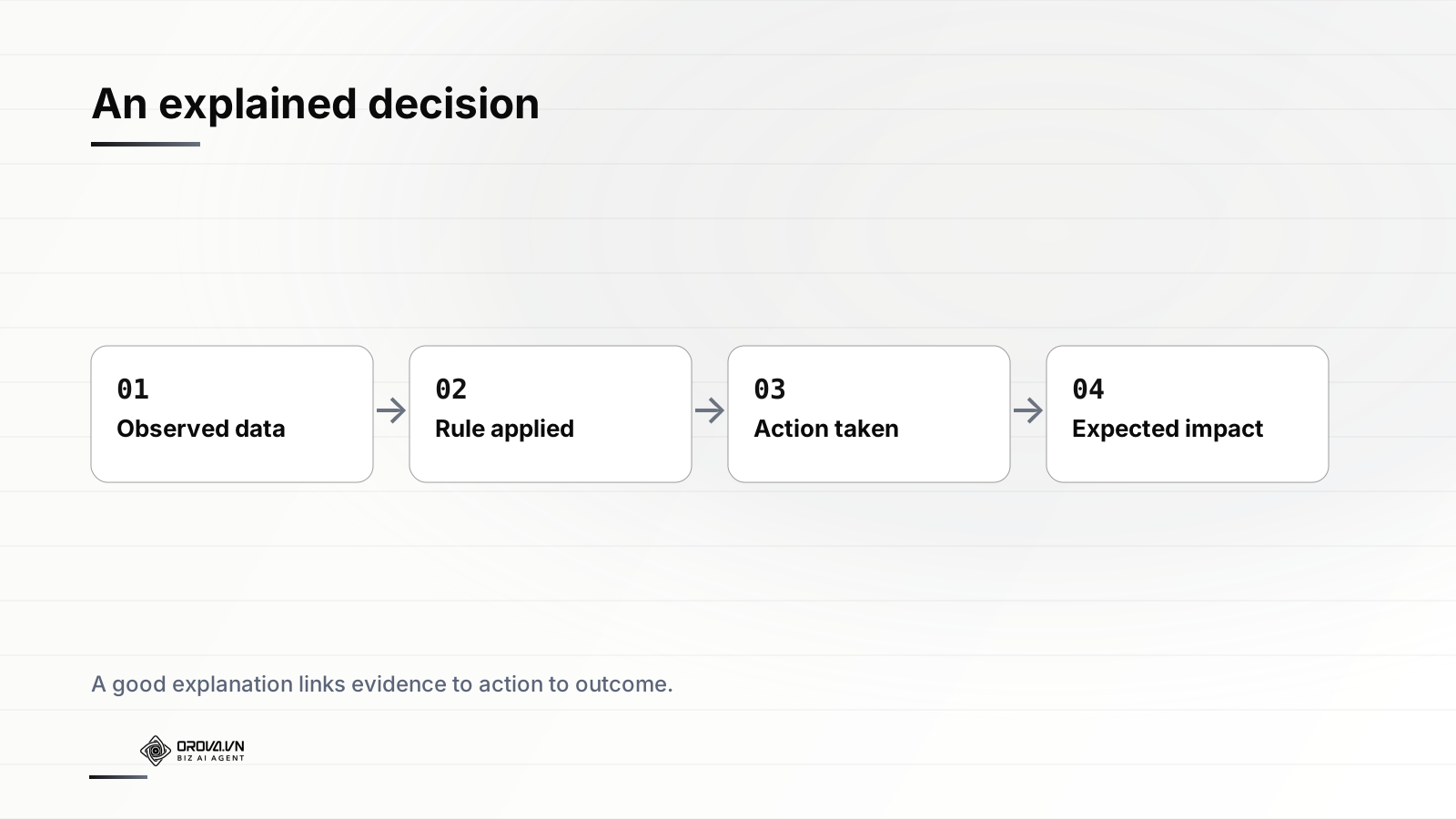
In ad management, an explanation has to be operational, not statistical. A good explanation answers three concrete questions, and it answers them in the language of the work:
- What did the agent observe? The specific data that triggered attention. Not "performance signals" — the actual numbers. "Campaign A spent $312 over the last 3 days with 2 conversions, a CPA of $156 against a target of $60."
- What rule or logic applied? The decision criterion that turned that observation into a candidate for action. "When a campaign exceeds 2x target CPA across a 3-day window with statistically meaningful volume, recommend a budget reduction."
- What action was taken, and what outcome is expected? The change itself plus a falsifiable prediction. "Reduced daily budget from $120 to $70; expected to cut wasted spend by roughly $50/day while preserving the top-performing ad set."
Notice what this structure does. It links evidence to action to outcome in a chain a non-technical stakeholder can follow. Observation justifies the rule firing; the rule justifies the action; the expected impact makes the action testable. If you can't produce that chain, you don't have an explanation — you have a press release for a decision you can't actually account for.
The difference between transparency and explainability
People conflate these, and the distinction matters. Transparency is being able to see what happened: a log that says "budget changed from $120 to $70 at 02:14 UTC." Explainability is being able to understand why it happened. A system can be perfectly transparent and completely inscrutable — a million-line audit trail that records every keystroke tells you nothing about reasoning. Conversely, a good explanation without a log is just a claim you can't verify.
You need both, and they serve different people. Transparency serves the auditor and the compliance officer; it answers "can we prove what occurred." Explainability serves the practitioner and the manager; it answers "do we agree with the judgment." The best ad automation systems treat these as two halves of one feature, not as competing priorities. We've written more about the verification side in our guide on how to audit an AI ad agent's decisions, because the explanation and the audit are inseparable in practice.
Why the black box is so dangerous with paid media specifically
Plenty of AI applications can tolerate opacity. A recommendation engine that suggests a slightly suboptimal product costs you a fraction of a cent. A spam filter that miscategorizes one email annoys one person for one moment. Ad management is different in three ways that make the black box genuinely hazardous.
The actions are irreversible and compounding
When an agent pauses a campaign at 2 a.m. and that campaign was carrying your weekend retargeting, you don't get those impressions back. The auction moved on. Worse, paid media has momentum — platforms like Meta and Google reward consistent spend and learning-phase stability, so a single bad pause can knock a well-optimized campaign out of its learning phase and degrade performance for days after you correct the mistake. A wrong decision isn't a point error; it's a trajectory error. You need to catch the reasoning before the action compounds, which is only possible if the reasoning is visible.
The stakes scale with the budget
An agent managing $5,000/month and an agent managing $500,000/month run the same logic, but the consequences of an unexplained mistake differ by two orders of magnitude. At scale, "trust me" is not an acceptable operating model. The CFO who signs off on a half-million-dollar media budget is going to ask how it's being controlled, and "an AI manages it and we're not totally sure how" is the kind of answer that gets automation banned company-wide after one bad quarter.
The domain is adversarial and non-stationary
Ad platforms change their algorithms, competitors change their bids, seasonality shifts demand, and your own creative fatigues. A model that was right last month can be confidently wrong this month for reasons that have nothing to do with the model and everything to do with the world changing underneath it. When the explanation is visible, a smart human can spot the stale assumption — "the agent is still optimizing for the Black Friday pattern and it's now January." When it's a black box, you only find out through lost money.
Explainability is what makes human-in-the-loop actually work
Most responsible ad automation today runs with a human in the loop — the agent recommends, a person approves. This is the right default. But here's the uncomfortable truth: human-in-the-loop is only meaningful if the human can actually evaluate the recommendation. If the agent says "reduce budget on Campaign 7 by $50" with no reasoning attached, what is the human supposed to do? They have two real choices: rubber-stamp everything (in which case the "loop" is theater) or investigate every recommendation from scratch (in which case the automation saves no time at all).
Explainability is the thing that makes the third, useful option possible: informed approval. When the recommendation arrives with its observation, rule, and expected impact, the human can do in five seconds what would otherwise take fifteen minutes of digging. They read the reason, sanity-check it against context the agent might not have ("oh, that campaign underperformed because we ran out of inventory, not because the targeting is wrong"), and approve or reject with actual judgment. The explanation isn't a nice-to-have wrapped around the decision. It's the interface through which human oversight is exercised at all.
Approval at speed requires reasons
Consider the math of a busy account. An agent reviewing a portfolio of 40 campaigns daily might surface 8–12 recommended actions. If each one requires the human to independently re-derive the rationale, you've replaced manual optimization with manual review of automated suggestions — no net gain. If each one arrives pre-explained, the human processes the whole batch in a few minutes, applying the one thing the machine can't: contextual judgment about whether the reasoning holds in the real world. The reason is what converts approval from a bottleneck into a quick, high-leverage checkpoint.
Rejection is data, but only if reasons exist
There's a second, subtler benefit. When a human rejects an explained recommendation, that rejection is interpretable. "I rejected the budget cut on Campaign 7 because we're intentionally running it at a loss to seed the audience" tells the system something specific. Over time, those interpretable rejections become training signal — the agent learns the account's actual constraints, not just its averages. A black box gets rejections it can't learn from, because nobody can tell whether the action was wrong or the timing was wrong or the human was just nervous. Explained actions create a feedback loop that compounds into genuine institutional knowledge.
Explainability accelerates learning — for the humans, too
We talk about AI learning, but there's an underappreciated effect running the other direction: an explainable agent teaches the people who work with it. A junior media buyer who watches an agent reason through "this campaign exceeded 2x target CPA across a meaningful window, so I'm reducing budget to protect the top ad set" is absorbing a heuristic they can carry into manual work. The explanations become a kind of continuous, on-the-job apprenticeship in optimization logic.
This matters more than it sounds. One of the quiet risks of automation is skill atrophy — teams that stop understanding the work because a machine does it for them, until the day the machine does something weird and nobody knows enough to catch it. Explainable AI inverts that risk. Because every action carries its reasoning, the humans stay fluent. They're not passengers; they're reviewing the work of a very fast colleague whose logic is always on display. When the agent's reasoning is visible, disagreements become productive conversations about strategy rather than mysteries about behavior.
Faster diagnosis when things go wrong
And things will go wrong — no automation is perfect. The question is how fast you can diagnose and correct. With explained actions, post-mortems take minutes: you read the reason chain, find the flawed assumption, and patch the rule. "The agent cut budget because it counted view-through conversions as zero, but our attribution window was misconfigured" is a fixable, specific finding. With a black box, the same post-mortem becomes archaeology — you're guessing at what the model saw, running experiments to reproduce behavior, and frequently giving up with a shrug and a manual override. Explainability turns failure from a catastrophe into a learning event.
What a real explanation looks like — and what fake explainability looks like
Be skeptical, because "explainable" has become a marketing checkbox. A lot of tools slap a confidence score or a generic label on an action and call it transparency. Here's how to tell the difference between an actual explanation and decoration.
The anatomy of a genuine explanation
A real explanation for a budget action might read like this:
Reduced daily budget on "Retargeting – Cart Abandoners" from $120 to $75. Observed: over the trailing 3 days this campaign spent $358 and produced 3 conversions (CPA $119) against a target CPA of $55, while the account-wide average CPA was $61. The campaign's top ad set ("7-day cart, lookalike excluded") accounts for 80% of conversions at a CPA of $48; the remaining two ad sets are spending $71/day at a combined CPA of over $200. Rule applied: when a campaign exceeds 1.8x target CPA across ≥3 days with ≥$200 spend, trim budget toward the efficient ad set rather than pausing the campaign. Expected impact: cuts roughly $45/day of inefficient spend while preserving the converting ad set; reassess in 72 hours.
Read that and notice everything you can do with it. You can verify the numbers. You can disagree with the threshold ("1.8x is too aggressive for our margins"). You can spot context the agent missed ("those two ad sets are intentional brand awareness, leave them"). You can predict whether the action will work and check the prediction later. That is what an explanation is for: it gives the human a complete, contestable account.
The tells of fake explainability
By contrast, watch for these patterns, which look like explanations but aren't:
- Confidence theater. "Recommended with 87% confidence." A number with no derivation tells you nothing about whether to trust it; it just borrows the aesthetics of rigor.
- Vague categories. "Optimizing for performance." "Improving efficiency." These are restatements of intent, not accounts of reasoning. Every action "optimizes for performance" — that's the point of all of them.
- Post-hoc narration. Some systems generate a plausible-sounding sentence after the decision, using a language model to describe an action the model didn't actually reason its way into. The narration and the real cause can diverge completely. A genuine explanation comes from the same logic that produced the action, not from a storyteller bolted on afterward.
- Untestable claims. If the expected impact is "better results," there's nothing to check. A real prediction is specific enough to be wrong: "cuts $45/day of waste, reassess in 72 hours."
Explainability and accountability are the same project
Once you accept that every action needs a reason, a lot of other good practices fall out almost automatically, because explanation and accountability turn out to be the same discipline viewed from two angles.
Audit becomes trivial instead of painful
When each action is recorded with its observation, rule, and expected impact, the audit trail isn't a separate artifact you have to build — it's the natural byproduct of operating explainably. An auditor (internal, a client, a regulator, or just future-you trying to understand last quarter) can walk the log and reconstruct not just what happened but the reasoning behind it. Compare that to auditing a black box, where the "trail" is a sequence of state changes with no rationale, and you're left inferring intent from outcomes. The explained system answers audit questions in seconds; the opaque one turns every audit into an investigation.
Client trust is built on legible reasoning
For agencies, this is existential. A client paying you to manage their spend wants to know they're getting judgment, not a script. "Our AI agent reduced your budget on the underperforming retargeting campaign because it was running at 2x your target cost-per-acquisition, and here's the data" is a sentence that builds confidence. It positions the automation as a disciplined operator the client can interrogate. "Our system optimized your account" is a sentence that invites the question every agency dreads: "optimized how, exactly?" Explainability is what lets you answer that question with pride instead of panic.
Compliance and governance follow the reason chain
As AI governance frameworks mature, the ability to explain automated decisions is moving from best practice toward expectation. Whatever the specific regime, the underlying requirement is consistent: automated decisions that affect money or people should be accountable, contestable, and documented. An ad agent built around the observation-rule-action-impact chain is already most of the way to compliant by construction, because the chain is the documentation. Bolting accountability onto a black box after the fact is far harder than building on a foundation where every action already carries its reason.
How to evaluate an AI ad tool for explainability
If you're assessing automation for your accounts, push past the demo gloss with concrete questions. The answers will separate the genuinely explainable systems from the ones that just say the word.
- Show me a real action with its full reasoning. Not a marketing slide — an actual decision from a live account, with the data, the rule, and the predicted outcome. If the vendor can't produce one quickly, the explainability probably isn't real.
- Can I see the rule that fired? Every action should trace to a stated criterion. "The model decided" is not a rule. Ask whether you can read, and ideally adjust, the thresholds.
- Are the expected outcomes recorded and checked? A system that predicts impact and then measures whether the prediction held is one that's actually learning. A system that never looks back at its own forecasts is flying blind.
- What does the human approval flow look like? Does the human see the reasoning at the moment of approval, or do they have to go find it? The reason has to be present at the point of decision, not buried in a report nobody reads.
- How are my rejections handled? Can you tell the system why you rejected an action, and does that feedback change future behavior? Explanation should run both directions.
- How complete is the audit log? Every action — including the automatic ones — should be reconstructable later with its rationale intact. Spot-check whether the log captures reasoning, not just state changes.
A tool that answers all six with specifics is one you can actually trust with budget. A tool that gets vague on three of them is one you'll eventually turn off after it does something you can't explain to your boss.
The bottom line: a reason is the price of automation at scale
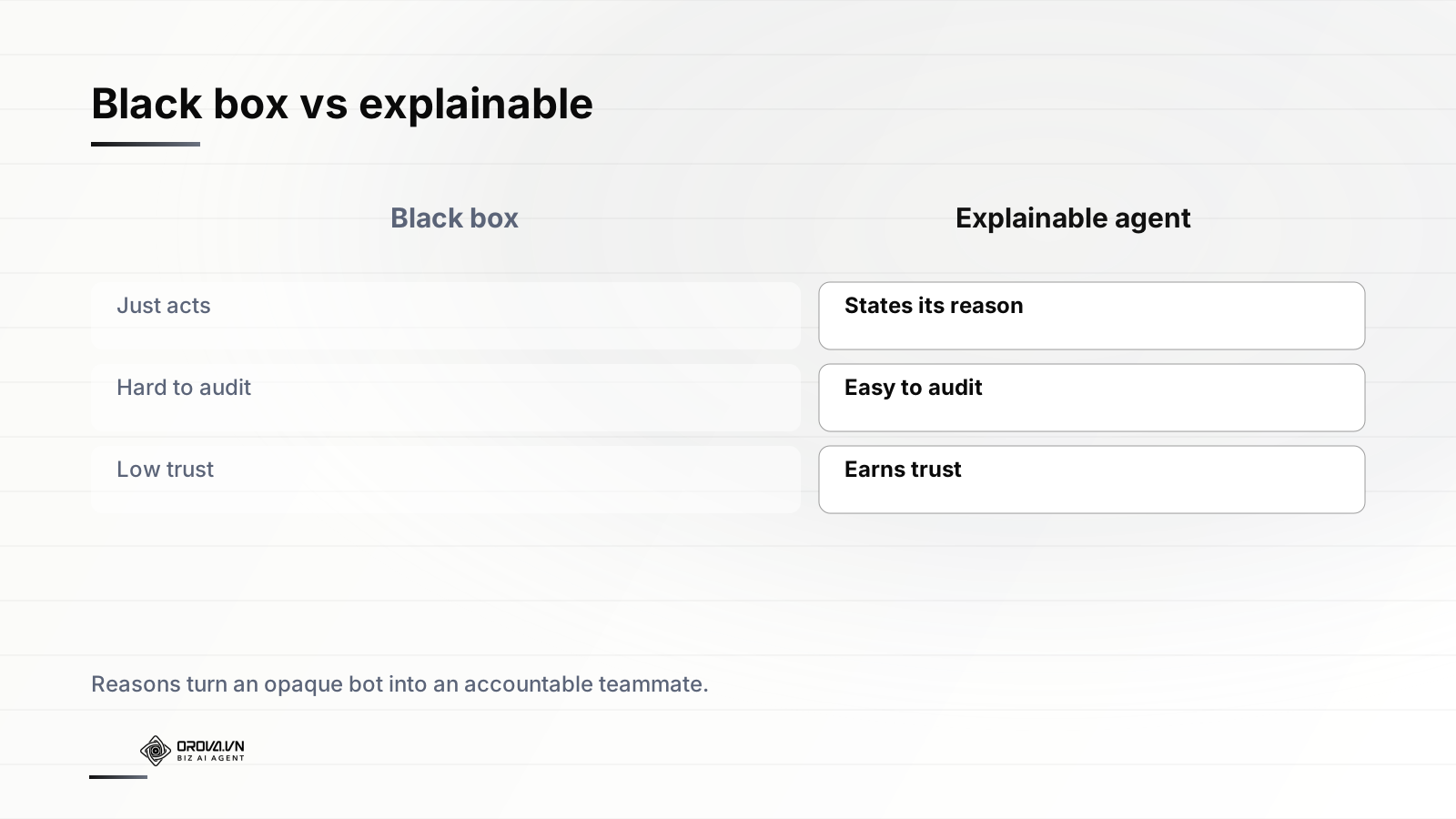
The instinct to demand a reason for every automated action isn't bureaucratic caution — it's the only thing that makes large-scale ad automation survivable. Without reasons, you're forced into a bad binary: blind trust or no trust. With reasons, you get something far more valuable than either — a fast, tireless operator whose judgment you can inspect, contest, correct, and learn from. The explanation is what turns an opaque bot into an accountable teammate, what makes human oversight real instead of ceremonial, and what lets the whole system get smarter over time instead of just busier.
Every action needs a reason because every action moves money, and money decisions in a serious operation must be defensible. That's not a constraint on automation. It's the foundation that lets automation scale past the point where any human could babysit it directly. Build the reasoning in from the start, and the audit, the trust, and the learning come almost for free. Leave it out, and you've built something fast that nobody can responsibly use.
If you want an AI agent that manages your paid spend across Google, Meta, and TikTok this way — reading your data every day, recommending optimizations with the data, rule, and expected impact spelled out, and executing budget, bid, on/off, and audience changes only with your approval and a full audit log behind every move — that's exactly how Orova Ads is built. Every action comes with its reason, so you stay in control while the agent does the heavy lifting.
Let a Tool Handle the Explaining, Not Just the Deciding
If you've read this far, you already know the real cost of automation without explanations isn't the bad decision itself — it's everything that happens after. Someone has to dig through logs, guess at what the system "probably" saw, write up a summary for the team, and rebuild trust from scratch every time something looks off. That's hours lost every week, on top of the stress of never quite knowing if the machine is helping you or working against you.
Orova Ads is built around the idea that every automated action should come with a plain-language reason attached, so you're not left reconstructing what happened after the fact. Instead of just adjusting bids and budgets quietly in the background, it aims to show you why it made the call, in terms you can actually act on. If that sounds like what your ad management has been missing, it's worth a look.
Orova Ads optimises campaigns for you
Connect Google, Meta and TikTok in one place. AI reads the numbers, proposes changes and executes under the rules you set.
Explore Orova Ads