
How a Small Team Handles Google Ads Management With AI
If you run a small team, you already know the feeling: every account looks fine on Monday and then something quietly breaks by Wednesday. A budget drifts past its limit, a winning ad goes stale, a competitor raises their bids, or a tracking tag stops firing and nobody catches it until the numbers look wrong on Friday. Google ads management for small business almost always comes down to this same trap — not too little effort, just too many small, repetitive things to watch at once. The stakes are real: according to the ANA Programmatic Transparency Study, roughly a quarter of programmatic ad spend is wasted on inefficient buying and invalid impressions, and that kind of leak is exactly what happens when nobody is watching closely enough, closely enough often enough.
The old way to fix this was to hire more people. More accounts meant more marketers, because someone had to physically check each campaign, catch each drift, and fix each small leak by hand. That approach works, but it is slow to scale, expensive to staff, and still depends on a human remembering to look at the right account on the right day — which is exactly where things fall through the cracks.
This article shows a different path: how a lean team can hand off the repetitive, rules-based checking work to an AI agent (software that follows set rules automatically) while keeping the judgment calls for themselves. By the end, you will understand what parts of account management can safely be delegated, what should always stay with a human, and how that shift lets a small team manage far more ad spend without losing quality or hiring their way out of the problem.
The real reason small teams hit a ceiling
To understand the leverage, you first have to understand the constraint. The constraint is not creativity or strategy. A talented marketer can write a brilliant campaign brief in an afternoon. The constraint is the sheer surface area of an active account once it is live.
Consider a single mid-sized e-commerce advertiser running across Google, Meta, and TikTok. On any given day there might be 30 active campaigns, 120 ad sets or ad groups, and 400 individual ads. Each of those objects has a budget, a bid strategy, an audience definition, a set of placements, and a stream of performance data that changes hourly. To "manage" this account well means, roughly:
- Checking every campaign against its target cost-per-acquisition or return on ad spend, and catching the ones drifting out of bounds before they burn a week of budget.
- Spotting creative fatigue, where an ad that converted at $18 last week now converts at $31 because the audience has seen it too many times.
- Reallocating budget from underperformers to the campaigns that are working, on a cadence fast enough to matter.
- Adjusting bids as auction dynamics shift, especially around weekends, paydays, and seasonal spikes.
- Pausing the long tail of placements, search terms, and audiences that quietly drain spend without returning anything.
Do the arithmetic. If a thorough daily review of one account takes 45 minutes, and a marketer has perhaps four productive hours before meetings and Slack and reporting eat the rest, they can credibly cover five accounts. Add a sixth and something gets skipped. The skipped thing is almost never the glamorous strategy work; it is the boring maintenance. And the boring maintenance is exactly where money leaks.
This is the trap small teams fall into. They are not short on ideas. They are short on the hours required to execute the unglamorous upkeep that keeps good ideas profitable. Hiring solves it by adding more hours, but hiring is slow, expensive, and risky, and a junior hire spends their first three months learning the accounts before they add net capacity. For a lean team, that is a brutal trade.
Why "just use the platform's automation" is not the answer
Every ad platform offers automated bidding and budget tools. They are useful and you should use them. But they optimize toward the goal you hand them inside their own walls, and they have a structural incentive to spend your budget. None of them looks across Google, Meta, and TikTok together to decide where the next dollar belongs. None of them explains, in plain language, why it made a change. None of them asks your permission. And none of them knows the context that lives in your head, that this campaign is a brand-awareness play you are willing to run at a loss, or that you must not scale that other one because inventory is tight.
Platform automation is a power tool. An AI agent is a teammate that operates the power tools on your behalf, across every platform at once, under rules you set, and reports back. The distinction matters enormously when you are trying to scale.
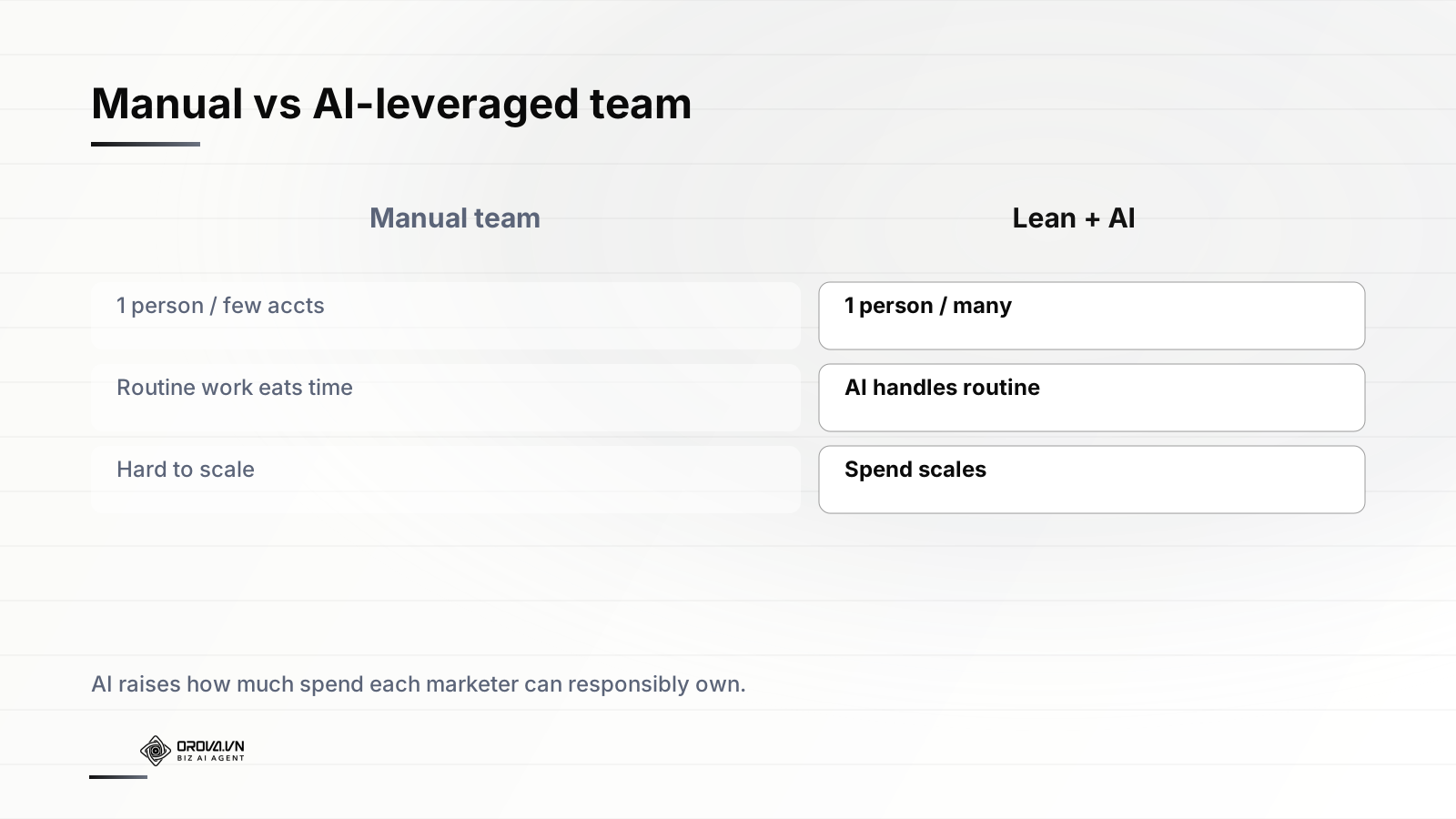
The delegation map: what goes to the agent, what stays with you
The single most important decision in building leverage is drawing a clean line between the work a machine should do and the work a human must do. Get this wrong in either direction and you suffer: delegate too little and you have an expensive tool that changes nothing, delegate too much and you wake up to an account that pursued a metric off a cliff because it had no judgment about your business.
Here is the map that works in practice. It splits the account into two layers.
The repetitive layer: delegate this
This is the daily and intra-day maintenance that is rules-based, data-driven, and high-frequency. It is work where the right answer can be derived from the numbers plus a clear policy, and where doing it faster and more consistently is strictly better. The agent earns its keep here:
- Budget reallocation. Shifting spend from campaigns missing their target toward campaigns beating it, within ceilings you define. A human doing this weekly leaves money on the table; an agent doing it daily compounds the gains.
- Bid adjustments. Nudging bids up where there is profitable headroom and down where cost-per-result is creeping past target.
- Pausing waste. Turning off the ads, ad sets, placements, and search terms that have spent enough to judge and have clearly failed. This is tedious, endless, and exactly what software is good at.
- Fatigue detection. Flagging creatives whose performance has decayed past a threshold so they can be refreshed before they drag the account down.
- Audience pruning and expansion. Trimming audiences that no longer convert and surfacing lookalikes or segments worth testing.
- Anomaly alerts. Catching the spend spike, the dropped conversion tag, the campaign that suddenly ate 4x its normal budget at 2am.
Notice that all of these share a property: the cost of doing them late or inconsistently is real money, and the decision logic can be made explicit. That is the signature of work that belongs to the machine.
The judgment layer: keep this human
The other half of the account is where judgment, taste, and accountability live. This work is low-frequency, high-stakes, and deeply contextual. No agent should own it, and you should be suspicious of any vendor who suggests otherwise:
- Strategy and goals. Which markets to enter, what overall ROAS or CPA target the business can sustain, how aggressively to chase growth versus protect margin. This flows from the business, not the data.
- Creative direction. What the ads say, what they look like, the angle, the offer, the brand voice. An agent can tell you a creative is fatiguing; it cannot tell you what the next great hook should be.
- Budget envelopes and guardrails. The maximum any single campaign may reach, the floor you will never starve, the brand campaigns exempt from pure efficiency rules.
- Approvals on material changes. The human in the loop who reviews and signs off on consequential moves before they go live.
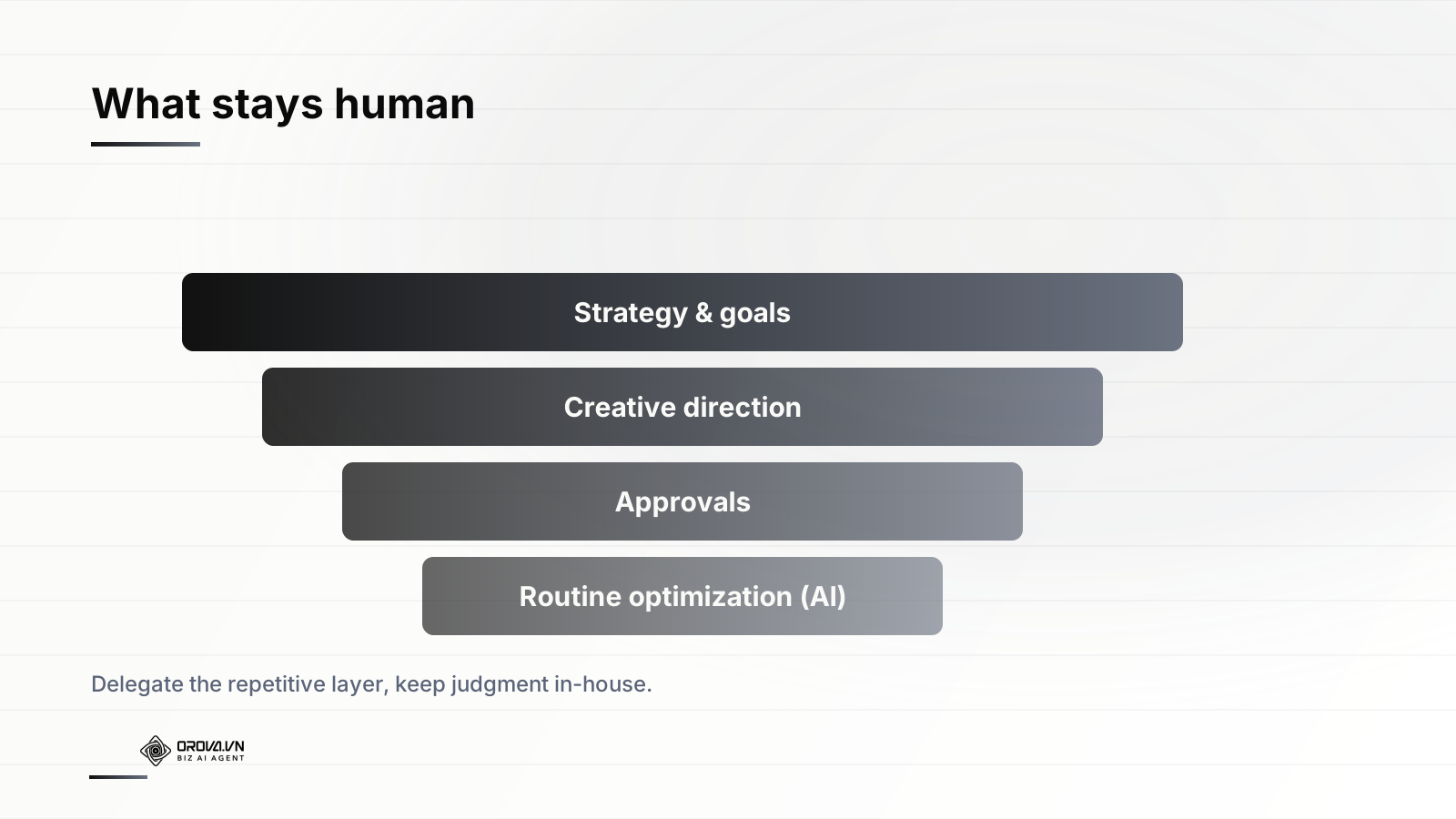
The clean version of this split is captured in the funnel below: strategy, creative, and approvals sit at the top as human responsibilities, while the routine optimization that used to consume your week becomes the agent's job. The relationship is not "AI replaces marketer." It is "AI handles the repetitive layer so the marketer spends their hours on the layer only a human can do."
How the per-marketer spend ceiling actually rises
Let us return to that ceiling, the $40,000 to $80,000 of monthly spend a single marketer can responsibly own. The reason it is so low is that maintenance scales linearly with the number of objects in the account, and a human's hours are fixed. Double the campaigns and you double the maintenance, but you do not double the marketer.
When the agent absorbs the maintenance layer, the marketer's time is freed for work that scales differently. Strategy and creative direction do not multiply one-for-one with spend. Setting a budget guardrail for a $200,000 account takes about as long as setting one for a $50,000 account. Reviewing a batch of proposed changes takes minutes regardless of whether those changes touch five campaigns or fifty. The work that remains human is, by its nature, leveraged: a single good decision propagates across the whole account.
In practice, teams that adopt this model report the per-marketer ceiling rising substantially, often to two or three times the previous figure. A marketer who comfortably owned $60,000 in monthly spend across four accounts can credibly steward $150,000 to $200,000 once the agent is doing the daily upkeep, because their hours now go to the decisions that move the needle rather than the chores that merely prevent decay. The exact multiple depends on account complexity and how disciplined your guardrails are, but the direction is consistent and the mechanism is not mysterious. You removed the linear constraint.
The point of leverage is not to do the same work faster. It is to stop spending your scarcest hours on work that never needed a human in the first place, and to redirect them to the work that does.
A concrete picture
Imagine a three-person growth team at a direct-to-consumer brand. Before adopting an agent, they ran roughly $180,000 a month across Google and Meta, and it felt stretched. Mornings went to dashboards, afternoons to firefighting, and TikTok stayed on the wish list because nobody had the hours to babysit a third platform.
After the agent took over the maintenance layer, the same three people opened the TikTok channel, pushed combined monthly spend past $400,000, and reported spending less time in the platforms, not more. The agent ran its daily review across all three channels, proposed budget shifts and bid changes, paused the long tail of waste, and flagged fatiguing creatives. The team's mornings shifted from "what broke overnight" to "which of these proposed changes do we approve, and what should we test next." That is the leverage made tangible: more spend, more channels, fewer hours, same headcount.
Keeping approvals manageable instead of moving the bottleneck
There is a legitimate worry hiding inside all of this. If the agent proposes changes and a human must approve them, have you simply replaced the maintenance bottleneck with an approvals bottleneck? If a marketer now has to review 200 individual change requests a day, you have not bought leverage; you have bought a new kind of tedium.
The answer is to design approvals around tiers of consequence rather than treating every change as equal. Not all decisions carry the same risk, so not all decisions deserve the same scrutiny. A well-built system lets you set this policy once and then runs within it.
Tier the decisions
- Low-stakes, fully automated. Pausing an ad that has spent $200 with zero conversions, or trimming a search term that is clearly junk, does not need a human. The downside is bounded and the logic is unambiguous. Let the agent act and log it.
- Medium-stakes, batched approval. Budget shifts within a defined range, bid adjustments, audience tweaks. The agent proposes these and presents them as a digest, so a marketer approves twenty sensible moves in two minutes rather than fielding twenty interruptions.
- High-stakes, explicit sign-off. Scaling a campaign past a major budget threshold, turning off a top spender, or anything that touches a campaign you flagged as sensitive. These always wait for a human yes.
This tiering is the crux of the whole model, and it is exactly the territory covered in our deeper look at when to let an agent execute autonomously versus when to keep it in advisory mode. The short version: you do not pick one setting for everything. You map each type of action to the level of human involvement its risk deserves, and you tighten or loosen that map as trust builds. New accounts and new channels start conservative; once you have watched the agent make good calls for a month, you let more of the low-stakes work run on its own.
Make every change auditable
Approvals only stay manageable if you trust the system, and trust requires visibility. Every change the agent makes or proposes should carry a plain-language rationale and a full record: what changed, when, why, what the metrics were before, and who approved it. This does three things. It lets you spot-check the agent's reasoning instead of re-deriving every decision. It gives you a defensible trail when a client or a CFO asks why spend moved. And it turns the agent into something you can actually learn from, because the patterns in its rationales teach the team what good optimization looks like.
An audit log is not bureaucratic overhead. For a small team, it is the thing that makes delegation psychologically possible. You can hand over the maintenance layer precisely because you can always see exactly what was done in your name.
Building the operating rhythm
Leverage is not a switch you flip; it is an operating rhythm you settle into. The teams that get the most from an AI agent tend to converge on a similar cadence, and it is worth describing because it shows how the human and the machine divide the calendar, not just the tasks.
- Daily, automated. The agent runs its full review every morning, acts on the fully-automated tier, and assembles a digest of everything in the approval tiers. By the time the team logs on, the routine work is either done or waiting in a tidy queue.
- Daily, human, ten minutes. A marketer reviews the digest, approves the batch, rejects anything that does not fit context the agent could not know, and notes anything worth a closer look. This replaces the old hour-long firefighting session.
- Weekly, human, one hour. The team reviews trends across all channels, decides what to test next, briefs new creative, and adjusts guardrails if the business has shifted. This is the strategy work the agent freed up time for.
- Monthly, human. A harder look at the spend ceiling and the trust map. Has the agent earned more autonomy on certain actions? Should any thresholds change? Are there new accounts or channels to bring under management now that capacity exists?
The shape of this rhythm is the whole argument in miniature. The high-frequency, low-judgment work belongs to the agent and happens automatically. The low-frequency, high-judgment work belongs to humans and happens on a calendar. The marketer's day stops being a treadmill of maintenance and becomes a sequence of decisions, which is what they were good at all along.
What to watch for as you scale
A few honest cautions, because leverage misapplied creates its own problems:
- Do not delegate before your tracking is solid. An agent optimizing toward a broken conversion signal will confidently make things worse. Fix measurement first.
- Do not set guardrails and forget them. Business context changes. The budget ceiling that was right in Q1 may be wrong in Q4. Revisit them.
- Do not chase a single metric blindly. An agent told only to minimize CPA may starve campaigns that build the brand and feed future demand. Encode the nuance in your goals.
- Do not skip the audit log review. Trust is built by checking, especially in the first month. Read the rationales. Calibrate.
None of these are reasons to avoid the model. They are reasons to adopt it deliberately. The leverage is real, but it is leverage on top of a sound foundation, not a substitute for one.
The bottom line for lean teams
The old equation said that scaling spend meant scaling headcount, because account management is mostly maintenance and maintenance scales linearly with the size of the account. That equation is broken, and breaking it is the single biggest operational advantage available to a small marketing team right now. By delegating the repetitive, rules-based layer to an AI agent and keeping strategy, creative, and approvals in human hands, a three-person team can responsibly manage what used to require eight or ten people, and each marketer's spend ceiling rises by a factor of two or three.
The catch, and it is a real one, is discipline. The leverage only works if you draw the delegation line cleanly, tier your approvals by consequence, and insist on a full audit trail so trust is earned rather than assumed. Do that, and you get the rare thing in marketing: more capacity without more cost, and more control rather than less.
If you are a lean team trying to manage more spend across Google, Meta, and TikTok without hiring, this is exactly what Orova Ads is built for. It is an AI agent that reads your account data every day, recommends and executes optimizations across all three platforms, budgets, bids, on/off decisions, and audiences, and keeps every change under human-in-the-loop approval with a complete audit log. You set the strategy and the guardrails; the agent handles the relentless daily upkeep. See how much spend your team could responsibly own at orova.vn.
Let the busywork run itself
If you have read this far, the pattern is clear: most of what limits a small team is not strategy, it is the constant maintenance — checking budgets, catching drift, watching for broken tags, reacting to competitor moves. Doing that by hand, account by account, is where hours disappear every single week, even for a sharp marketer.
Orova Ads is built to take that maintenance layer off your plate, handling the routine checks and daily monitoring automatically so your team can focus on strategy and judgment calls instead of babysitting campaigns. If that sounds like the kind of leverage your team could use, it is worth taking a look.
Related reading: UGC Ads at Scale Playbook
Read next: Google Performance Max: How It Works and What to Watch · Performance Max Search Themes: How to Use Them Right · Google Ads Optimization: 200+ Actions an AI Agent Can Do · AI Ads Agent Setup: What to Do in Your First Week
Orova Ads optimises campaigns for you
Connect Google, Meta and TikTok in one place. AI reads the numbers, proposes changes and executes under the rules you set.
Explore Orova Ads