
Long-Tail Keywords in the AI Era: Do They Still Work?
Somewhere around 2022, a consensus quietly formed in SEO circles that the long tail was finished. Keyword tools showed zero volume for anything longer than five words. Google's language models had become so good at mapping odd phrasings onto common intents that a thousand variant queries collapsed into one results page — so why write for the variants? The professional advice hardened into "target the head and mid-tail, let Google's understanding handle the rest." It was reasonable advice, built on accurate observations. It is also now wrong, and it is worth being precise about why.
The long tail did not die. It migrated. The same demand that once arrived as millions of rare, specific search queries now arrives as prompts in chat boxes — ChatGPT, Gemini, Perplexity, Google's AI Mode — and as the synthetic sub-queries those systems generate behind the scenes. The tail is longer, more specific, and more commercially loaded than it ever was in the keyword era. It is simply invisible to the tools that were built to measure the old tail, which is why most teams have concluded it no longer exists at the exact moment it started mattering most.
This is an analysis piece: I want to trace where the long tail actually went, look at the mechanics of how it now reaches your content, and work out what a long-tail strategy means when the tail can no longer be enumerated in a spreadsheet.
Long-tail search did not disappear — it moved into AI chat interfaces, where prompts average far more words than classic queries and AI engines expand every question into dozens of specific sub-queries. Content that covers a topic's full constraint space gets retrieved for this invisible tail, even though no keyword tool can measure it.
A short history of the tail, in three acts
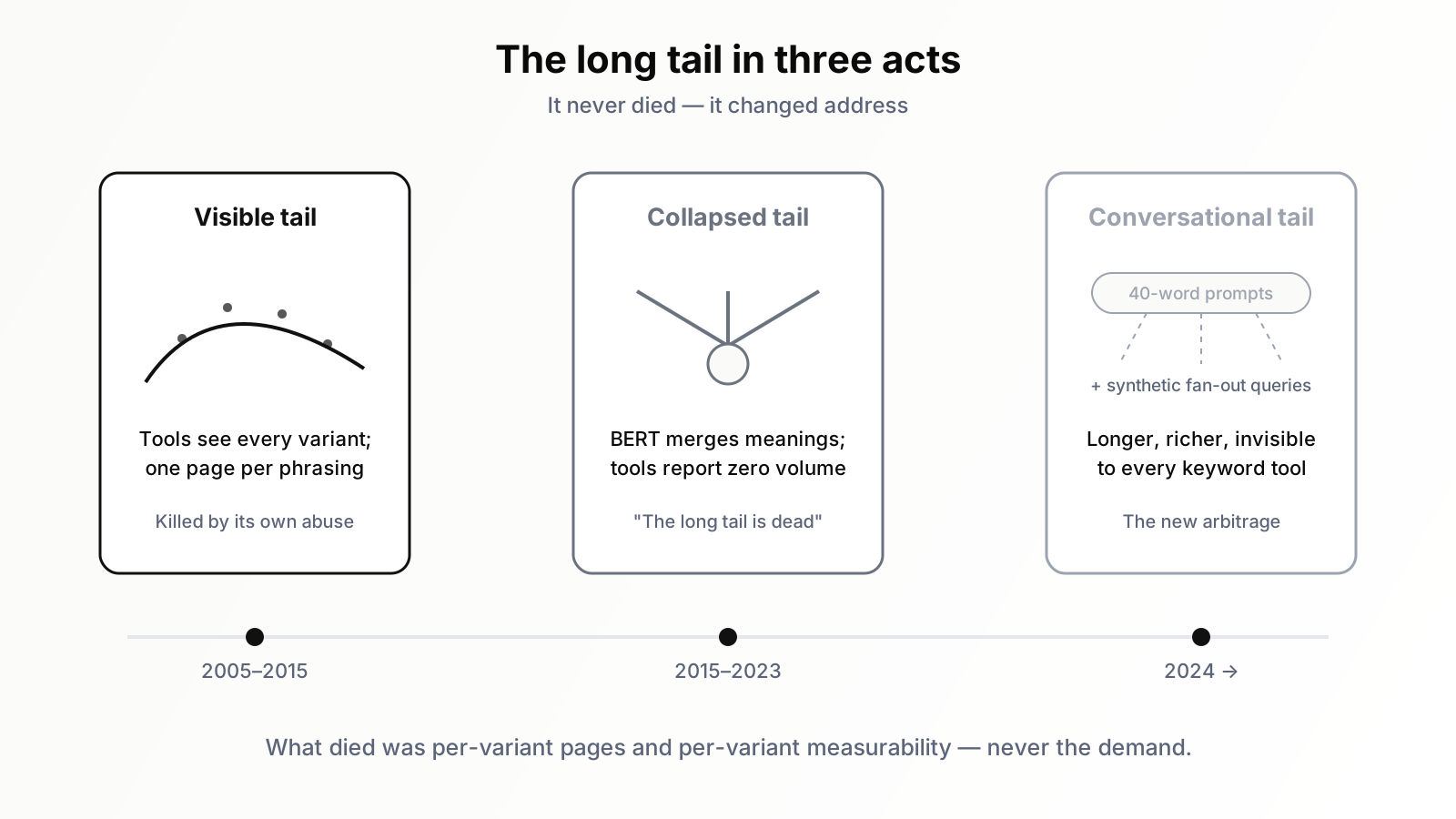
To see why the migration matters, rewind the story. Act one, roughly 2005 to 2015: the visible tail. The long tail was SEO's favourite arbitrage. Head terms were brutal; the millions of three-to-seven-word variants were not, and they collectively carried more demand than the heads did. Tools could see them, sites could target them — often with a dedicated page per variant — and the strategy worked until it was abused into oblivion by doorway pages and thin programmatic content.
Act two, roughly 2015 to 2023: the collapsed tail. Google responded with semantics. RankBrain, then BERT, then MUM meant the engine stopped matching strings and started matching meanings. A thousand phrasings of the same need began returning essentially the same results, so a dedicated page per phrasing became pointless — worse, it became a quality liability. Keyword tools, which estimate volume from clickstream samples, increasingly reported the tail as zero: each individual phrasing was too rare to register, even as the aggregate remained enormous. This is the era that produced "the long tail is dead." What actually died was the per-variant page strategy and the per-variant measurability. The demand never went anywhere.
Act three, 2024 onward: the conversational tail. Chat interfaces removed the behavioural ceiling that kept queries short. A Google search box trained users for two decades to compress ("crm small business"); a chat box trains them to elaborate ("we're a five-person agency on Google Workspace, we've outgrown spreadsheets, and we need a CRM under $50 a seat that won't take a month to set up — what should we look at?"). That is a forty-word query. In keyword-era terms it is so far down the tail it has no name. In a chat interface it is just a normal message — and some version of it is asked, in unique words, thousands of times a day across the assistant platforms. The tail did not regrow. It exploded.
The mechanics: how the invisible tail reaches your content
If long-tail demand now lives inside conversations, the obvious question is how any of it can possibly touch your website. The answer has two halves: retrieval and fan-out.
The retrieval half is straightforward. ChatGPT Search, Perplexity, Gemini, and Google's AI features do not answer purely from model memory for anything current or specific; they search, fetch pages, and synthesise an answer with citations. Every one of those forty-word prompts triggers retrieval against an index, and your content either gets pulled into the answer's source set or it does not. That is long-tail matching — the same game as 2009, except the "results page" is now an answer paragraph and "ranking" means being selected as a source. How engines pick those sources is the subject of our analysis of how Google builds an AI Overview.
The fan-out half is the part most teams have not internalised. Google has publicly described the query fan-out technique behind AI Mode and AI Overviews: the system takes the user's prompt and generates multiple related sub-queries — narrower, more specific, differently-angled — runs them all, and synthesises across the results. A single human query becomes a bouquet of machine-generated long-tail queries. The user typed one question; your content competed in perhaps a dozen retrievals, eleven of which were phrasings no human typed at all. The long tail has become partially synthetic: an inexhaustible stream of specific queries generated by machines, on behalf of humans, against which your content is matched continuously and invisibly.
Put the halves together and you get the strange new shape of the game. In the keyword era, the long tail was visible and you targeted it query by query. Now the tail is invisible and you cannot target it query by query — there is no list, the list is generated fresh per conversation. You can only target the space the queries are drawn from. Which has a name worth dwelling on.
From keyword lists to constraint space
Look again at the forty-word CRM prompt. Strip the politeness and it is a head term plus a stack of constraints: team size (five people), current tooling (Google Workspace, spreadsheets), budget (under $50 a seat), setup tolerance (under a month). Every realistic long-tail query in a topic is built this way — a core need multiplied by the constraints real situations impose. The set of plausible constraints is not infinite. Team size, budget, industry, region, stack, urgency, skill level, compliance needs: for any given topic, a couple of hours of honest thinking (or one pass through your sales-call notes) yields the ten or fifteen constraint dimensions that generate virtually the entire tail.
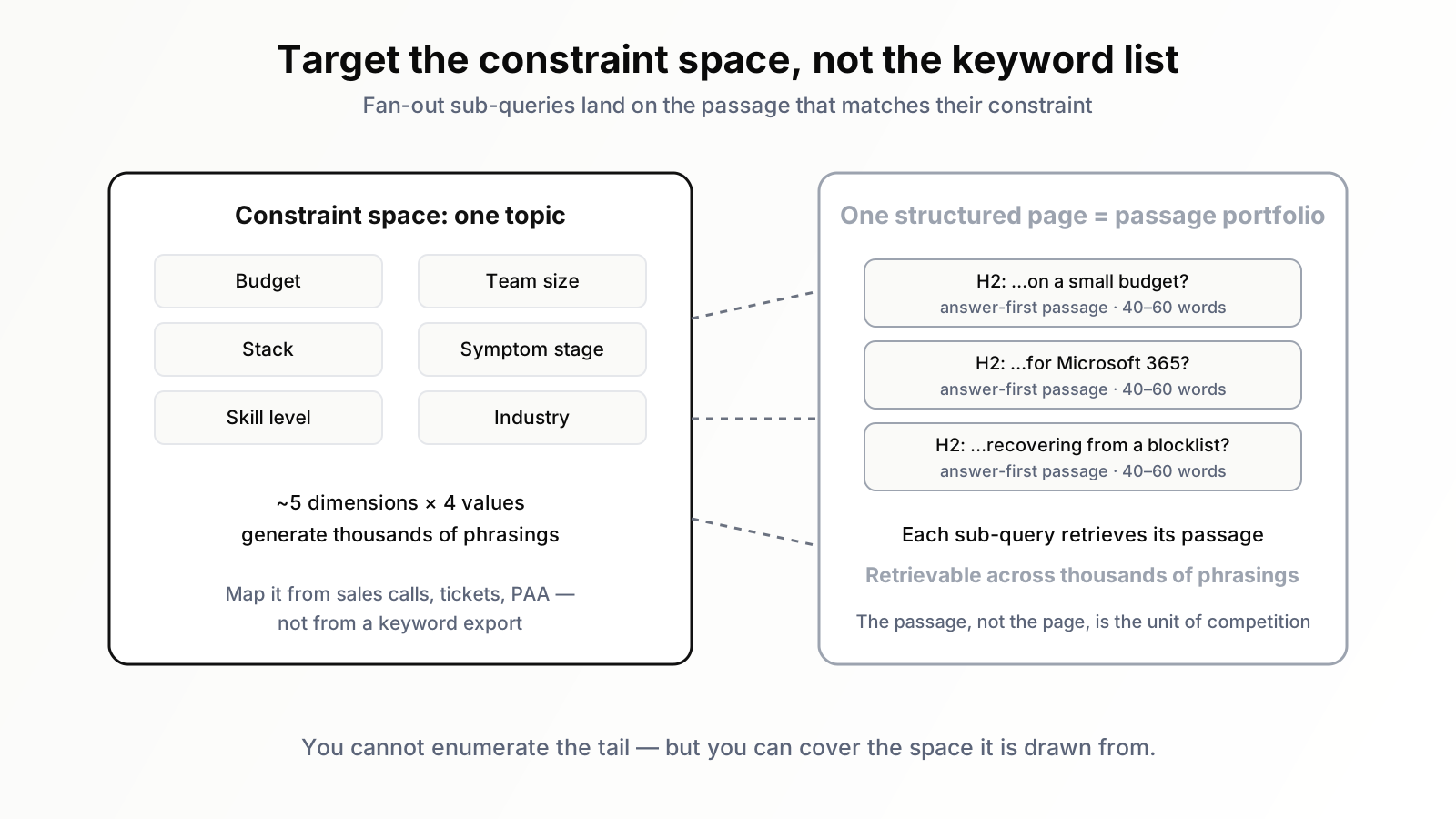
That is the strategic unlock. You cannot enumerate the tail, but you can map the constraint space that generates it. Content built to cover the constraint space — explicitly addressing how the answer changes for small teams versus large, cheap versus premium, regulated versus not, beginner versus expert — is retrievable across thousands of tail phrasings it never mentions verbatim, because each fan-out sub-query lands on the section addressing its constraint. This is materially different advice from "write comprehensive content." A page can be five thousand comprehensive words and still cover one cell of the constraint matrix. Coverage now means breadth across situations, not depth on one.
Notice also what this does to the old fear of cannibalisation. In the per-variant era, covering many variants on one page risked diluting; covering them on many pages risked competing with yourself. In the retrieval era the unit of competition is the passage, not the page. An AI engine fanning out a query retrieves passages, and a well-structured page contributes several distinct passages to several distinct sub-queries. The page is a portfolio of answers. Structure — clear question-style headings, self-contained answer-first sections — is what lets the portfolio pay out, which is why the formatting discipline in our guide to writing for conversational queries is not a style preference but a retrieval strategy.
The evidence that the tail still pays
An analysis should show its receipts, so here is the observable evidence — some public, some from our own logs, stated generically.
First, the query-length drift is in everyone's Search Console. Filter your own queries by word count over the last three years: in most accounts we have examined, the share of impressions from queries of five-plus words has climbed steadily, and question-pattern queries have climbed faster. That is the human side of the migration showing up even inside classic search, as chat-trained users type chat-shaped queries into Google.
Second, the referral patterns from AI engines skew tail-ward. When Perplexity or ChatGPT Search sends a visitor, the landing page is disproportionately a deep, specific page — a follow-up answer, a comparison for a narrow situation, an edge-case how-to — rather than the homepage or the head-term pillar. Assistants answer specific questions, so they cite specific passages. Our research piece on where Perplexity actually sends traffic found the same shape: the pages earning assistant citations were rarely the pages winning the head terms.
Third, and most telling: pages we built for zero-volume specificity outperform their dashboards. Articles targeting questions every keyword tool scored at zero routinely accumulate impressions for hundreds of distinct rare phrasings, earn AI citations, and convert entrances at multiples of head-term content — the pattern we documented first-hand in the follow-up question goldmine. The tail pays; it just refuses to be invoiced under the keyword's name.
A worked example: mapping one topic's constraint space
Abstractions are cheap, so let me make the constraint-space idea concrete with a topic everyone can picture: "email deliverability" for a SaaS audience. The head term is one phrase. The constraint space behind it, assembled in an afternoon from sales notes, support threads, and PAA trees, looks like this:
- Sender type — marketing newsletters, transactional email, cold outreach, product notifications. The honest answer differs sharply across these; cold outreach advice applied to transactional mail is actively harmful.
- Volume tier — a hundred emails a day versus a hundred thousand. Warm-up advice, infrastructure choices, and provider thresholds all pivot on this dimension.
- Stack — Google Workspace versus Microsoft 365 versus a dedicated sending platform; each has its own failure modes and settings.
- Symptom stage — preventing problems, diagnosing a sudden drop, recovering from a blocklist. Same topic, three completely different searcher emergencies.
- Technical depth — a founder who needs the one-paragraph version versus an engineer who needs DNS record syntax.
Five dimensions, four-ish values each. That small grid generates the overwhelming majority of real-world phrasings — "why did our transactional emails suddenly start going to spam on Microsoft 365" is just a path through the grid (transactional × diagnosing × Microsoft stack). A content cluster designed against this grid — one pillar walking the whole topic, cluster pages for the high-stakes cells, answer-first sections for the rest — is retrievable across thousands of conversational phrasings nobody will ever type twice. The same exercise works for any topic you sell into; if you cannot name your topic's five constraint dimensions, that is the research gap to close before writing anything else.
What dies, what survives: the strategic ledger
If the tail has moved into the chat box, some long-running practices are now on the wrong side of history, and it is worth being blunt about which.
Dead: the variant-page playbook. Programmatically generating a page per phrasing was already a liability under the helpful content era; under fan-out retrieval it is pure waste, because the engine maps variants to meanings before retrieval ever happens. A hundred thin variant pages now lose to one structured page with a hundred good passages.
Dead: volume as the admission ticket. Any content process that begins with "what's the search volume?" silently filters out the entire conversational tail, because the tail's volume is unmeasurable by construction. Volume still matters for head-term prioritisation; as a gate for question content, it is a machine for ignoring your best opportunities.
Surviving, transformed: long-tail intent research. The research instinct — find the specific, underserved need — matters more than ever; only the sources changed. Sales calls, support threads, community posts, PAA trees, and your own GSC question queries replace the keyword export — the full sourcing playbook is in our guide to question keywords as a goldmine. You are mapping constraint dimensions now, not collecting strings.
Surviving, promoted: topical architecture. Pillar-and-cluster structure was good practice before; under fan-out it is close to mandatory, because the engine's sub-queries spread across a topic's whole surface and reward sites that cover the surface coherently. The cluster, not the page, is the unit that competes for a conversation. The pillar logic in our AI Overviews complete guide applies directly here.
New on the ledger: passage discipline. The craft of writing self-contained, quotable, answer-first passages — 40 to 60 words that survive being lifted out of context — is to the conversational tail what title tags were to the keyword tail: the smallest unit of optimisation with the largest aggregate effect.
The obvious objection: doesn't the head still win?
A reasonable strategist will push back here: if AI engines synthesise answers anyway, why not just keep fighting for the head terms and let the engines do the fanning? Two reasons the objection fails. First, the head and the tail are no longer separate contests — fan-out makes tail coverage part of the head contest. When the engine expands the head question into specific sub-queries, the site that answers the sub-queries supplies more of the synthesis and earns more of the citations, even on the head query itself. Tail coverage is how you show up at the head now; we have watched our own deep tail pages get cited inside AI Overviews triggered by head terms our pillar never won in classic rankings.
Second, the head terms are where AI compresses hardest. Generic head questions get fully satisfied inside the AI answer — the searcher reads the overview and leaves, the classic zero-click squeeze. The constrained tail question is where the searcher's situation is specific enough that they click through for the detail, the tool, or the next step. In click-through terms, the tail is not the leftovers of the head; increasingly it is where the remaining clicks live. Betting everything on head terms in 2026 means betting on the exact segment of search where clicks are evaporating fastest.
There is also a competitive asymmetry worth naming. Big competitors with big content teams are still mostly running volume-gated processes — their roadmaps are sorted by keyword tools, which means they are structurally blind to the same tail you are. Unlike the head terms, where their authority advantage is decisive, the conversational tail is a contest they have not entered. Smaller sites that cover a constraint space thoroughly beat larger sites that cover it incidentally, because retrieval rewards the best passage, and the best passage for a constrained query is almost always on the site that wrote for that constraint on purpose.
The measurement problem, honestly stated
Here is the uncomfortable part of the analysis: you will never get clean attribution for most of this. Search Console anonymises rare queries, so the visible question list is a sample of your tail, not a census. AI Overview impressions blend into normal search reporting. Assistant platforms send referrers inconsistently, and the fan-out sub-queries your content matched are not reported anywhere, by anyone, at any price. A strategy whose wins are individually invisible is a hard sell to anyone who manages by dashboard.
The honest response is cohort measurement plus sampling. Track the tail as a portfolio: total distinct queries earning impressions (especially five-plus words and question patterns), aggregate impressions and conversions for tail-targeted page cohorts, referral traffic from assistant domains, and a recurring manual sample — ask the major engines your topic's important questions monthly and log who gets cited. None of it is perfect attribution. All of it together is enough to see whether the portfolio is compounding, which is the only question that matters. And the soft signal that the tail is working is the one dashboards show last: branded search rising, because people who keep meeting your answers inside other interfaces eventually come looking for the source — the dynamic we unpacked in zero-click doesn't mean zero value.
One more measurement habit pays its way: instrument the questions, not just the pages. Keep a living register of the fifty questions that matter most to your pipeline — the ones sales hears, the ones your constraint map says are high-stakes cells — and review that register monthly against three columns: do we have the best passage on the web for this, who is being cited for it in AI answers, and what did the engines' answers get wrong. The third column is quietly the most valuable. Every error or omission you find in a current AI answer is an open brief: a question the synthesis layer wants to answer better and lacks a good source for. Filling those gaps is the closest thing the conversational tail has to a guaranteed placement.
The tail is dead; long live the tail
Every era of search has had a long tail, because human needs are specific and language is infinite — the only things that change are where the tail lives and who can see it. For fifteen years it lived in the search box and everyone could see it, so everyone competed for it. Now it lives in the chat box and almost nobody can see it, which means, for a window that will not stay open forever, it is once again what it was in 2008: an arbitrage for the teams willing to do unglamorous, specific work that the dashboard cannot yet applaud.
The work itself is clear enough: map your topic's constraint space, mine the real phrasings from wherever your customers actually talk, and build structured, passage-disciplined clusters that cover situations instead of strings — at a volume no human team enjoys producing, which is exactly the layer an SEO AI agent like Orova is built to carry, from mining the question patterns in your search data to drafting the constraint-by-constraint sections for human review. The long tail rewarded the methodical once, and made a lot of careers doing it. It moved house, not character. It is waiting in the chat box for whoever shows up first.
Let Orova SEO handle the repetitive part
Keyword research, drafting, refreshing old posts and rank tracking — running automatically on your own site.
Explore Orova SEO