
Tone of Voice & CTA: Convert Readers Into Customers
Your blog gets read, your emails get opened, but somehow readers just... leave. No reply, no click, no sale. You start wondering if your writing is boring, or if people just don't need what you're selling after all.
Here's the real issue: most business owners fix this by tweaking sentences, adding more adjectives, or hiring someone to "sound more professional." But that's not the problem. The problem is your tone of voice — the personality your brand sounds like across every page — changes from one piece of content to the next, so readers never feel like they know you well enough to trust you. It doesn't help that SparkToro found 68% of US Google searches in early 2026 ended without a single click — when someone does land on your page, an inconsistent voice is often the difference between them staying or bouncing right back.
This article walks you through what tone of voice actually means for a business (not a linguistics lesson), how to keep it consistent without hiring a full-time writer, and how to pair that consistent voice with calls-to-action that actually convert readers into customers. By the end, you'll have a simple, repeatable way to write content that sounds like you and leads somewhere.
You walked them to the door… then forgot to invite them in
Picture a charming salesperson. They chat well, advise warmly, the customer nods along, delighted. Then… nothing. They never say "shall I ring it up?", never hand over the form, never point to the till. The customer thanks them cheerfully and leaves — and buys elsewhere. All that conversation wasted for lack of one final invitation.
Countless great articles fall into exactly that trap: solid content, a gripping read, the reader nodding along — then no path forward. They finish, close the tab, leave. Writing well only pulls people to the door; to get them to step in, you need two more things: a tone of voice that makes them trust and like you, and a call to action (CTA) that spells out the next step.
This guide covers both: what tone of voice is and the four axes that shape it, how to keep voice consistent, what a CTA is and what makes one good or bad, how to pick the right CTA for the reader's stage, the anatomy of a strong CTA, and the process to write for conversion, not just reading.
What is tone of voice? How you say things — the personality coming through your words, consistent across every article. The same information, said warm-and-playful versus formal-and-serious, feels completely different. Voice is what makes readers like and remember you among thousands of similar pieces.
The four axes of voice
Voice sounds abstract, but you can shape it concretely along four axes — you choose your brand's position on each.
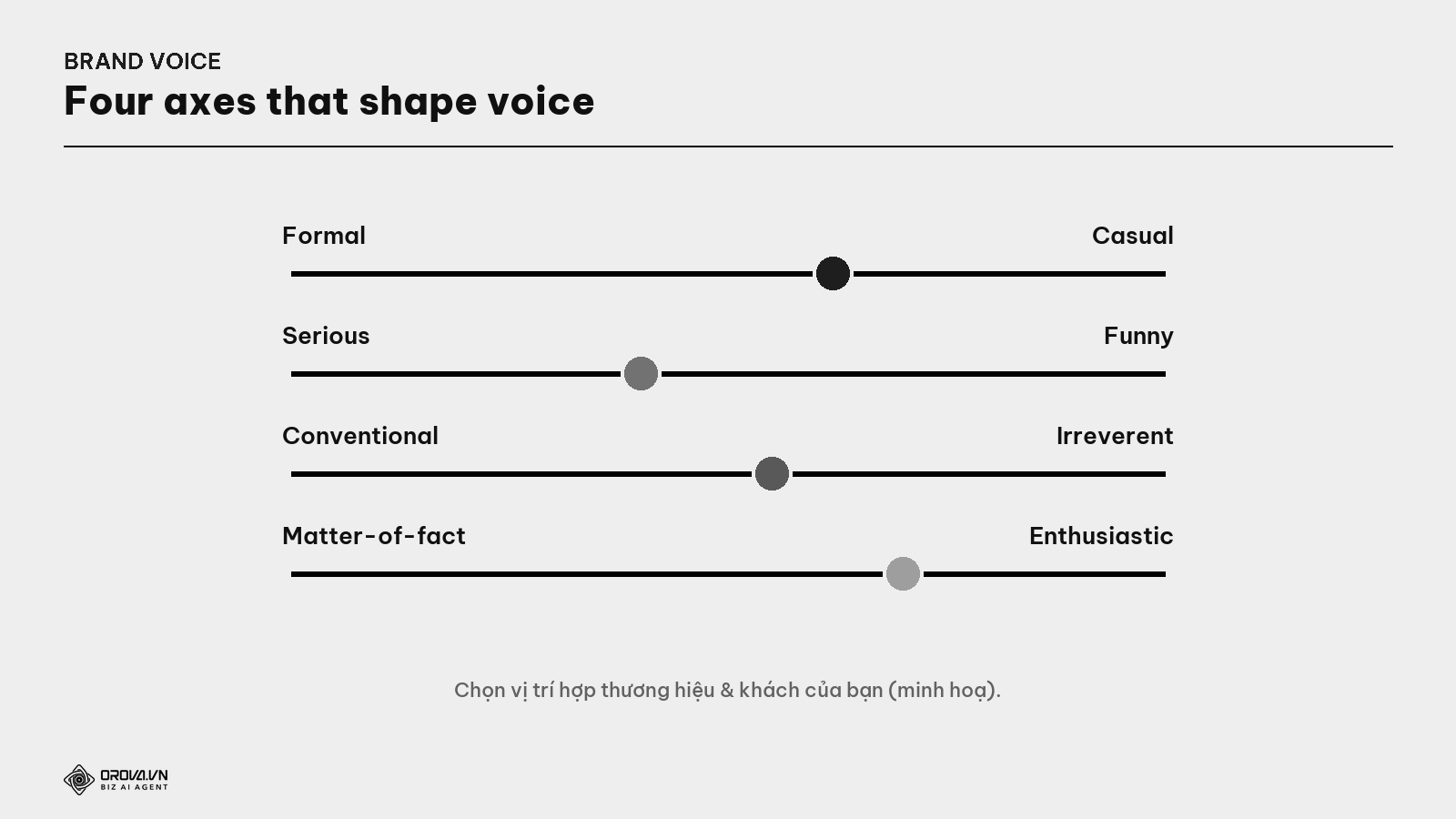
- Formal ↔ Casual. Careful, proper language (banking, law) or friendly like a buddy (young brands)?
- Serious ↔ Funny. Do you allow jokes and wordplay, or always keep a professional face?
- Conventional ↔ Irreverent. Stick to safe norms, or dare to be different, to "go against the grain"?
- Matter-of-fact ↔ Enthusiastic. Just state facts tidily, or inspire with energy?
There's no absolute "right" position — only the one that fits your brand and your customers. A finance brand should lean formal/serious; a coffee brand for young people can be casual/funny.
Keeping voice consistent: the style guide
Choosing a voice is half the job; keeping every article, every writer on the same voice is the harder half.
What is a style guide? A short document spelling out the brand voice: position on the four axes, a few "write like this / not like this" examples, how to address readers, words to use/avoid. With it, many writers (or an AI Agent) all produce content in one voice, no chaos.
A minimal style guide should have: the four-axis positions, how you address readers (e.g., "you" vs "valued customer"), 3–5 "do/don't" example pairs, and a list of signature words to use. It matters most when you scale content across many writers or AI (see the Content Brief & AI Content guides).
CTA: what turns readers into customers
This is the "final invitation" that charming salesperson forgot.
What is a CTA (Call To Action)? A line/button spelling out the next step you want the reader to take: "Start a free trial", "Download the guide", "Book a consultation", "Buy now". Without a CTA, a reader — however much they liked it — doesn't know what to do next, and usually does nothing.
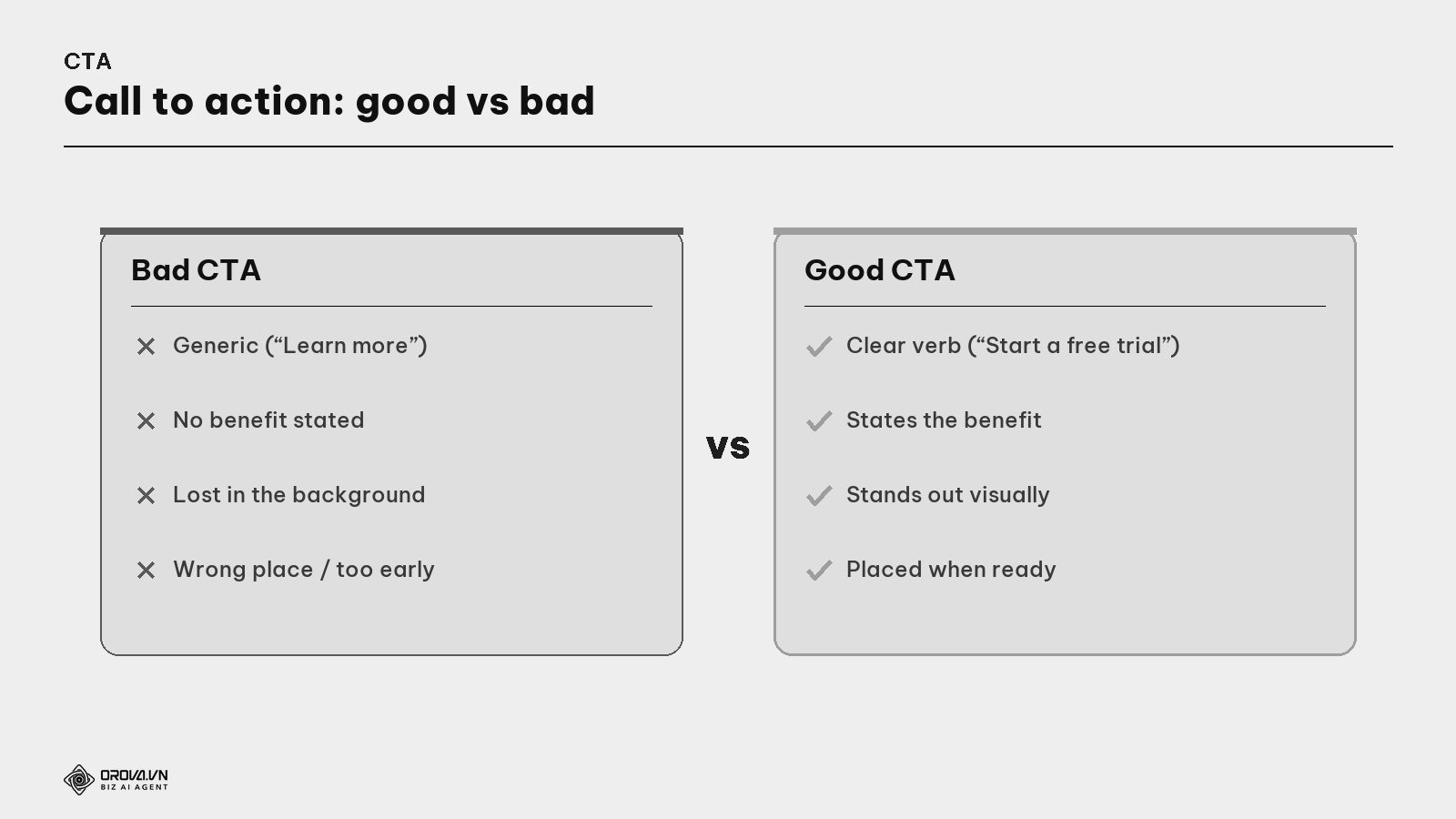
- Bad CTA: generic ("Learn more", "Click here"), no benefit stated, lost in the page background, or misplaced (demanding a purchase when they've read one line).
- Good CTA: uses a clear action verb, states the benefit to the reader, stands out visually, and is placed when they're ready.
The anatomy of a strong CTA
A good CTA usually has four elements.
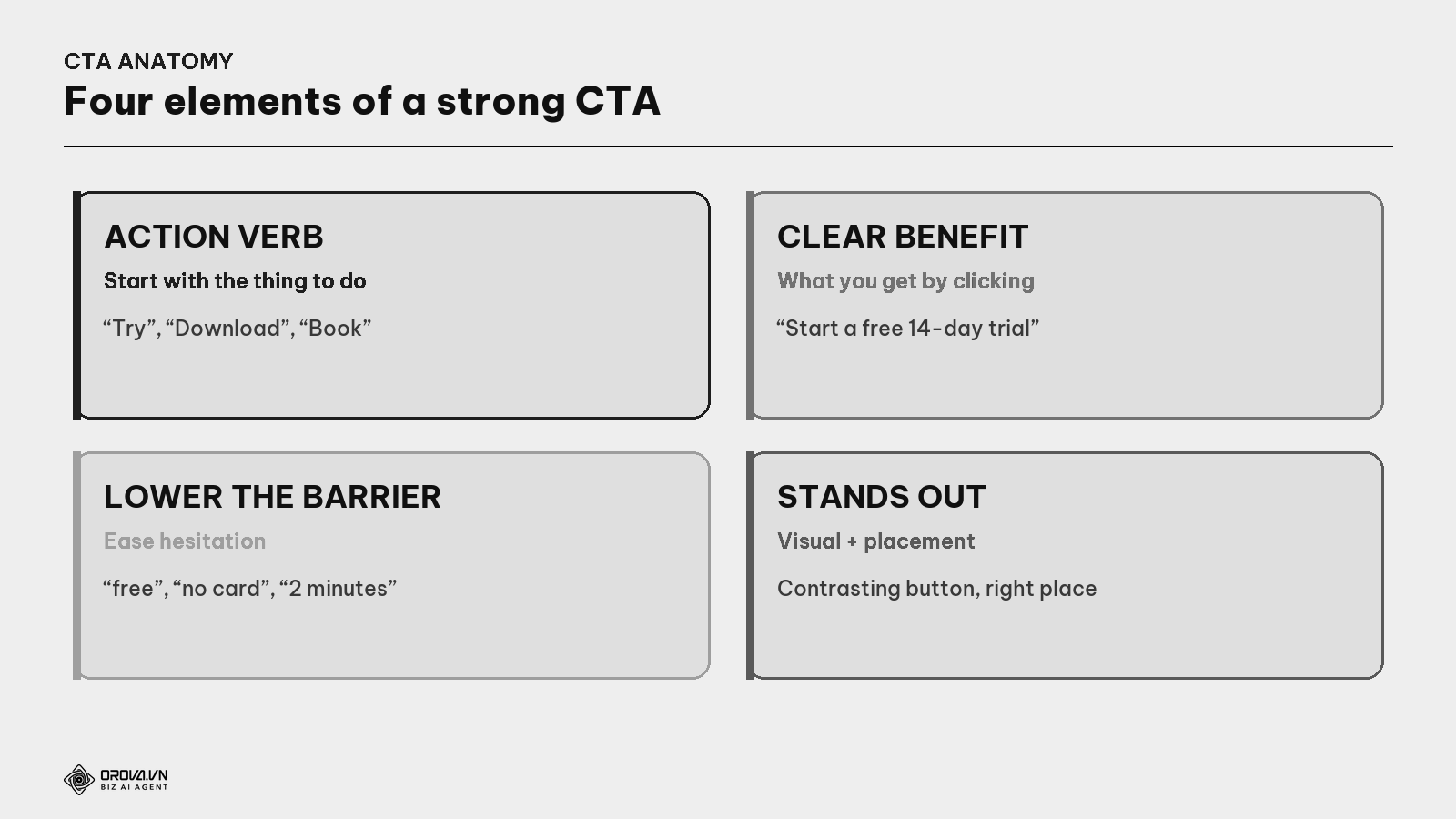
- Action verb. Open with the thing to do: "Try", "Download", "Book".
- Clear benefit. Say what clicking gets you: "Start a free 14-day trial", not just "Sign up".
- Lower the barrier. Reassure to ease hesitation: "free", "no card needed", "takes 2 minutes".
- Stands out. Visually (a contrasting button) and by placement (where the reader has just seen enough to be convinced).
The right CTA for the right stage: don't propose on the first date
The worst CTA mistake is asking too much, too soon. Someone who just met you, hit with "Buy now", will run — like proposing on the first date.
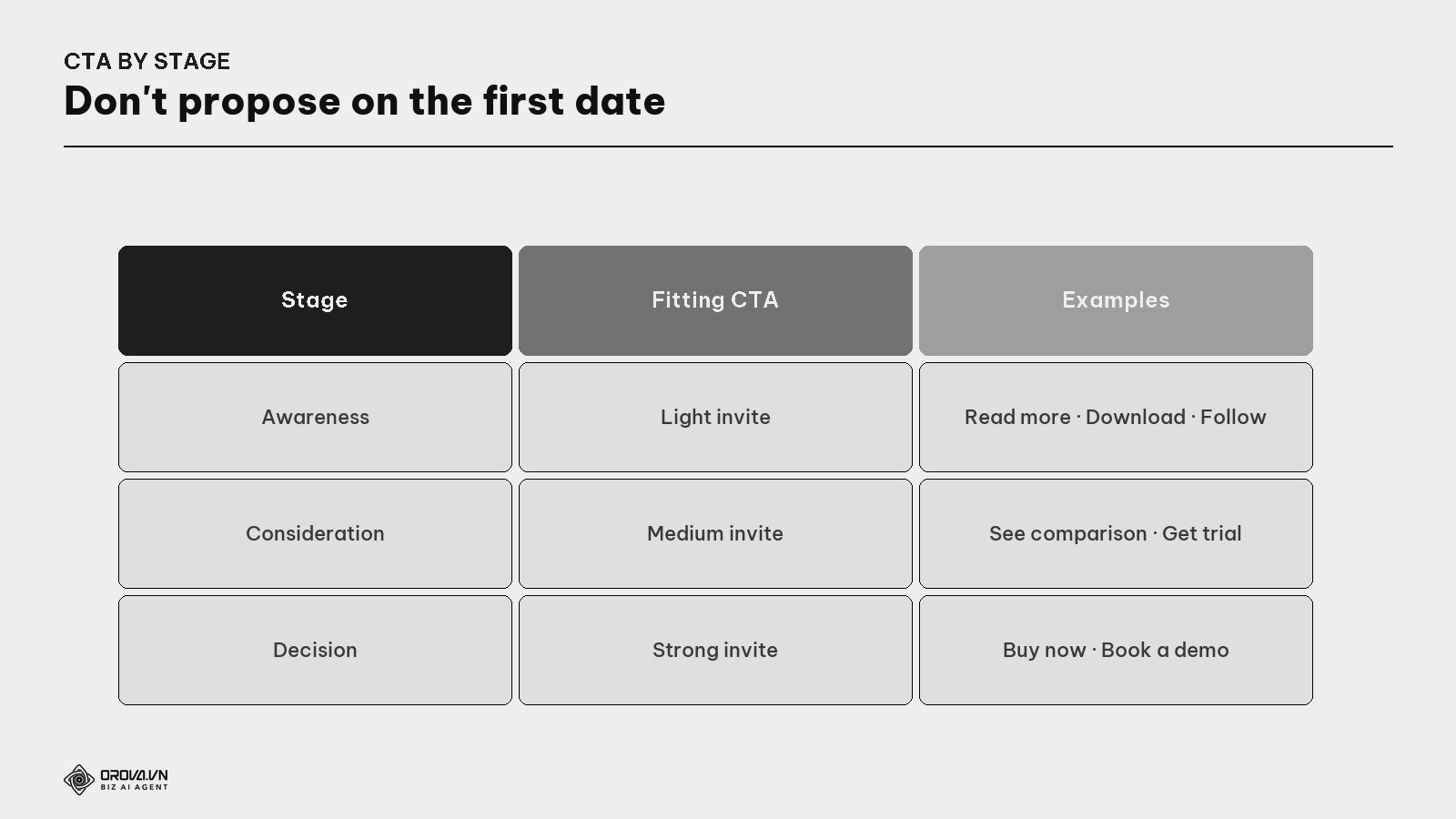
Match the CTA to the reader's stage (see the Search Intent & Content Strategy guides):
- Awareness (just met you): a light invite — "Read more", "Download the guide", "Follow". The goal is to build a relationship, not sell yet.
- Consideration (comparing): a medium invite — "See the comparison", "Get the trial", "Register for the webinar".
- Decision (ready to buy): a strong invite — "Buy now", "Book a demo", "Get started".
A TOFU article shouldn't hard-sell; a BOFU page must have a clear buy CTA. Matching the right "invitation" to the right "dating stage" is the art of conversion.
The process to write for conversion
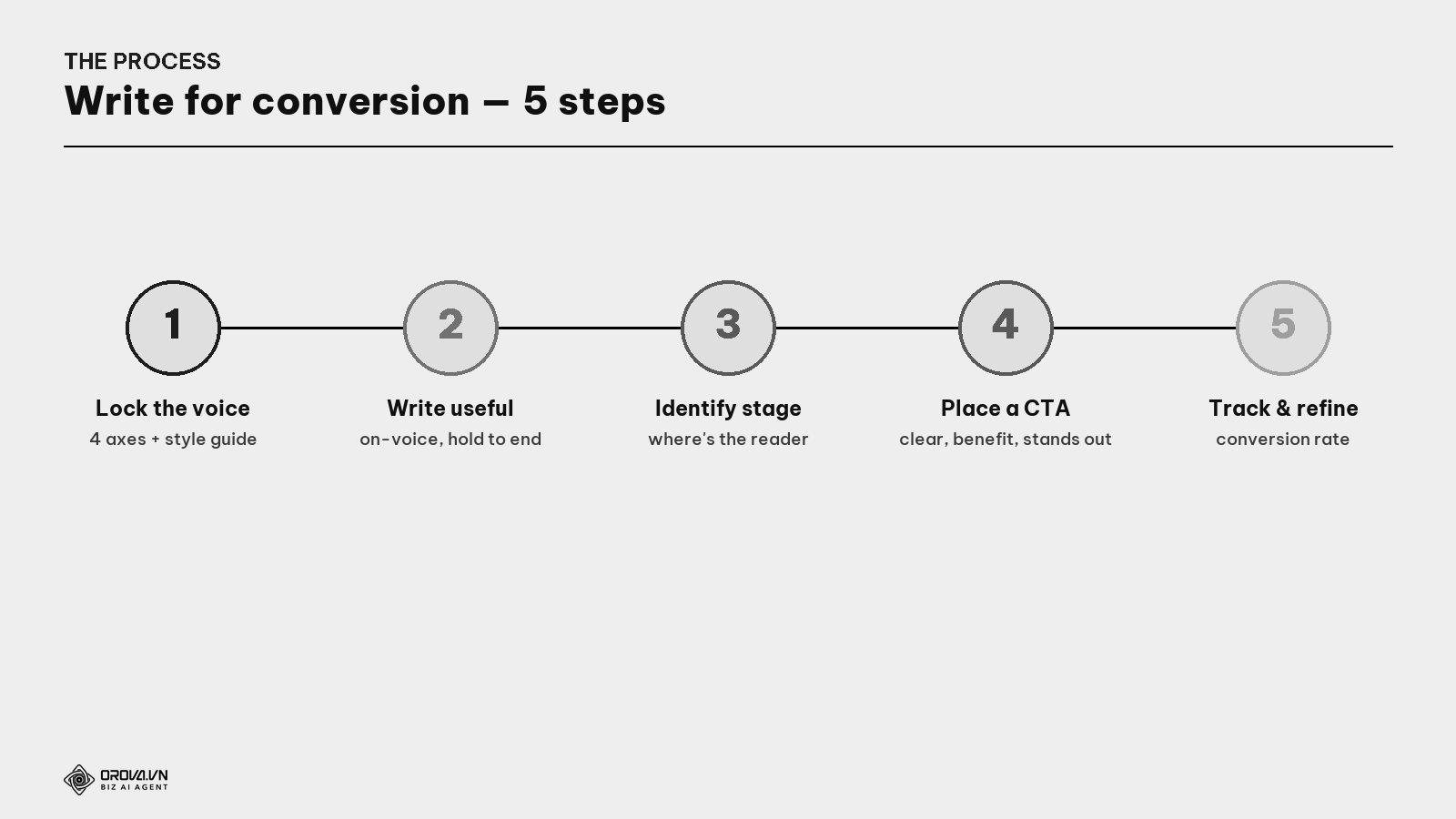
- Lock the voice (four-axis position + style guide) so every article is consistent.
- Write useful, on-voice content — keep readers to the end (see the Writing SEO Content guide).
- Identify which stage this article's reader is at.
- Place a stage-matched CTA — clear verb, stated benefit, lowered barrier, stands out, well placed.
- Track the conversion rate (how many readers click the CTA) and refine over time (see the Measuring SEO guide).
What is conversion rate? The share of readers who take the action you want (click the CTA, leave an email, buy) out of all readers. It measures whether an article turns readers into customers — not just "how many read it".
"Pass" standard
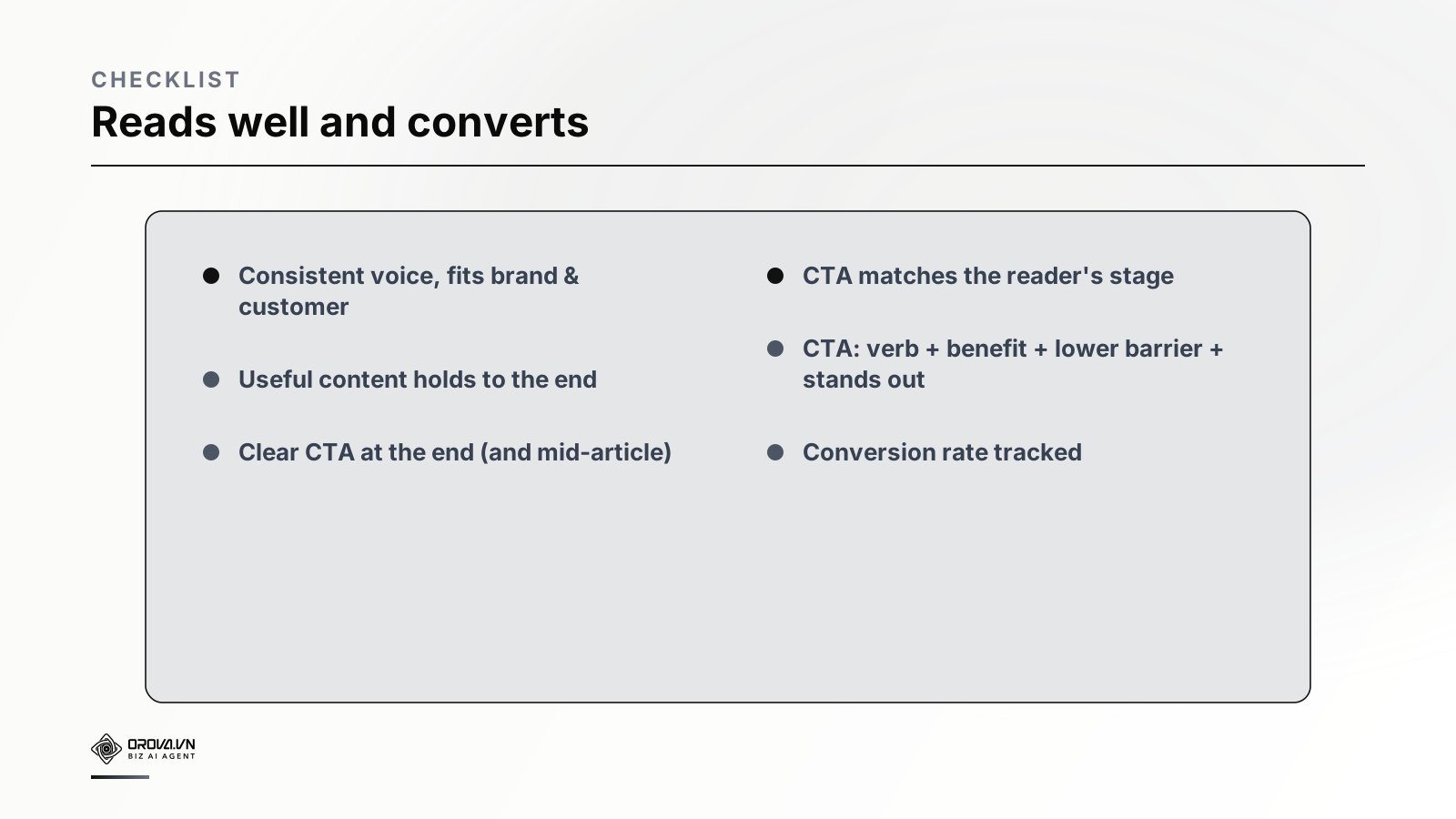
"Pass" standard: the article has a consistent voice fitting the brand and customer; useful content keeps readers to the end; at least one clear CTA (verb + benefit + lowered barrier + stands out) placed at the right moment; the CTA matches the reader's stage; and you track conversion rate to improve. At this level, your article doesn't stop at "got read" but leads the reader onward — turning content into business results.
Benefit: voice + CTA is the bridge between "writes well" and "delivers results". A good voice makes readers trust and remember you; a good CTA turns that trust into action. Without them, you're the charming salesperson who never closes — many fans, no buyers. With them, every good article gets a chance to become a customer.
FAQ
Does voice really affect results, or is it just "decoration"? It really affects results. The same information in a fitting voice makes readers trust and like you — and people who trust/like you act more readily. Voice also makes you distinct and memorable in a sea of similar content.
How many CTAs should an article have? At least one clear CTA at the end. A long article can add 1–2 context-fitting CTAs in the middle (after a persuasive section). Don't cram many buy-CTAs — it's off-putting and dilutes.
Where's the best place for a CTA? Where the reader has just seen enough to be convinced: the end is standard; for long articles, after the section spelling out the benefit/solution. Avoid a buy-CTA at the very top before they've had time to trust.
Do informational (TOFU) articles need a sales CTA? They shouldn't sell. Use a light CTA fitting the awareness stage: "read more", "download the guide", "follow". Save buy-CTAs for MOFU/BOFU content when the reader is closer to deciding.
How do I know which voice fits my brand? Think about your customers (how they talk) and your brand personality (if it were a person, what kind). Position on the four axes to match both, write a few test passages, then lock it into a style guide.
What's wrong with "Learn more"? It's too generic — it doesn't say what you get by clicking, so it's unappealing. Replace it with a specific, benefit-stating CTA: "See pricing", "Get a free trial", "Download the checklist". Specific always converts better than vague.
How does an AI writer keep voice consistent? Give the AI the style guide (four axes + do/don't examples) in the brief, and have a human edit the voice in the final step. With a clear guide, AI follows the voice quite well; the human just refines (see the AI Content guide).
Back to the charming salesperson
Remember the salesperson who chatted beautifully but never invited the sale? They failed not for lack of charm — but for forgetting the final invitation. The customer liked them, but liking isn't buying; without a clear next step, that goodwill drifted away.
Writing content is the same. Writing well, on-voice, only makes the reader like you — pulls them to the door. To get them in, you must invite: a clear, stage-matched CTA pointing to the right next step. Don't be the charming salesperson who never closes. Let every good article end with a kind invitation — and turn the people who merely "stopped to read" into people who step in and stay.
This article is part of Orova's complete SEO guide series. It's a deep-dive within the cluster — see "Writing SEO Content", "Content Strategy", "Search Intent", and "Measuring SEO" for the full picture. Get started with Orova at orova.vn/en/seo.
Sources
Nielsen Norman Group (tone of voice & the 4 tone axes) · Content Marketing Institute (building a brand voice) · HubSpot & Unbounce (writing CTAs that convert, CTAs by funnel stage).
Consistent voice is a system, not a New Year's resolution
Writing down your tone of voice rules once is easy. The hard part is applying them every single time you publish — checking every blog post, every email, every product page against a style guide, catching inconsistencies before they go live, and doing it again next week, and the week after that. Most business owners either skip this step entirely or burn hours on it that should go into running the business.
This is exactly the kind of repetitive, detail-heavy work Orova SEO takes off your plate. It helps keep your content's tone consistent and structured for conversion automatically, so you don't have to manually double-check every piece before it goes out. If that sounds like time you'd rather spend elsewhere, it's worth taking a look.
Let Orova SEO handle the repetitive part
Keyword research, drafting, refreshing old posts and rank tracking — running automatically on your own site.
Explore Orova SEO