
I Added 300 Internal Links in a Week — Here's What Moved
Internal linking gets recommended constantly and demonstrated rarely. Everyone agrees you should do it; far fewer people show you what happens when you actually do. So I ran a deliberate experiment: over the course of one week, I added roughly three hundred internal links to a content site, changed nothing else, and then watched closely for several weeks to see what moved, what did not, and what the pattern of results actually taught.
A note on honesty before anything else. This is one site, one experiment, over one stretch of time. It is not a controlled study and it cannot prove universal laws. I will not be quoting precise percentages as if they were findings — search results shift for many reasons at once, and isolating the effect of one change with the certainty a hard number implies would be dishonest. What this experiment can offer is a clear account of a real intervention and the qualitative patterns that emerged. Patterns, properly described, are useful. Fabricated precision is not.
The starting point
The site was a mid-sized content site — a few hundred articles built up over several years. Like most sites of that age and size, its internal linking was the product of accumulation rather than design. Early articles linked to each other reasonably well, because when there were only twenty pages it was easy. Later articles were published into relative isolation, because by then nobody could hold the whole site in their head.
An audit before starting confirmed the familiar picture. A meaningful share of pages had very few internal links pointing to them. A smaller set were genuine orphans, reachable only through the sitemap. And the newer articles — the ones published in the last year or two — were consistently the most under-linked, because the habit of going back to update older pages had never existed. The site was not broken. It was just loosely wired, in exactly the way most sites of its age are.
What I actually did
The intervention had three parts, and I kept it strictly to internal linking so that whatever moved could be attributed to one kind of change.
First, I dealt with the orphans. Every orphaned page got relevant editorial links from appropriate existing pages, so that nothing on the site was reachable only through the sitemap.
Second, I fed the under-linked pages. For every page sitting well below a reasonable inbound-link count, I found relevant existing pages and added links pointing to it — prioritising pages that were topically important and commercially relevant.
Third, I strengthened the cluster structure. Where groups of articles clearly belonged to the same topic, I made sure they linked to each other and to the broadest page in the group, tightening loose clusters into coherent ones.
Throughout, I followed sane anchor text practice — descriptive, varied, naturally fitted to the sentence — rather than stuffing exact-match phrases. And I changed nothing else. No new content. No technical work. No backlink outreach. For the duration of the experiment, internal linking was the only variable I touched, because a result you cannot attribute is not a result.
Pattern one: the under-linked pages moved most
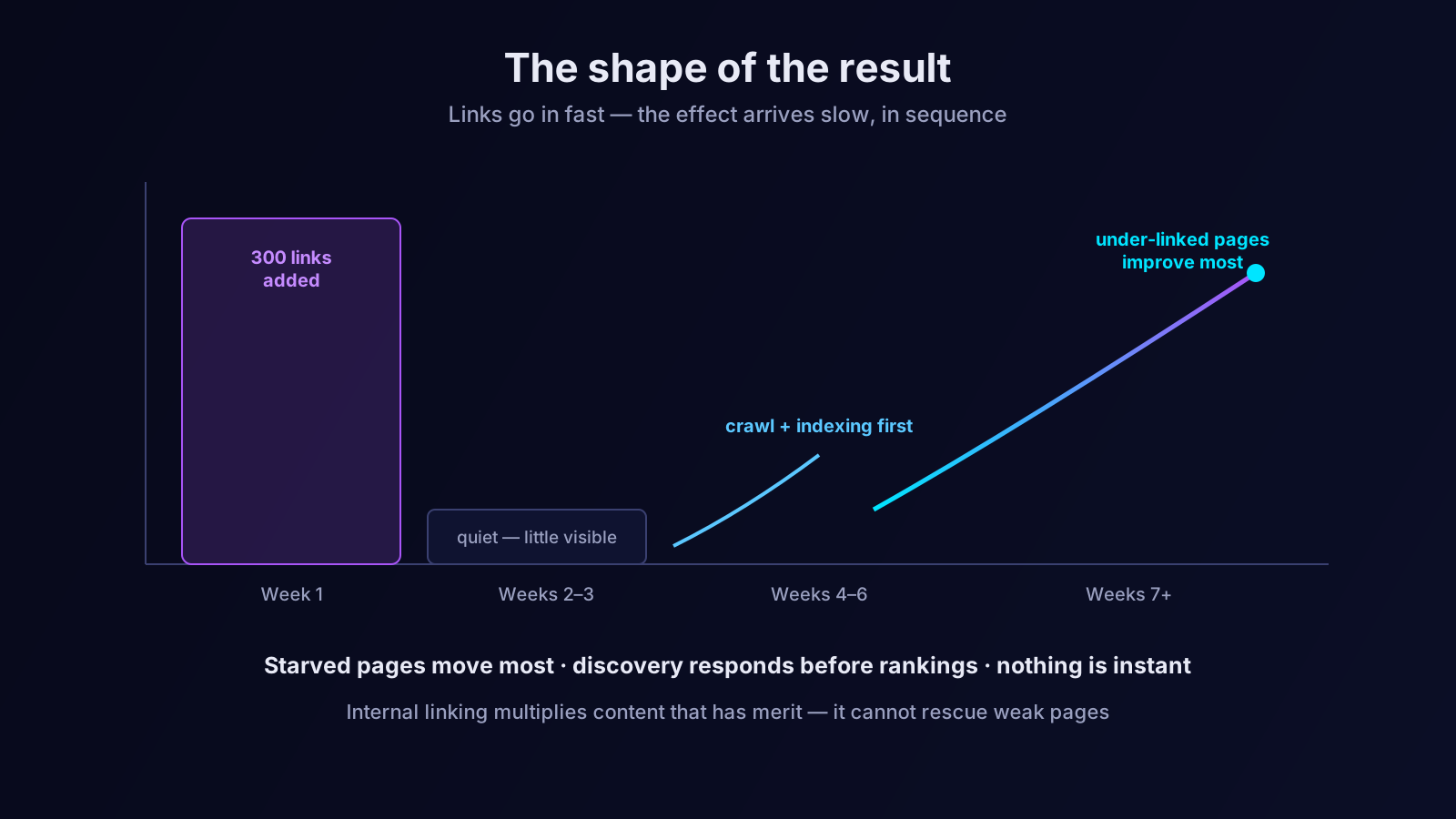
The clearest pattern, and the least surprising once seen, was that the pages which had been most starved of internal links were the pages that improved most after receiving them.
This makes intuitive sense. A page that already had plenty of internal links was not being held back by a link shortage, so adding a few more did little. A page that had been receiving almost nothing had a real, specific deficiency — and supplying what it lacked addressed a genuine bottleneck. The improvement was not uniform across the site. It was concentrated exactly where the prior deprivation had been worst.
The lesson here is about diagnosis. Internal linking is not a blanket treatment that lifts everything equally. It is a fix for a specific problem — pages cut off from authority and discovery — and it works best when aimed at pages that actually have that problem. If your pages are already well linked, adding more will do little. If some of your pages are starved, feeding those is where the movement is.
Pattern two: crawling and indexing responded first
Before any ranking changes appeared, something else shifted, and it shifted sooner: discovery.
The orphaned pages — the ones that had been reachable only through the sitemap — started getting crawled through their new editorial links. Pages that had been crawled rarely began to be visited more often once they sat on well-connected paths. The pages I had recently published, now woven into the site, were found and re-found faster than before.
This is a useful sequencing insight. Internal linking acts on discovery before it acts on ranking, because discovery is upstream — a page has to be found and crawled before improved understanding of it can translate into a ranking change. If you run a similar intervention and watch only rankings in the first days, you will see nothing and may conclude it failed. The earliest evidence is in crawl behaviour, not in positions.
Pattern three: nothing happened immediately
The most important pattern for anyone planning to do this is the least dramatic: there was no overnight result. The links went in across one week. Then, for a stretch afterward, very little visibly changed.
This is normal and it is worth bracing for. Search engines have to re-crawl the pages carrying the new links, process the changed link graph, and re-evaluate the destination pages. That takes time, and it takes more time on a site that is crawled less aggressively. The changes, when they came, came gradually — a drift over weeks, not a jump.
The practical danger here is impatience. A team that adds internal links, sees nothing within a week, and concludes the effort was wasted will have drawn exactly the wrong conclusion from exactly the right action. The effect of internal linking is real but unhurried. You have to give it the weeks it needs before you judge it.
Pattern four: the cluster effect was subtle but real
The third part of the intervention — tightening loose clusters into coherent ones — produced the subtlest pattern, and one I want to describe carefully because it is easy to overstate.
Where I had taken a loose group of related articles and properly interlinked them into a cluster, the pages in that group seemed to firm up together — not one page jumping while the others sat still, but the group as a whole becoming a little more solid in its topic. It read less like individual pages being boosted and more like the site demonstrating, through the tightened structure, that it covered that topic with genuine depth.
I describe this cautiously because it was the hardest pattern to be sure about and the easiest to imagine. But it was consistent with what the cluster model predicts: interlinking related pages does not just help each page individually, it makes the group legible as a body of work on a subject. If you want the reasoning behind that, our guides on topic clusters and internal linking strategy lay it out.
What did not move
An honest experiment reports the negatives, and there were two.
The already well-linked pages barely changed. As noted, they had no link shortage to fix, so the intervention had little to give them. This is not a failure of internal linking; it is confirmation that internal linking is a remedy for a deficiency, and applying a remedy where there is no deficiency does little.
And the pages with genuinely weak content did not rise. Some of the orphans and under-linked pages were thin or mediocre, and improving their internal links did not transform them into strong rankers. Internal linking can help search engines find and understand a page, and it can route authority toward it — but it cannot make a poor page deserve to rank. If the underlying content does not satisfy the searcher, better wiring will not rescue it. Internal linking is a multiplier of content that has merit, not a substitute for merit.
Pattern five: the anchor text mattered more than expected
One pattern I had not set out to test, but could not avoid noticing, concerned the anchor text of the three hundred links.
Because I had deliberately used descriptive, varied anchors throughout — rather than dropping in generic "read more" links or hammering the same exact-match phrase — the links seemed to do more than simply connect pages. Where the destination page's topic was reinforced by anchors that consistently and naturally described it, that page appeared to firm up more clearly than pages connected by vaguer links.
I want to be careful here, because this was the hardest pattern to isolate and I cannot separate it cleanly from the link-count effect. But the impression was consistent enough to mention: the value of an internal link is not just the connection, it is the description that rides along with it. Three hundred links with thoughtful anchors did more than three hundred links with lazy ones would have. If you run a similar intervention, do not treat the anchors as an afterthought — choosing them well is part of the work, not a finishing touch.
Pattern six: commercial pages behaved differently
A subset of the under-linked pages I fed were commercial pages — the pages closest to a purchase decision. Their behaviour was worth separating from the informational pages, because it differed in a useful way.
The commercial pages were slower to show ranking movement than the informational ones. Commercial queries are typically more competitive, and a competitive query does not yield to internal linking alone as readily as a quieter informational query does. But the commercial pages showed a different kind of benefit sooner: the informational pages now linking to them began sending readers along those links. Even before rankings shifted, the internal links were doing navigational work — routing people who had been reading and learning toward the page where they could act.
This reframes what an internal link to a commercial page is for. It is partly a ranking signal, and that part is slow on competitive terms. But it is also, immediately, a path — a way for an engaged reader to move from learning to deciding. The experiment was set up to watch rankings, but this pattern was a reminder that internal links earn their keep through reader movement too, and that benefit does not wait for the search engine to catch up. If you are linking informational pages to commercial ones, you are getting value from day one, whatever the rankings do.
Pattern seven: where the links came from mattered as much as where they went
I had designed the experiment around destinations — which starved pages would receive links. Partway through, it became clear the sources deserved equal attention, and that was a pattern I had not planned to observe.
A link from a strong, well-established, frequently-crawled page did visibly more for its destination than a link from a weak, rarely-visited one. This sounds obvious stated plainly, but in practice it changes how you do the work. Adding a link to a starved page from another starved page connects two weak pages and moves little. Adding a link to that same starved page from one of the site's strongest, most-crawled pages routes real authority and real crawl attention toward it. The same edit — one internal link — was worth substantially more depending on which page it started from.
So midway through I changed my approach. Instead of just asking "which pages need links?", I began asking, for each starved page, "which of our strongest relevant pages could plausibly link here?" The destinations stayed the same; the sources got deliberately better. If I ran the experiment again, I would build that into the plan from the first day rather than discovering it in the middle. An internal link is a pipe, and the pressure behind the pipe depends entirely on what it is connected to at the far end.
What the experiment changed about how I publish
The most lasting result of the week was not a ranking change at all. It was a change in habit.
The whole reason the site needed three hundred links in the first place was that internal linking had been treated as something you do later — a cleanup task, deferred until a loose-wiring problem had quietly accumulated for years. The experiment made the cost of that deferral concrete: a punishing week of remedial work that a small, steady habit would have made unnecessary.
So now every new article is published already wired. Before it goes live it links out to the relevant existing pages, and — the step almost everyone skips — a handful of relevant existing pages are updated to link to it. The article enters the site connected, not isolated, and never becomes a future orphan needing rescue. The three-hundred-link week was worth running for what it taught, but its real value was making it obvious that the intervention should never need to be run again. Wiring at publication is cheap. Re-wiring in bulk, years later, is not.
What I would tell someone planning the same thing
Pulling the patterns together, here is the practical advice the experiment supports.
Audit first, so you know which pages are actually starved — that is where the movement will be. Prioritise the orphans and the under-linked, important, commercially relevant pages; do not spread effort evenly across pages that do not need it. Watch crawl behaviour as your early signal and do not panic at flat rankings in the first weeks. Give the experiment real time before judging it. And do not expect internal linking to fix weak content — fix the content separately, on its own merits.
One more thing, about effort. Adding three hundred internal links by hand in a week is genuinely tedious work — auditing the graph, finding every orphan, identifying which existing pages should link to each under-fed page, choosing a sensible anchor for each, making three hundred edits. It is doable, but it is the kind of grind that gets started and abandoned, and it is also the kind of structured, repetitive work software handles without fatigue. An SEO AI agent can map the link graph, surface every orphan and under-linked page, and propose relevant, well-anchored links at exactly this volume — turning a punishing manual week into a reviewed-and-approved afternoon. Orova is built for this kind of systematic internal linking work, so the intervention this experiment describes is not a heroic one-off but something a site keeps current as a matter of routine. The patterns were real. The effort to capture them does not have to be.
Let an AI Agent handle your SEO
Orova plans, writes, optimizes, and tracks rankings on its own — you just read the results.
Try it free