
The Author Page Is the Most Underrated Page on Your Site
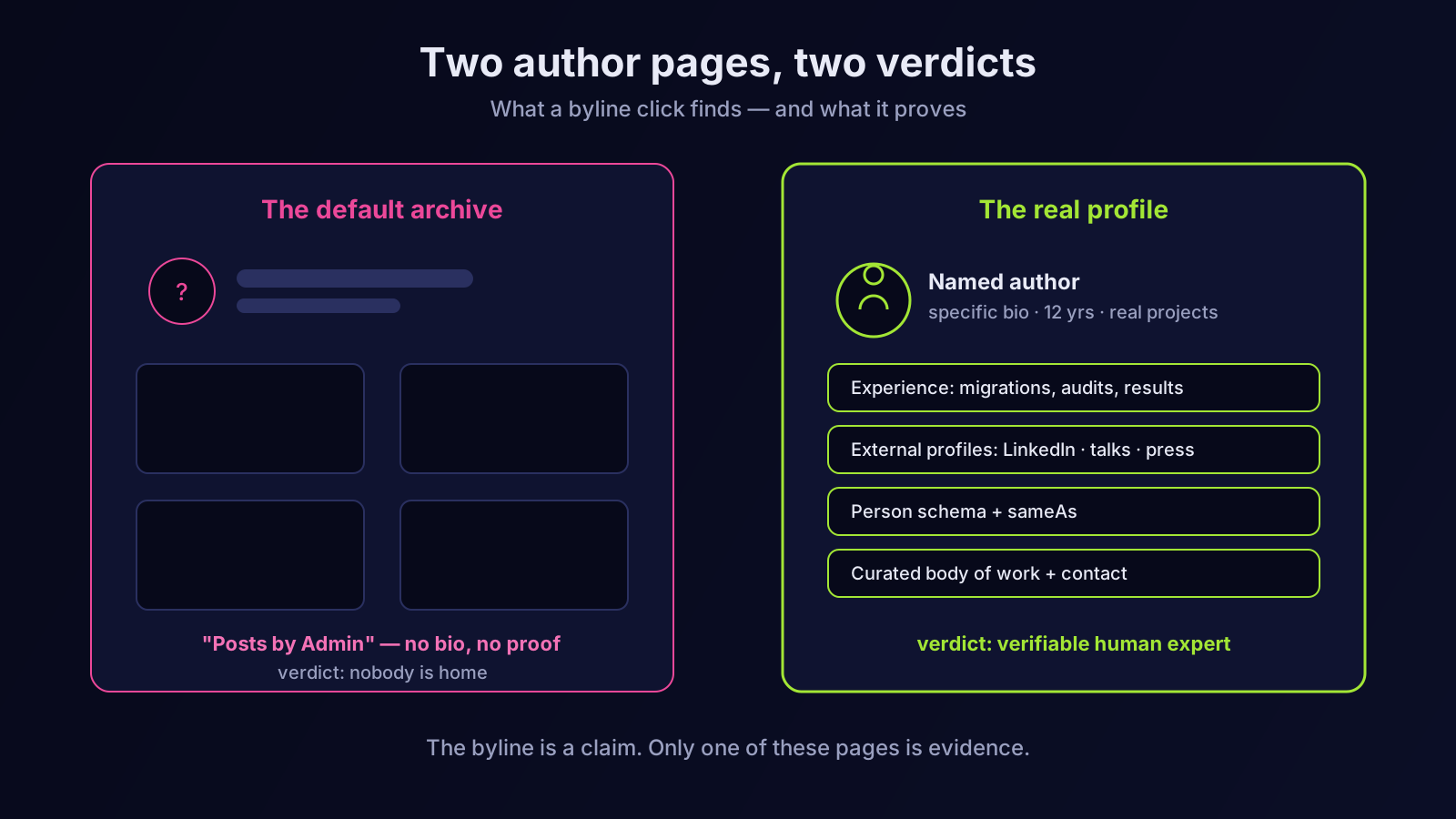
Go to almost any company blog. Find an article. Click the author's name. Now observe what you get: a page titled "Posts by Sarah," containing a grid of article cards, a 60-pixel avatar, and — if the developers were feeling generous — one sentence of bio that says Sarah "is passionate about marketing." No history. No credentials. No evidence she exists outside this template. This is the author page in 2026 on the majority of the web: an auto-generated archive that nobody designed, nobody owns, and nobody has looked at since the theme was installed.
Meanwhile, the same companies spend real money on the question of trust. They commission brand campaigns about authenticity. They run content programs explicitly aimed at demonstrating expertise. They read about E-E-A-T and nod gravely. And the single page on their site whose entire job is to prove that a real, qualified human stands behind their content — the page Google's quality raters are literally instructed to go looking for, the page AI engines resolve when deciding whether a byline means anything — renders as a paginated list of cards with a stock-photo energy that whispers: no one is home.
This is a critique, so let me state the thesis bluntly: the author page is the most underrated page on your site, the cheapest E-E-A-T investment available to you, and the clearest example of an industry optimising everything except the thing that matters. The neglect is not a small oversight. It is a structural failure with a specific cause, a measurable cost, and a fix that takes about a day per author.
Author pages matter because they are where machines and humans verify a byline. A strong author page turns "Sarah wrote this" from an unverifiable claim into documented evidence: a specific bio, credentials, first-hand experience, Person schema with sameAs links to external profiles, and a body of work — the raw material of E-E-A-T.
How the author page became a ghost town
The neglect has an architecture, and it is worth tracing because it explains why the fix never happens on its own.
The author page is an orphan by design. It is generated automatically by every CMS — WordPress creates author archives whether you want them or not — so it exists without anyone deciding it should. Pages that nobody decides to create are pages that nobody owns. The content team thinks of it as a template, so it belongs to the developers. The developers think of it as content, so it belongs to the content team. The brand team has never seen it, because no customer journey map has ever included "user clicks the byline." And so the most identity-critical page on the site is governed by the same political logic as the office fridge: shared by everyone, cleaned by no one.
Then there is the measurement problem. Author pages convert nothing, rank for nothing obvious, and show up in no campaign dashboard. By every metric a marketing team is paid to move, the author page is a rounding error — so in a world where work must justify itself in next quarter's numbers, it never makes the sprint. The irony is sharp: the page's value is precisely that it underwrites the credibility of every other page, and "underwrites everything, converts nothing" is exactly the kind of value that performance dashboards are blind to.
And finally, the historical alibi: for years, neglect was rational. Google's old systems read author pages weakly if at all; authorship markup had a public failed experiment (Google killed its rel=author program in 2014 after three years), and the lesson the industry internalised — wrongly, as it turns out — was "Google doesn't care who wrote it." That lesson expired. The Search Quality Rater Guidelines now instruct raters to research content creators — to look for information about who made the content and what their reputation is. Google's own guidance for self-assessing content quality asks, in nearly these words, whether your content makes clear who wrote it and whether they have demonstrable expertise. And the new generation of answer engines, as we argued in our analysis of E-E-A-T in the AI era, performs authorship resolution as part of deciding which sources are safe to build answers on. The world changed. The template did not.
The byline is a claim. The author page is the evidence.
Here is the conceptual frame that makes the stakes obvious. Every byline is a claim: this content was created by this person, and this person is worth listening to. Claims require evidence, and the author page is the only place on your site structurally positioned to provide it. When the evidence is missing, the claim doesn't just go unproven — it starts to look like what unproven claims usually are.
Walk through who actually evaluates that claim, because the audience is bigger than most teams think.
Human readers under uncertainty. Most readers never click a byline — until the content asks them to trust it with something. Medical information, financial decisions, security advice, expensive purchases: the moment stakes appear, a meaningful slice of readers performs exactly one act of due diligence, and it is clicking the author's name. What they find either completes the sale of trust or refunds it. An empty archive page at that moment is not neutral; it is an answer, and the answer is "we hoped you wouldn't check."
Quality raters. Google's raters are explicitly instructed to look for information about content creators when assessing page quality, especially for topics that affect health, finances, or safety. Raters do not directly move your rankings — their judgments tune the systems that do. But this means the algorithm is being perpetually calibrated toward the kind of site where rater questions like "who created this and what is their reputation" have findable, satisfying answers. The author page is where that answer lives or dies.
Entity resolution systems. As we covered in depth in Entity SEO: teaching machines who you are, machines reconcile identity across sources, and every author is an entity whose evidence needs a home node. The author page is the natural entity home for a person: the URL that Person schema points to, that sameAs radiates from, that external profiles can corroborate. Without it, an author's credibility evidence — years of articles, citations, appearances — has nowhere to accumulate. With it, every new article compounds an identity that machines can resolve and weight.
Answer engines choosing sources. When AI systems select which pages ground an answer — the selection mechanics our complete guide to AI Overviews describes — attributable content from identifiable experts is structurally safer than anonymous content, because the engine's own credibility is on the line. The author page is what makes attribution resolvable at machine speed. It is also part of how you become quotable in the first place: the path we mapped in how to become the source ChatGPT quotes runs through being a named, consistent, corroborated expert — not a content brand with a rotating cast of ghosts.
Anatomy of an author page that actually works
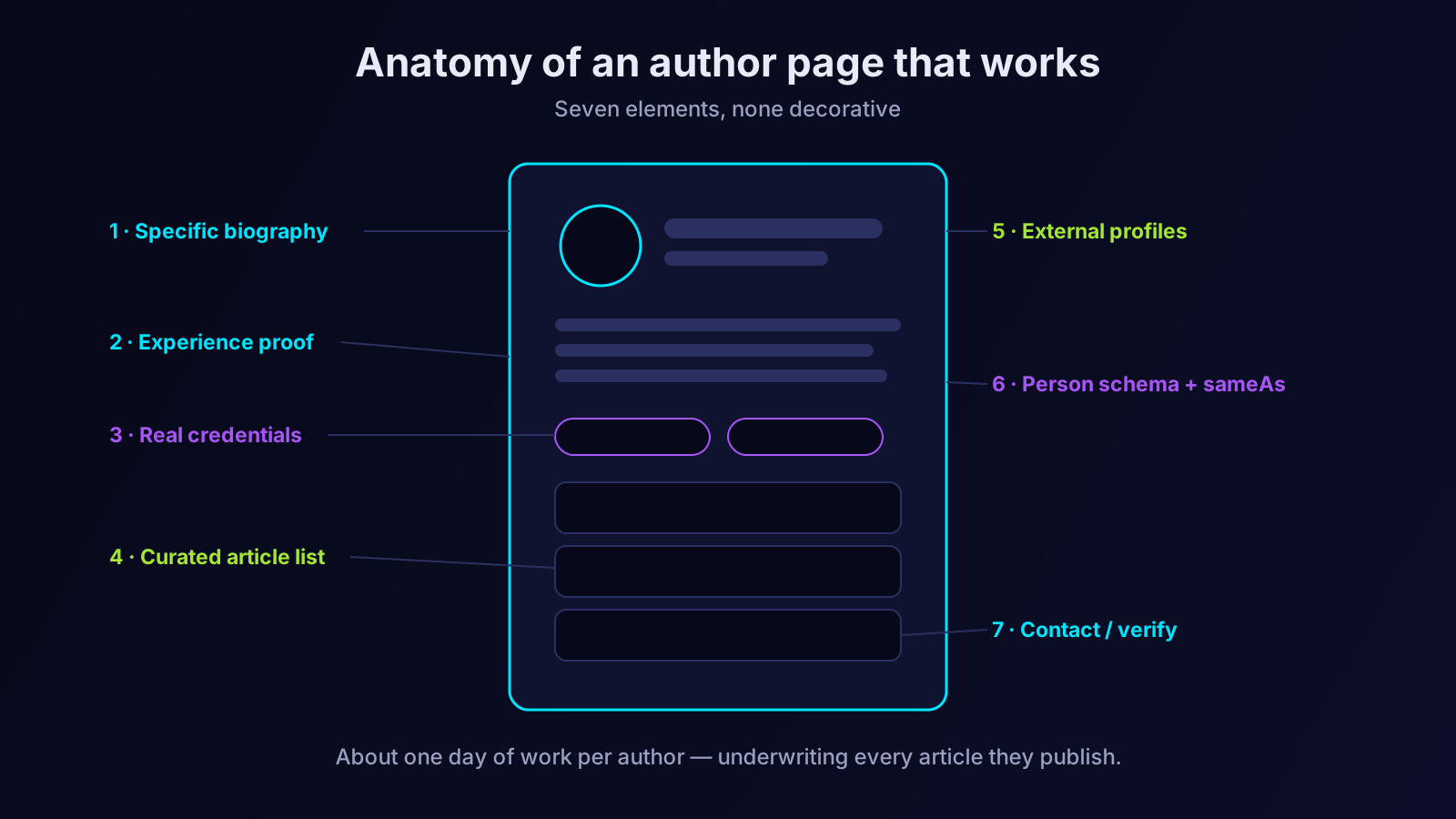
Enough critique; here is the standard. An author page that does its job contains seven elements, and none of them is decorative.
A specific biography. Not "passionate about marketing" — specific. What the person has actually done, for how long, in what roles, with what scope. The test for every sentence: could this appear unchanged on a competitor's author page? If yes, delete it. "Twelve years running technical SEO for e-commerce sites, including three replatforming migrations over 100,000 URLs" survives the test; "loves helping brands grow" does not. Specificity is not a style preference — it is what separates verifiable claims from filler, for human readers and language models alike.
Demonstrated experience. The Experience letter in E-E-A-T wants first-hand evidence, and the author page is where it concentrates: projects shipped, systems run, results achieved (with honest numbers), failures survived. A short "things I have actually done" section outperforms any adjective.
Credentials and affiliations, where real. Degrees, certifications, employers, professional memberships — listed plainly, without inflation. If the author has none, do not invent them; experience documented well beats credentials faked badly, and the fabrication risk is asymmetric in exactly the way our E-E-A-T analysis described.
Proof of existence beyond your domain. Links to the author's LinkedIn, X, GitHub, Google Scholar, conference talks, podcast appearances, articles on other publications. This is the corroboration layer: an identity that exists only on your own site is, from a machine's perspective, indistinguishable from an invented one. Three good external links transform the page from self-declaration into a verifiable node.
Person schema, properly wired. The page should carry Person markup with name, jobTitle, description, worksFor, knowsAbout for their topical areas, and a sameAs array pointing to those external profiles. Every article byline should link to this page, and every article's author schema property should reference the same Person — same name string, same URL — so the graph machines assemble has one clean node per human instead of a smear of partial matches.
The body of work, organised. Keep the article list — it is genuine evidence of sustained topical focus — but curate it: lead with the author's strongest or most representative pieces, group by topic if the catalogue is large. A reader (or rater) should be able to see at a glance what this person is an authority on.
A way to verify or contact. An email, a contact form, even just active social profiles. Reachability is a trust signal precisely because fabricated authors are unreachable by construction.
What the neglect looks like in the wild
To keep this critique honest, we recently walked through the blogs of several dozen B2B software companies — the kind that publish weekly, employ content teams, and talk about thought leadership in their job ads — and clicked every byline. The patterns were depressingly uniform, and worth cataloguing because you will recognise your own site in at least one of them.
The most common specimen was the default archive: byline leads to a paginated post grid with no bio at all, headline "Author: firstname.lastname" — sometimes literally rendering the username. Next came the one-liner: a single sentence of bio, usually containing the word "passionate," with no links, no history, no schema. Then the dead end: bylines that are not links at all, so the claim of authorship cannot be inspected even by a willing reader. Then the ghost crew: a suspicious roster of authors with no surnames, no external presence, and headshots with that unmistakable generated symmetry — sites that decided authorship signals mattered and chose to counterfeit rather than build them. And finally, vanishingly rare, the real thing: a profile with specifics, corroboration, and markup. The scarcity is the opportunity. When almost every competitor in a vertical presents anonymous or counterfeit authorship, the first site to present verifiable humans is not marginally better — it is categorically different, to every audience that checks.
What makes this audit damning rather than merely sad is who the offenders are. These are not abandoned hobby blogs; they are funded companies whose content exists specifically to manufacture trust. The single page where trust gets verified is the one page the entire operation forgot.
The author page as an asset, not just an alibi
Everything so far frames the author page defensively — evidence for claims, insurance against doubt. But a well-built author page is also a quietly productive asset in at least three ways.
First, it ranks for people queries. Authors who publish, speak, and get cited start generating searches for their own names, and your author page should be the result that wins those queries — not their LinkedIn, not a conference bio. Owning the landing page for your expert's name means owning the first impression of every due-diligence search a prospect, journalist, or hiring manager ever runs.
Second, it is internal-linking infrastructure. The author page links to every article; every article links back. For a site organised around topical depth, that hub structure concentrates crawl attention on exactly the pages that demonstrate your expertise, and gives machines one more consistent path from "this person" to "these topics" — the entity-to-topic attachment that the rest of your E-E-A-T work depends on. Our breakdown of what Google actually rewards with E-E-A-T covers why that attachment, not any single badge or bio line, is what the quality systems are tuned to detect.
Third, it compounds into the author's career — and that loop benefits the site. Experts whose home-base profile is excellent get invited onto more podcasts, panels, and publications; every appearance adds corroboration that flows back through the sameAs graph to strengthen the very page that started the loop. The author page is the flywheel's axle. Sites that treat it as an alibi get insurance; sites that treat it as an asset get momentum.
Objections, and why they don't survive contact
Every time I make this argument to a content team, the same three objections arrive on schedule. They deserve honest answers.
"Our content is by the brand, not individuals." Sometimes genuinely true — documentation, product announcements, collaborative research. Fine: then build the organisational equivalent properly. A real editorial-team page naming actual humans, an organisational entity with externally corroborated expertise, named reviewers on high-stakes pieces. What is not fine is using "brand voice" as a euphemism for "nobody will put their name on this." Readers and raters can tell the difference between a brand that aggregates real experts and a brand that launders anonymity — and so, increasingly, can the systems doing authorship resolution at scale.
"We use ghostwriters and freelancers." Ghostwriting with a named, qualified human who reviews and stands behind the content is a publishing tradition older than SEO, and it is compatible with everything above — the byline's claim is "this person vouches for this content," and that claim is honest. What is not compatible is the inverted version: junior freelancers producing content published under an invented senior persona with a generated headshot. That is not ghostwriting; it is forged evidence, and it fails in the specific way forged evidence fails — the moment anyone, human or machine, checks the corroboration layer and finds vacuum.
"We're a small team; our people have thin track records." Then the author page is where the track record starts compounding. A junior author with an honest page — real bio, real (modest) experience, growing article list, live external profiles — is accumulating verifiable history with every publish. Thinness is a starting condition, not a verdict. The only way to never have a corroborated author entity is to never begin one. And smallness cuts the other way too: a five-person company can credibly make every author page excellent in a week, which is more than most enterprises can say.
Implementation notes the tutorials skip
A few practical details determine whether the rebuild actually works, and they are the ones generic advice omits.
Decide: archive, profile, or both. The CMS default conflates two pages — the paginated archive of posts and the profile of the person. The cleanest pattern is a single rich profile page that includes a curated work section, with the raw paginated archive either folded in or noindexed. What you should not have is a thin auto-archive as the only destination for byline clicks, which is the current default disaster.
One author, one URL, forever. Authors who leave the company should not 404. Their articles still carry their byline, and a dead author URL breaks the attribution graph for every piece they wrote. Keep the page, note the tenure ("was head of research here from 2021 to 2025"), keep the schema. Identity is append-only.
Wire the byline everywhere it appears. Article header, article schema, RSS, Open Graph where applicable — the name string and the URL must match across all of them. Half the entity-resolution noise on real sites comes from "Sarah Chen" in the byline, "S. Chen" in the schema, and "sarah-c" in the URL.
Cross-link the external profiles back. sameAs asserts identity in one direction; the assertion strengthens enormously when the LinkedIn profile links back to the author page or at least the site. Reciprocity is cheap and most teams never do it.
Review pages annually. Bios rot. Roles change, numbers age, links die. Put author pages in the same maintenance rotation as your top landing pages — because in trust terms, that is what they are.
The cheapest credibility you will ever build
Step back and run the cost-benefit honestly. A proper author page costs roughly a day per author: an hour of interview, a few hours of writing, an hour of schema, an hour of wiring and profile cleanup. For a team of five authors, that is a week of work — once, with light annual maintenance. Against that cost, the page underwrites the trustworthiness of every article those authors ever publish, answers the due-diligence click at the exact moment a reader decides whether to believe you, gives quality raters the findable answer their guidelines tell them to seek, and hands every entity-resolution system on the internet a clean node to attach your accumulating reputation to. There is no other page on your site with that ratio. The author page is not underrated because it is secretly complicated; it is underrated because its value lands everywhere except the dashboard. Fix yours before your competitors read their rater guidelines.
And once they are fixed, keep them honest automatically — Orova's site audits flag the drift that kills this work quietly: bylines pointing at dead URLs, Person schema that stopped validating, author pages contradicting the articles they anchor. Credibility is built in a week and lost in silence; the watching is the part worth delegating to a machine.
Let an AI Agent handle your SEO
Orova plans, writes, optimizes, and tracks rankings on its own — you just read the results.
Try it free